Institute for Informatics and Automation Problems
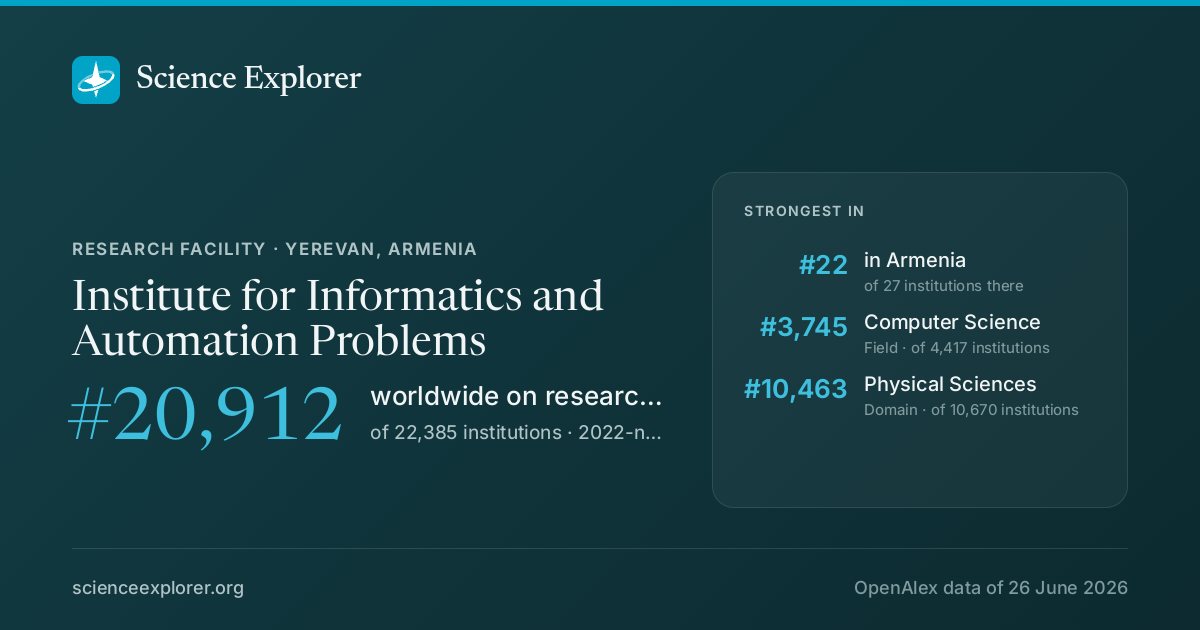
In research, Institute for Informatics and Automation Problems stands highest in Computer Science (#3,745 of 4,417 worldwide) and Physical Sciences (#10,463 of 10,670 worldwide), 2022-now.
- World rank, 2022-now
- #20,912 of 22,385 · #31,871 all time
- Rank in Armenia
- #22 of 27
- Research works
- 931 ▲ 73% vs 2018-21
- Citations
- 3.1k 3.3 per fractional work
- Top-10% rate
- 3.8% all institutions 10.0%
- vs its own fields
- 0.76× 1.00× is exactly expected
- Open access
- 36% world 40%
- International
- 18% world 18%
What is Institute for Informatics and Automation Problems known for in research?
The fields where it stands highest, 2022-now, ranked among every institution above the floor in each field.
| Field | World rank | Where that sits | Top-10% rate | Works | All time |
|---|---|---|---|---|---|
| Computer ScienceField | #3,745 of 4,417 | 4.0% | 73 | #5097 | |
| Physical SciencesDomain | #10,463 of 10,670 | 2.2% | 195 | #16733 |
Each strip is that field's whole ranked pool, with the notch where Institute for Informatics and Automation Problems sits in it, in the colour of the band that rank falls in. The track under the rate is the rate itself: it carries no average mark, because the average differs by field (from about 6% in Dentistry to 21% in Economics).
Which fields of science does Institute for Informatics and Automation Problems work in?
In 2022-now, 84% of research at Institute for Informatics and Automation Problems is in Physical Sciences, 7% in Social Sciences. Its largest fields are Computer Science (32%), Physics and Astronomy (17%), Engineering (15%). It does 2.1× the world's share of Physical Sciences.
Each ring splits the one inside it: the four domains of science, their fields, their subfields. Size is fractional works in 2022-now. Every slice is a page; the interactive view zooms down to single topics and colours each by how much more of it this institution does than the world.
Its 4 domains and 24 fields, with their numbers
- Physical Sciences22383.6%
- Computer Science8632.1%
- Physics and Astronomy4416.5%
- Engineering4015.1%
- Materials Science186.7%
- Mathematics145.2%
- Chemistry93.6%
- Environmental Science51.9%
- Earth and Planetary Sciences51.8%
- Energy20.6%
- Chemical Engineering00.1%
- Social Sciences207.3%
- Life Sciences165.9%
- Health Sciences83.2%
- Medicine72.5%
- Health Professions10.5%
- Nursing10.2%
Field profile
Location quotient across every field it publishes in: outside the ring is more than an institution of this size would be expected to publish, inside it is less.
Rings at 0.5×, 1× and 2×. Widest outward: Physics and Astronomy, 7.4×. Every wedge is a field page.
All 24 fields, with their numbers
- Physics and Astronomy7.43×44 works
- Mathematics4.44×14 works
- Computer Science4.12×86 works
- Decision Sciences3.21×8 works
- Chemistry2.26×10 works
- Materials Science1.92×18 works
- Earth and Planetary Sciences1.15×5 works
- Engineering1.01×40 works
- Neuroscience0.95×4 works
- Pharmacology, Toxicology and Pharmaceutics0.83×1 works
- Energy0.61×2 works
- Nursing0.47×1 works
- Biochemistry, Genetics and Molecular Biology0.45×6 works
- Economics, Econometrics and Finance0.41×2 works
- Environmental Science0.38×5 works
- Agricultural and Biological Sciences0.32×4 works
- Business, Management and Accounting0.29×2 works
- Chemical Engineering0.27×0 works
- Health Professions0.17×1 works
- Social Sciences0.15×5 works
- Medicine0.13×7 works
- Immunology and Microbiology0.12×0 works
- Psychology0.09×1 works
- Arts and Humanities0.07×0 works
- Physics and Astronomy 7.4×
- Mathematics 4.4×
- Computer Science 4.1×
- Decision Sciences 3.2×
- Chemistry 2.3×
- Materials Science 1.9×
- Earth and Planetary Sciences 1.1×
- Engineering 1.0×
- Neuroscience 0.9×
- Pharmacology, Toxicology and Pharmaceutics 0.8×
- Energy 0.6×
- Nursing 0.5×
- Biochemistry, Genetics and Molecular Biology 0.5×
- Economics, Econometrics and Finance 0.4×
- Environmental Science 0.4×
- Agricultural and Biological Sciences 0.3×
- Business, Management and Accounting 0.3×
- Chemical Engineering 0.3×
- Health Professions 0.2×
- Social Sciences 0.1×
- Medicine 0.1×
- Immunology and Microbiology 0.1×
- Psychology 0.1×
- Arts and Humanities 0.1×
Who are the top researchers at Institute for Informatics and Automation Problems?
Ranked on the quality score, Sergey Abrahamyan, Rafayel R. Kamalian and Yeghisabet Alaverdyan lead among researchers whose main affiliation is Institute for Informatics and Automation Problems.
- 1
Sergey Abrahamyan
 Armenia · #4,319,563 worldwide
51 citations · 17 works
- 2
Rafayel R. Kamalian
Armenia · #4,833,979 worldwide
209 citations · 40 works
- 3
Yeghisabet Alaverdyan
Armenia · #4,992,245 worldwide
75 citations · 18 works
- 4
Rita Abrahamyan
Armenia · #4,997,323 worldwide
149 citations · 28 works
- 5
Shushanik A. Sargsyan
Armenia · #5,043,591 worldwide
82 citations · 26 works
- 6
Gurgen H. Khachatrian
Armenia · #5,351,411 worldwide
112 citations · 25 works
- 7
Melsik K. Kyuregyan
Armenia · #5,428,488 worldwide
93 citations · 15 works
- 8
Aram Mirzoyan
Armenia · #5,448,244 worldwide
29 citations · 18 works
- 9
Vladimir Sahakyan
Armenia · #5,453,051 worldwide
89 citations · 16 works
- 10
Hayk A. Grigoryan
Armenia · #5,500,101 worldwide
186 citations · 31 works
Which keywords describe research at Institute for Informatics and Automation Problems?
By fractional works in 2022-now, weighted toward what it does more of than the world: Deep Learning, Distributed Systems, Crystal Growth, Synchrotron Radiation, High-Performance Computing, Fault Tolerance, Resource Management and Tomography.
- Szemerédi's Theorem
- Photonic Crystals
- Ptychography
- Wireless Communications
- X-ray Imaging
- Molecular Structure
- Parameterized Complexity
- Graph Theory
- Nonlinear Optical Materials
- Fuzzy Controller
- Multi-Agent Systems
- Cyber-Physical Systems
- Channeling
- Approximation Algorithms
- Photovoltaics
- Resource Management
- High-Performance Computing
- Crystal Growth
- Energy Efficiency
- Machine Learning
- Deep Learning
- Neural Networks
- Distributed Systems
- Synchrotron Radiation
- Fault Tolerance
- Tomography
- Algorithmic Applications
- Workflow Management
- Nuclear Resonant Spectroscopy
- Quantum Dots
- Crystal Structure
- Redundant Transmission
- Semiconductor
- Grid Computing
- Task Scheduling
- Nanocrystals
- Second Harmonic Generation
- Phase Retrieval
- Mobile Edge Computing
- Graph Limits
Size is fractional works in 2022-now in the topics tagged with each word; colour is the word's share of this institution's work against its share of the world's. The 40 words are chosen for being large and distinctive. Each links to the topic it comes from most.
All 40 words, with their numbers
- Deep Learning22▲ 2.3×42 topics
- Machine Learning14▲ 1.57×29 topics
- Neural Networks11▲ 2.6×17 topics
- Energy Efficiency9▲ 3.6×10 topics
- Distributed Systems9▲ 19×6 topics
- Crystal Growth8▲ 12×6 topics
- Synchrotron Radiation8▲ 57×3 topics
- High-Performance Computing7▲ 31×3 topics
- Fault Tolerance6▲ 16×5 topics
- Resource Management6▲ 14×2 topics
- Tomography6▲ 13×4 topics
- Photovoltaics6▲ 15×3 topics
- Algorithmic Applications6▲ 61×2 topics
- Approximation Algorithms6▲ 30×2 topics
- Workflow Management6▲ 30×2 topics
- Channeling6▲ 452×1 topic
- Nuclear Resonant Spectroscopy6▲ 452×1 topic
- Cyber-Physical Systems5▲ 7.1×3 topics
- Quantum Dots5▲ 20×3 topics
- Multi-Agent Systems5▲ 9.5×4 topics
- Crystal Structure5▲ 13×6 topics
- Fuzzy Controller5▲ 71×1 topic
- Redundant Transmission5▲ 71×1 topic
- Nonlinear Optical Materials5▲ 45×3 topics
- Semiconductor5▲ 5.2×5 topics
- Graph Theory4▲ 14×1 topic
- Grid Computing4▲ 49×1 topic
- Parameterized Complexity4▲ 76×1 topic
- Task Scheduling4▲ 49×1 topic
- Molecular Structure4▲ 14×2 topics
- Nanocrystals4▲ 5.8×3 topics
- X-ray Imaging4▲ 43×2 topics
- Second Harmonic Generation4▲ 55×2 topics
- Wireless Communications4▲ 8.4×3 topics
- Phase Retrieval4▲ 92×1 topic
- Ptychography4▲ 92×1 topic
- Mobile Edge Computing4▲ 8.5×2 topics
- Photonic Crystals4▲ 11×5 topics
- Graph Limits4▲ 132×1 topic
- Szemerédi's Theorem4▲ 132×1 topic
Which research topics does Institute for Informatics and Automation Problems publish most on?
By volume in 2022-now: Crystallography and Radiation Phenomena, Advanced Data Processing Techniques, Advanced Graph Theory Research and Distributed and Parallel Computing Systems.
Area is fractional works; colour is the subfield each topic belongs to.
- 1 Crystallography and Radiation Phenomena Condensed Matter Physics 6 works
- 2 Advanced Data Processing Techniques Control and Systems Engineering 5 works
- 3 Advanced Graph Theory Research Computational Theory and Mathematics 4 works
- 4 Distributed and Parallel Computing Systems Computer Networks and Communications 4 works
- 5 Advanced X-ray Imaging Techniques Radiation 4 works
- 6 Limits and Structures in Graph Theory Discrete Mathematics and Combinatorics 4 works
- 7 Neural Networks and Applications Artificial Intelligence 3 works
- 8 Crystal structures of chemical compounds Inorganic Chemistry 3 works
- 9 UAV Applications and Optimization Aerospace Engineering 3 works
- 10 Distributed Control Multi-Agent Systems Computer Networks and Communications 3 works
How open and international is its research?
Against the world's own shares: the tick on each track. Both are shares of its output, so they sit on one scale and can be read against each other as well as against the world.
World: 40% of research is openly available.
World: 18% is written across borders.
How has Institute for Informatics and Automation Problems's research output changed?
Output in 2022-2025 was 73% higher than in 2018-2021.
The same series as a ribbon: one cell per year, darker for more. The line above answers how much; this answers when.
Its share of all research
Growing output can still be a shrinking share: all of science grows. This is Institute for Informatics and Automation Problems as a percentage of every work published that year, 0.0011% in 2024.
Fractional works of Institute for Informatics and Automation Problems over all fractional works that year. How the balance of science has shifted.
How much of it reaches the world top 10%
Year by year, against all institutions in the same year.
Of each year's output, the share that reached the world's 10% most cited for its field and year. Peak 5.0% in 2013.
Other research institutions in Yerevan
- Yerevan State University
- National Academy of Sciences of Armenia
- National Institute of Health
- Yerevan State Medical University
- National Polytechnic University of Armenia
- Psychiatric Medical Center
- Armenian State University of Economics
- Russian-Armenian University



Share Institute for Informatics and Automation Problems's ranking
Badges for a website1Each links back here and updates with every snapshot

Research measures only: rankings here say nothing about teaching, admissions or student experience. Comparable institutions and collaboration partners have tabs of their own, above.
Discussion
Ask a question or share a note about Institute for Informatics and Automation Problems. Keep it to the research: no personal attacks, advertising or links. Any reader can report a post, which collapses it for everyone until it is opened.