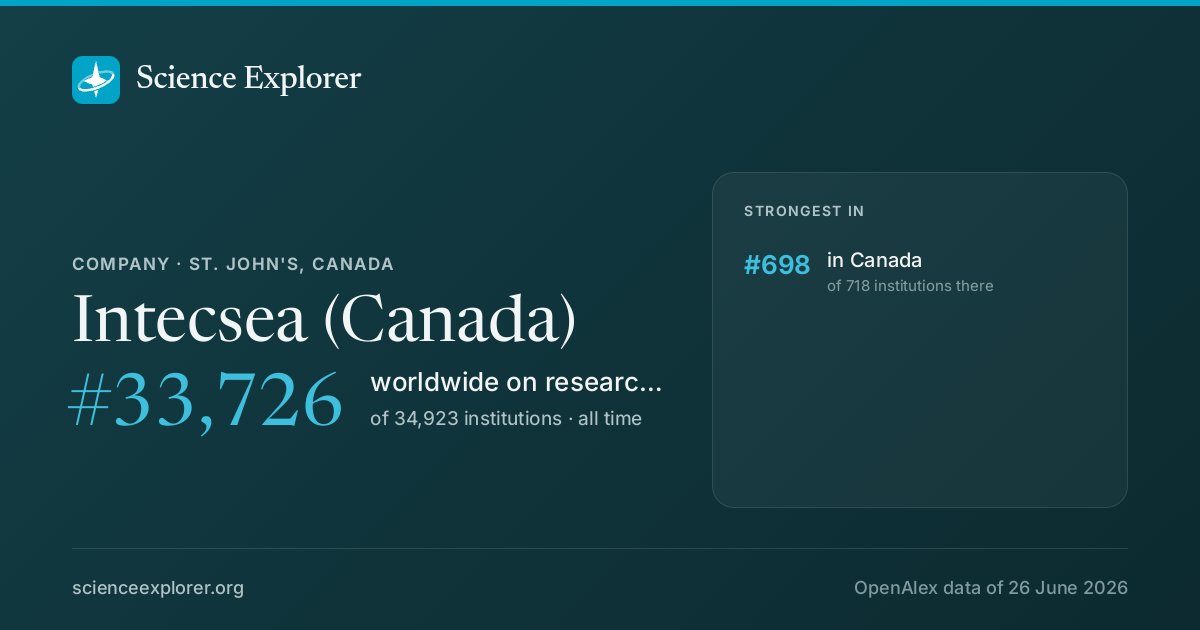
- World rank, all time
- #33,726 of 34,923
- Rank in Canada
- #698 of 718
- Research works
- 139 ▼ 67% vs 2018-21
- Citations
- 504 3.6 per fractional work
- Top-10% rate
- 0.0% all institutions 10.0%
- vs its own fields
- 0.90× 1.00× is exactly expected
- Open access
- 8% world 40%
- International
- 59% world 18%
Which fields of science does Intecsea (Canada) work in?
In all years, 86% of research at Intecsea (Canada) is in Physical Sciences, 8% in Health Sciences. Its largest fields are Engineering (73%), Medicine (8%), Computer Science (4%). It does 2.1× the world's share of Physical Sciences.
Each ring splits the one inside it: the four domains of science, their fields, their subfields. Size is fractional works in all years. Every slice is a page; the interactive view zooms down to single topics and colours each by how much more of it this institution does than the world.
Its 4 domains and 21 fields, with their numbers
- Physical Sciences11985.7%
- Engineering10173.0%
- Computer Science64.1%
- Earth and Planetary Sciences43.1%
- Materials Science32.2%
- Environmental Science21.8%
- Energy10.5%
- Physics and Astronomy10.5%
- Chemical Engineering00.3%
- Mathematics00.1%
- Chemistry00.1%
- Health Sciences118.1%
- Medicine117.9%
- Health Professions00.2%
- Social Sciences75.2%
- Life Sciences11.0%
Field profile
Location quotient across every field it publishes in: outside the ring is more than an institution of this size would be expected to publish, inside it is less.
Rings at 0.5×, 1× and 2×. Widest outward: Engineering, 4.2×. Every wedge is a field page.
All 8 fields, with their numbers
- Engineering4.17×4 works
- Energy3.02×0 works
- Arts and Humanities1.92×0 works
- Psychology1.82×0 works
- Earth and Planetary Sciences1.77×0 works
- Social Sciences1.53×1 works
- Computer Science0.13×0 works
- Environmental Science0.09×0 works
Who are the top researchers at Intecsea (Canada)?
Ranked on the quality score, Philip Cooper, Shankar Bhat and Kourosh Abdolmaleki lead among researchers whose main affiliation is Intecsea (Canada).
- 1
Philip Cooper
 Canada · #2,670,284 worldwide
635 citations · 26 works
- 2
Shankar Bhat
Canada · #3,274,080 worldwide
620 citations · 35 works
- 3
Kourosh Abdolmaleki
Canada · #3,404,367 worldwide
49 citations · 16 works
- 4
Nathan Cooke
Canada · #4,577,634 worldwide
20 citations · 17 works
- 5
Ruud Selker
Canada · #4,621,139 worldwide
13 citations · 17 works
- 6
Mike Paulin
Canada · #4,832,651 worldwide
226 citations · 38 works
- 7
Terry Wood
Canada · #4,995,660 worldwide
73 citations · 23 works
- 8
Glenn A. Lanan
Canada · #5,407,094 worldwide
196 citations · 32 works
- 9
Duane D. DeGeer
Canada · #5,441,183 worldwide
203 citations · 33 works
- 10
Arya Majed
Canada · #5,791,852 worldwide
26 citations · 42 works
Which keywords describe research at Intecsea (Canada)?
By fractional works in all years, weighted toward what it does more of than the world: Renewable Energy, Oil and Gas, Technology, Flow Assurance, Subsea, Pipeline, Corrosion and Finite Element Analysis.
- Non-Destructive Evaluation
- Vaginal Birth
- Cesarean Section
- Fluid-Conveying Pipes
- Fretting Wear
- Ensemble Kalman Filter
- Uncertainty Quantification
- Numerical Simulation
- Vibration Analysis
- Seismic
- Analysis
- Artificial Lift Systems
- Offshore Decommissioning
- Environmental Impact
- Risk Analysis
- Pitting Corrosion
- Machine Learning
- Pipeline
- Flow Assurance
- Oil and Gas
- Renewable Energy
- Technology
- Subsea
- Corrosion
- Finite Element Analysis
- Reliability Assessment
- Sustainability
- Marine Pollution
- Ship Recycling
- Fault Diagnosis
- Optimization
- Tunnel
- Nonlinear Dynamics
- Control Strategies
- Data Assimilation
- Finite Element Simulation
- Axially Moving Systems
- Arctic
- Defect Detection
- Eddy Current Testing
Size is fractional works in all years in the topics tagged with each word; colour is the word's share of this institution's work against its share of the world's. The 40 words are chosen for being large and distinctive. Each links to the topic it comes from most.
All 40 words, with their numbers
- Renewable Energy29▲ 21×5 topics
- Oil and Gas28▲ 602×2 topics
- Technology27▲ 45×3 topics
- Flow Assurance26▲ 1421×1 topic
- Subsea26▲ 1421×1 topic
- Pipeline18▲ 136×3 topics
- Corrosion13▲ 79×4 topics
- Machine Learning13▲ 4.2×10 topics
- Finite Element Analysis12▲ 39×5 topics
- Pitting Corrosion12▲ 160×2 topics
- Reliability Assessment11▲ 234×1 topic
- Risk Analysis11▲ 136×1 topic
- Sustainability10▲ 4.2×5 topics
- Environmental Impact9▲ 5.0×5 topics
- Marine Pollution8▲ 288×2 topics
- Offshore Decommissioning8▲ 553×1 topic
- Ship Recycling8▲ 553×1 topic
- Artificial Lift Systems8▲ 182×1 topic
- Fault Diagnosis8▲ 24×1 topic
- Analysis6▲ 42×2 topics
- Optimization6▲ 8.2×5 topics
- Seismic6▲ 81×1 topic
- Tunnel6▲ 55×1 topic
- Vibration Analysis5▲ 13×2 topics
- Nonlinear Dynamics5▲ 15×5 topics
- Numerical Simulation4▲ 9.1×7 topics
- Control Strategies4▲ 23×2 topics
- Uncertainty Quantification4▲ 30×2 topics
- Data Assimilation4▲ 15×1 topic
- Ensemble Kalman Filter4▲ 24×1 topic
- Finite Element Simulation4▲ 75×1 topic
- Fretting Wear4▲ 101×1 topic
- Axially Moving Systems4▲ 51×1 topic
- Fluid-Conveying Pipes4▲ 51×1 topic
- Arctic3▲ 23×4 topics
- Cesarean Section3▲ 53×1 topic
- Defect Detection3▲ 19×2 topics
- Vaginal Birth3▲ 53×1 topic
- Eddy Current Testing2▲ 41×1 topic
- Non-Destructive Evaluation2▲ 41×1 topic
Which research topics does Intecsea (Canada) publish most on?
By volume in 2022-now: Offshore Engineering and Technologies, Access Control and Trust, Robotics and Automated Systems and Mechanical stress and fatigue analysis.
Area is fractional works; colour is the subfield each topic belongs to.
- 1 Offshore Engineering and Technologies Ocean Engineering 1 works
- 2 Access Control and Trust Sociology and Political Science 0 works
- 3 Robotics and Automated Systems Control and Systems Engineering 0 works
- 4 Mechanical stress and fatigue analysis Mechanics of Materials 0 works
- 5 Geotechnical Engineering and Underground Structures Civil and Structural Engineering 0 works
- 6 Child Development and Digital Technology Education 0 works
- 7 Marine and Offshore Engineering Studies Ocean Engineering 0 works
- 8 Literacy, Media, and Education Literature and Literary Theory 0 works
- 9 Structural Integrity and Reliability Analysis Mechanical Engineering 0 works
- 10 Educational Games and Gamification Developmental and Educational Psychology 0 works
How open and international is its research?
Against the world's own shares: the tick on each track. Both are shares of its output, so they sit on one scale and can be read against each other as well as against the world.
World: 40% of research is openly available.
World: 18% is written across borders.
How has Intecsea (Canada)'s research output changed?
Output in 2022-2025 was 67% lower than in 2018-2021.
The same series as a ribbon: one cell per year, darker for more. The line above answers how much; this answers when.
Its share of all research
Growing output can still be a shrinking share: all of science grows. This is Intecsea (Canada) as a percentage of every work published that year, 0.000014% in 2024.
Fractional works of Intecsea (Canada) over all fractional works that year. How the balance of science has shifted.
Other research institutions in St. John's
- Memorial University of Newfoundland
- Research & Development Corporation
- Workplace Health, Safety and Compensation Commission
- Government of Newfoundland and Labrador
- St. John’s Health Sciences Centre
- Department of Environment and Conservation
- Health Care Foundation
- Janeway Children's Health and Rehabilitation Centre

Share Intecsea (Canada)'s ranking
Badges for a website1Each links back here and updates with every snapshot

Research measures only: rankings here say nothing about teaching, admissions or student experience. Comparable institutions and collaboration partners have tabs of their own, above.
Discussion
Ask a question or share a note about Intecsea (Canada). Posts are plain text and can be reported.