Science Explorer Back to mapMap
Discussion
Company · Middelfart · Denmark

Interacoustics (Denmark)

World rank, all time
#26,847
of 34,923
Rank in Denmark
#150
of 179
Research works
177
▲ 107% vs 2018-21
Citations
3.7k
20.6 per fractional work
Top-10% rate
11.3%
all institutions 10.0%
vs its own fields
0.95×
1.00× is exactly expected
Open access
42%
world 40%
International
55%
world 18%

Which fields of science does Interacoustics (Denmark) work in?

In 2022-now, 52% of research at Interacoustics (Denmark) is in Physical Sciences, 19% in Life Sciences. Its largest fields are Engineering (26%), Neuroscience (15%), Environmental Science (13%). It does 1.3× the world's share of Life Sciences.

Physical Sciences: 28 fractional works · 52.2% of its workEngineering: 14 fractional works · 26.1% of its workBiomedical Engineering: 3 fractional works · 5.7% of its workMechanical Engineering: 2 fractional works · 4.1% of its workAutomotive Engineering: 2 fractional works · 3.3% of its workElectrical and Electronic Engineering: 2 fractional works · 3.2% of its workCivil and Structural Engineering: 2 fractional works · 3.0% of its workAerospace Engineering: 1 fractional works · 2.4% of its workMechanics of Materials: 1 fractional works · 1.5% of its workMedia Technology: 0 fractional works · 0.9% of its workBuilding and Construction: 0 fractional works · 0.9% of its workOcean Engineering: 0 fractional works · 0.6% of its workComputational Mechanics: 0 fractional works · 0.3% of its workControl and Systems Engineering: 0 fractional works · 0.3% of its workEnvironmental Science: 7 fractional works · 13.3% of its workEcology: 3 fractional works · 6.4% of its workManagement, Monitoring, Policy and Law: 2 fractional works · 2.9% of its workWater Science and Technology: 0 fractional works · 0.9% of its workEcological Modeling: 0 fractional works · 0.7% of its workGlobal and Planetary Change: 0 fractional works · 0.7% of its workHealth, Toxicology and Mutagenesis: 0 fractional works · 0.6% of its workNature and Landscape Conservation: 0 fractional works · 0.6% of its workEnvironmental Engineering: 0 fractional works · 0.3% of its workSmaller subfields together: 0 fractional works · 0.1% of its workComputer Science: 4 fractional works · 6.7% of its workComputer Vision and Pattern Recognition: 1 fractional works · 2.6% of its workSignal Processing: 1 fractional works · 1.7% of its workHuman-Computer Interaction: 0 fractional works · 0.9% of its workComputer Networks and Communications: 0 fractional works · 0.6% of its workInformation Systems: 0 fractional works · 0.5% of its workHardware and Architecture: 0 fractional works · 0.2% of its workSmaller subfields together: 0 fractional works · 0.0% of its workEarth and Planetary Sciences: 2 fractional works · 3.1% of its workOceanography: 1 fractional works · 2.4% of its workGeology: 0 fractional works · 0.3% of its workGeophysics: 0 fractional works · 0.3% of its workSmaller subfields together: 0 fractional works · 0.1% of its workMaterials Science: 1 fractional works · 1.8% of its workPolymers and Plastics: 0 fractional works · 0.6% of its workElectronic, Optical and Magnetic Materials: 0 fractional works · 0.5% of its workMetals and Alloys: 0 fractional works · 0.3% of its workBiomaterials: 0 fractional works · 0.2% of its workMaterials Chemistry: 0 fractional works · 0.2% of its workPhysics and Astronomy: 0 fractional works · 0.7% of its workStatistical and Nonlinear Physics: 0 fractional works · 0.4% of its workAtomic and Molecular Physics, and Optics: 0 fractional works · 0.3% of its workEnergy: 0 fractional works · 0.3% of its workRenewable Energy, Sustainability and the Environment: 0 fractional works · 0.3% of its workLife Sciences: 10 fractional works · 19.1% of its workNeuroscience: 8 fractional works · 15.2% of its workCognitive Neuroscience: 5 fractional works · 9.3% of its workSensory Systems: 2 fractional works · 4.0% of its workNeurology: 1 fractional works · 2.0% of its workBiochemistry, Genetics and Molecular Biology: 1 fractional works · 2.4% of its workDevelopmental Biology: 1 fractional works · 2.1% of its workMolecular Biology: 0 fractional works · 0.3% of its workSmaller subfields together: 0 fractional works · 0.1% of its workAgricultural and Biological Sciences: 1 fractional works · 1.3% of its workEcology, Evolution, Behavior and Systematics: 0 fractional works · 0.8% of its workAquatic Science: 0 fractional works · 0.3% of its workSmaller subfields together: 0 fractional works · 0.1% of its workImmunology and Microbiology: 0 fractional works · 0.1% of its workHealth Sciences: 8 fractional works · 14.4% of its workMedicine: 4 fractional works · 7.7% of its workOtorhinolaryngology: 2 fractional works · 2.8% of its workPulmonary and Respiratory Medicine: 1 fractional works · 1.0% of its workSurgery: 0 fractional works · 0.8% of its workPhysiology: 0 fractional works · 0.6% of its workRadiology, Nuclear Medicine and Imaging: 0 fractional works · 0.6% of its workPathology and Forensic Medicine: 0 fractional works · 0.5% of its workPublic Health, Environmental and Occupational Health: 0 fractional works · 0.4% of its workAnesthesiology and Pain Medicine: 0 fractional works · 0.2% of its workPsychiatry and Mental health: 0 fractional works · 0.2% of its workSmaller subfields together: 0 fractional works · 0.5% of its workHealth Professions: 3 fractional works · 6.4% of its workSpeech and Hearing: 3 fractional works · 5.8% of its workComplementary and Manual Therapy: 0 fractional works · 0.3% of its workSmaller subfields together: 0 fractional works · 0.3% of its workVeterinary: 0 fractional works · 0.2% of its workDentistry: 0 fractional works · 0.1% of its workSocial Sciences: 8 fractional works · 14.4% of its workSocial Sciences: 4 fractional works · 8.0% of its workSociology and Political Science: 2 fractional works · 3.7% of its workEducation: 1 fractional works · 2.2% of its workPolitical Science and International Relations: 1 fractional works · 1.4% of its workAnthropology: 0 fractional works · 0.4% of its workLaw: 0 fractional works · 0.3% of its workPsychology: 1 fractional works · 1.8% of its workSocial Psychology: 0 fractional works · 0.8% of its workExperimental and Cognitive Psychology: 0 fractional works · 0.7% of its workSmaller subfields together: 0 fractional works · 0.3% of its workDecision Sciences: 1 fractional works · 1.7% of its workInformation Systems and Management: 1 fractional works · 1.4% of its workStatistics, Probability and Uncertainty: 0 fractional works · 0.3% of its workArts and Humanities: 1 fractional works · 1.6% of its workVisual Arts and Performing Arts: 0 fractional works · 0.9% of its workMusic: 0 fractional works · 0.4% of its workConservation: 0 fractional works · 0.2% of its workSmaller subfields together: 0 fractional works · 0.1% of its workBusiness, Management and Accounting: 0 fractional works · 0.9% of its workStrategy and Management: 0 fractional works · 0.6% of its workSmaller subfields together: 0 fractional works · 0.3% of its workEconomics, Econometrics and Finance: 0 fractional works · 0.3% of its workALL ITS WORKInteracoustics(Denmark)54fractional works, 2022-now
Life Sciences19%Physical Sciences52%Health Sciences14%Social Sciences14%

Each ring splits the one inside it: the four domains of science, their fields, their subfields. Size is fractional works in 2022-now. Every slice is a page; the interactive view zooms down to single topics and colours each by how much more of it this institution does than the world.

Its 4 domains and 21 fields, with their numbers
    1. Engineering1426.1%
    2. Environmental Science713.3%
    3. Computer Science46.7%
    4. Earth and Planetary Sciences23.1%
    5. Materials Science11.8%
    6. Physics and Astronomy00.7%
    7. Energy00.3%
    1. Neuroscience815.2%
    2. Biochemistry, Genetics and Molecular Biology12.4%
    3. Agricultural and Biological Sciences11.3%
    4. Immunology and Microbiology00.1%
    1. Medicine47.7%
    2. Health Professions36.4%
    3. Veterinary00.2%
    4. Dentistry00.1%
    1. Social Sciences48.0%
    2. Psychology11.8%
    3. Decision Sciences11.7%
    4. Arts and Humanities11.6%
    5. Business, Management and Accounting00.9%
    6. Economics, Econometrics and Finance00.3%
All of science, and how each field's share has moved since 1950: the Science domain explorer

Field profile

Location quotient across every field it publishes in: outside the ring is more than an institution of this size would be expected to publish, inside it is less.

Agricultural and Biological Sciences: 0.26× its world share, 1 worksAgricultural and Bio…Biochemistry, Genetics and Molecular Biology: 0.46× its world share, 1 worksBiochemistry, Geneti…Immunology and Microbiology: 0.12× its world share, 0 worksImmunology and Micro…Neuroscience: 9.40× its world share, 8 worksNeuroscienceComputer Science: 0.86× its world share, 4 worksComputer ScienceEarth and Planetary Sciences: 2.01× its world share, 2 worksEarth and Planetary …Energy: 0.34× its world share, 0 worksEnergyEngineering: 1.74× its world share, 14 worksEngineeringEnvironmental Science: 2.68× its world share, 7 worksEnvironmental ScienceMaterials Science: 0.52× its world share, 1 worksMaterials SciencePhysics and Astronomy: 0.33× its world share, 0 worksPhysics and AstronomyDentistry: 0.25× its world share, 0 worksDentistryHealth Professions: 2.42× its world share, 3 worksHealth ProfessionsMedicine: 0.40× its world share, 4 worksMedicineVeterinary: 1.32× its world share, 0 worksVeterinaryArts and Humanities: 0.56× its world share, 1 worksArts and HumanitiesBusiness, Management and Accounting: 0.27× its world share, 0 worksBusiness, Management…Decision Sciences: 1.81× its world share, 1 worksDecision SciencesEconomics, Econometrics and Finance: 0.14× its world share, 0 worksEconomics, Econometr…Psychology: 0.59× its world share, 1 worksPsychologySocial Sciences: 0.63× its world share, 4 worksSocial Sciences1×world share
more than its size predictsabout as predictedless

Rings at 0.5×, 1× and 2×. Widest outward: Neuroscience, 9.4×. Every wedge is a field page.

All 21 fields, with their numbers
  1. Neuroscience9.40×8 works
  2. Environmental Science2.68×7 works
  3. Health Professions2.42×3 works
  4. Earth and Planetary Sciences2.01×2 works
  5. Decision Sciences1.81×1 works
  6. Engineering1.74×14 works
  7. Veterinary1.32×0 works
  8. Computer Science0.86×4 works
  9. Social Sciences0.63×4 works
  10. Psychology0.59×1 works
  11. Arts and Humanities0.56×1 works
  12. Materials Science0.52×1 works
  13. Biochemistry, Genetics and Molecular Biology0.46×1 works
  14. Medicine0.40×4 works
  15. Energy0.34×0 works
  16. Physics and Astronomy0.33×0 works
  17. Business, Management and Accounting0.27×0 works
  18. Agricultural and Biological Sciences0.26×1 works
  19. Dentistry0.25×0 works
  20. Economics, Econometrics and Finance0.14×0 works
  21. Immunology and Microbiology0.12×0 works

Who are the top researchers at Interacoustics (Denmark)?

Ranked on the quality score, Allen Mornington-West and Kren Rahbek Nørgaard lead among researchers whose main affiliation is Interacoustics (Denmark).

  1. 1 Allen Mornington-West Denmark · #4,526,257 worldwide 69 citations · 18 works
  2. 2 Kren Rahbek Nørgaard Denmark · #5,079,015 worldwide 167 citations · 18 works
All ranked researchers at Interacoustics (Denmark)

What are the most cited papers from Interacoustics (Denmark)?

The most cited paper from Interacoustics (Denmark) is "Modified assay for determination of hydroxyproline in a tissue hydrolyzate" (Chris A. Edwards, William D. O’Brien, 1980), with 479 citations. Next come "Ultrasonic absorption and attenuation in mammalian tissues" (311) and "Multiple-focus ultrasound phased-array pattern synthesis: optimal driving-signal distributions for hyperthermia" (291).

Most cited papers
#PaperReleasedCitations
1 Modified assay for determination of hydroxyproline in a tissue hydrolyzate Chris A. Edwards, William D. O’Brien · Clinica Chimica Acta Jun 1980 479
2 Ultrasonic absorption and attenuation in mammalian tissues S. A. Goss, Leon A. Frizzell, F. LOWELL DUNN · Ultrasound in Medicine & Biology 1979 311
3 Multiple-focus ultrasound phased-array pattern synthesis: optimal driving-signal distributions for hyperthermia Emad S. Ebbini, Charles A. Cain · IEEE Transactions on Ultrasonics Ferroelectrics and Frequency Control Sep 1989 291
4 Forward masking as a function of frequency, masker level, and signal delay Walt Jesteadt, Sid P. Bacon, James R. Lehman · The Journal of the Acoustical Society of America Apr 1982 244
5 Otoacoustic emissions from normal-hearing and hearing-impaired subjects: Distortion product responses Michael P. Gorga, Stephen T. Neely, Brenda M. Bergman et al. · The Journal of the Acoustical Society of America Apr 1993 220
All 60 most cited papers, with filters and sorting

Which keywords describe research at Interacoustics (Denmark)?

By fractional works in 2022-now, weighted toward what it does more of than the world: Hearing Loss, Vibration Control, Cognitive Decline, Quality of Life, Cochlear Implants, Speech Perception, Acoustic Communication and Climate Change.

▲ more of its work than of the world's◆ about the world's share▼ less than the world's

Size is fractional works in 2022-now in the topics tagged with each word; colour is the word's share of this institution's work against its share of the world's. The 40 words are chosen for being large and distinctive. Each links to the topic it comes from most.

All 40 words, with their numbers
  1. Hearing Loss8▲ 118×3 topics
  2. Climate Change5▲ 3.2×8 topics
  3. Quality of Life4▲ 5.7×6 topics
  4. Vibration Control4▲ 119×3 topics
  5. Cognitive Decline4▲ 59×2 topics
  6. Cochlear Implants4▲ 194×1 topic
  7. Speech Perception4▲ 84×1 topic
  8. Acoustic Communication3▲ 121×2 topics
  9. Public Health3▲ 4.2×2 topics
  10. Health Effects3▲ 9.6×1 topic
  11. Noise Pollution3▲ 137×1 topic
  12. Wave Propagation3▲ 50×2 topics
  13. Machine Learning3▲ 1.60×8 topics
  14. Conservation3▲ 12×4 topics
  15. Acoustic Metamaterials3▲ 139×1 topic
  16. Phononic Crystals3▲ 139×1 topic
  17. Anthropogenic Noise2▲ 150×1 topic
  18. Marine Mammals2▲ 150×1 topic
  19. Cochlear Neuropathy2▲ 133×1 topic
  20. Tinnitus2▲ 133×1 topic
  21. Acute Otitis Media2▲ 132×1 topic
  22. Human-Computer Interaction2▲ 15×3 topics
  23. Otitis Media2▲ 132×1 topic
  24. Gesture Recognition1▲ 33×2 topics
  25. Ocean Acidification1▲ 33×2 topics
  26. Sound Quality1▲ 183×1 topic
  27. Transfer Path Analysis1▲ 183×1 topic
  28. Energy Consumption1▲ 9.5×2 topics
  29. Interactive Evolutionary Computation1▲ 107×1 topic
  30. Music Generation1▲ 107×1 topic
  31. Neuroimaging1▲ 8.0×4 topics
  32. Smartphones1▲ 67×2 topics
  33. Avian Vocal Communication1▲ 124×1 topic
  34. Birdsong1▲ 124×1 topic
  35. Cognition1▲ 14×3 topics
  36. Classroom Environment1▲ 122×1 topic
  37. Green IT1▲ 96×1 topic
  38. Mobile Devices1▲ 32×1 topic
  39. Online Gaming1▲ 49×1 topic
  40. Teacher-Student Relationships1▲ 122×1 topic

Which research topics does Interacoustics (Denmark) publish most on?

By volume in 2022-now: Hearing Loss and Rehabilitation, Noise Effects and Management, Acoustic Wave Phenomena Research and Marine animal studies overview.

  1. 1 Hearing Loss and Rehabilitation Cognitive Neuroscience 4 works
  2. 2 Noise Effects and Management Speech and Hearing 3 works
  3. 3 Acoustic Wave Phenomena Research Biomedical Engineering 3 works
  4. 4 Marine animal studies overview Ecology 2 works
  5. 5 Hearing, Cochlea, Tinnitus, Genetics Sensory Systems 2 works
  6. 6 Ear Surgery and Otitis Media Otorhinolaryngology 2 works
  7. 7 Music Technology and Sound Studies Computer Vision and Pattern Recognition 1 works
  8. 8 Vehicle Noise and Vibration Control Automotive Engineering 1 works
  9. 9 Animal Vocal Communication and Behavior Developmental Biology 1 works
  10. 10 Green IT and Sustainability Electrical and Electronic Engineering 1 works

How open and international is its research?

Against the world's own shares: the tick on each track. Both are shares of its output, so they sit on one scale and can be read against each other as well as against the world.

openly available42.3%not open57.7%

World: 40% of research is openly available.

with international co-authors54.6%domestic only45.4%

World: 18% is written across borders.

How has Interacoustics (Denmark)'s research output changed?

Output in 2022-2025 was 107% higher than in 2018-2021.

still counting1990200020102020
grewheldshrank

The same series as a ribbon: one cell per year, darker for more. The line above answers how much; this answers when.

Its share of all research

Growing output can still be a shrinking share: all of science grows. This is Interacoustics (Denmark) as a percentage of every work published that year, 0.00023% in 2024.

still counting0.0010%0.0020%Interacoustics (Denmark)0.00024% in 202519801990200020102020

Fractional works of Interacoustics (Denmark) over all fractional works that year. How the balance of science has shifted.

Other research institutions in Middelfart

All research institutions in Middelfart

Share Interacoustics (Denmark)'s ranking
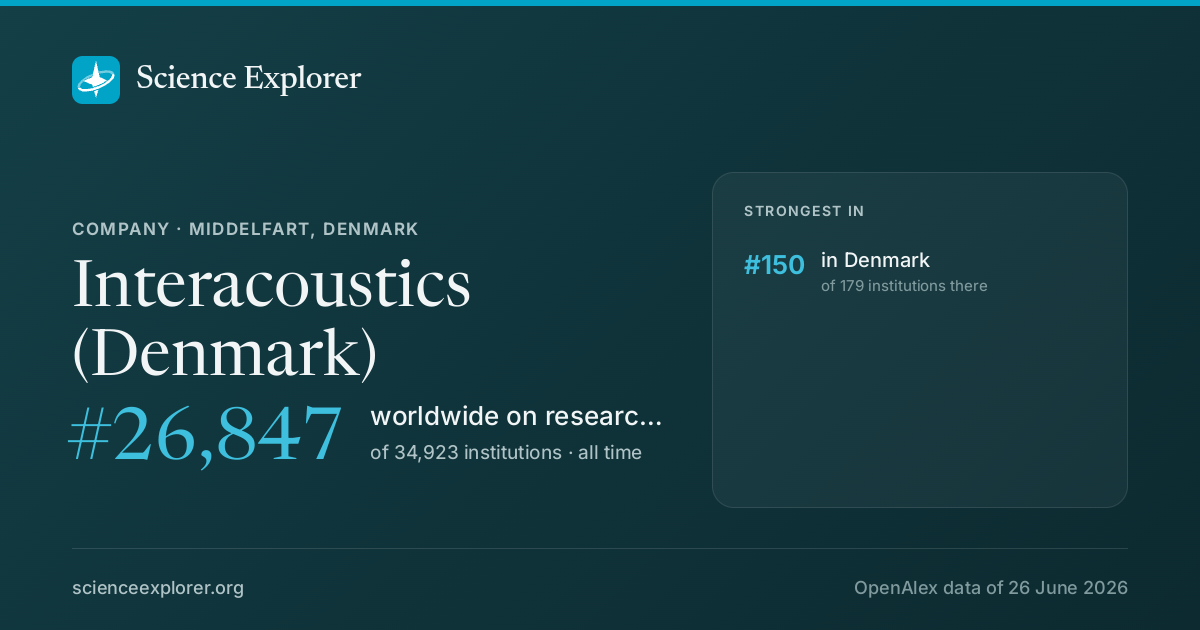
Interacoustics (Denmark) on Science Explorer

A card with Interacoustics (Denmark)'s standing and the fields it leads in, for a post or a slide. A link to this page previews as the same card.

Download the card

1200 × 630 PNG, sized for social posts, drawn from the latest snapshot.

Badges for a website1Each links back here and updates with every snapshot

Research measures only: rankings here say nothing about teaching, admissions or student experience. Comparable institutions and collaboration partners have tabs of their own, above.

Discussion

Ask a question or share a note about Interacoustics (Denmark). Posts are plain text and can be reported.