Killingbeck
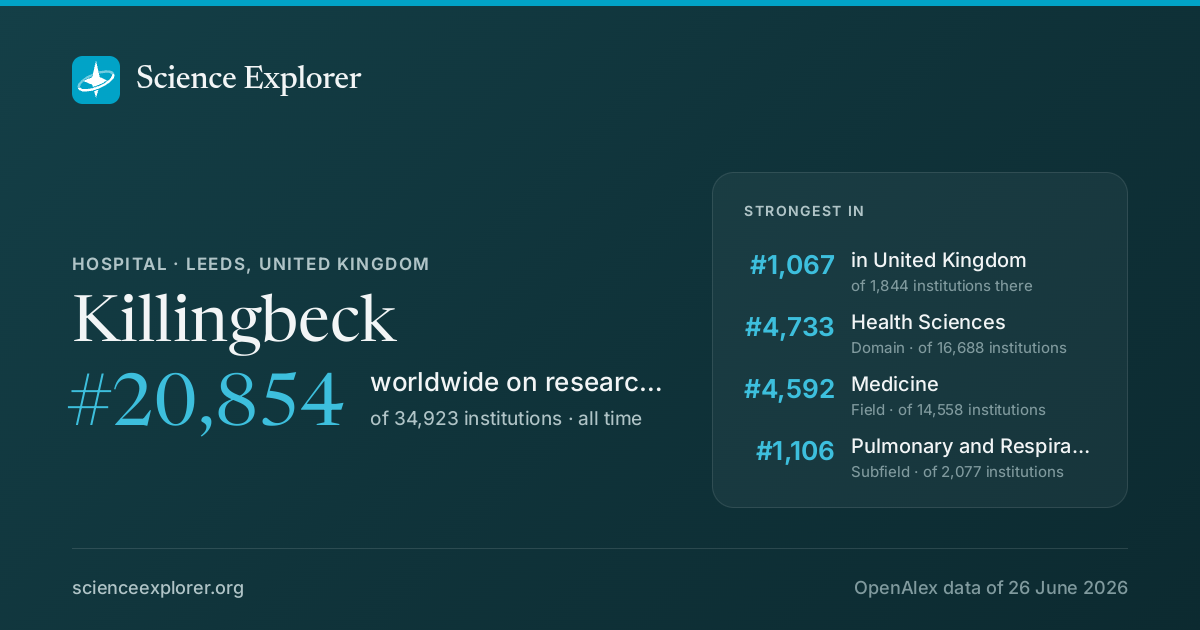
In research, Killingbeck stands highest in Health Sciences (#4,733 of 16,688 worldwide), Medicine (#4,592 of 14,558 worldwide) and Pulmonary and Respiratory Medicine (#1,106 of 2,077 worldwide), over all time.
- World rank, all time
- #20,854 of 34,923
- Rank in United Kingdom
- #1,067 of 1,844
- Research works
- 509 ▼ 100% vs 2018-21
- Citations
- 8.3k 16.2 per fractional work
- Top-10% rate
- 9.0% all institutions 10.0%
- vs its own fields
- 0.95× 1.00× is exactly expected
- Open access
- 29% world 40%
- International
- 4% world 18%
What is Killingbeck known for in research?
The fields where it stands highest, over all time, ranked among every institution above the floor in each field.
| Field | World rank | Where that sits | Top-10% rate | Works |
|---|---|---|---|---|
| Health SciencesDomain | #4,733 of 16,688 | 4.7% | 459 | |
| MedicineField | #4,592 of 14,558 | 4.4% | 450 | |
| Pulmonary and Respiratory MedicineSubfield | #1,106 of 2,077 | 3.5% | 135 |
Each strip is that field's whole ranked pool, with the notch where Killingbeck sits in it, in the colour of the band that rank falls in. The track under the rate is the rate itself: it carries no average mark, because the average differs by field (from about 6% in Dentistry to 21% in Economics).
Which fields of science does Killingbeck work in?
In all years, 90% of research at Killingbeck is in Health Sciences, 5% in Physical Sciences. Its largest fields are Medicine (88%), Engineering (3%), Biochemistry, Genetics and Molecular Biology (2%). It does 3.8× the world's share of Health Sciences.
Each ring splits the one inside it: the four domains of science, their fields, their subfields. Size is fractional works in all years. Every slice is a page; the interactive view zooms down to single topics and colours each by how much more of it this institution does than the world.
Its 4 domains and 24 fields, with their numbers
- Health Sciences45990.2%
- Medicine45088.3%
- Health Professions61.2%
- Nursing20.5%
- Dentistry10.1%
- Veterinary00.1%
- Physical Sciences275.2%
- Engineering173.4%
- Materials Science30.6%
- Computer Science20.4%
- Chemistry20.3%
- Environmental Science10.3%
- Chemical Engineering10.1%
- Physics and Astronomy00.1%
- Mathematics00.0%
- Life Sciences183.6%
- Social Sciences51.0%
Field profile
Location quotient across every field it publishes in: outside the ring is more than an institution of this size would be expected to publish, inside it is less.
Who are the top researchers at Killingbeck?
Ranked on the quality score, Alan Mackintosh, M F Muers and Olive Scott lead among researchers whose main affiliation is Killingbeck.
- 1
Alan Mackintosh
 United Kingdom · #1,190,825 worldwide
2.2k citations · 210 works
- 2
M F Muers
United Kingdom · #1,294,228 worldwide
3.8k citations · 95 works
- 3
Olive Scott
United Kingdom · #2,165,225 worldwide
926 citations · 37 works
- 4
Garrick I. Fiddler
United Kingdom · #2,375,532 worldwide
729 citations · 22 works
- 5
David F. Dickinson
United Kingdom · #2,528,093 worldwide
2.2k citations · 73 works
- 6
Gill A. Wharton
United Kingdom · #3,046,104 worldwide
522 citations · 18 works
- 7
S B Pearson
United Kingdom · #3,119,343 worldwide
1.3k citations · 56 works
- 8
John L Gibbs
United Kingdom · #3,208,042 worldwide
2k citations · 63 works
- 9
M. J. Crow
United Kingdom · #3,321,921 worldwide
1.7k citations · 59 works
- 10
Alan E. Steel
United Kingdom · #3,441,408 worldwide
345 citations · 24 works
Which keywords describe research at Killingbeck?
By fractional works in all years, weighted toward what it does more of than the world: Pulmonary Alveolar Microlithiasis, Pulmonary Sclerosing Hemangioma, Echocardiography, Congenital Heart Disease, Management, Neurodevelopmental Outcomes, Cardiac Surgery and Mortality Risk.
- Cardiomyopathy
- Cardiovascular Risk
- Mechanical Ventilation
- Chronic Kidney Disease
- Solitary Fibrous Tumor
- Radiation Therapy
- Cardiac Imaging
- Hematoma
- Guidelines
- Myocardial Infarction
- Inflammation
- Soft Tissue Sarcoma
- Surgical Aortic-Valve Replacement
- Surgery
- Pulmonary Valve Replacement
- Mortality Risk
- Neurodevelopmental Outcomes
- Management
- Congenital Heart Disease
- Pulmonary Sclerosing Hemangioma
- Pulmonary Alveolar Microlithiasis
- Echocardiography
- Epidemiology
- Treatment
- Cardiac Surgery
- Adult Congenital Heart Disease
- Diagnosis
- Heart Failure
- Transcatheter Aortic-Valve Replacement
- Anticoagulant Therapy
- Prognostic Factors
- Embolization
- Endovascular Intervention
- Percutaneous Coronary Intervention
- Complications
- Desmoid Tumor
- Extracorporeal Membrane Oxygenation
- Prophylaxis
- Magnetic Resonance Imaging
- Pulmonary Hypertension
Size is fractional works in all years in the topics tagged with each word; colour is the word's share of this institution's work against its share of the world's. The 40 words are chosen for being large and distinctive. Each links to the topic it comes from most.
All 40 words, with their numbers
- Pulmonary Alveolar Microlithiasis60▲ 296×1 topic
- Pulmonary Sclerosing Hemangioma60▲ 296×1 topic
- Echocardiography40▲ 29×8 topics
- Congenital Heart Disease32▲ 69×3 topics
- Epidemiology32▲ 1.55×28 topics
- Management29▲ 7.5×11 topics
- Treatment27▲ 4.1×15 topics
- Neurodevelopmental Outcomes27▲ 26×2 topics
- Cardiac Surgery27▲ 68×2 topics
- Mortality Risk27▲ 26×2 topics
- Adult Congenital Heart Disease26▲ 88×1 topic
- Pulmonary Valve Replacement26▲ 88×1 topic
- Diagnosis24▲ 4.7×15 topics
- Surgery24▲ 14×5 topics
- Heart Failure24▲ 10×11 topics
- Surgical Aortic-Valve Replacement21▲ 60×1 topic
- Transcatheter Aortic-Valve Replacement21▲ 60×1 topic
- Soft Tissue Sarcoma21▲ 66×2 topics
- Anticoagulant Therapy21▲ 35×2 topics
- Inflammation21▲ 1.72×25 topics
- Prognostic Factors20▲ 8.7×7 topics
- Myocardial Infarction19▲ 14×7 topics
- Embolization19▲ 52×3 topics
- Guidelines19▲ 7.6×7 topics
- Endovascular Intervention18▲ 411×1 topic
- Hematoma18▲ 411×1 topic
- Percutaneous Coronary Intervention17▲ 22×4 topics
- Cardiac Imaging16▲ 22×3 topics
- Complications16▲ 6.0×9 topics
- Radiation Therapy15▲ 20×2 topics
- Desmoid Tumor14▲ 143×1 topic
- Solitary Fibrous Tumor14▲ 143×1 topic
- Extracorporeal Membrane Oxygenation13▲ 32×2 topics
- Chronic Kidney Disease13▲ 10×7 topics
- Prophylaxis13▲ 18×2 topics
- Mechanical Ventilation12▲ 19×2 topics
- Magnetic Resonance Imaging12▲ 6.4×4 topics
- Cardiovascular Risk12▲ 6.6×5 topics
- Pulmonary Hypertension11▲ 13×3 topics
- Cardiomyopathy10▲ 18×3 topics
Which research topics does Killingbeck publish most on?
By volume in 2022-now: Cardiac Arrest and Resuscitation, Urinary Bladder and Prostate Research and Gastroesophageal reflux and treatments.
Area is fractional works; colour is the subfield each topic belongs to.
How open and international is its research?
Against the world's own shares: the tick on each track. Both are shares of its output, so they sit on one scale and can be read against each other as well as against the world.
World: 40% of research is openly available.
World: 18% is written across borders.
How has Killingbeck's research output changed?
Output in 2022-2025 was 100% lower than in 2018-2021.
The same series as a ribbon: one cell per year, darker for more. The line above answers how much; this answers when.
Its share of all research
Growing output can still be a shrinking share: all of science grows. This is Killingbeck as a percentage of every work published that year, 0.000011% in 2019.
Fractional works of Killingbeck over all fractional works that year. How the balance of science has shifted.
Other research institutions in Leeds
- University of Leeds
- Leeds Beckett University
- Leeds Teaching Hospitals NHS Trust
- Feminist Archive North
- National Centre for Atmospheric Science
- The Mount
- Health Education England
- Leeds Trinity University

Share Killingbeck's ranking
Badges for a website1Each links back here and updates with every snapshot

Research measures only: rankings here say nothing about teaching, admissions or student experience. Comparable institutions and collaboration partners have tabs of their own, above.
Discussion
Ask a question or share a note about Killingbeck. Posts are plain text and can be reported.