Science Explorer Back to mapMap
Research facility · Saint-Ouen-sur-Seine · France

Laboratoire Quartz

In research, Laboratoire Quartz stands highest in Physical Sciences (#14,205 of 17,446 worldwide), over all time.

World rank, all time
#33,702
of 34,923
Rank in France
#924
of 943
Research works
146
▼ 31% vs 2018-21
Citations
1.1k
7.3 per fractional work
Top-10% rate
7.6%
all institutions 10.0%
vs its own fields
0.87×
1.00× is exactly expected
Open access
47%
world 40%
International
55%
world 18%

What is Laboratoire Quartz known for in research?

The fields where it stands highest, over all time, ranked among every institution above the floor in each field.

FieldWorld rankWhere that sitsTop-10% rateWorks
Physical SciencesDomain #14,205 of 17,446 4.7%120

Each strip is that field's whole ranked pool, with the notch where Laboratoire Quartz sits in it, in the colour of the band that rank falls in. The track under the rate is the rate itself: it carries no average mark, because the average differs by field (from about 6% in Dentistry to 21% in Economics).

Which fields of science does Laboratoire Quartz work in?

In 2022-now, 81% of research at Laboratoire Quartz is in Physical Sciences, 13% in Social Sciences. Its largest fields are Engineering (60%), Business, Management and Accounting (9%), Computer Science (7%). It does 1.9× the world's share of Physical Sciences.

Physical Sciences: 32 fractional works · 81.1% of its workEngineering: 23 fractional works · 59.9% of its workIndustrial and Manufacturing Engineering: 4 fractional works · 11.4% of its workMechanical Engineering: 3 fractional works · 8.9% of its workControl and Systems Engineering: 3 fractional works · 7.2% of its workMechanics of Materials: 2 fractional works · 6.2% of its workAutomotive Engineering: 2 fractional works · 5.0% of its workCivil and Structural Engineering: 2 fractional works · 4.4% of its workElectrical and Electronic Engineering: 2 fractional works · 4.1% of its workComputational Mechanics: 1 fractional works · 3.3% of its workAerospace Engineering: 1 fractional works · 3.3% of its workBiomedical Engineering: 1 fractional works · 2.4% of its workBuilding and Construction: 1 fractional works · 1.4% of its workSafety, Risk, Reliability and Quality: 0 fractional works · 1.1% of its workArchitecture: 0 fractional works · 0.4% of its workMedia Technology: 0 fractional works · 0.4% of its workOcean Engineering: 0 fractional works · 0.3% of its workComputer Science: 3 fractional works · 7.5% of its workArtificial Intelligence: 1 fractional works · 1.9% of its workComputer Vision and Pattern Recognition: 1 fractional works · 1.7% of its workComputational Theory and Mathematics: 1 fractional works · 1.4% of its workComputer Networks and Communications: 0 fractional works · 1.1% of its workSoftware: 0 fractional works · 0.7% of its workHardware and Architecture: 0 fractional works · 0.4% of its workSmaller subfields together: 0 fractional works · 0.3% of its workMaterials Science: 2 fractional works · 5.9% of its workPolymers and Plastics: 1 fractional works · 2.8% of its workMaterials Chemistry: 1 fractional works · 2.3% of its workGeneral Materials Science: 0 fractional works · 0.2% of its workSmaller subfields together: 0 fractional works · 0.5% of its workEnvironmental Science: 1 fractional works · 3.2% of its workEcology: 1 fractional works · 1.3% of its workGlobal and Planetary Change: 0 fractional works · 0.5% of its workEnvironmental Engineering: 0 fractional works · 0.4% of its workPollution: 0 fractional works · 0.4% of its workEcological Modeling: 0 fractional works · 0.3% of its workManagement, Monitoring, Policy and Law: 0 fractional works · 0.3% of its workPhysics and Astronomy: 1 fractional works · 1.9% of its workStatistical and Nonlinear Physics: 0 fractional works · 1.1% of its workAtomic and Molecular Physics, and Optics: 0 fractional works · 0.7% of its workSmaller subfields together: 0 fractional works · 0.2% of its workEarth and Planetary Sciences: 1 fractional works · 1.7% of its workGeology: 0 fractional works · 0.6% of its workAtmospheric Science: 0 fractional works · 0.6% of its workOceanography: 0 fractional works · 0.6% of its workEnergy: 0 fractional works · 0.7% of its workRenewable Energy, Sustainability and the Environment: 0 fractional works · 0.5% of its workEnergy Engineering and Power Technology: 0 fractional works · 0.2% of its workMathematics: 0 fractional works · 0.3% of its workSocial Sciences: 5 fractional works · 13.4% of its workBusiness, Management and Accounting: 4 fractional works · 9.3% of its workManagement of Technology and Innovation: 2 fractional works · 5.8% of its workManagement Information Systems: 1 fractional works · 2.4% of its workStrategy and Management: 0 fractional works · 1.2% of its workArts and Humanities: 1 fractional works · 2.3% of its workHistory: 0 fractional works · 1.0% of its workLanguage and Linguistics: 0 fractional works · 0.8% of its workPhilosophy: 0 fractional works · 0.4% of its workDecision Sciences: 0 fractional works · 0.8% of its workStatistics, Probability and Uncertainty: 0 fractional works · 0.6% of its workSmaller subfields together: 0 fractional works · 0.2% of its workSocial Sciences: 0 fractional works · 0.7% of its workLinguistics and Language: 0 fractional works · 0.4% of its workEducation: 0 fractional works · 0.3% of its workPsychology: 0 fractional works · 0.3% of its workClinical Psychology: 0 fractional works · 0.3% of its workLife Sciences: 1 fractional works · 2.9% of its workAgricultural and Biological Sciences: 0 fractional works · 1.3% of its workSoil Science: 0 fractional works · 1.0% of its workSmaller subfields together: 0 fractional works · 0.3% of its workNeuroscience: 0 fractional works · 0.9% of its workCognitive Neuroscience: 0 fractional works · 0.7% of its workCellular and Molecular Neuroscience: 0 fractional works · 0.3% of its workBiochemistry, Genetics and Molecular Biology: 0 fractional works · 0.6% of its workMolecular Biology: 0 fractional works · 0.6% of its workImmunology and Microbiology: 0 fractional works · 0.2% of its workHealth Sciences: 1 fractional works · 2.6% of its workHealth Professions: 1 fractional works · 1.5% of its workHealth Information Management: 0 fractional works · 0.8% of its workGeneral Health Professions: 0 fractional works · 0.4% of its workSmaller subfields together: 0 fractional works · 0.2% of its workMedicine: 0 fractional works · 1.0% of its workDermatology: 0 fractional works · 0.4% of its workUrology: 0 fractional works · 0.4% of its workSmaller subfields together: 0 fractional works · 0.1% of its workDentistry: 0 fractional works · 0.1% of its workALL ITS WORKLaboratoireQuartz39fractional works, 2022-now
Life Sciences3%Physical Sciences81%Health Sciences3%Social Sciences13%

Each ring splits the one inside it: the four domains of science, their fields, their subfields. Size is fractional works in 2022-now. Every slice is a page; the interactive view zooms down to single topics and colours each by how much more of it this institution does than the world.

Its 4 domains and 20 fields, with their numbers
    1. Engineering2359.9%
    2. Computer Science37.5%
    3. Materials Science25.9%
    4. Environmental Science13.2%
    5. Physics and Astronomy11.9%
    6. Earth and Planetary Sciences11.7%
    7. Energy00.7%
    8. Mathematics00.3%
    1. Business, Management and Accounting49.3%
    2. Arts and Humanities12.3%
    3. Decision Sciences00.8%
    4. Social Sciences00.7%
    5. Psychology00.3%
    1. Agricultural and Biological Sciences01.3%
    2. Neuroscience00.9%
    3. Biochemistry, Genetics and Molecular Biology00.6%
    4. Immunology and Microbiology00.2%
    1. Health Professions11.5%
    2. Medicine01.0%
    3. Dentistry00.1%
All of science, and how each field's share has moved since 1950: the Science domain explorer

Field profile

Location quotient across every field it publishes in: outside the ring is more than an institution of this size would be expected to publish, inside it is less.

Agricultural and Biological Sciences: 0.26× its world share, 0 worksAgricultural and Bio…Biochemistry, Genetics and Molecular Biology: 0.11× its world share, 0 worksBiochemistry, Geneti…Immunology and Microbiology: 0.14× its world share, 0 worksImmunology and Micro…Neuroscience: 0.59× its world share, 0 worksNeuroscienceComputer Science: 0.96× its world share, 3 worksComputer ScienceEarth and Planetary Sciences: 1.10× its world share, 1 worksEarth and Planetary …Energy: 0.72× its world share, 0 worksEnergyEngineering: 3.99× its world share, 23 worksEngineeringEnvironmental Science: 0.65× its world share, 1 worksEnvironmental ScienceMaterials Science: 1.68× its world share, 2 worksMaterials ScienceMathematics: 0.27× its world share, 0 worksMathematicsPhysics and Astronomy: 0.87× its world share, 1 worksPhysics and AstronomyDentistry: 0.25× its world share, 0 worksDentistryHealth Professions: 0.55× its world share, 1 worksHealth ProfessionsMedicine: 0.05× its world share, 0 worksMedicineArts and Humanities: 0.79× its world share, 1 worksArts and HumanitiesBusiness, Management and Accounting: 2.89× its world share, 4 worksBusiness, Management…Decision Sciences: 0.79× its world share, 0 worksDecision SciencesPsychology: 0.11× its world share, 0 worksPsychologySocial Sciences: 0.06× its world share, 0 worksSocial Sciences1×world share
more than its size predictsabout as predictedless

Rings at 0.5×, 1× and 2×. Widest outward: Engineering, 4.0×. Every wedge is a field page.

All 20 fields, with their numbers
  1. Engineering3.99×23 works
  2. Business, Management and Accounting2.89×4 works
  3. Materials Science1.68×2 works
  4. Earth and Planetary Sciences1.10×1 works
  5. Computer Science0.96×3 works
  6. Physics and Astronomy0.87×1 works
  7. Arts and Humanities0.79×1 works
  8. Decision Sciences0.79×0 works
  9. Energy0.72×0 works
  10. Environmental Science0.65×1 works
  11. Neuroscience0.59×0 works
  12. Health Professions0.55×1 works
  13. Mathematics0.27×0 works
  14. Agricultural and Biological Sciences0.26×0 works
  15. Dentistry0.25×0 works
  16. Immunology and Microbiology0.14×0 works
  17. Biochemistry, Genetics and Molecular Biology0.11×0 works
  18. Psychology0.11×0 works
  19. Social Sciences0.06×0 works
  20. Medicine0.05×0 works

Who are the top researchers at Laboratoire Quartz?

Ranked on the quality score, Jean-Philippe Crété lead among researchers whose main affiliation is Laboratoire Quartz.

  1. 1 Jean-Philippe Crété France · #6,047,695 worldwide 134 citations · 60 works
All ranked researchers at Laboratoire Quartz

What are the most cited papers from Laboratoire Quartz?

The most cited paper from Laboratoire Quartz is "Applying integrated Blockchain and Big Data technologies to improve supply chain traceability and information sharing in the textile sector" (Manal Hader, David Tchoffa, Abderrahman El Mhamedi et al., 2022), with 144 citations. Next come "Nonlinear magnetic vibration absorber for passive control of a multi–storey structure" (137) and "“Upgradable PSS”: Clarifying a new concept of sustainable consumption/production based on upgradablility" (128).

Most cited papers
#PaperReleasedCitations
1 Applying integrated Blockchain and Big Data technologies to improve supply chain traceability and information sharing in the textile sector Manal Hader, David Tchoffa, Abderrahman El Mhamedi et al. · Journal of Industrial Information Integration Open access 10 Mar 2022 144
2 Nonlinear magnetic vibration absorber for passive control of a multi–storey structure Stefania Lo Feudo, Cyril Touzé, Jean Boisson et al. · Journal of Sound and Vibration Open access 8 Sep 2018 137
3 “Upgradable PSS”: Clarifying a new concept of sustainable consumption/production based on upgradablility Olivier Pialot, Dominique Millet, Justine Bisiaux · Journal of Cleaner Production 9 Sep 2016 128
4 Multi-scale approach from mechatronic to Cyber-Physical Systems for the design of manufacturing systems Olivia Penas, Régis Plateaux, Stanislao Patalano et al. · Computers in Industry 23 Dec 2016 117
5 Analysis of Digital Twin Applications in Energy Efficiency: A Systematic Review Labouda Ba, Fatma Tangour, Ikram El Abbassi et al. · Sustainability ReviewOpen access 15 Apr 2025 92
All 60 most cited papers, with filters and sorting

Which keywords describe research at Laboratoire Quartz?

By fractional works in 2022-now, weighted toward what it does more of than the world: Supply Chain Management, Mechanical Properties, Obsolescence Forecasting, Technology Refreshment, Additive Manufacturing, Sustainability, Assembly Planning and Design for Manufacture.

▲ more of its work than of the world's◆ about the world's share▼ less than the world's

Size is fractional works in 2022-now in the topics tagged with each word; colour is the word's share of this institution's work against its share of the world's. The 15 words are chosen for being large and distinctive. Each links to the topic it comes from most.

All 15 words, with their numbers
  1. Supply Chain Management3▲ 7.8×8 topics
  2. Sustainability3▲ 2.8×8 topics
  3. Mechanical Properties2▲ 5.6×11 topics
  4. Additive Manufacturing2▲ 14×3 topics
  5. Obsolescence Forecasting2▲ 1568×1 topic
  6. Technology Refreshment2▲ 1568×1 topic
  7. Assembly Planning2▲ 56×1 topic
  8. Design for Manufacture2▲ 56×1 topic
  9. Machine Learning1◆ 0.97×8 topics
  10. Polymer Composites1▲ 11×3 topics
  11. 3D Printing1▲ 13×2 topics
  12. Cyber-Physical Systems1▲ 10×3 topics
  13. Environmental Impact1▲ 1.59×7 topics
  14. Multi-Objective Optimization1▲ 78×2 topics
  15. Nonlinear Systems1▲ 12×5 topics

Which research topics does Laboratoire Quartz publish most on?

By volume in 2022-now: Transportation Systems and Infrastructure, Manufacturing Process and Optimization, Additive Manufacturing and 3D Printing Technologies and Railway Engineering and Dynamics.

  1. 1 Transportation Systems and Infrastructure Management of Technology and Innovation 2 works
  2. 2 Manufacturing Process and Optimization Industrial and Manufacturing Engineering 2 works
  3. 3 Additive Manufacturing and 3D Printing Technologies Automotive Engineering 1 works
  4. 4 Railway Engineering and Dynamics Mechanical Engineering 1 works
  5. 5 Digital Transformation in Industry Industrial and Manufacturing Engineering 1 works
  6. 6 Assembly Line Balancing Optimization Industrial and Manufacturing Engineering 1 works
  7. 7 Product Development and Customization Management of Technology and Innovation 1 works
  8. 8 Structural Health Monitoring Techniques Civil and Structural Engineering 1 works
  9. 9 Mechanical Behavior of Composites Mechanics of Materials 1 works
  10. 10 Hydrology and Sediment Transport Processes Ecology 0 works

How open and international is its research?

Against the world's own shares: the tick on each track. Both are shares of its output, so they sit on one scale and can be read against each other as well as against the world.

openly available47.2%not open52.8%

World: 40% of research is openly available.

with international co-authors54.8%domestic only45.2%

World: 18% is written across borders.

How has Laboratoire Quartz's research output changed?

Output in 2022-2025 was 31% lower than in 2018-2021.

still counting200020102020
grewheldshrank

The same series as a ribbon: one cell per year, darker for more. The line above answers how much; this answers when.

Its share of all research

Growing output can still be a shrinking share: all of science grows. This is Laboratoire Quartz as a percentage of every work published that year, 0.00018% in 2024.

still counting0.00020%0.00040%Laboratoire Quartz0.000091% in 202519801990200020102020

Fractional works of Laboratoire Quartz over all fractional works that year. How the balance of science has shifted.

Other research institutions in Saint-Ouen-sur-Seine

All research institutions in Saint-Ouen-sur-Seine

Share Laboratoire Quartz's ranking
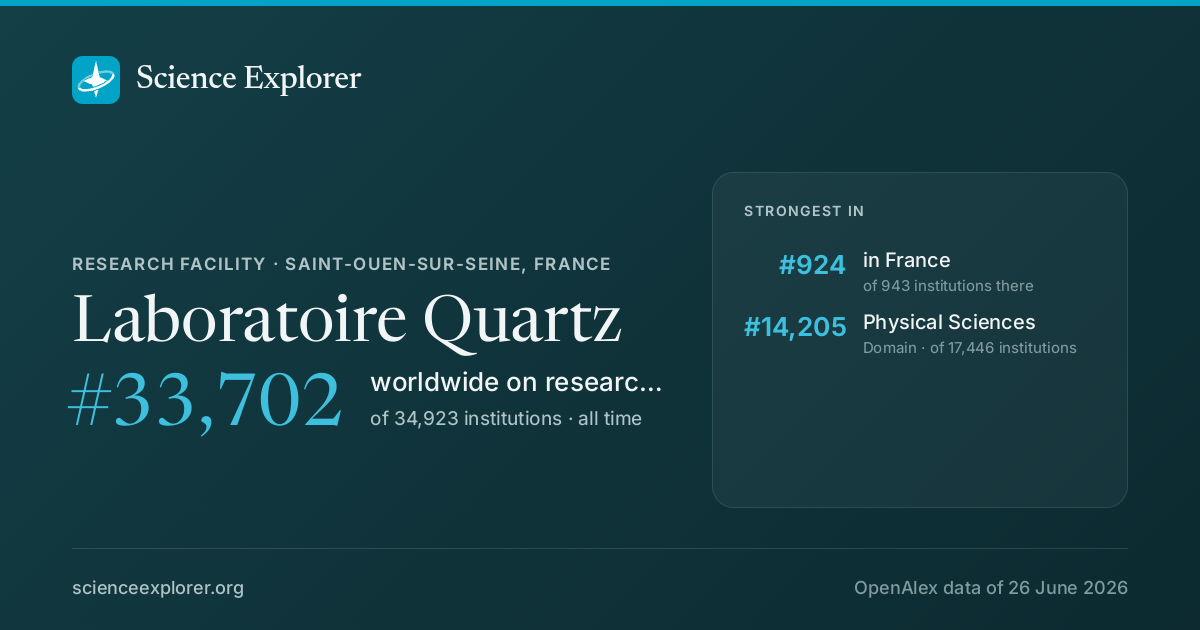
Laboratoire Quartz on Science Explorer

A card with Laboratoire Quartz's standing and the fields it leads in, for a post or a slide. A link to this page previews as the same card.

Download the card

1200 × 630 PNG, sized for social posts, drawn from the latest snapshot.

Badges for a website1Each links back here and updates with every snapshot

Research measures only: rankings here say nothing about teaching, admissions or student experience. Comparable institutions and collaboration partners have tabs of their own, above.

Discussion

Ask a question or share a note about Laboratoire Quartz. Keep it to the research: no personal attacks, advertising or links. Any reader can report a post, which collapses it for everyone until it is opened.
