Lawrence Berkeley National Laboratory

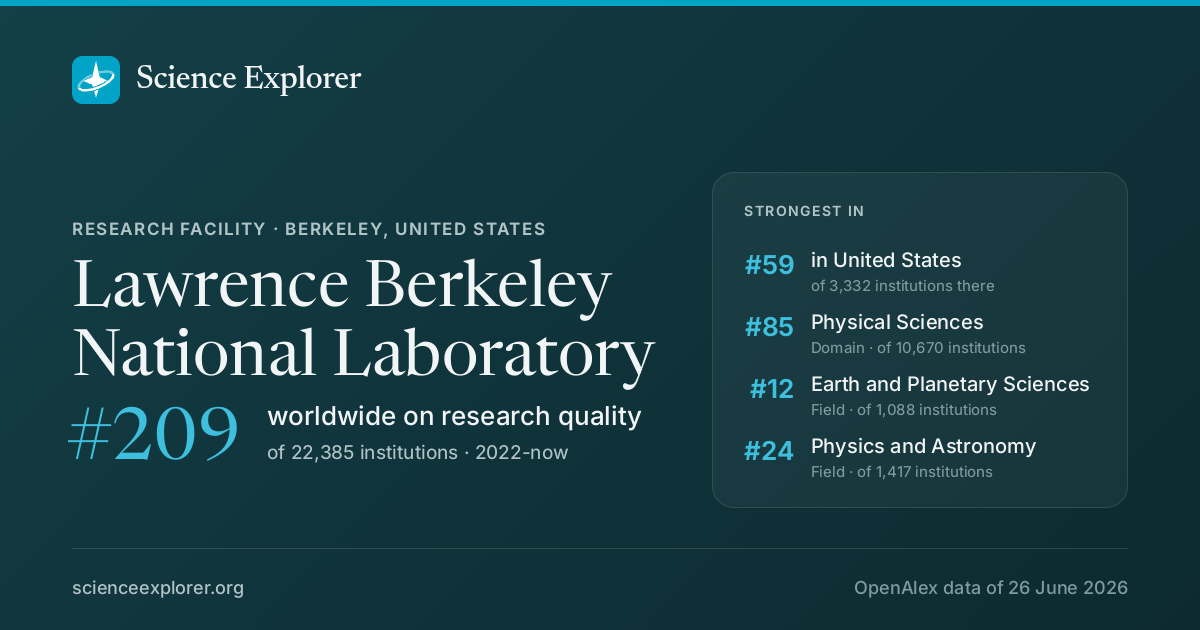
In research, Lawrence Berkeley National Laboratory stands highest in Physical Sciences (#85 of 10,670 worldwide), Earth and Planetary Sciences (#12 of 1,088 worldwide) and Physics and Astronomy (#24 of 1,417 worldwide), 2022-now. Relative to its size it is most specialised in Structural Biology, Environmental Chemistry and Nuclear and High Energy Physics (Structural Biology is 39.1× its share of world research).
- World rank, 2022-now
- #209 of 22,385 · #94 all time
- Rank in United States
- #59 of 3,332
- Research works
- 48k ▲ 9% vs 2018-21
- Citations
- 2.6M 53.4 per fractional work
- Top-10% rate
- 14.9% all institutions 10.0%
- vs its own fields
- 1.30× 1.00× is exactly expected
- Open access
- 49% world 40%
- International
- 21% world 18%
What is Lawrence Berkeley National Laboratory known for in research?
The fields where it stands highest, 2022-now, ranked among every institution above the floor in each field.
| Field | World rank | Where that sits | Top-10% rate | Works | All time |
|---|---|---|---|---|---|
| Physical SciencesDomain | #85 of 10,670 | 15.0% | 4,627 | #38 | |
| Earth and Planetary SciencesField | #12 of 1,088 | 22.5% | 472 | #29 | |
| Physics and AstronomyField | #24 of 1,417 | 14.9% | 865 | #15 | |
| EngineeringField | #102 of 5,901 | 14.6% | 1,153 | #52 | |
| Life SciencesDomain | #152 of 6,403 | 18.0% | 452 | #140 | |
| Materials ScienceField | #72 of 2,276 | 14.9% | 522 | #17 | |
| Electrical and Electronic EngineeringSubfield | #69 of 2,176 | 13.9% | 497 | #40 | |
| Materials ChemistrySubfield | #50 of 1,473 | 14.7% | 352 | #15 | |
| Atomic and Molecular Physics, and OpticsSubfield | #20 of 547 | 18.1% | 246 | #8 | |
| Computer ScienceField | #170 of 4,417 | 15.0% | 370 | #130 |
Each strip is that field's whole ranked pool, with the notch where Lawrence Berkeley National Laboratory sits in it, in the colour of the band that rank falls in. The track under the rate is the rate itself: it carries no average mark, because the average differs by field (from about 6% in Dentistry to 21% in Economics).
Which of those standings moved
The same fields on both windows: where it stood over the whole record, and where it stands in 2022-now. The distance is the story, and it is the one thing the two rank columns above cannot show.
- Physical Sciences#38 #85
- Earth and Planetary Sciences#29 #12
- Physics and Astronomy#15 #24
- Engineering#52 #102
- Life Sciences#140 #152
- Materials Science#17 #72
- Electrical and Electronic Engineering#40 #69
- Materials Chemistry#15 #50
- Atomic and Molecular Physics, and Optics#8 #20
- Computer Science#130 #170
A dot further right is a better standing. Fields it was not ranked in over the whole record are left out.
Which fields of science does Lawrence Berkeley National Laboratory work in?
In 2022-now, 85% of research at Lawrence Berkeley National Laboratory is in Physical Sciences, 9% in Life Sciences. Its largest fields are Engineering (21%), Physics and Astronomy (16%), Environmental Science (16%). It does 2.2× the world's share of Physical Sciences.
Each ring splits the one inside it: the four domains of science, their fields, their subfields. Size is fractional works in 2022-now. Every slice is a page; the interactive view zooms down to single topics and colours each by how much more of it this institution does than the world.
Its 4 domains and 26 fields, with their numbers
- Physical Sciences5,01385.4%
- Engineering1,25121.3%
- Physics and Astronomy94016.0%
- Environmental Science91015.5%
- Materials Science5809.9%
- Earth and Planetary Sciences4928.4%
- Computer Science4127.0%
- Chemistry1783.0%
- Energy1682.9%
- Chemical Engineering520.9%
- Mathematics300.5%
- Life Sciences5369.1%
- Health Sciences1813.1%
- Medicine1612.7%
- Health Professions150.3%
- Nursing40.1%
- Dentistry10.0%
- Veterinary10.0%
- Social Sciences1372.3%
- Decision Sciences540.9%
- Social Sciences370.6%
- Economics, Econometrics and Finance160.3%
- Business, Management and Accounting130.2%
- Psychology100.2%
- Arts and Humanities60.1%
What does Lawrence Berkeley National Laboratory specialise in?
Where its research is concentrated relative to its size: Structural Biology takes 39.1× the share of its output that it takes of world research.
- Structural BiologySubfield · 36.5 works39×
- Environmental ChemistrySubfield · 314.7 works25×
- Nuclear and High Energy PhysicsSubfield · 261.1 works14×
- GeophysicsSubfield · 273.6 works13×
- RadiationSubfield · 107.4 works13×
- Environmental EngineeringSubfield · 303.5 works9.6×
- Surfaces, Coatings and FilmsSubfield · 51.0 works8.9×
Location quotient, a volume reading rather than an impact one. It surfaces small, lopsided specialities.
Field profile
Location quotient across every field it publishes in: outside the ring is more than an institution of this size would be expected to publish, inside it is less.
Rings at 0.5×, 1× and 2×. Widest outward: Physics and Astronomy, 7.2×. Every wedge is a field page.
All 26 fields, with their numbers
- Physics and Astronomy7.20×940 works
- Earth and Planetary Sciences5.35×492 works
- Energy3.12×168 works
- Environmental Science3.12×910 works
- Materials Science2.83×580 works
- Chemical Engineering2.51×52 works
- Chemistry1.94×178 works
- Engineering1.42×1,251 works
- Biochemistry, Genetics and Molecular Biology1.21×380 works
- Decision Sciences0.96×54 works
- Computer Science0.90×412 works
- Mathematics0.43×30 works
- Neuroscience0.40×38 works
- Agricultural and Biological Sciences0.37×103 works
- Immunology and Microbiology0.19×11 works
- Pharmacology, Toxicology and Pharmaceutics0.19×4 works
- Medicine0.14×161 works
- Nursing0.13×4 works
- Economics, Econometrics and Finance0.13×16 works
- Health Professions0.10×15 works
- Veterinary0.07×1 works
- Business, Management and Accounting0.07×13 works
- Psychology0.05×10 works
- Social Sciences0.05×37 works
- Dentistry0.04×1 works
- Arts and Humanities0.04×6 works
- Physics and Astronomy 7.2×
- Earth and Planetary Sciences 5.3×
- Energy 3.1×
- Environmental Science 3.1×
- Materials Science 2.8×
- Chemical Engineering 2.5×
- Chemistry 1.9×
- Engineering 1.4×
- Biochemistry, Genetics and Molecular Biology 1.2×
- Decision Sciences 1.0×
- Computer Science 0.9×
- Mathematics 0.4×
- Neuroscience 0.4×
- Agricultural and Biological Sciences 0.4×
- Immunology and Microbiology 0.2×
- Pharmacology, Toxicology and Pharmaceutics 0.2×
- Medicine 0.1×
- Nursing 0.1×
- Economics, Econometrics and Finance 0.1×
- Health Professions 0.1×
- Veterinary 0.1×
- Business, Management and Accounting 0.1×
- Psychology 0.1×
- Social Sciences 0.1×
- Dentistry 0.0×
- Arts and Humanities 0.0×
Who are the top researchers at Lawrence Berkeley National Laboratory?
Ranked on the quality score, J. Borrill, Uroš Seljak and Tianzhen Hong lead among researchers whose main affiliation is Lawrence Berkeley National Laboratory.
- 1
J. Borrill
 United States · #1,127 worldwide
87k citations · 293 works
- 2
Uroš Seljak
United States · #3,585 worldwide
55k citations · 285 works
- 3
Tianzhen Hong
United States · #3,605 worldwide
24k citations · 352 works
- 4
Trevor F. Keenan
United States · #4,011 worldwide
27k citations · 347 works
- 5
Kristin Aslaug Persson
United States · #4,204 worldwide
70k citations · 732 works
- 6
Hee‐Jong Seo
United States · #4,633 worldwide
41k citations · 374 works
- 7
Axel Visel
United States · #5,320 worldwide
61k citations · 265 works
- 8
Hiroyasu Furukawa
United States · #5,844 worldwide
68k citations · 288 works
- 9
Ronald M. Krauss
United States · #7,789 worldwide
95k citations · 580 works
- 10
Haegyeom Kim
United States · #8,916 worldwide
22k citations · 169 works
Which keywords describe research at Lawrence Berkeley National Laboratory?
By fractional works in 2022-now, weighted toward what it does more of than the world: Microbial Communities, Hydrological Modeling, Methane Oxidation, Anaerobic, Gas Hydrates, Tomography, Data Assimilation and Satellite Observations.
- Parallel Computing
- Particle Physics
- Electronic Structure
- Rechargeable Batteries
- Ionosphere
- Solar Wind
- GRACE
- Geodetic Measurements
- Lithium-ion Batteries
- Molecular Dynamics
- Cathode Materials
- Microwave Retrieval
- Soil Moisture
- Validation
- Seismic Noise
- Machine Learning
- Tomography
- Gas Hydrates
- Methane Oxidation
- Hydrological Modeling
- Microbial Communities
- Climate Change
- Anaerobic
- Remote Sensing
- Data Assimilation
- Satellite Observations
- Surface Wave
- Spatial Variability
- Global Monitoring
- Renewable Energy
- Energy Storage
- Sea Level Rise
- Electron Acceleration
- Catalysis
- groundwater depletion
- Dark Matter
- Magnetosphere
- Crystal Growth
- Superconductivity
- Ionic Conductivity
Size is fractional works in 2022-now in the topics tagged with each word; colour is the word's share of this institution's work against its share of the world's. The 40 words are chosen for being large and distinctive. Each links to the topic it comes from most.
All 40 words, with their numbers
- Microbial Communities331▲ 13×10 topics
- Hydrological Modeling327▲ 23×5 topics
- Climate Change312▲ 1.96×75 topics
- Methane Oxidation303▲ 66×2 topics
- Anaerobic302▲ 80×1 topic
- Gas Hydrates302▲ 80×1 topic
- Remote Sensing289▲ 4.0×31 topics
- Tomography286▲ 28×5 topics
- Data Assimilation229▲ 24×4 topics
- Machine Learning226▲ 1.16×71 topics
- Satellite Observations223▲ 38×3 topics
- Seismic Noise217▲ 78×1 topic
- Surface Wave217▲ 78×1 topic
- Validation203▲ 39×2 topics
- Spatial Variability202▲ 53×2 topics
- Soil Moisture201▲ 46×4 topics
- Global Monitoring201▲ 133×1 topic
- Microwave Retrieval201▲ 133×1 topic
- Renewable Energy167▲ 1.96×41 topics
- Cathode Materials153▲ 6.7×3 topics
- Energy Storage136▲ 3.6×12 topics
- Molecular Dynamics125▲ 12×6 topics
- Sea Level Rise124▲ 17×3 topics
- Lithium-ion Batteries120▲ 4.9×4 topics
- Electron Acceleration119▲ 31×2 topics
- Geodetic Measurements111▲ 18×2 topics
- Catalysis111▲ 2.9×26 topics
- GRACE102▲ 36×1 topic
- groundwater depletion102▲ 36×1 topic
- Solar Wind96▲ 18×2 topics
- Dark Matter91▲ 13×4 topics
- Ionosphere91▲ 28×1 topic
- Magnetosphere91▲ 28×1 topic
- Rechargeable Batteries91▲ 5.8×2 topics
- Crystal Growth84▲ 5.2×11 topics
- Electronic Structure82▲ 7.8×8 topics
- Superconductivity82▲ 8.1×9 topics
- Particle Physics74▲ 17×2 topics
- Ionic Conductivity65▲ 8.2×2 topics
- Parallel Computing65▲ 9.3×5 topics
Which research topics does Lawrence Berkeley National Laboratory publish most on?
By volume in 2022-now: Methane Hydrates and Related Phenomena, Seismic Waves and Analysis, Soil Moisture and Remote Sensing and Geophysics and Gravity Measurements.
Area is fractional works; colour is the subfield each topic belongs to.
- 1 Methane Hydrates and Related Phenomena Environmental Chemistry 302 works
- 2 Seismic Waves and Analysis Geophysics 217 works
- 3 Soil Moisture and Remote Sensing Environmental Engineering 201 works
- 4 Geophysics and Gravity Measurements Oceanography 102 works
- 5 Ionosphere and magnetosphere dynamics Astronomy and Astrophysics 91 works
- 6 Advancements in Battery Materials Electrical and Electronic Engineering 67 works
- 7 Advanced Battery Materials and Technologies Electrical and Electronic Engineering 62 works
- 8 Particle physics theoretical and experimental studies Nuclear and High Energy Physics 54 works
- 9 Machine Learning in Materials Science Materials Chemistry 53 works
- 10 Building Energy and Comfort Optimization Building and Construction 48 works
How open and international is its research?
Against the world's own shares: the tick on each track. Both are shares of its output, so they sit on one scale and can be read against each other as well as against the world.
World: 40% of research is openly available.
World: 18% is written across borders.
How has Lawrence Berkeley National Laboratory's research output changed?
Output in 2022-2025 was 9% higher than in 2018-2021.
The same series as a ribbon: one cell per year, darker for more. The line above answers how much; this answers when.
Its share of all research
Growing output can still be a shrinking share: all of science grows. This is Lawrence Berkeley National Laboratory as a percentage of every work published that year, 0.021% in 2024.
Fractional works of Lawrence Berkeley National Laboratory over all fractional works that year. How the balance of science has shifted.
How much of it reaches the world top 10%
Year by year, against all institutions in the same year.
Of each year's output, the share that reached the world's 10% most cited for its field and year. Peak 23.0% in 2012.
Other research institutions in Berkeley
- University of California, Berkeley
- Neurobehavioral Systems
- Mathematical Sciences Research Institute
- Plant (United States)
- Department of Health Services
- Museum of Vertebrate Zoology
- Berkeley Public Health Division
- Joint Genome Institute

Which institutions have research most like Lawrence Berkeley National Laboratory's?
Among the world's leading institutions, Helmholtz Association of German Research Centres has the research profile closest to Lawrence Berkeley National Laboratory's, with both strong in Physics and Astronomy.
- 1
Helmholtz Association of German Research Centres
 Germany · Both strong in Physics and Astronomy, Earth and Planetary Sciences, Chemical Engineering
0.96 Compare
- 2
Argonne National LaboratoryUnited States · Both strong in Physics and Astronomy, Earth and Planetary Sciences, Energy
0.95 Compare
- 3
King Abdullah University of Science and Technology
 Saudi Arabia · Both strong in Earth and Planetary Sciences, Energy, Materials Science
0.94 Compare
- 4
University of Chinese Academy of Sciences
 China · Both strong in Earth and Planetary Sciences, Physics and Astronomy, Materials Science
0.93 Compare
- 5
Chinese Academy of SciencesChina · Both strong in Earth and Planetary Sciences, Physics and Astronomy, Materials Science
0.93 Compare
Similarity is the correlation of each side's location quotients across every field it publishes in, on a log scale: 1 is the same shape of research, 0 is unrelated. It ignores size. How it is measured.
Compare Lawrence Berkeley National Laboratory with
- vs
 Sapienza University of Rome
- vs
 Université Grenoble Alpes
- vs Technische Universität Berlin
- vs Mount Sinai Health System
- vs Mayo Clinic
- vs University of Massachusetts Amherst
Share Lawrence Berkeley National Laboratory's ranking



Research measures only: rankings here say nothing about teaching, admissions or student experience. Comparable institutions and collaboration partners have tabs of their own, above.
Questions people ask
What does Lawrence Berkeley National Laboratory research?
In research, Lawrence Berkeley National Laboratory stands highest in Physical Sciences (#85 of 10,670 worldwide), Earth and Planetary Sciences (#12 of 1,088 worldwide) and Physics and Astronomy (#24 of 1,417 worldwide), 2022-now. Relative to its size it is most specialised in Structural Biology, Environmental Chemistry and Nuclear and High Energy Physics (Structural Biology is 39.1× its share of world research).
Discussion
Ask a question or share a note about Lawrence Berkeley National Laboratory. Posts are plain text and can be reported.