Maternité Port Royal
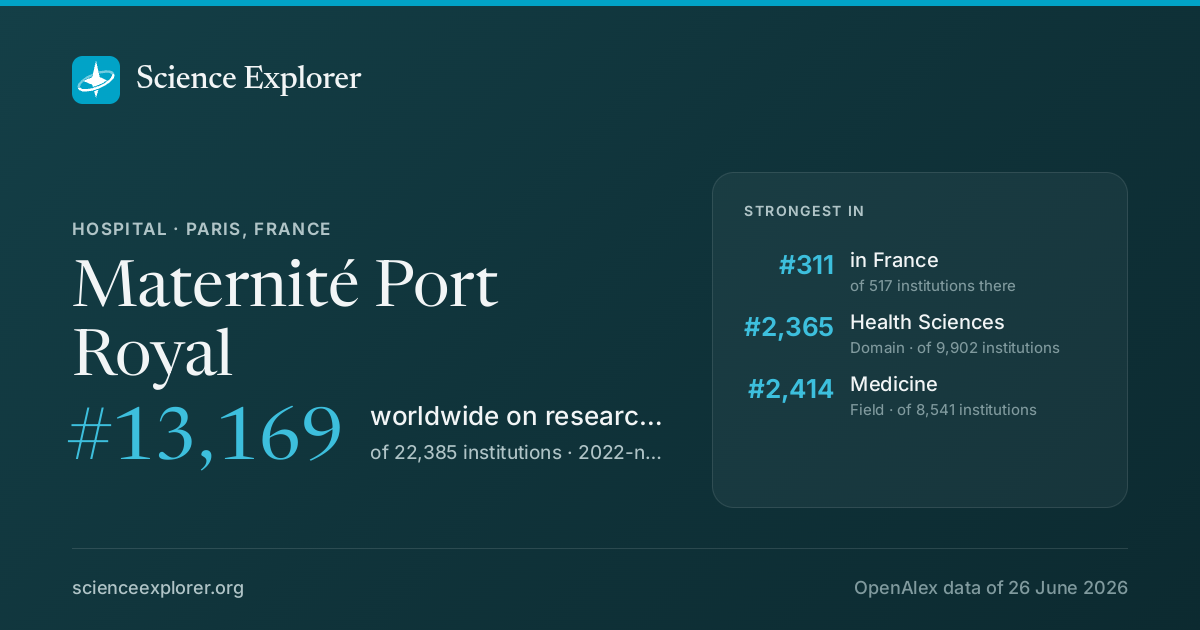
In research, Maternité Port Royal stands highest in Health Sciences (#2,365 of 9,902 worldwide) and Medicine (#2,414 of 8,541 worldwide), 2022-now.
- World rank, 2022-now
- #13,169 of 22,385 · #7,681 all time
- Rank in France
- #311 of 517
- Research works
- 1.7k ▲ 17% vs 2018-21
- Citations
- 40k 23.8 per fractional work
- Top-10% rate
- 7.0% all institutions 10.0%
- vs its own fields
- 1.04× 1.00× is exactly expected
- Open access
- 17% world 40%
- International
- 10% world 18%
What is Maternité Port Royal known for in research?
The fields where it stands highest, 2022-now, ranked among every institution above the floor in each field.
| Field | World rank | Where that sits | Top-10% rate | Works | All time |
|---|---|---|---|---|---|
| Health SciencesDomain | #2,365 of 9,902 | 6.6% | 107 | #2448 | |
| MedicineField | #2,414 of 8,541 | 6.7% | 95 | #2294 |
Each strip is that field's whole ranked pool, with the notch where Maternité Port Royal sits in it, in the colour of the band that rank falls in. The track under the rate is the rate itself: it carries no average mark, because the average differs by field (from about 6% in Dentistry to 21% in Economics).
Which fields of science does Maternité Port Royal work in?
In 2022-now, 79% of research at Maternité Port Royal is in Health Sciences, 11% in Social Sciences. Its largest fields are Medicine (71%), Health Professions (7%), Social Sciences (6%). It does 3.2× the world's share of Health Sciences.
Each ring splits the one inside it: the four domains of science, their fields, their subfields. Size is fractional works in 2022-now. Every slice is a page; the interactive view zooms down to single topics and colours each by how much more of it this institution does than the world.
Its 4 domains and 21 fields, with their numbers
- Health Sciences11879.3%
- Medicine10671.3%
- Health Professions117.2%
- Nursing10.7%
- Veterinary00.1%
- Dentistry00.1%
- Social Sciences1610.9%
- Social Sciences95.8%
- Psychology63.9%
- Arts and Humanities11.0%
- Economics, Econometrics and Finance00.2%
- Decision Sciences00.0%
- Life Sciences138.8%
- Physical Sciences10.9%
- Engineering10.4%
- Environmental Science00.2%
- Physics and Astronomy00.2%
- Mathematics00.1%
- Chemistry00.0%
- Materials Science00.0%
Field profile
Location quotient across every field it publishes in: outside the ring is more than an institution of this size would be expected to publish, inside it is less.
Rings at 0.5×, 1× and 2×. Widest outward: Medicine, 3.7×. Every wedge is a field page.
All 19 fields, with their numbers
- Medicine3.71×106 works
- Health Professions2.73×11 works
- Immunology and Microbiology1.62×2 works
- Nursing1.39×1 works
- Psychology1.28×6 works
- Biochemistry, Genetics and Molecular Biology0.93×7 works
- Veterinary0.77×0 works
- Neuroscience0.71×2 works
- Pharmacology, Toxicology and Pharmaceutics0.53×0 works
- Social Sciences0.46×9 works
- Arts and Humanities0.35×2 works
- Agricultural and Biological Sciences0.19×1 works
- Economics, Econometrics and Finance0.11×0 works
- Dentistry0.10×0 works
- Mathematics0.08×0 works
- Physics and Astronomy0.08×0 works
- Environmental Science0.04×0 works
- Engineering0.03×1 works
- Chemistry0.01×0 works
- Medicine 3.7×
- Health Professions 2.7×
- Immunology and Microbiology 1.6×
- Nursing 1.4×
- Psychology 1.3×
- Biochemistry, Genetics and Molecular Biology 0.9×
- Veterinary 0.8×
- Neuroscience 0.7×
- Pharmacology, Toxicology and Pharmaceutics 0.5×
- Social Sciences 0.5×
- Arts and Humanities 0.3×
- Agricultural and Biological Sciences 0.2×
- Economics, Econometrics and Finance 0.1×
- Dentistry 0.1×
- Mathematics 0.1×
- Physics and Astronomy 0.1×
- Environmental Science 0.0×
- Engineering 0.0×
- Chemistry 0.0×
Who are the top researchers at Maternité Port Royal?
Ranked on the quality score, François Goffinet, Fabrice P Brunet and E. Pannier lead among researchers whose main affiliation is Maternité Port Royal.
- 1
François Goffinet
 France · #511,180 worldwide
23k citations · 895 works
- 2
Fabrice P Brunet
France · #1,355,009 worldwide
4.6k citations · 132 works
- 3
E. Pannier
France · #1,434,430 worldwide
1.9k citations · 132 works
- 4
V. Tessier
France · #1,730,466 worldwide
1.5k citations · 56 works
- 5
J B Dubuisson
France · #2,166,545 worldwide
2.9k citations · 99 works
- 6
H. Foulot
France · #2,323,138 worldwide
2.6k citations · 69 works
- 7
D. Villemant
France · #2,420,493 worldwide
1.1k citations · 24 works
- 8
P.-H. Jarreau
France · #2,692,346 worldwide
839 citations · 50 works
- 9
P.‐H. Jarreau
France · #2,798,396 worldwide
218 citations · 23 works
- 10
Francois Xavier Aubriot
France · #3,159,429 worldwide
977 citations · 32 works
Which keywords describe research at Maternité Port Royal?
By fractional works in 2022-now, weighted toward what it does more of than the world: Epidemiology, Maternal Mortality, Prenatal Diagnosis, Pregnancy, Maternal Outcomes, Perinatal Outcomes, Neurodevelopmental Outcomes and Diagnosis.
- Digital Health
- Patient Rights
- Breast Cancer
- End-of-Life Care
- Palliative Care
- Preterm Birth
- Placenta Accreta
- Hypertensive Disorders
- Cardiovascular Health
- Surgical Treatment
- Preeclampsia
- Metabolic Syndrome
- Cesarean Section
- Global Trends
- Perinatal Outcomes
- Management
- Pregnancy
- Prenatal Diagnosis
- Public Health
- Maternal Mortality
- Epidemiology
- Inflammation
- Mental Health
- Diagnosis
- Quality of Life
- Maternal Outcomes
- Neurodevelopmental Outcomes
- Risk Factors
- Vaginal Birth
- Preterm Infants
- Endothelial Dysfunction
- Pregnancy Complications
- Infertility
- Placental Development
- Postpartum Hemorrhage
- Cognitive Function
- Social Determinants of Health
- Medical Ethics
- Healthcare Legislation
- Pathophysiology
Size is fractional works in 2022-now in the topics tagged with each word; colour is the word's share of this institution's work against its share of the world's. The 40 words are chosen for being large and distinctive. Each links to the topic it comes from most.
All 40 words, with their numbers
- Epidemiology19▲ 3.2×86 topics
- Maternal Mortality12▲ 35×5 topics
- Inflammation8▲ 2.5×32 topics
- Public Health8▲ 3.6×21 topics
- Mental Health8▲ 3.5×15 topics
- Prenatal Diagnosis8▲ 34×7 topics
- Diagnosis7▲ 5.3×29 topics
- Pregnancy7▲ 23×8 topics
- Quality of Life7▲ 3.2×23 topics
- Management6▲ 5.4×21 topics
- Maternal Outcomes6▲ 56×2 topics
- Perinatal Outcomes6▲ 56×2 topics
- Neurodevelopmental Outcomes6▲ 22×6 topics
- Global Trends6▲ 48×2 topics
- Risk Factors6▲ 3.5×18 topics
- Cesarean Section6▲ 94×1 topic
- Vaginal Birth6▲ 94×1 topic
- Metabolic Syndrome6▲ 4.6×13 topics
- Preterm Infants5▲ 28×4 topics
- Preeclampsia5▲ 45×2 topics
- Endothelial Dysfunction5▲ 14×6 topics
- Surgical Treatment5▲ 17×4 topics
- Pregnancy Complications5▲ 40×2 topics
- Cardiovascular Health5▲ 16×3 topics
- Infertility4▲ 21×3 topics
- Hypertensive Disorders4▲ 46×1 topic
- Placental Development4▲ 46×1 topic
- Placenta Accreta4▲ 90×1 topic
- Postpartum Hemorrhage4▲ 90×1 topic
- Preterm Birth4▲ 41×2 topics
- Cognitive Function4▲ 15×5 topics
- Palliative Care4▲ 17×3 topics
- Social Determinants of Health4▲ 12×3 topics
- End-of-Life Care4▲ 23×3 topics
- Medical Ethics4▲ 20×2 topics
- Breast Cancer4▲ 9.9×10 topics
- Healthcare Legislation4▲ 45×1 topic
- Patient Rights4▲ 36×1 topic
- Pathophysiology4▲ 8.3×7 topics
- Digital Health4▲ 21×2 topics
Which research topics does Maternité Port Royal publish most on?
By volume in 2022-now: Maternal and Perinatal Health Interventions, Pregnancy and preeclampsia studies, Maternal and fetal healthcare and Health, Medicine and Society.
Area is fractional works; colour is the subfield each topic belongs to.
- 1 Maternal and Perinatal Health Interventions Obstetrics and Gynecology 6 works
- 2 Pregnancy and preeclampsia studies Obstetrics and Gynecology 4 works
- 3 Maternal and fetal healthcare Pediatrics, Perinatology and Child Health 4 works
- 4 Health, Medicine and Society General Health Professions 4 works
- 5 Healthcare Systems and Practices General Health Professions 4 works
- 6 Endometriosis Research and Treatment Reproductive Medicine 3 works
- 7 Neonatal Respiratory Health Research Pulmonary and Respiratory Medicine 3 works
- 8 Infant Development and Preterm Care Pediatrics, Perinatology and Child Health 2 works
- 9 Pregnancy-related medical research Public Health, Environmental and Occupational Health 2 works
- 10 Migration, Identity, and Health Sociology and Political Science 2 works
How open and international is its research?
Against the world's own shares: the tick on each track. Both are shares of its output, so they sit on one scale and can be read against each other as well as against the world.
World: 40% of research is openly available.
World: 18% is written across borders.
How has Maternité Port Royal's research output changed?
Output in 2022-2025 was 17% higher than in 2018-2021.
The same series as a ribbon: one cell per year, darker for more. The line above answers how much; this answers when.
Its share of all research
Growing output can still be a shrinking share: all of science grows. This is Maternité Port Royal as a percentage of every work published that year, 0.00048% in 2024.
Fractional works of Maternité Port Royal over all fractional works that year. How the balance of science has shifted.
How much of it reaches the world top 10%
Year by year, against all institutions in the same year.
Of each year's output, the share that reached the world's 10% most cited for its field and year. Peak 15.8% in 1991.
Other research institutions in Paris
- Centre National de la Recherche Scientifique
- Inserm
- Université Paris Cité
- Sorbonne Université
- Commissariat à l'Énergie Atomique et aux Énergies Alternatives
- Institut National de Recherche pour l'Agriculture, l'Alimentation et l'Environnement
- Université Paris Sciences et Lettres
- Assistance Publique – Hôpitaux de Paris





Share Maternité Port Royal's ranking
Badges for a website1Each links back here and updates with every snapshot

Research measures only: rankings here say nothing about teaching, admissions or student experience. Comparable institutions and collaboration partners have tabs of their own, above.
Discussion
Ask a question or share a note about Maternité Port Royal. Keep it to the research: no personal attacks, advertising or links. Any reader can report a post, which collapses it for everyone until it is opened.