Science Explorer Back to mapMap
Discussion
Company · Aberdeen · United Kingdom

National Hyperbaric Centre

World rank, all time
#33,627
of 34,923
Rank in United Kingdom
#1,800
of 1,844
Research works
136
▲ 82% vs 2018-21
Citations
1.6k
11.8 per fractional work
Top-10% rate
6.5%
all institutions 10.0%
vs its own fields
0.86×
1.00× is exactly expected
Open access
31%
world 40%
International
42%
world 18%

Which fields of science does National Hyperbaric Centre work in?

In 2022-now, 62% of research at National Hyperbaric Centre is in Health Sciences, 16% in Life Sciences. Its largest fields are Medicine (57%), Neuroscience (11%), Psychology (7%). It does 2.1× the world's share of Health Sciences.

Health Sciences: 16 fractional works · 62.0% of its workMedicine: 14 fractional works · 57.3% of its workSurgery: 2 fractional works · 7.4% of its workPulmonary and Respiratory Medicine: 2 fractional works · 7.1% of its workEndocrinology, Diabetes and Metabolism: 2 fractional works · 6.1% of its workEpidemiology: 1 fractional works · 5.4% of its workPsychiatry and Mental health: 1 fractional works · 4.5% of its workNeurology: 1 fractional works · 4.1% of its workPhysiology: 1 fractional works · 2.9% of its workCardiology and Cardiovascular Medicine: 1 fractional works · 2.6% of its workOphthalmology: 1 fractional works · 2.3% of its workPediatrics, Perinatology and Child Health: 0 fractional works · 1.7% of its workNephrology: 0 fractional works · 1.7% of its workPublic Health, Environmental and Occupational Health: 0 fractional works · 1.3% of its workEmergency Medicine: 0 fractional works · 1.2% of its workRehabilitation: 0 fractional works · 1.1% of its workUrology: 0 fractional works · 1.1% of its workOtorhinolaryngology: 0 fractional works · 1.0% of its workCritical Care and Intensive Care Medicine: 0 fractional works · 1.0% of its workGenetics: 0 fractional works · 0.7% of its workInfectious Diseases: 0 fractional works · 0.7% of its workPathology and Forensic Medicine: 0 fractional works · 0.7% of its workPharmacology: 0 fractional works · 0.7% of its workOncology: 0 fractional works · 0.6% of its workOrthopedics and Sports Medicine: 0 fractional works · 0.6% of its workComplementary and alternative medicine: 0 fractional works · 0.3% of its workDermatology: 0 fractional works · 0.3% of its workAnesthesiology and Pain Medicine: 0 fractional works · 0.3% of its workHealth Professions: 1 fractional works · 4.7% of its workRadiological and Ultrasound Technology: 0 fractional works · 1.9% of its workOccupational Therapy: 0 fractional works · 1.3% of its workSpeech and Hearing: 0 fractional works · 0.7% of its workEmergency Medical Services: 0 fractional works · 0.6% of its workGeneral Health Professions: 0 fractional works · 0.3% of its workLife Sciences: 4 fractional works · 16.0% of its workNeuroscience: 3 fractional works · 11.4% of its workCognitive Neuroscience: 2 fractional works · 9.1% of its workBiological Psychiatry: 0 fractional works · 1.3% of its workNeurology: 0 fractional works · 0.7% of its workCellular and Molecular Neuroscience: 0 fractional works · 0.4% of its workBiochemistry, Genetics and Molecular Biology: 1 fractional works · 4.6% of its workMolecular Biology: 1 fractional works · 3.7% of its workGenetics: 0 fractional works · 1.0% of its workSocial Sciences: 3 fractional works · 11.0% of its workPsychology: 2 fractional works · 7.4% of its workDevelopmental and Educational Psychology: 1 fractional works · 4.3% of its workClinical Psychology: 1 fractional works · 2.7% of its workApplied Psychology: 0 fractional works · 0.4% of its workBusiness, Management and Accounting: 0 fractional works · 1.9% of its workOrganizational Behavior and Human Resource Management: 0 fractional works · 0.8% of its workStrategy and Management: 0 fractional works · 0.7% of its workAccounting: 0 fractional works · 0.3% of its workSmaller subfields together: 0 fractional works · 0.2% of its workDecision Sciences: 0 fractional works · 1.0% of its workStatistics, Probability and Uncertainty: 0 fractional works · 1.0% of its workSocial Sciences: 0 fractional works · 0.7% of its workEducation: 0 fractional works · 0.7% of its workPhysical Sciences: 3 fractional works · 10.9% of its workEngineering: 2 fractional works · 7.0% of its workMechanical Engineering: 1 fractional works · 2.3% of its workElectrical and Electronic Engineering: 0 fractional works · 2.0% of its workAerospace Engineering: 0 fractional works · 0.7% of its workMechanics of Materials: 0 fractional works · 0.7% of its workCivil and Structural Engineering: 0 fractional works · 0.5% of its workBiomedical Engineering: 0 fractional works · 0.4% of its workBuilding and Construction: 0 fractional works · 0.3% of its workOcean Engineering: 0 fractional works · 0.3% of its workMaterials Science: 0 fractional works · 1.1% of its workMaterials Chemistry: 0 fractional works · 1.1% of its workComputer Science: 0 fractional works · 1.0% of its workArtificial Intelligence: 0 fractional works · 0.7% of its workSignal Processing: 0 fractional works · 0.3% of its workEnergy: 0 fractional works · 0.7% of its workEnergy Engineering and Power Technology: 0 fractional works · 0.7% of its workEnvironmental Science: 0 fractional works · 0.7% of its workEcology: 0 fractional works · 0.7% of its workPhysics and Astronomy: 0 fractional works · 0.4% of its workRadiation: 0 fractional works · 0.4% of its workALL ITS WORKNationalHyperbaric Centre25fractional works, 2022-now
Life Sciences16%Physical Sciences11%Health Sciences62%Social Sciences11%

Each ring splits the one inside it: the four domains of science, their fields, their subfields. Size is fractional works in 2022-now. Every slice is a page; the interactive view zooms down to single topics and colours each by how much more of it this institution does than the world.

Its 4 domains and 14 fields, with their numbers
    1. Medicine1457.3%
    2. Health Professions14.7%
    1. Neuroscience311.4%
    2. Biochemistry, Genetics and Molecular Biology14.6%
    1. Psychology27.4%
    2. Business, Management and Accounting01.9%
    3. Decision Sciences01.0%
    4. Social Sciences00.7%
    1. Engineering27.0%
    2. Materials Science01.1%
    3. Computer Science01.0%
    4. Energy00.7%
    5. Environmental Science00.7%
    6. Physics and Astronomy00.4%
All of science, and how each field's share has moved since 1950: the Science domain explorer

Field profile

Location quotient across every field it publishes in: outside the ring is more than an institution of this size would be expected to publish, inside it is less.

Biochemistry, Genetics and Molecular Biology: 0.87× its world share, 1 worksBiochemistry, Geneti…Neuroscience: 7.05× its world share, 3 worksNeuroscienceComputer Science: 0.13× its world share, 0 worksComputer ScienceEnergy: 0.72× its world share, 0 worksEnergyEngineering: 0.47× its world share, 2 worksEngineeringEnvironmental Science: 0.13× its world share, 0 worksEnvironmental ScienceMaterials Science: 0.32× its world share, 0 worksMaterials SciencePhysics and Astronomy: 0.20× its world share, 0 worksPhysics and AstronomyHealth Professions: 1.80× its world share, 1 worksHealth ProfessionsMedicine: 2.98× its world share, 14 worksMedicineBusiness, Management and Accounting: 0.60× its world share, 0 worksBusiness, Management…Decision Sciences: 1.03× its world share, 0 worksDecision SciencesPsychology: 2.43× its world share, 2 worksPsychologySocial Sciences: 0.05× its world share, 0 worksSocial Sciences1×world share
more than its size predictsabout as predictedless

Rings at 0.5×, 1× and 2×. Widest outward: Neuroscience, 7.0×. Every wedge is a field page.

All 14 fields, with their numbers
  1. Neuroscience7.05×3 works
  2. Medicine2.98×14 works
  3. Psychology2.43×2 works
  4. Health Professions1.80×1 works
  5. Decision Sciences1.03×0 works
  6. Biochemistry, Genetics and Molecular Biology0.87×1 works
  7. Energy0.72×0 works
  8. Business, Management and Accounting0.60×0 works
  9. Engineering0.47×2 works
  10. Materials Science0.32×0 works
  11. Physics and Astronomy0.20×0 works
  12. Computer Science0.13×0 works
  13. Environmental Science0.13×0 works
  14. Social Sciences0.05×0 works

Who are the top researchers at National Hyperbaric Centre?

Ranked on the quality score, Philip Bryson lead among researchers whose main affiliation is National Hyperbaric Centre.

  1. 1 Philip Bryson United Kingdom · #4,460,216 worldwide 1.2k citations · 37 works
All ranked researchers at National Hyperbaric Centre

What are the most cited papers from National Hyperbaric Centre?

The most cited paper from National Hyperbaric Centre is "Tenth European Consensus Conference on Hyperbaric Medicine: recommendations for accepted and non-accepted clinical indications and practice of hyperbaric oxygen treatment" (Daniel Mathieu, Alessandro Marroni, Jacek Kot, 2017), with 298 citations. Next come "A Phase I Study of Low-Pressure Hyperbaric Oxygen Therapy for Blast-Induced Post-Concussion Syndrome and Post-Traumatic Stress Disorder" (151) and "The implications of the presence of osteomyelitis on outcomes of infected diabetic foot wounds" (122).

Most cited papers
#PaperReleasedCitations
1 Tenth European Consensus Conference on Hyperbaric Medicine: recommendations for accepted and non-accepted clinical indications and practice of hyperbaric oxygen treatment Daniel Mathieu, Alessandro Marroni, Jacek Kot · Diving and Hyperbaric Medicine Journal Open access 31 Mar 2017 298
2 A Phase I Study of Low-Pressure Hyperbaric Oxygen Therapy for Blast-Induced Post-Concussion Syndrome and Post-Traumatic Stress Disorder Paul G. Harch, Susan R. Andrews, Edward Fogarty et al. · Journal of Neurotrauma Open access 25 Oct 2011 151
3 The implications of the presence of osteomyelitis on outcomes of infected diabetic foot wounds Mesut Mutluoğlu, Ali Kemal Sivrioğlu, Murat Eroğlu et al. · Scandinavian Journal of Infectious Diseases 5 Feb 2013 122
4 HOPON (Hyperbaric Oxygen for the Prevention of Osteoradionecrosis): A Randomized Controlled Trial of Hyperbaric Oxygen to Prevent Osteoradionecrosis of the Irradiated Mandible After Dentoalveolar Surgery Richard Shaw, Chris Butterworth, Paul Silcocks et al. · International Journal of Radiation Oncology*Biology*Physics Open access 6 Mar 2019 115
5 Right-to-left shunt and risk of decompression illness with cochleovestibular and cerebral symptoms in divers: Case control study in 101 consecutive dive accidents Emmanuel Cantais, Pierre Louge, Alain Suppini et al. · Critical Care Medicine 2003 104
All 61 most cited papers, with filters and sorting

Which keywords describe research at National Hyperbaric Centre?

By fractional works in 2022-now, weighted toward what it does more of than the world: Epidemiology, Genetics, Autism Spectrum Disorders, Diabetes, Executive Functioning, Management, Neurodevelopmental Disorders and Social Skills Interventions.

▲ more of its work than of the world's◆ about the world's share▼ less than the world's

Size is fractional works in 2022-now in the topics tagged with each word; colour is the word's share of this institution's work against its share of the world's. The 23 words are chosen for being large and distinctive. Each links to the topic it comes from most.

All 23 words, with their numbers
  1. Epidemiology6▲ 5.6×15 topics
  2. Genetics2▲ 14×4 topics
  3. Autism Spectrum Disorders2▲ 94×2 topics
  4. Diabetes2▲ 17×5 topics
  5. Executive Functioning2▲ 64×2 topics
  6. Management2▲ 10×5 topics
  7. Inflammation2▲ 3.5×11 topics
  8. Neurodevelopmental Disorders2▲ 58×1 topic
  9. Prevention2▲ 18×3 topics
  10. Social Skills Interventions2▲ 121×1 topic
  11. Wound Healing2▲ 27×3 topics
  12. Foot Ulcers1▲ 145×1 topic
  13. Neuropathy1▲ 118×1 topic
  14. Oxidative Stress1▲ 3.2×6 topics
  15. Medical Therapy1▲ 109×2 topics
  16. Behavioral Interventions1▲ 53×1 topic
  17. Cryptogenic Stroke1▲ 251×1 topic
  18. Neuroprotection1▲ 13×5 topics
  19. Patent Foramen Ovale1▲ 251×1 topic
  20. Quality of Life1▲ 3.1×6 topics
  21. Special Education1▲ 72×1 topic
  22. Cardiovascular Disease1▲ 3.6×2 topics
  23. Treatment1▲ 3.4×7 topics

Which research topics does National Hyperbaric Centre publish most on?

By volume in 2022-now: Autism Spectrum Disorder Research, Diabetic Foot Ulcer Assessment and Management, Behavioral and Psychological Studies and Cardiovascular and Diving-Related Complications.

  1. 1 Autism Spectrum Disorder Research Cognitive Neuroscience 2 works
  2. 2 Diabetic Foot Ulcer Assessment and Management Endocrinology, Diabetes and Metabolism 1 works
  3. 3 Behavioral and Psychological Studies Developmental and Educational Psychology 1 works
  4. 4 Cardiovascular and Diving-Related Complications Pulmonary and Respiratory Medicine 1 works
  5. 5 Family and Disability Support Research Clinical Psychology 1 works
  6. 6 Heart Rate Variability and Autonomic Control Cardiology and Cardiovascular Medicine 1 works
  7. 7 Long-Term Effects of COVID-19 Neurology 0 works
  8. 8 Spaceflight effects on biology Physiology 0 works
  9. 9 Optical Wireless Communication Technologies Electrical and Electronic Engineering 0 works
  10. 10 Bladder and Urothelial Cancer Treatments Surgery 0 works

How open and international is its research?

Against the world's own shares: the tick on each track. Both are shares of its output, so they sit on one scale and can be read against each other as well as against the world.

openly available30.7%not open69.3%

World: 40% of research is openly available.

with international co-authors42.2%domestic only57.8%

World: 18% is written across borders.

How has National Hyperbaric Centre's research output changed?

Output in 2022-2025 was 82% higher than in 2018-2021.

still counting1990200020102020
grewheldshrank

The same series as a ribbon: one cell per year, darker for more. The line above answers how much; this answers when.

Its share of all research

Growing output can still be a shrinking share: all of science grows. This is National Hyperbaric Centre as a percentage of every work published that year, 0.00013% in 2024.

still counting0.00050%0.0010%0.0015%National Hyperbaric Centre0.00014% in 202519801990200020102020

Fractional works of National Hyperbaric Centre over all fractional works that year. How the balance of science has shifted.

Other research institutions in Aberdeen

All research institutions in Aberdeen

Share National Hyperbaric Centre's ranking
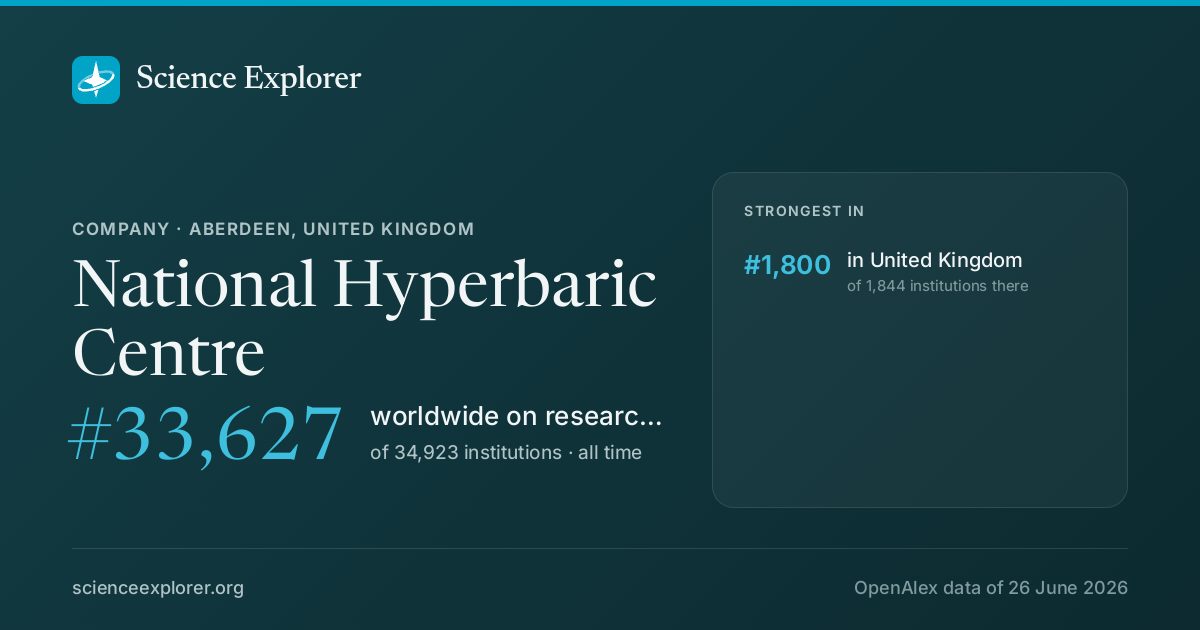
National Hyperbaric Centre on Science Explorer

A card with National Hyperbaric Centre's standing and the fields it leads in, for a post or a slide. A link to this page previews as the same card.

Download the card

1200 × 630 PNG, sized for social posts, drawn from the latest snapshot.

Badges for a website1Each links back here and updates with every snapshot

Research measures only: rankings here say nothing about teaching, admissions or student experience. Comparable institutions and collaboration partners have tabs of their own, above.

Discussion

Ask a question or share a note about National Hyperbaric Centre. Posts are plain text and can be reported.