Oceanography Society
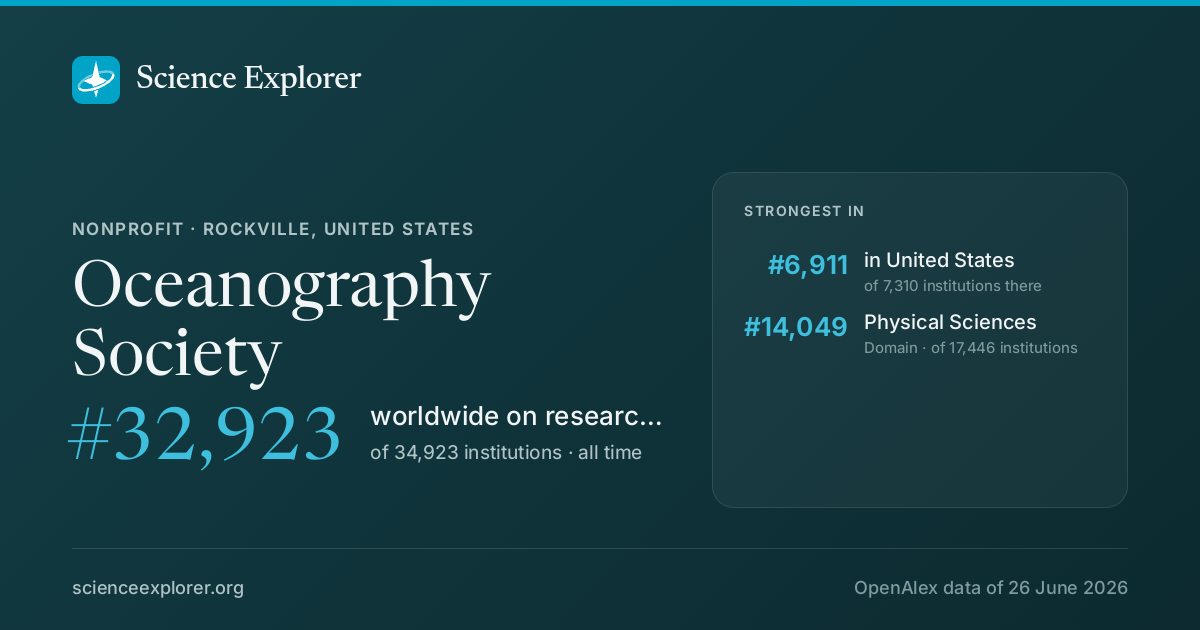
In research, Oceanography Society stands highest in Physical Sciences (#14,049 of 17,446 worldwide), over all time. Relative to its size it is most specialised in Oceanography and Earth and Planetary Sciences (Oceanography is 87.0× its share of world research).
- World rank, all time
- #32,923 of 34,923
- Rank in United States
- #6,911 of 7,310
- Research works
- 144 ▼ 100% vs 2018-21
- Citations
- 8.5k 59.1 per fractional work
- Top-10% rate
- 20.0% all institutions 10.0%
- vs its own fields
- 1.35× 1.00× is exactly expected
- Open access
- 98% world 40%
- International
- 9% world 18%
What is Oceanography Society known for in research?
The fields where it stands highest, over all time, ranked among every institution above the floor in each field.
| Field | World rank | Where that sits | Top-10% rate | Works |
|---|---|---|---|---|
| Physical SciencesDomain | #14,049 of 17,446 | 29.3% | 125 |
Each strip is that field's whole ranked pool, with the notch where Oceanography Society sits in it, in the colour of the band that rank falls in. The track under the rate is the rate itself: it carries no average mark, because the average differs by field (from about 6% in Dentistry to 21% in Economics).
Which fields of science does Oceanography Society work in?
In all years, 87% of research at Oceanography Society is in Physical Sciences, 8% in Social Sciences. Its largest fields are Earth and Planetary Sciences (48%), Environmental Science (33%), Social Sciences (5%). It does 2.1× the world's share of Physical Sciences.
Each ring splits the one inside it: the four domains of science, their fields, their subfields. Size is fractional works in all years. Every slice is a page; the interactive view zooms down to single topics and colours each by how much more of it this institution does than the world.
Its 4 domains and 17 fields, with their numbers
- Physical Sciences12587.3%
- Earth and Planetary Sciences6947.7%
- Environmental Science4833.1%
- Engineering53.4%
- Computer Science21.4%
- Physics and Astronomy10.7%
- Energy10.7%
- Mathematics00.2%
- Social Sciences128.4%
- Life Sciences53.7%
- Health Sciences10.7%
- Medicine10.5%
- Health Professions00.2%
What does Oceanography Society specialise in?
Where its research is concentrated relative to its size: Oceanography takes 87.0× the share of its output that it takes of world research.
- OceanographySubfield · 43.5 works87×
- Earth and Planetary SciencesField · 68.6 works25×
Location quotient, a volume reading rather than an impact one. It surfaces small, lopsided specialities.
Field profile
Location quotient across every field it publishes in: outside the ring is more than an institution of this size would be expected to publish, inside it is less.
Which keywords describe research at Oceanography Society?
By fractional works in all years, weighted toward what it does more of than the world: Climate Change, Ocean Circulation, Data Assimilation, Oceanic Modeling, Tidal Analysis, Remote Sensing, Global Warming and Ocean Acidification.
- Shale Gas
- Extreme Events
- Tropical Cyclones
- Population Dynamics
- Coral Reefs
- Sea Level Rise
- Holocene
- Deep-Sea Ecology
- Continental Margin
- Sea Ice
- Environmental Impact
- Eutrophication
- Marine Fisheries
- Marine Organisms
- CO2 Emissions
- Global Change
- Ocean Acidification
- Remote Sensing
- Oceanic Modeling
- Ocean Circulation
- Climate Change
- Data Assimilation
- Tidal Analysis
- Global Warming
- Fisheries Sustainability
- Arctic
- Harmful Algal Blooms
- Ecosystem Management
- Dissolved Organic Matter
- Biogeography
- Decline
- Ecosystem Functioning
- Crustal Structure
- Marine Biodiversity
- Marine Ecosystems
- Bleaching
- Ecosystem Services
- Sea Level
- Climate Modeling
- Greenhouse Gas Emissions
Size is fractional works in all years in the topics tagged with each word; colour is the word's share of this institution's work against its share of the world's. The 40 words are chosen for being large and distinctive. Each links to the topic it comes from most.
All 40 words, with their numbers
- Climate Change49▲ 13×29 topics
- Ocean Circulation24▲ 118×3 topics
- Data Assimilation16▲ 59×3 topics
- Oceanic Modeling15▲ 230×1 topic
- Tidal Analysis15▲ 230×1 topic
- Remote Sensing13▲ 8.4×10 topics
- Global Warming13▲ 25×4 topics
- Ocean Acidification12▲ 105×2 topics
- Fisheries Sustainability9▲ 48×2 topics
- Global Change8▲ 19×2 topics
- Arctic8▲ 55×4 topics
- CO2 Emissions8▲ 51×1 topic
- Harmful Algal Blooms8▲ 56×2 topics
- Marine Organisms8▲ 482×1 topic
- Ecosystem Management8▲ 68×1 topic
- Marine Fisheries8▲ 98×1 topic
- Dissolved Organic Matter8▲ 94×1 topic
- Eutrophication8▲ 36×1 topic
- Biogeography7▲ 14×3 topics
- Environmental Impact6▲ 3.1×5 topics
- Decline6▲ 148×1 topic
- Sea Ice6▲ 148×1 topic
- Ecosystem Functioning5▲ 18×3 topics
- Continental Margin5▲ 52×2 topics
- Crustal Structure5▲ 52×2 topics
- Deep-Sea Ecology5▲ 71×1 topic
- Marine Biodiversity5▲ 41×1 topic
- Holocene4▲ 19×3 topics
- Marine Ecosystems4▲ 54×2 topics
- Sea Level Rise4▲ 23×3 topics
- Bleaching4▲ 83×1 topic
- Coral Reefs4▲ 83×1 topic
- Ecosystem Services4▲ 8.1×3 topics
- Population Dynamics4▲ 9.0×3 topics
- Sea Level4▲ 19×2 topics
- Tropical Cyclones4▲ 46×2 topics
- Climate Modeling4▲ 37×1 topic
- Extreme Events4▲ 30×1 topic
- Greenhouse Gas Emissions4▲ 13×2 topics
- Shale Gas4▲ 20×2 topics
Which research topics does Oceanography Society publish most on?
By volume in 2022-now: Marine animal studies overview, Arctic and Antarctic ice dynamics and Turtle Biology and Conservation.
How open and international is its research?
Against the world's own shares: the tick on each track. Both are shares of its output, so they sit on one scale and can be read against each other as well as against the world.
World: 40% of research is openly available.
World: 18% is written across borders.
How has Oceanography Society's research output changed?
Output in 2022-2025 was 100% lower than in 2018-2021.
The same series as a ribbon: one cell per year, darker for more. The line above answers how much; this answers when.
Its share of all research
Growing output can still be a shrinking share: all of science grows. This is Oceanography Society as a percentage of every work published that year, 0.00000093% in 2023.
Fractional works of Oceanography Society over all fractional works that year. How the balance of science has shifted.
Other research institutions in Rockville
- United States Nuclear Regulatory Commission
- Signal Processing (United States)
- Orthopaedic Center
- Biomedical Research Institute
- Westat (United States)
- Research Applications (United States)
- Kai Research (United States)
- Micro Focus (United States)

Share Oceanography Society's ranking
Badges for a website1Each links back here and updates with every snapshot

Research measures only: rankings here say nothing about teaching, admissions or student experience. Comparable institutions and collaboration partners have tabs of their own, above.
Discussion
Ask a question or share a note about Oceanography Society. Posts are plain text and can be reported.