Ordnance Engineering College
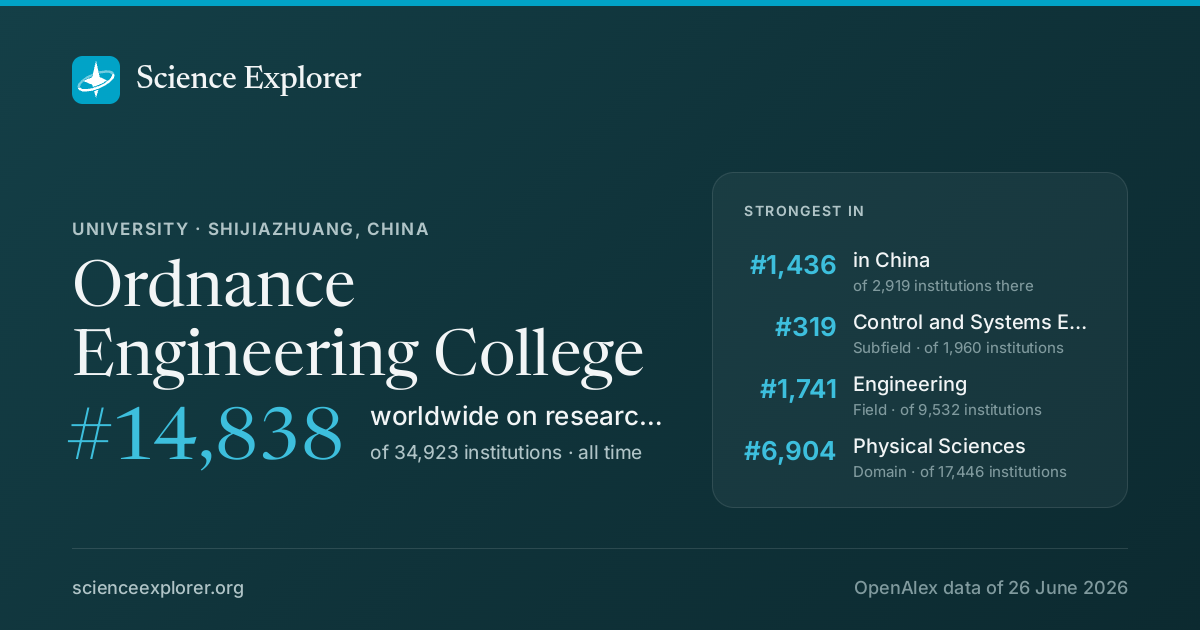
In research, Ordnance Engineering College stands highest in Control and Systems Engineering (#319 of 1,960 worldwide), Engineering (#1,741 of 9,532 worldwide) and Physical Sciences (#6,904 of 17,446 worldwide), over all time.
- World rank, all time
- #14,838 of 34,923
- Rank in China
- #1,436 of 2,919
- Research works
- 5.7k ▼ 62% vs 2018-21
- Citations
- 8.9k 1.5 per fractional work
- Top-10% rate
- 6.3% all institutions 10.0%
- vs its own fields
- 0.33× 1.00× is exactly expected
- Open access
- 12% world 40%
- International
- 1% world 18%
What is Ordnance Engineering College known for in research?
The fields where it stands highest, over all time, ranked among every institution above the floor in each field.
| Field | World rank | Where that sits | Top-10% rate | Works |
|---|---|---|---|---|
| Control and Systems EngineeringSubfield | #319 of 1,960 | 6.3% | 1,419 | |
| EngineeringField | #1,741 of 9,532 | 3.6% | 3,664 | |
| Physical SciencesDomain | #6,904 of 17,446 | 3.5% | 5,374 | |
| Computer ScienceField | #2,940 of 6,336 | 3.4% | 1,187 | |
| Electrical and Electronic EngineeringSubfield | #1,828 of 3,725 | 2.2% | 781 | |
| Information SystemsSubfield | #1,502 of 2,566 | 4.9% | 339 | |
| Artificial IntelligenceSubfield | #1,817 of 2,786 | 4.3% | 391 | |
| Aerospace EngineeringSubfield | #1,154 of 1,601 | 0.6% | 475 | |
| Mechanical EngineeringSubfield | #2,202 of 2,525 | 2.0% | 248 | |
| Safety, Risk, Reliability and QualitySubfield | #370 of 424 | 5.3% | 227 |
Each strip is that field's whole ranked pool, with the notch where Ordnance Engineering College sits in it, in the colour of the band that rank falls in. The track under the rate is the rate itself: it carries no average mark, because the average differs by field (from about 6% in Dentistry to 21% in Economics).
Which fields of science does Ordnance Engineering College work in?
In all years, 94% of research at Ordnance Engineering College is in Physical Sciences, 5% in Social Sciences. Its largest fields are Engineering (64%), Computer Science (21%), Materials Science (3%). It does 2.3× the world's share of Physical Sciences.
Each ring splits the one inside it: the four domains of science, their fields, their subfields. Size is fractional works in all years. Every slice is a page; the interactive view zooms down to single topics and colours each by how much more of it this institution does than the world.
Its 4 domains and 23 fields, with their numbers
- Physical Sciences5,37493.9%
- Engineering3,66464.0%
- Computer Science1,18720.7%
- Materials Science1873.3%
- Physics and Astronomy1101.9%
- Mathematics741.3%
- Environmental Science661.2%
- Energy360.6%
- Earth and Planetary Sciences270.5%
- Chemistry200.3%
- Chemical Engineering40.1%
- Social Sciences2624.6%
- Business, Management and Accounting841.5%
- Social Sciences821.4%
- Decision Sciences681.2%
- Arts and Humanities150.3%
- Psychology90.2%
- Economics, Econometrics and Finance30.1%
- Health Sciences621.1%
- Medicine440.8%
- Health Professions180.3%
- Life Sciences270.5%
Field profile
Location quotient across every field it publishes in: outside the ring is more than an institution of this size would be expected to publish, inside it is less.
Rings at 0.5×, 1× and 2×. Widest outward: Engineering, 4.2×. Every wedge is a field page.
All 12 fields, with their numbers
- Engineering4.16×12 works
- Physics and Astronomy2.21×1 works
- Energy1.89×0 works
- Decision Sciences1.80×0 works
- Computer Science1.64×2 works
- Earth and Planetary Sciences1.48×0 works
- Materials Science1.30×1 works
- Psychology0.57×0 works
- Environmental Science0.55×0 works
- Social Sciences0.24×1 works
- Health Professions0.22×0 works
- Medicine0.08×0 works
Who are the top researchers at Ordnance Engineering College?
Ranked on the quality score, Yongke Li, Shuang-shan Mi and Xinghui Zhang lead among researchers whose main affiliation is Ordnance Engineering College.
- 1
Yongke Li
 China · #2,106,703 worldwide
702 citations · 20 works
- 2
Shuang-shan Mi
China · #2,340,396 worldwide
590 citations · 26 works
- 3
Xinghui Zhang
China · #2,527,115 worldwide
1.6k citations · 113 works
- 4
DU Xinkang
China · #2,663,876 worldwide
227 citations · 15 works
- 5
Peilin Zhang
China · #2,926,238 worldwide
810 citations · 65 works
- 6
Dongwei Li
China · #3,152,031 worldwide
383 citations · 23 works
- 7
Hai Ying Huang
China · #3,323,703 worldwide
97 citations · 16 works
- 8
Xisheng Jia
China · #3,334,698 worldwide
412 citations · 41 works
- 9
Wencheng Jiao
China · #3,337,968 worldwide
221 citations · 20 works
- 10
Yongqiang He
China · #3,449,892 worldwide
353 citations · 59 works
Which keywords describe research at Ordnance Engineering College?
By fractional works in all years, weighted toward what it does more of than the world: Neural Network, Internet of Things, Fault Diagnosis, Fuzzy Control, Detection, Optimization, Machine Learning and Image Processing.
- Hydraulic System Modeling
- Multi-Agent Systems
- Expert Systems
- Intelligent Systems
- Virtual Prototyping
- Wireless Sensor Networks
- Network Simulation
- Data Fusion
- PID Controller
- Control Systems
- Monitoring System
- Control System
- Photoelectric
- Optoelectronic
- Artificial Intelligence
- Neural Networks
- Remote Sensing
- Detection
- Fuzzy Control
- Internet of Things
- Neural Network
- Fault Diagnosis
- Machine Learning
- Optimization
- Image Processing
- Modeling
- High-Speed Imaging
- Measurement
- Target
- Simulation
- Wireless Sensor Network
- Real-Time Monitoring
- Temperature
- Virtual Reality
- Training System
- Data Integration
- Ontology
- Wavelet Analysis
- Semantic Knowledge Base
- Knowledge Management
Size is fractional works in all years in the topics tagged with each word; colour is the word's share of this institution's work against its share of the world's. The 40 words are chosen for being large and distinctive. Each links to the topic it comes from most.
All 40 words, with their numbers
- Neural Network675▲ 42×9 topics
- Internet of Things594▲ 19×17 topics
- Fault Diagnosis538▲ 42×7 topics
- Fuzzy Control527▲ 59×3 topics
- Machine Learning496▲ 4.0×49 topics
- Detection396▲ 24×4 topics
- Optimization378▲ 12×17 topics
- Remote Sensing357▲ 5.7×22 topics
- Image Processing355▲ 19×12 topics
- Neural Networks331▲ 5.5×25 topics
- Modeling328▲ 22×7 topics
- Artificial Intelligence326▲ 6.9×19 topics
- High-Speed Imaging323▲ 45×3 topics
- Optoelectronic320▲ 72×2 topics
- Measurement318▲ 57×2 topics
- Photoelectric318▲ 126×1 topic
- Target318▲ 126×1 topic
- Control System308▲ 44×4 topics
- Simulation306▲ 16×13 topics
- Monitoring System299▲ 65×2 topics
- Wireless Sensor Network299▲ 70×3 topics
- Control Systems295▲ 20×10 topics
- Real-Time Monitoring295▲ 49×4 topics
- PID Controller292▲ 66×2 topics
- Temperature291▲ 38×2 topics
- Data Fusion291▲ 82×1 topic
- Virtual Reality274▲ 13×9 topics
- Network Simulation262▲ 85×1 topic
- Training System262▲ 85×1 topic
- Wireless Sensor Networks258▲ 12×17 topics
- Data Integration257▲ 19×4 topics
- Virtual Prototyping256▲ 31×2 topics
- Ontology253▲ 26×2 topics
- Intelligent Systems252▲ 49×2 topics
- Wavelet Analysis251▲ 42×2 topics
- Expert Systems250▲ 36×1 topic
- Semantic Knowledge Base250▲ 55×1 topic
- Multi-Agent Systems250▲ 22×6 topics
- Knowledge Management245▲ 9.4×6 topics
- Hydraulic System Modeling235▲ 68×1 topic
Which research topics does Ordnance Engineering College publish most on?
By volume in 2022-now: Energetic Materials and Combustion, Simulation and Modeling Applications, Target Tracking and Data Fusion in Sensor Networks and Advanced Measurement and Detection Methods.
Area is fractional works; colour is the subfield each topic belongs to.
- 1 Energetic Materials and Combustion Mechanics of Materials 1 works
- 2 Simulation and Modeling Applications Control and Systems Engineering 1 works
- 3 Target Tracking and Data Fusion in Sensor Networks Artificial Intelligence 1 works
- 4 Advanced Measurement and Detection Methods Electrical and Electronic Engineering 1 works
- 5 Rocket and propulsion systems research Aerospace Engineering 1 works
- 6 Military Defense Systems Analysis Aerospace Engineering 0 works
- 7 Thermal and Kinetic Analysis Materials Chemistry 0 works
- 8 Robotic Path Planning Algorithms Computer Vision and Pattern Recognition 0 works
- 9 Advanced Photonic Communication Systems Electrical and Electronic Engineering 0 works
- 10 Advanced Computational Techniques and Applications Artificial Intelligence 0 works
How open and international is its research?
Against the world's own shares: the tick on each track. Both are shares of its output, so they sit on one scale and can be read against each other as well as against the world.
World: 40% of research is openly available.
World: 18% is written across borders.
How has Ordnance Engineering College's research output changed?
Output in 2022-2025 was 62% lower than in 2018-2021.
The same series as a ribbon: one cell per year, darker for more. The line above answers how much; this answers when.
Its share of all research
Growing output can still be a shrinking share: all of science grows. This is Ordnance Engineering College as a percentage of every work published that year, 0.00010% in 2024.
Fractional works of Ordnance Engineering College over all fractional works that year. How the balance of science has shifted.
How much of it reaches the world top 10%
Year by year, against all institutions in the same year.
Of each year's output, the share that reached the world's 10% most cited for its field and year. Peak 5.9% in 2001.
Other research institutions in Shijiazhuang
- Hebei Medical University
- Hebei Normal University
- Hebei University of Science and Technology
- Shijiazhuang Tiedao University
- Shijiazhuang University
- Hebei GEO University
- Hebei University of Economics and Business
- Hospital of Hebei Province
Share Ordnance Engineering College's ranking
Badges for a website1Each links back here and updates with every snapshot

Research measures only: rankings here say nothing about teaching, admissions or student experience. Comparable institutions and collaboration partners have tabs of their own, above.
Discussion
Ask a question or share a note about Ordnance Engineering College. Posts are plain text and can be reported.