Pain in Motion
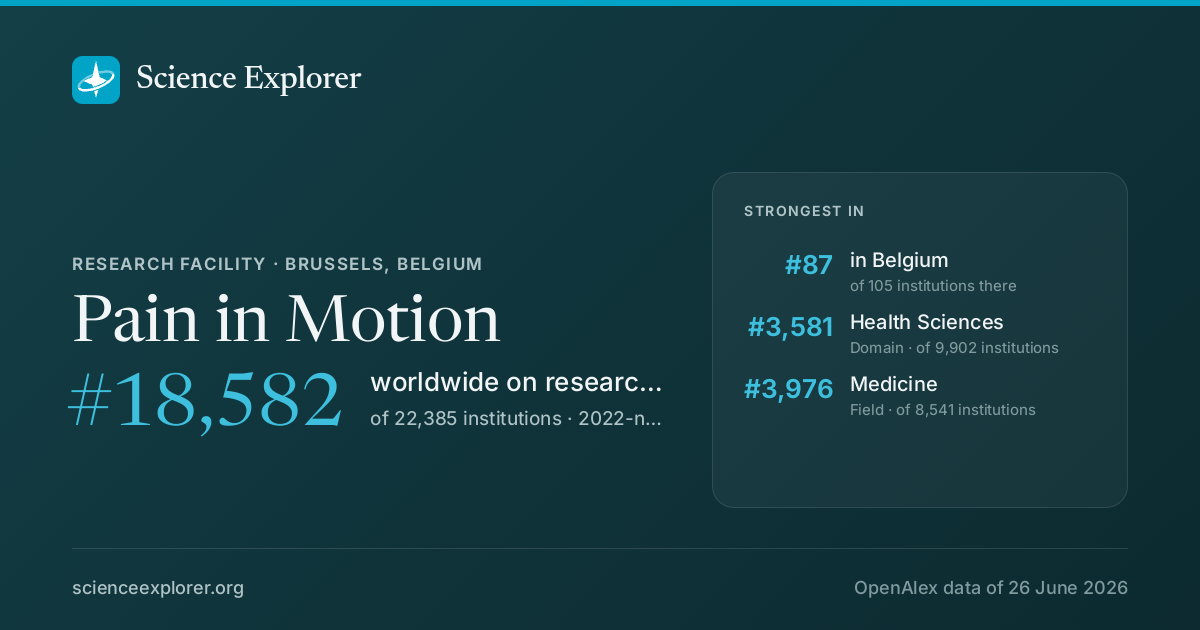
In research, Pain in Motion stands highest in Health Sciences (#3,581 of 9,902 worldwide) and Medicine (#3,976 of 8,541 worldwide), 2022-now.
- World rank, 2022-now
- #18,582 of 22,385 · #22,736 all time
- Rank in Belgium
- #87 of 105
- Research works
- 223 ▲ 43% vs 2018-21
- Citations
- 5.8k 25.9 per fractional work
- Top-10% rate
- 20.4% all institutions 10.0%
- vs its own fields
- 1.11× 1.00× is exactly expected
- Open access
- 61% world 40%
- International
- 57% world 18%
What is Pain in Motion known for in research?
The fields where it stands highest, 2022-now, ranked among every institution above the floor in each field.
| Field | World rank | Where that sits | Top-10% rate | Works | All time |
|---|---|---|---|---|---|
| Health SciencesDomain | #3,581 of 9,902 | 20.4% | 71 | #4305 | |
| MedicineField | #3,976 of 8,541 | 19.4% | 66 | #4783 |
Each strip is that field's whole ranked pool, with the notch where Pain in Motion sits in it, in the colour of the band that rank falls in. The track under the rate is the rate itself: it carries no average mark, because the average differs by field (from about 6% in Dentistry to 21% in Economics).
Which fields of science does Pain in Motion work in?
In 2022-now, 80% of research at Pain in Motion is in Health Sciences, 9% in Life Sciences. Its largest fields are Medicine (74%), Psychology (6%), Health Professions (6%). It does 3.2× the world's share of Health Sciences.
Each ring splits the one inside it: the four domains of science, their fields, their subfields. Size is fractional works in 2022-now. Every slice is a page; the interactive view zooms down to single topics and colours each by how much more of it this institution does than the world.
Its 4 domains and 17 fields, with their numbers
- Health Sciences8480.3%
- Medicine7773.9%
- Health Professions66.0%
- Veterinary00.2%
- Nursing00.1%
- Dentistry00.1%
- Life Sciences99.0%
- Social Sciences98.5%
- Physical Sciences22.3%
- Engineering21.9%
- Computer Science00.4%
Field profile
Location quotient across every field it publishes in: outside the ring is more than an institution of this size would be expected to publish, inside it is less.
Rings at 0.5×, 1× and 2×. Widest outward: Medicine, 3.8×. Every wedge is a field page.
All 17 fields, with their numbers
- Medicine3.84×77 works
- Neuroscience3.24×6 works
- Health Professions2.28×6 works
- Psychology2.03×6 works
- Veterinary1.17×0 works
- Biochemistry, Genetics and Molecular Biology0.69×4 works
- Economics, Econometrics and Finance0.36×1 works
- Nursing0.21×0 works
- Dentistry0.16×0 works
- Engineering0.13×2 works
- Arts and Humanities0.12×0 works
- Social Sciences0.08×1 works
- Computer Science0.05×0 works
- Immunology and Microbiology0.04×0 works
- Business, Management and Accounting0.04×0 works
- Agricultural and Biological Sciences0.01×0 works
- Decision Sciences0.01×0 works
- Medicine 3.8×
- Neuroscience 3.2×
- Health Professions 2.3×
- Psychology 2.0×
- Veterinary 1.2×
- Biochemistry, Genetics and Molecular Biology 0.7×
- Economics, Econometrics and Finance 0.4×
- Nursing 0.2×
- Dentistry 0.2×
- Engineering 0.1×
- Arts and Humanities 0.1×
- Social Sciences 0.1×
- Computer Science 0.1×
- Immunology and Microbiology 0.0×
- Business, Management and Accounting 0.0×
- Agricultural and Biological Sciences 0.0×
- Decision Sciences 0.0×
Who are the top researchers at Pain in Motion?
Ranked on the quality score, Andrea Polli, Laurence Leysen and Thomas Bilterys lead among researchers whose main affiliation is Pain in Motion.
- 1
Andrea Polli
 Belgium · #182,172 worldwide
3.4k citations · 95 works
- 2
Laurence Leysen
Belgium · #690,372 worldwide
2.4k citations · 51 works
- 3
Thomas Bilterys
Belgium · #704,747 worldwide
781 citations · 25 works
- 4
Ömer Elma
Belgium · #774,037 worldwide
833 citations · 31 works
- 5
Anneleen Malfliet
Belgium · #795,515 worldwide
4.5k citations · 134 works
- 6
Sevilay Tümkaya Yılmaz
Belgium · #920,113 worldwide
687 citations · 20 works
- 7
Iris Coppieters
Belgium · #936,249 worldwide
4.3k citations · 130 works
- 8
Ward Willaert
Belgium · #1,127,595 worldwide
952 citations · 24 works
- 9
Paul van Wilgen
Belgium · #1,913,657 worldwide
1.2k citations · 73 works
- 10
Nils Runge
Belgium · #1,980,767 worldwide
375 citations · 42 works
Which keywords describe research at Pain in Motion?
By fractional works in 2022-now, weighted toward what it does more of than the world: Epidemiology, Chronic Pain, Psychological Factors, Low Back Pain, Clinical Trials, Global Burden, Musculoskeletal Disorders and Disability.
- Pediatric Pain
- Lumbar Disc Degeneration
- Degenerative Disc Disease
- Psychological Interventions
- Spinal Fusion
- Anxiety
- Shoulder Function
- Postoperative Pain
- Rehabilitation
- Chronic Fatigue Syndrome
- Neurobiology
- Treatment
- Nociception
- Neuroinflammation
- Quality of Life
- Central Sensitization
- Measurement Properties
- Global Burden
- Low Back Pain
- Chronic Pain
- Epidemiology
- Psychological Factors
- Clinical Trials
- Disability
- Musculoskeletal Disorders
- Pain Management
- Neuropathic Pain
- Neuronal Plasticity
- Pain Modulation
- Diagnostic Criteria
- Pain Assessment Tools
- Fibromyalgia
- Depression
- Elderly Patients
- Adolescents
- Health-related Quality of Life
- Surgical Treatment
- Clinical Outcomes
- Intervertebral Disc
- Pain Measurement
Size is fractional works in 2022-now in the topics tagged with each word; colour is the word's share of this institution's work against its share of the world's. The 40 words are chosen for being large and distinctive. Each links to the topic it comes from most.
All 40 words, with their numbers
- Epidemiology29▲ 6.9×30 topics
- Chronic Pain24▲ 106×4 topics
- Psychological Factors20▲ 90×5 topics
- Low Back Pain16▲ 93×3 topics
- Clinical Trials16▲ 23×7 topics
- Global Burden14▲ 24×4 topics
- Disability13▲ 119×1 topic
- Measurement Properties13▲ 173×1 topic
- Musculoskeletal Disorders13▲ 127×2 topics
- Central Sensitization13▲ 194×2 topics
- Pain Management10▲ 42×8 topics
- Quality of Life10▲ 6.5×22 topics
- Neuropathic Pain10▲ 134×2 topics
- Neuroinflammation7▲ 24×3 topics
- Neuronal Plasticity7▲ 121×2 topics
- Nociception7▲ 145×1 topic
- Pain Modulation7▲ 191×1 topic
- Treatment7▲ 5.2×9 topics
- Diagnostic Criteria6▲ 26×4 topics
- Neurobiology6▲ 23×3 topics
- Pain Assessment Tools6▲ 96×2 topics
- Chronic Fatigue Syndrome6▲ 199×1 topic
- Fibromyalgia6▲ 199×1 topic
- Rehabilitation5▲ 12×8 topics
- Depression5▲ 5.2×14 topics
- Postoperative Pain4▲ 41×2 topics
- Elderly Patients4▲ 21×3 topics
- Shoulder Function4▲ 41×2 topics
- Adolescents4▲ 9.1×5 topics
- Anxiety4▲ 7.0×7 topics
- Health-related Quality of Life4▲ 14×3 topics
- Spinal Fusion3▲ 32×2 topics
- Surgical Treatment3▲ 16×4 topics
- Psychological Interventions3▲ 22×3 topics
- Clinical Outcomes3▲ 14×3 topics
- Degenerative Disc Disease3▲ 30×2 topics
- Intervertebral Disc3▲ 43×1 topic
- Lumbar Disc Degeneration3▲ 43×1 topic
- Pain Measurement3▲ 93×1 topic
- Pediatric Pain3▲ 93×1 topic
Which research topics does Pain in Motion publish most on?
By volume in 2022-now: Musculoskeletal pain and rehabilitation, Pain Mechanisms and Treatments, Fibromyalgia and Chronic Fatigue Syndrome Research and Pediatric Pain Management Techniques.
Area is fractional works; colour is the subfield each topic belongs to.
- 1 Musculoskeletal pain and rehabilitation Pharmacology 13 works
- 2 Pain Mechanisms and Treatments Physiology 7 works
- 3 Fibromyalgia and Chronic Fatigue Syndrome Research Psychiatry and Mental health 6 works
- 4 Pediatric Pain Management Techniques Pediatrics, Perinatology and Child Health 3 works
- 5 Spine and Intervertebral Disc Pathology Pathology and Forensic Medicine 3 works
- 6 Pain Management and Opioid Use Anesthesiology and Pain Medicine 3 works
- 7 Shoulder Injury and Treatment Surgery 3 works
- 8 Pain Management and Treatment Anesthesiology and Pain Medicine 3 works
- 9 Myofascial pain diagnosis and treatment Cell Biology 2 works
- 10 Sports injuries and prevention Orthopedics and Sports Medicine 2 works
How open and international is its research?
Against the world's own shares: the tick on each track. Both are shares of its output, so they sit on one scale and can be read against each other as well as against the world.
World: 40% of research is openly available.
World: 18% is written across borders.
How has Pain in Motion's research output changed?
Output in 2022-2025 was 43% higher than in 2018-2021.
The same series as a ribbon: one cell per year, darker for more. The line above answers how much; this answers when.
Its share of all research
Growing output can still be a shrinking share: all of science grows. This is Pain in Motion as a percentage of every work published that year, 0.00047% in 2024.
Fractional works of Pain in Motion over all fractional works that year. How the balance of science has shifted.
Other research institutions in Brussels
- Université Libre de Bruxelles
- Vrije Universiteit Brussel
- European Commission
- European Union of Medical Specialists
- European Union
- Institute of Natural Sciences
- IS practice
- European Corporate Governance Institute


Share Pain in Motion's ranking
Badges for a website1Each links back here and updates with every snapshot

Research measures only: rankings here say nothing about teaching, admissions or student experience. Comparable institutions and collaboration partners have tabs of their own, above.
Discussion
Ask a question or share a note about Pain in Motion. Posts are plain text and can be reported.