Petrobras (Brazil)
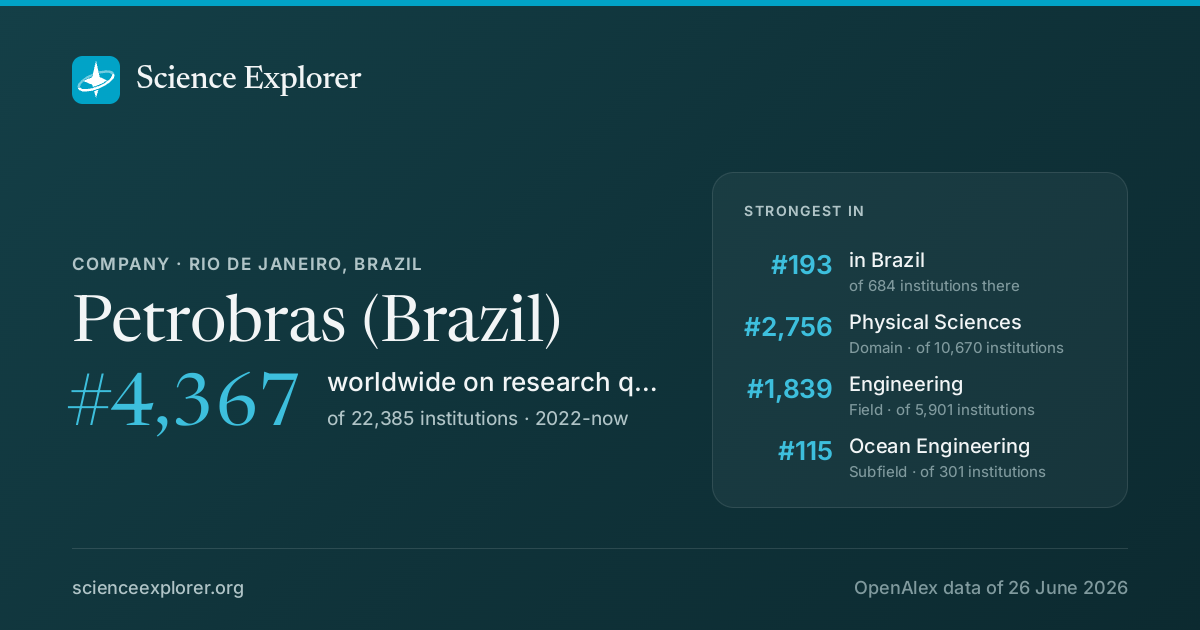
In research, Petrobras (Brazil) stands highest in Physical Sciences (#2,756 of 10,670 worldwide), Engineering (#1,839 of 5,901 worldwide) and Ocean Engineering (#115 of 301 worldwide), 2022-now. Relative to its size it is most specialised in Ocean Engineering, Geophysics and Earth-Surface Processes (Ocean Engineering is 48.2× its share of world research).
- World rank, 2022-now
- #4,367 of 22,385 · #3,540 all time
- Rank in Brazil
- #193 of 684
- Research works
- 7.7k ▲ 42% vs 2018-21
- Citations
- 80k 10.4 per fractional work
- Top-10% rate
- 4.0% all institutions 10.0%
- vs its own fields
- 0.83× 1.00× is exactly expected
- Open access
- 22% world 40%
- International
- 17% world 18%
What is Petrobras (Brazil) known for in research?
The fields where it stands highest, 2022-now, ranked among every institution above the floor in each field.
| Field | World rank | Where that sits | Top-10% rate | Works | All time |
|---|---|---|---|---|---|
| Physical SciencesDomain | #2,756 of 10,670 | 3.5% | 1,181 | #2514 | |
| EngineeringField | #1,839 of 5,901 | 2.8% | 685 | #1694 | |
| Ocean EngineeringSubfield | #115 of 301 | 3.3% | 325 | #169 | |
| Earth and Planetary SciencesField | #591 of 1,088 | 5.8% | 200 | #695 | |
| Environmental ScienceField | #2,171 of 3,334 | 3.3% | 81 | #3104 | |
| Mechanical EngineeringSubfield | #927 of 1,319 | 1.9% | 118 | #1049 | |
| Mechanics of MaterialsSubfield | #363 of 482 | 3.2% | 71 | #920 | |
| Computer ScienceField | #3,420 of 4,417 | 6.2% | 85 | #4052 | |
| GeophysicsSubfield | #188 of 225 | 2.1% | 109 | #545 | |
| Social SciencesDomain | #8,870 of 9,585 | 4.5% | 92 | #12150 |
Each strip is that field's whole ranked pool, with the notch where Petrobras (Brazil) sits in it, in the colour of the band that rank falls in. The track under the rate is the rate itself: it carries no average mark, because the average differs by field (from about 6% in Dentistry to 21% in Economics).
Which of those standings moved
The same fields on both windows: where it stood over the whole record, and where it stands in 2022-now. The distance is the story, and it is the one thing the two rank columns above cannot show.
- Physical Sciences#2,514 #2,756
- Engineering#1,694 #1,839
- Ocean Engineering#169 #115
- Earth and Planetary Sciences#695 #591
- Environmental Science#3,104 #2,171
- Mechanical Engineering#1,049 #927
- Mechanics of Materials#920 #363
- Computer Science#4,052 #3,420
- Geophysics#545 #188
- Social Sciences#12,150 #8,870
A dot further right is a better standing. Fields it was not ranked in over the whole record are left out.
Which fields of science does Petrobras (Brazil) work in?
In 2022-now, 90% of research at Petrobras (Brazil) is in Physical Sciences, 7% in Social Sciences. Its largest fields are Engineering (52%), Earth and Planetary Sciences (15%), Computer Science (7%). It does 2.3× the world's share of Physical Sciences.
Each ring splits the one inside it: the four domains of science, their fields, their subfields. Size is fractional works in 2022-now. Every slice is a page; the interactive view zooms down to single topics and colours each by how much more of it this institution does than the world.
Its 4 domains and 25 fields, with their numbers
- Physical Sciences1,32289.6%
- Engineering76752.0%
- Earth and Planetary Sciences22014.9%
- Computer Science966.5%
- Environmental Science966.5%
- Materials Science604.0%
- Chemistry412.8%
- Energy181.2%
- Physics and Astronomy130.9%
- Chemical Engineering80.5%
- Mathematics30.2%
- Social Sciences1026.9%
- Decision Sciences362.4%
- Social Sciences302.0%
- Business, Management and Accounting151.0%
- Economics, Econometrics and Finance100.7%
- Arts and Humanities70.5%
- Psychology50.3%
- Life Sciences271.8%
- Health Sciences241.6%
- Medicine120.8%
- Health Professions110.7%
- Dentistry10.1%
- Nursing00.0%
What does Petrobras (Brazil) specialise in?
Where its research is concentrated relative to its size: Ocean Engineering takes 48.2× the share of its output that it takes of world research.
- Ocean EngineeringSubfield · 369.6 works48×
- GeophysicsSubfield · 117.4 works23×
- Earth-Surface ProcessesSubfield · 32.4 works18×
- Earth and Planetary SciencesField · 220.1 works9.5×
- Analytical ChemistrySubfield · 26.4 works9.3×
- Statistics, Probability and UncertaintySubfield · 20.4 works8.2×
Location quotient, a volume reading rather than an impact one. It surfaces small, lopsided specialities.
Field profile
Location quotient across every field it publishes in: outside the ring is more than an institution of this size would be expected to publish, inside it is less.
Rings at 0.5×, 1× and 2×. Widest outward: Earth and Planetary Sciences, 9.5×. Every wedge is a field page.
All 25 fields, with their numbers
- Earth and Planetary Sciences9.51×220 works
- Engineering3.47×767 works
- Decision Sciences2.52×36 works
- Chemistry1.77×41 works
- Chemical Engineering1.55×8 works
- Energy1.35×18 works
- Environmental Science1.30×96 works
- Materials Science1.16×60 works
- Computer Science0.84×96 works
- Physics and Astronomy0.40×13 works
- Economics, Econometrics and Finance0.33×10 works
- Business, Management and Accounting0.32×15 works
- Health Professions0.28×11 works
- Mathematics0.19×3 works
- Agricultural and Biological Sciences0.17×12 works
- Biochemistry, Genetics and Molecular Biology0.17×14 works
- Arts and Humanities0.16×7 works
- Social Sciences0.16×30 works
- Psychology0.11×5 works
- Dentistry0.10×1 works
- Immunology and Microbiology0.04×1 works
- Medicine0.04×12 works
- Neuroscience0.03×1 works
- Nursing0.02×0 works
- Pharmacology, Toxicology and Pharmaceutics0.01×0 works
- Earth and Planetary Sciences 9.5×
- Engineering 3.5×
- Decision Sciences 2.5×
- Chemistry 1.8×
- Chemical Engineering 1.6×
- Energy 1.4×
- Environmental Science 1.3×
- Materials Science 1.2×
- Computer Science 0.8×
- Physics and Astronomy 0.4×
- Economics, Econometrics and Finance 0.3×
- Business, Management and Accounting 0.3×
- Health Professions 0.3×
- Mathematics 0.2×
- Agricultural and Biological Sciences 0.2×
- Biochemistry, Genetics and Molecular Biology 0.2×
- Arts and Humanities 0.2×
- Social Sciences 0.2×
- Psychology 0.1×
- Dentistry 0.1×
- Immunology and Microbiology 0.0×
- Medicine 0.0×
- Neuroscience 0.0×
- Nursing 0.0×
- Pharmacology, Toxicology and Pharmaceutics 0.0×
Who are the top researchers at Petrobras (Brazil)?
Ranked on the quality score, Leonardo Ribeiro Tedeschi, Eugênio V. Santos Neto and Rafael Menegassi de Almeida lead among researchers whose main affiliation is Petrobras (Brazil).
- 1
Leonardo Ribeiro Tedeschi
 Brazil · #459,221 worldwide
840 citations · 31 works
- 2
Eugênio V. Santos Neto
Brazil · #769,788 worldwide
1.7k citations · 39 works
- 3
Rafael Menegassi de Almeida
Brazil · #936,400 worldwide
748 citations · 21 works
- 4
Lincoln F. L. Moro
Brazil · #1,141,068 worldwide
1.1k citations · 23 works
- 5
Antônio Carlos Zanin
Brazil · #1,509,830 worldwide
714 citations · 27 works
- 6
E. J. Milani
Brazil · #1,546,821 worldwide
2.3k citations · 33 works
- 7
Adriano Roessler Viana
Brazil · #1,576,523 worldwide
3.4k citations · 113 works
- 8
Henrique S. Cerqueira
Brazil · #1,628,818 worldwide
2.4k citations · 57 works
- 9
Renato Oscar Kowsmann
Brazil · #1,782,309 worldwide
2.2k citations · 77 works
- 10
Alexandre Anozé Emerick
Brazil · #1,829,066 worldwide
3.4k citations · 93 works
Which keywords describe research at Petrobras (Brazil)?
By fractional works in 2022-now, weighted toward what it does more of than the world: Optimization, Data Assimilation, Uncertainty Quantification, Ensemble Kalman Filter, Closed-Loop Control, Well Placement, CO2 Sequestration and Machine Learning.
- Thermal Maturity
- Nanopores
- Gas Permeability
- Offshore Decommissioning
- Marine Pollution
- Electric Submersible Pumps
- Subsea
- Predictive Maintenance
- Fault Diagnosis
- Full-Waveform Tomography
- Shale Gas Reservoirs
- Inverse Problems
- Hydraulic Fracturing
- Well Integrity
- Rheological Properties
- CO2 Sequestration
- Nanoparticles
- Closed-Loop Control
- Uncertainty Quantification
- Optimization
- Machine Learning
- Data Assimilation
- Ensemble Kalman Filter
- Well Placement
- Renewable Energy
- Vibration Analysis
- Drilling Fluids
- Geophysical Imaging
- Environmental Impact
- Fracture Propagation
- Elastic Properties
- Seismic Waveform Inversion
- Technology
- Oil and Gas
- Artificial Lift Systems
- Economic Analysis
- Shale Gas
- Ship Recycling
- Pore Structure
- Mudstones
Size is fractional works in 2022-now in the topics tagged with each word; colour is the word's share of this institution's work against its share of the world's. The 40 words are chosen for being large and distinctive. Each links to the topic it comes from most.
All 40 words, with their numbers
- Machine Learning130▲ 2.6×42 topics
- Optimization116▲ 18×17 topics
- Data Assimilation110▲ 46×4 topics
- Uncertainty Quantification109▲ 94×2 topics
- Ensemble Kalman Filter108▲ 71×2 topics
- Closed-Loop Control107▲ 162×1 topic
- Well Placement107▲ 162×1 topic
- Nanoparticles85▲ 4.5×22 topics
- Renewable Energy84▲ 4.0×31 topics
- CO2 Sequestration82▲ 28×4 topics
- Vibration Analysis75▲ 19×6 topics
- Rheological Properties71▲ 27×5 topics
- Drilling Fluids70▲ 89×1 topic
- Well Integrity70▲ 89×1 topic
- Geophysical Imaging69▲ 88×2 topics
- Hydraulic Fracturing69▲ 44×2 topics
- Environmental Impact68▲ 2.7×31 topics
- Inverse Problems68▲ 41×3 topics
- Fracture Propagation66▲ 76×1 topic
- Shale Gas Reservoirs66▲ 76×1 topic
- Elastic Properties66▲ 57×2 topics
- Full-Waveform Tomography65▲ 107×1 topic
- Seismic Waveform Inversion65▲ 107×1 topic
- Fault Diagnosis56▲ 26×4 topics
- Technology54▲ 7.1×4 topics
- Predictive Maintenance53▲ 49×3 topics
- Oil and Gas52▲ 101×1 topic
- Subsea52▲ 377×1 topic
- Artificial Lift Systems52▲ 127×1 topic
- Electric Submersible Pumps52▲ 127×1 topic
- Economic Analysis49▲ 24×5 topics
- Marine Pollution48▲ 171×2 topics
- Shale Gas46▲ 26×2 topics
- Offshore Decommissioning45▲ 342×1 topic
- Ship Recycling45▲ 342×1 topic
- Gas Permeability45▲ 32×2 topics
- Pore Structure44▲ 24×3 topics
- Nanopores43▲ 31×2 topics
- Mudstones43▲ 40×1 topic
- Thermal Maturity43▲ 40×1 topic
Which research topics does Petrobras (Brazil) publish most on?
By volume in 2022-now: Reservoir Engineering and Simulation Methods, Drilling and Well Engineering, Hydraulic Fracturing and Reservoir Analysis and Seismic Imaging and Inversion Techniques.
Area is fractional works; colour is the subfield each topic belongs to.
- 1 Reservoir Engineering and Simulation Methods Ocean Engineering 107 works
- 2 Drilling and Well Engineering Ocean Engineering 70 works
- 3 Hydraulic Fracturing and Reservoir Analysis Mechanical Engineering 66 works
- 4 Seismic Imaging and Inversion Techniques Geophysics 65 works
- 5 Offshore Engineering and Technologies Ocean Engineering 52 works
- 6 Oil and Gas Production Techniques Ocean Engineering 52 works
- 7 Marine and Offshore Engineering Studies Ocean Engineering 45 works
- 8 Hydrocarbon exploration and reservoir analysis Mechanics of Materials 43 works
- 9 Geological formations and processes Earth-Surface Processes 28 works
- 10 Enhanced Oil Recovery Techniques Ocean Engineering 26 works
How open and international is its research?
Against the world's own shares: the tick on each track. Both are shares of its output, so they sit on one scale and can be read against each other as well as against the world.
World: 40% of research is openly available.
World: 18% is written across borders.
How has Petrobras (Brazil)'s research output changed?
Output in 2022-2025 was 42% higher than in 2018-2021.
The same series as a ribbon: one cell per year, darker for more. The line above answers how much; this answers when.
Its share of all research
Growing output can still be a shrinking share: all of science grows. This is Petrobras (Brazil) as a percentage of every work published that year, 0.0062% in 2024.
Fractional works of Petrobras (Brazil) over all fractional works that year. How the balance of science has shifted.
How much of it reaches the world top 10%
Year by year, against all institutions in the same year.
Of each year's output, the share that reached the world's 10% most cited for its field and year. Peak 11.6% in 1991.
Other research institutions in Rio de Janeiro
- Universidade Federal do Rio de Janeiro
- Universidade do Estado do Rio de Janeiro
- Fundação Oswaldo Cruz
- Pontifícia Universidade Católica do Rio de Janeiro
- Universidade Federal do Estado do Rio de Janeiro
- Fundação Getulio Vargas
- State University of Norte Fluminense
- Institute of Religious Studies



Share Petrobras (Brazil)'s ranking
Badges for a website1Each links back here and updates with every snapshot

Research measures only: rankings here say nothing about teaching, admissions or student experience. Comparable institutions and collaboration partners have tabs of their own, above.
Discussion
Ask a question or share a note about Petrobras (Brazil). Posts are plain text and can be reported.