Physical Optics Corporation
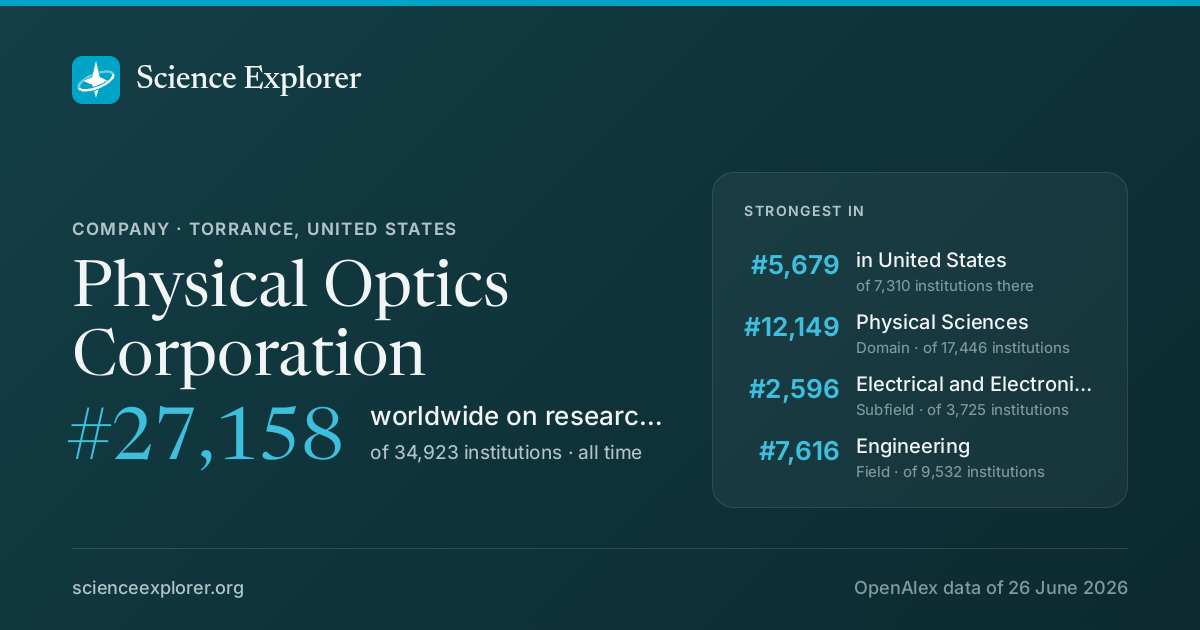
In research, Physical Optics Corporation stands highest in Physical Sciences (#12,149 of 17,446 worldwide), Electrical and Electronic Engineering (#2,596 of 3,725 worldwide) and Engineering (#7,616 of 9,532 worldwide), over all time.
- World rank, all time
- #27,158 of 34,923
- Rank in United States
- #5,679 of 7,310
- Research works
- 501 ▼ 80% vs 2018-21
- Citations
- 2.2k 4.3 per fractional work
- Top-10% rate
- 6.3% all institutions 10.0%
- vs its own fields
- 0.76× 1.00× is exactly expected
- Open access
- 5% world 40%
- International
- 2% world 18%
What is Physical Optics Corporation known for in research?
The fields where it stands highest, over all time, ranked among every institution above the floor in each field.
| Field | World rank | Where that sits | Top-10% rate | Works |
|---|---|---|---|---|
| Physical SciencesDomain | #12,149 of 17,446 | 2.0% | 460 | |
| Electrical and Electronic EngineeringSubfield | #2,596 of 3,725 | 2.8% | 173 | |
| EngineeringField | #7,616 of 9,532 | 2.5% | 277 |
Each strip is that field's whole ranked pool, with the notch where Physical Optics Corporation sits in it, in the colour of the band that rank falls in. The track under the rate is the rate itself: it carries no average mark, because the average differs by field (from about 6% in Dentistry to 21% in Economics).
Which fields of science does Physical Optics Corporation work in?
In all years, 92% of research at Physical Optics Corporation is in Physical Sciences, 4% in Health Sciences. Its largest fields are Engineering (55%), Physics and Astronomy (14%), Computer Science (13%). It does 2.2× the world's share of Physical Sciences.
Each ring splits the one inside it: the four domains of science, their fields, their subfields. Size is fractional works in all years. Every slice is a page; the interactive view zooms down to single topics and colours each by how much more of it this institution does than the world.
Its 4 domains and 23 fields, with their numbers
- Physical Sciences46091.8%
- Engineering27755.3%
- Physics and Astronomy7114.1%
- Computer Science6412.8%
- Materials Science214.1%
- Chemical Engineering102.0%
- Environmental Science61.2%
- Chemistry51.0%
- Earth and Planetary Sciences40.7%
- Mathematics20.5%
- Energy10.2%
- Health Sciences183.6%
- Medicine163.3%
- Dentistry10.2%
- Health Professions10.2%
- Veterinary00.0%
- Life Sciences132.7%
- Social Sciences101.9%
Field profile
Location quotient across every field it publishes in: outside the ring is more than an institution of this size would be expected to publish, inside it is less.
Rings at 0.5×, 1× and 2×. Widest outward: Mathematics, 15.8×. Every wedge is a field page.
All 10 fields, with their numbers
- Mathematics15.84×0 works
- Neuroscience5.61×0 works
- Physics and Astronomy5.03×0 works
- Psychology2.85×0 works
- Chemistry1.98×0 works
- Engineering1.53×1 works
- Computer Science1.06×0 works
- Social Sciences0.98×0 works
- Materials Science0.71×0 works
- Agricultural and Biological Sciences0.65×0 works
Who are the top researchers at Physical Optics Corporation?
Ranked on the quality score, Judy Chen, Yunlu Zou and Joanna L. Jannson lead among researchers whose main affiliation is Physical Optics Corporation.
- 1
Judy Chen
 United States · #1,251,399 worldwide
1.1k citations · 52 works
- 2
Yunlu Zou
United States · #4,386,895 worldwide
179 citations · 18 works
- 3
Joanna L. Jannson
United States · #4,759,563 worldwide
319 citations · 46 works
- 4
Guoda Xu
United States · #4,761,911 worldwide
84 citations · 26 works
- 5
Russell M. Kurtz
United States · #4,889,121 worldwide
218 citations · 36 works
- 6
Jeongdal Kim
United States · #5,200,477 worldwide
11 citations · 15 works
- 6
Sookwang Ro
United States · #5,200,477 worldwide
33 citations · 15 works
- 8
Aramais A. Avakian
United States · #5,284,819 worldwide
12 citations · 15 works
- 9
Ranjit D. Pradhan
United States · #5,304,990 worldwide
427 citations · 51 works
- 10
Hung Chou
United States · #5,331,938 worldwide
5 citations · 16 works
Which keywords describe research at Physical Optics Corporation?
By fractional works in all years, weighted toward what it does more of than the world: Optical Modulators, Biosensors, Raman Lasers, Integrated Circuits, Silicon Photonics, Microcavities, Nanophotonic Waveguides and Semiconductor Lasers.
- Digital Signal Processing
- Nanofabrication
- Potentiometric Sensors
- Field-Effect Transistors
- Sensor Technology
- Structural Health Monitoring
- Optical Sensors
- Imaging
- Spectroscopy
- Stereoscopic Displays
- Optical Fiber
- Photonics
- Virtual Reality
- Frequency Conversion
- Microresonators
- Vertical-Cavity Surface-Emitting Lasers (VCSELs)
- Semiconductor Lasers
- Microcavities
- Integrated Circuits
- Biosensors
- Optical Modulators
- Raman Lasers
- Silicon Photonics
- Nanophotonic Waveguides
- Optical Interconnects
- Nonlinear Optics
- Photonic Crystals
- Deep Learning
- Lithium Niobate
- Machine Learning
- Holographic Displays
- Microwave Photonics
- Fiber Lasers
- Optical Frequency Combs
- Ultrafast Lasers
- Fiber Optic Sensors
- Sparse Representation
- Ion-Selective Electrodes
- Image Processing
- Coherent Detection
Size is fractional works in all years in the topics tagged with each word; colour is the word's share of this institution's work against its share of the world's. The 40 words are chosen for being large and distinctive. Each links to the topic it comes from most.
All 40 words, with their numbers
- Optical Modulators82▲ 79×3 topics
- Biosensors73▲ 26×8 topics
- Raman Lasers65▲ 77×2 topics
- Integrated Circuits60▲ 52×3 topics
- Silicon Photonics60▲ 76×2 topics
- Microcavities59▲ 75×1 topic
- Nanophotonic Waveguides59▲ 84×1 topic
- Semiconductor Lasers45▲ 93×2 topics
- Optical Interconnects42▲ 105×1 topic
- Vertical-Cavity Surface-Emitting Lasers (VCSELs)42▲ 105×1 topic
- Nonlinear Optics36▲ 41×4 topics
- Microresonators34▲ 54×3 topics
- Photonic Crystals32▲ 41×4 topics
- Frequency Conversion31▲ 61×3 topics
- Deep Learning25▲ 2.4×29 topics
- Virtual Reality23▲ 13×6 topics
- Lithium Niobate22▲ 129×1 topic
- Photonics22▲ 86×1 topic
- Machine Learning21▲ 1.90×24 topics
- Optical Fiber19▲ 30×2 topics
- Holographic Displays18▲ 180×1 topic
- Stereoscopic Displays18▲ 180×1 topic
- Microwave Photonics17▲ 28×2 topics
- Spectroscopy16▲ 9.7×5 topics
- Fiber Lasers14▲ 19×3 topics
- Imaging13▲ 7.5×6 topics
- Optical Frequency Combs12▲ 30×1 topic
- Optical Sensors12▲ 16×2 topics
- Ultrafast Lasers12▲ 30×1 topic
- Structural Health Monitoring11▲ 21×2 topics
- Fiber Optic Sensors11▲ 36×1 topic
- Sensor Technology11▲ 36×1 topic
- Sparse Representation10▲ 11×6 topics
- Field-Effect Transistors10▲ 11×3 topics
- Ion-Selective Electrodes10▲ 20×1 topic
- Potentiometric Sensors10▲ 20×1 topic
- Image Processing10▲ 6.1×11 topics
- Nanofabrication9▲ 21×2 topics
- Coherent Detection9▲ 28×1 topic
- Digital Signal Processing9▲ 24×1 topic
Which research topics does Physical Optics Corporation publish most on?
By volume in 2022-now: Evaluation of Teaching Practices, History and Theory of Mathematics, Mathematics and Applications and Mentoring and Academic Development.
Area is fractional works; colour is the subfield each topic belongs to.
- 1 Evaluation of Teaching Practices Education 0 works
- 2 History and Theory of Mathematics Theoretical Computer Science 0 works
- 3 Mathematics and Applications Geometry and Topology 0 works
- 4 Mentoring and Academic Development Social Psychology 0 works
- 5 Earthquake and Disaster Impact Studies Transportation 0 works
- 6 Advanced Mathematical Theories Mathematical Physics 0 works
- 7 Space Exploration and Technology Aerospace Engineering 0 works
- 8 Planetary Science and Exploration Astronomy and Astrophysics 0 works
- 9 Photonic and Optical Devices Electrical and Electronic Engineering 0 works
- 10 Visual perception and processing mechanisms Cognitive Neuroscience 0 works
How open and international is its research?
Against the world's own shares: the tick on each track. Both are shares of its output, so they sit on one scale and can be read against each other as well as against the world.
World: 40% of research is openly available.
World: 18% is written across borders.
How has Physical Optics Corporation's research output changed?
Output in 2022-2025 was 80% lower than in 2018-2021.
The same series as a ribbon: one cell per year, darker for more. The line above answers how much; this answers when.
Its share of all research
Growing output can still be a shrinking share: all of science grows. This is Physical Optics Corporation as a percentage of every work published that year, 0.0000037% in 2023.
Fractional works of Physical Optics Corporation over all fractional works that year. How the balance of science has shifted.
How much of it reaches the world top 10%
Year by year, against all institutions in the same year.
Of each year's output, the share that reached the world's 10% most cited for its field and year. Peak 5.6% in 2002.
Other research institutions in Torrance
- Plasma Technology (United States)
- Torrance Memorial Medical Center
- Dynamic Research (United States)
- Toyota Motor North America (United States)
- MARK Resources (United States)
- El Camino College
- Intelligent Optical Systems (United States)
- NextGen Aeronautics (United States)
Share Physical Optics Corporation's ranking
Badges for a website1Each links back here and updates with every snapshot

Research measures only: rankings here say nothing about teaching, admissions or student experience. Comparable institutions and collaboration partners have tabs of their own, above.
Discussion
Ask a question or share a note about Physical Optics Corporation. Keep it to the research: no personal attacks, advertising or links. Any reader can report a post, which collapses it for everyone until it is opened.