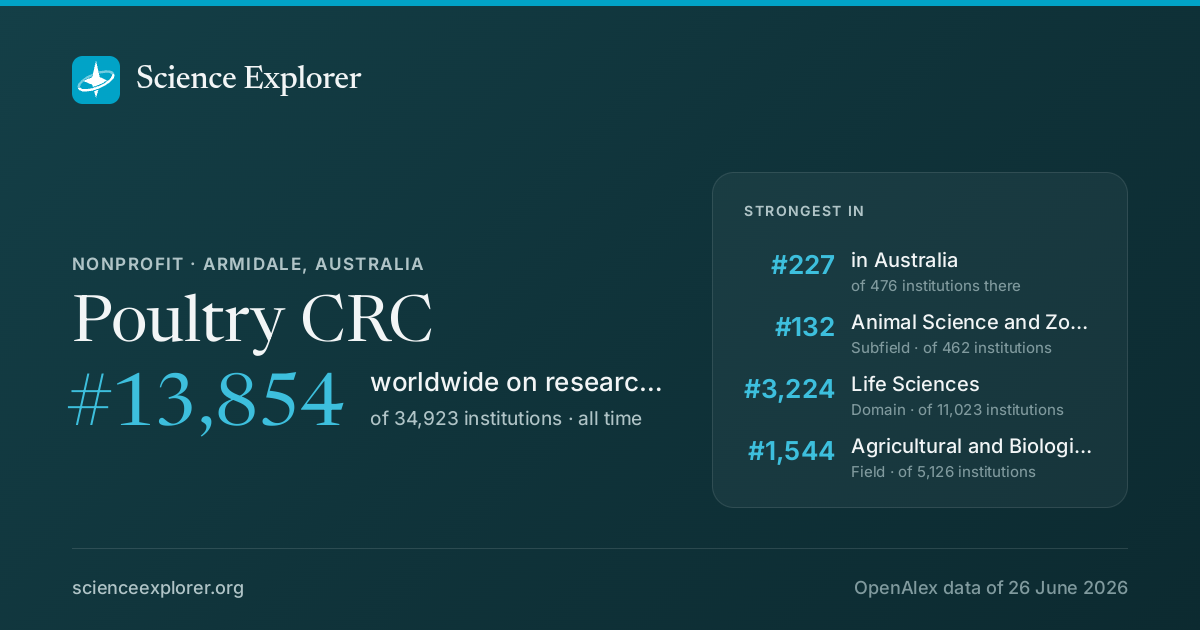
Poultry CRC
In research, Poultry CRC stands highest in Animal Science and Zoology (#132 of 462 worldwide), Life Sciences (#3,224 of 11,023 worldwide) and Agricultural and Biological Sciences (#1,544 of 5,126 worldwide), over all time. Relative to its size it is most specialised in Agricultural and Biological Sciences (Agricultural and Biological Sciences is 10.6× its share of world research).
- World rank, all time
- #13,854 of 34,923
- Rank in Australia
- #227 of 476
- Research works
- 657 ▼ 34% vs 2018-21
- Citations
- 19k 29.0 per fractional work
- Top-10% rate
- 17.0% all institutions 10.0%
- vs its own fields
- 0.96× 1.00× is exactly expected
- Open access
- 33% world 40%
- International
- 29% world 18%
What is Poultry CRC known for in research?
The fields where it stands highest, over all time, ranked among every institution above the floor in each field.
| Field | World rank | Where that sits | Top-10% rate | Works |
|---|---|---|---|---|
| Animal Science and ZoologySubfield | #132 of 462 | 21.0% | 157 | |
| Life SciencesDomain | #3,224 of 11,023 | 15.7% | 398 | |
| Agricultural and Biological SciencesField | #1,544 of 5,126 | 17.5% | 283 | |
| Health SciencesDomain | #12,234 of 16,688 | 12.0% | 121 |
Each strip is that field's whole ranked pool, with the notch where Poultry CRC sits in it, in the colour of the band that rank falls in. The track under the rate is the rate itself: it carries no average mark, because the average differs by field (from about 6% in Dentistry to 21% in Economics).
Which fields of science does Poultry CRC work in?
In 2022-now, 61% of research at Poultry CRC is in Life Sciences, 17% in Health Sciences. Its largest fields are Agricultural and Biological Sciences (51%), Medicine (11%), Biochemistry, Genetics and Molecular Biology (10%). It does 3.4× the world's share of Life Sciences.
Each ring splits the one inside it: the four domains of science, their fields, their subfields. Size is fractional works in 2022-now. Every slice is a page; the interactive view zooms down to single topics and colours each by how much more of it this institution does than the world.
Its 4 domains and 18 fields, with their numbers
- Life Sciences2761.4%
- Health Sciences817.3%
- Medicine510.6%
- Nursing12.9%
- Veterinary12.6%
- Health Professions11.2%
- Physical Sciences511.2%
- Environmental Science35.7%
- Engineering24.0%
- Computer Science01.1%
- Chemistry00.2%
- Materials Science00.2%
- Energy00.1%
- Social Sciences410.1%
- Social Sciences37.3%
- Economics, Econometrics and Finance11.6%
- Psychology00.6%
- Decision Sciences00.4%
- Arts and Humanities00.2%
What does Poultry CRC specialise in?
Where its research is concentrated relative to its size: Agricultural and Biological Sciences takes 10.6× the share of its output that it takes of world research.
- Agricultural and Biological SciencesField · 22.4 works11×
Location quotient, a volume reading rather than an impact one. It surfaces small, lopsided specialities.
Field profile
Location quotient across every field it publishes in: outside the ring is more than an institution of this size would be expected to publish, inside it is less.
Rings at 0.5×, 1× and 2×. Widest outward: Veterinary, 19.5×. Every wedge is a field page.
All 18 fields, with their numbers
- Veterinary19.49×1 works
- Agricultural and Biological Sciences10.64×22 works
- Nursing5.89×1 works
- Biochemistry, Genetics and Molecular Biology1.86×4 works
- Environmental Science1.15×2 works
- Immunology and Microbiology0.87×0 works
- Economics, Econometrics and Finance0.75×1 works
- Social Sciences0.58×3 works
- Medicine0.55×5 works
- Health Professions0.47×0 works
- Decision Sciences0.39×0 works
- Engineering0.26×2 works
- Psychology0.19×0 works
- Chemistry0.16×0 works
- Computer Science0.14×0 works
- Energy0.12×0 works
- Arts and Humanities0.07×0 works
- Materials Science0.04×0 works
- Veterinary 19.5×
- Agricultural and Biological Sciences 10.6×
- Nursing 5.9×
- Biochemistry, Genetics and Molecular Biology 1.9×
- Environmental Science 1.1×
- Immunology and Microbiology 0.9×
- Economics, Econometrics and Finance 0.8×
- Social Sciences 0.6×
- Medicine 0.6×
- Health Professions 0.5×
- Decision Sciences 0.4×
- Engineering 0.3×
- Psychology 0.2×
- Chemistry 0.2×
- Computer Science 0.1×
- Energy 0.1×
- Arts and Humanities 0.1×
- Materials Science 0.0×
Who are the top researchers at Poultry CRC?
Ranked on the quality score, TE Allen, Chen Guang Olnood and Yumin Bao lead among researchers whose main affiliation is Poultry CRC.
- 1
TE Allen
 Australia · #1,825,965 worldwide
410 citations · 17 works
- 2
Chen Guang Olnood
Australia · #2,366,197 worldwide
487 citations · 18 works
- 3
Yumin Bao
Australia · #2,640,234 worldwide
775 citations · 19 works
- 4
W. H. Southcott
Australia · #3,061,943 worldwide
1.1k citations · 64 works
- 5
Linus Nnabuike Malu
Australia · #3,362,682 worldwide
10 citations · 29 works
- 6
M. W. McDonald
Australia · #3,932,416 worldwide
588 citations · 41 works
- 7
Jane Lamb
Australia · #4,415,138 worldwide
319 citations · 54 works
- 8
P. F. May
Australia · #5,083,559 worldwide
107 citations · 18 works
- 9
A. K. Sheridan
Australia · #5,086,884 worldwide
617 citations · 25 works
- 10
Fred Skaller
Australia · #5,213,161 worldwide
60 citations · 22 works
Which keywords describe research at Poultry CRC?
By fractional works in 2022-now, weighted toward what it does more of than the world: Heat Stress, Amino Acids, Gut Microbiota, Probiotics, Intestinal Barrier, Antibiotic Alternatives, Poultry Production and Genetic Diversity.
- medicinal uses
- Protein Oxidation
- Moringa oleifera
- Antioxidants
- Antioxidant Properties
- Consumer Perception
- Genomic Selection
- Population Genetics
- Animal Welfare
- Bioactive Compounds
- Plant Breeding
- Quality
- Chicken Domestication
- Dietary Fiber
- Food Security
- Gender Equality
- Genetic Diversity
- Antibiotic Alternatives
- Intestinal Barrier
- Amino Acids
- Heat Stress
- Gut Microbiota
- Probiotics
- Poultry Production
- Nutrition
- Climate Change
- Ancient DNA
- Microbiota
- Village Poultry
- Rabbit Meat
- Marker-Assisted Selection
- Livestock Production
- Genome-Wide Association
- Animal Breeding
- Aquaculture
- Nutritional Quality
- Lipid Oxidation
- Meat Quality
- Phytochemicals
- Spoilage Microbiota
Size is fractional works in 2022-now in the topics tagged with each word; colour is the word's share of this institution's work against its share of the world's. The 40 words are chosen for being large and distinctive. Each links to the topic it comes from most.
All 40 words, with their numbers
- Heat Stress8▲ 211×2 topics
- Amino Acids7▲ 175×2 topics
- Gut Microbiota7▲ 46×2 topics
- Intestinal Barrier7▲ 200×2 topics
- Probiotics7▲ 66×2 topics
- Antibiotic Alternatives7▲ 287×1 topic
- Poultry Production7▲ 287×1 topic
- Genetic Diversity5▲ 24×5 topics
- Nutrition4▲ 20×4 topics
- Gender Equality4▲ 28×2 topics
- Climate Change3▲ 2.9×21 topics
- Food Security3▲ 14×5 topics
- Ancient DNA3▲ 124×2 topics
- Dietary Fiber3▲ 61×2 topics
- Microbiota3▲ 30×5 topics
- Chicken Domestication3▲ 415×1 topic
- Village Poultry3▲ 415×1 topic
- Quality2▲ 130×1 topic
- Rabbit Meat2▲ 330×1 topic
- Plant Breeding2▲ 49×3 topics
- Marker-Assisted Selection2▲ 57×2 topics
- Bioactive Compounds2▲ 16×3 topics
- Livestock Production2▲ 43×3 topics
- Animal Welfare2▲ 44×3 topics
- Genome-Wide Association2▲ 48×2 topics
- Population Genetics2▲ 27×3 topics
- Animal Breeding1▲ 73×1 topic
- Genomic Selection1▲ 73×1 topic
- Aquaculture1▲ 11×3 topics
- Consumer Perception1▲ 12×2 topics
- Nutritional Quality1▲ 40×3 topics
- Antioxidant Properties1▲ 19×2 topics
- Lipid Oxidation1▲ 27×2 topics
- Antioxidants1▲ 5.8×2 topics
- Meat Quality1▲ 35×2 topics
- Moringa oleifera1▲ 93×1 topic
- Phytochemicals1▲ 23×2 topics
- Protein Oxidation1▲ 43×1 topic
- Spoilage Microbiota1▲ 43×1 topic
- medicinal uses1▲ 87×1 topic
Which research topics does Poultry CRC publish most on?
By volume in 2022-now: Animal Nutrition and Physiology, Livestock and Poultry Management, Rabbits: Nutrition, Reproduction, Health and Genetic and phenotypic traits in livestock.
Area is fractional works; colour is the subfield each topic belongs to.
- 1 Animal Nutrition and Physiology Animal Science and Zoology 7 works
- 2 Livestock and Poultry Management Animal Science and Zoology 3 works
- 3 Rabbits: Nutrition, Reproduction, Health Animal Science and Zoology 2 works
- 4 Genetic and phenotypic traits in livestock Genetics 1 works
- 5 Moringa oleifera research and applications Plant Science 1 works
- 6 Meat and Animal Product Quality Animal Science and Zoology 1 works
- 7 Animal Behavior and Welfare Studies Small Animals 1 works
- 8 Agriculture Sustainability and Environmental Impact Ecology 1 works
- 9 Aquaculture Nutrition and Growth Aquatic Science 1 works
- 10 Microfinance and Financial Inclusion Economics and Econometrics 1 works
How open and international is its research?
Against the world's own shares: the tick on each track. Both are shares of its output, so they sit on one scale and can be read against each other as well as against the world.
World: 40% of research is openly available.
World: 18% is written across borders.
How has Poultry CRC's research output changed?
Output in 2022-2025 was 34% lower than in 2018-2021.
The same series as a ribbon: one cell per year, darker for more. The line above answers how much; this answers when.
Its share of all research
Growing output can still be a shrinking share: all of science grows. This is Poultry CRC as a percentage of every work published that year, 0.00018% in 2024.
Fractional works of Poultry CRC over all fractional works that year. How the balance of science has shifted.
Other research institutions in Armidale
Share Poultry CRC's ranking
Badges for a website1Each links back here and updates with every snapshot

Research measures only: rankings here say nothing about teaching, admissions or student experience. Comparable institutions and collaboration partners have tabs of their own, above.
Discussion
Ask a question or share a note about Poultry CRC. Posts are plain text and can be reported.