Science Explorer Back to mapMap
Archive · Prague · Czechia

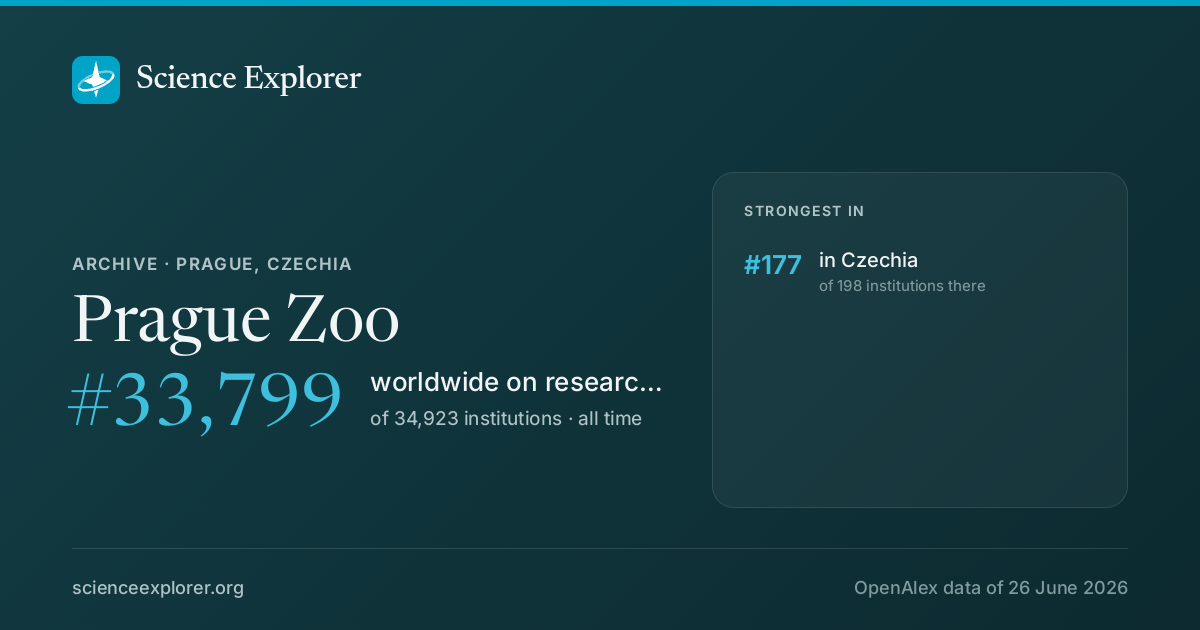
Prague Zoo

World rank, all time
#33,799
of 34,923
Rank in Czechia
#177
of 198
Research works
147
▲ 5% vs 2018-21
Citations
1.1k
7.8 per fractional work
Top-10% rate
11.2%
all institutions 10.0%
vs its own fields
0.85×
1.00× is exactly expected
Open access
50%
world 40%
International
25%
world 18%

Which fields of science does Prague Zoo work in?

In 2022-now, 43% of research at Prague Zoo is in Life Sciences, 23% in Physical Sciences. Its largest fields are Agricultural and Biological Sciences (26%), Medicine (19%), Environmental Science (16%). It does 2.2× the world's share of Life Sciences.

Life Sciences: 12 fractional works · 42.9% of its workAgricultural and Biological Sciences: 7 fractional works · 25.5% of its workInsect Science: 2 fractional works · 7.7% of its workPlant Science: 2 fractional works · 7.5% of its workAgronomy and Crop Science: 1 fractional works · 2.8% of its workEcology, Evolution, Behavior and Systematics: 1 fractional works · 2.4% of its workGeneral Agricultural and Biological Sciences: 1 fractional works · 2.4% of its workAnimal Science and Zoology: 0 fractional works · 1.8% of its workFood Science: 0 fractional works · 0.8% of its workSmaller subfields together: 0 fractional works · 0.2% of its workBiochemistry, Genetics and Molecular Biology: 3 fractional works · 10.4% of its workGenetics: 2 fractional works · 7.6% of its workMolecular Biology: 1 fractional works · 2.1% of its workAging: 0 fractional works · 0.5% of its workSmaller subfields together: 0 fractional works · 0.2% of its workImmunology and Microbiology: 2 fractional works · 6.6% of its workParasitology: 1 fractional works · 2.6% of its workMicrobiology: 1 fractional works · 2.2% of its workImmunology: 0 fractional works · 1.7% of its workSmaller subfields together: 0 fractional works · 0.1% of its workNeuroscience: 0 fractional works · 0.4% of its workCellular and Molecular Neuroscience: 0 fractional works · 0.4% of its workPhysical Sciences: 7 fractional works · 23.4% of its workEnvironmental Science: 4 fractional works · 15.6% of its workEcology: 3 fractional works · 10.0% of its workEcological Modeling: 1 fractional works · 2.0% of its workManagement, Monitoring, Policy and Law: 0 fractional works · 1.7% of its workGlobal and Planetary Change: 0 fractional works · 1.3% of its workPollution: 0 fractional works · 0.4% of its workSmaller subfields together: 0 fractional works · 0.1% of its workEarth and Planetary Sciences: 1 fractional works · 3.5% of its workOceanography: 0 fractional works · 1.8% of its workPaleontology: 0 fractional works · 1.2% of its workGeophysics: 0 fractional works · 0.6% of its workComputer Science: 0 fractional works · 1.8% of its workArtificial Intelligence: 0 fractional works · 1.8% of its workEngineering: 0 fractional works · 1.3% of its workBiomedical Engineering: 0 fractional works · 1.2% of its workSmaller subfields together: 0 fractional works · 0.1% of its workMathematics: 0 fractional works · 1.2% of its workTheoretical Computer Science: 0 fractional works · 1.2% of its workHealth Sciences: 6 fractional works · 21.9% of its workMedicine: 5 fractional works · 18.9% of its workEpidemiology: 2 fractional works · 6.9% of its workPublic Health, Environmental and Occupational Health: 1 fractional works · 3.8% of its workInfectious Diseases: 1 fractional works · 2.3% of its workDermatology: 0 fractional works · 1.2% of its workSurgery: 0 fractional works · 1.2% of its workOncology: 0 fractional works · 0.8% of its workPhysiology: 0 fractional works · 0.8% of its workHematology: 0 fractional works · 0.6% of its workObstetrics and Gynecology: 0 fractional works · 0.4% of its workPathology and Forensic Medicine: 0 fractional works · 0.4% of its workPulmonary and Respiratory Medicine: 0 fractional works · 0.4% of its workSmaller subfields together: 0 fractional works · 0.2% of its workVeterinary: 1 fractional works · 2.4% of its workSmall Animals: 1 fractional works · 2.0% of its workEquine: 0 fractional works · 0.4% of its workNursing: 0 fractional works · 0.6% of its workNutrition and Dietetics: 0 fractional works · 0.6% of its workSocial Sciences: 3 fractional works · 11.8% of its workArts and Humanities: 2 fractional works · 6.4% of its workArcheology: 1 fractional works · 3.5% of its workPhilosophy: 0 fractional works · 1.6% of its workHistory: 0 fractional works · 1.3% of its workSocial Sciences: 1 fractional works · 3.6% of its workSociology and Political Science: 0 fractional works · 1.2% of its workAnthropology: 0 fractional works · 1.0% of its workPolitical Science and International Relations: 0 fractional works · 0.5% of its workEducation: 0 fractional works · 0.2% of its workGeneral Social Sciences: 0 fractional works · 0.2% of its workSafety Research: 0 fractional works · 0.2% of its workSmaller subfields together: 0 fractional works · 0.1% of its workPsychology: 0 fractional works · 1.4% of its workSocial Psychology: 0 fractional works · 1.0% of its workExperimental and Cognitive Psychology: 0 fractional works · 0.4% of its workEconomics, Econometrics and Finance: 0 fractional works · 0.4% of its workEconomics and Econometrics: 0 fractional works · 0.4% of its workALL ITS WORKPrague Zoo28fractional works, 2022-now
Life Sciences43%Physical Sciences23%Health Sciences22%Social Sciences12%

Each ring splits the one inside it: the four domains of science, their fields, their subfields. Size is fractional works in 2022-now. Every slice is a page; the interactive view zooms down to single topics and colours each by how much more of it this institution does than the world.

Its 4 domains and 16 fields, with their numbers
    1. Agricultural and Biological Sciences725.5%
    2. Biochemistry, Genetics and Molecular Biology310.4%
    3. Immunology and Microbiology26.6%
    4. Neuroscience00.4%
    1. Environmental Science415.6%
    2. Earth and Planetary Sciences13.5%
    3. Computer Science01.8%
    4. Engineering01.3%
    5. Mathematics01.2%
    1. Medicine518.9%
    2. Veterinary12.4%
    3. Nursing00.6%
    1. Arts and Humanities26.4%
    2. Social Sciences13.6%
    3. Psychology01.4%
    4. Economics, Econometrics and Finance00.4%
All of science, and how each field's share has moved since 1950: the Science domain explorer

Field profile

Location quotient across every field it publishes in: outside the ring is more than an institution of this size would be expected to publish, inside it is less.

Agricultural and Biological Sciences: 5.36× its world share, 7 worksAgricultural and Bio…Biochemistry, Genetics and Molecular Biology: 1.95× its world share, 3 worksBiochemistry, Geneti…Immunology and Microbiology: 6.55× its world share, 2 worksImmunology and Micro…Neuroscience: 0.24× its world share, 0 worksNeuroscienceComputer Science: 0.23× its world share, 0 worksComputer ScienceEarth and Planetary Sciences: 2.25× its world share, 1 worksEarth and Planetary …Engineering: 0.09× its world share, 0 worksEngineeringEnvironmental Science: 3.14× its world share, 4 worksEnvironmental ScienceMathematics: 1.00× its world share, 0 worksMathematicsMedicine: 0.98× its world share, 5 worksMedicineNursing: 1.20× its world share, 0 worksNursingVeterinary: 17.76× its world share, 1 worksVeterinaryArts and Humanities: 2.22× its world share, 2 worksArts and HumanitiesEconomics, Econometrics and Finance: 0.18× its world share, 0 worksEconomics, Econometr…Psychology: 0.46× its world share, 0 worksPsychologySocial Sciences: 0.28× its world share, 1 worksSocial Sciences1×world share
more than its size predictsabout as predictedless

Rings at 0.5×, 1× and 2×. Widest outward: Veterinary, 17.8×. Every wedge is a field page.

All 16 fields, with their numbers
  1. Veterinary17.76×1 works
  2. Immunology and Microbiology6.55×2 works
  3. Agricultural and Biological Sciences5.36×7 works
  4. Environmental Science3.14×4 works
  5. Earth and Planetary Sciences2.25×1 works
  6. Arts and Humanities2.22×2 works
  7. Biochemistry, Genetics and Molecular Biology1.95×3 works
  8. Nursing1.20×0 works
  9. Mathematics1.00×0 works
  10. Medicine0.98×5 works
  11. Psychology0.46×0 works
  12. Social Sciences0.28×1 works
  13. Neuroscience0.24×0 works
  14. Computer Science0.23×0 works
  15. Economics, Econometrics and Finance0.18×0 works
  16. Engineering0.09×0 works

Who are the top researchers at Prague Zoo?

Ranked on the quality score, Roman Vodička, David Fischer and Ivan Rehák lead among researchers whose main affiliation is Prague Zoo.

  1. 1 Roman Vodička Czechia · #1,472,632 worldwide 637 citations · 50 works
  2. 2 David Fischer Czechia · #2,864,815 worldwide 7 citations · 54 works
  3. 3 Ivan Rehák Czechia · #3,013,473 worldwide 497 citations · 25 works
  4. 4 Petr Velenský Czechia · #3,306,267 worldwide 642 citations · 31 works
  5. 5 Josef Janeček Czechia · #4,642,797 worldwide 81 citations · 22 works
  6. 6 Evžen Korec Czechia · #5,483,888 worldwide 146 citations · 33 works
  7. 7 LUDEK J. DOBRORUKA Czechia · #5,633,489 worldwide 61 citations · 35 works
All ranked researchers at Prague Zoo

What are the most cited papers from Prague Zoo?

The most cited paper from Prague Zoo is "Measurement of fecal steroids in the black rhinoceros (Diceros bicornis) using group-specific enzyme immunoassays for 20-oxo-pregnanes" (Franz Schwarzenberger, Kristina Tomášová, Dana Holečková et al., 1996), with 120 citations. Next come "The evolution of brain neuron numbers in amniotes" (115) and "Genome of the Komodo dragon reveals adaptations in the cardiovascular and chemosensory systems of monitor lizards" (98).

Most cited papers
#PaperReleasedCitations
1 Measurement of fecal steroids in the black rhinoceros (Diceros bicornis) using group-specific enzyme immunoassays for 20-oxo-pregnanes Franz Schwarzenberger, Kristina Tomášová, Dana Holečková et al. · Zoo Biology 1996 120
2 The evolution of brain neuron numbers in amniotes Kristina Kverková, Lucie Marhounová, Alexandra Polonyiová et al. · Proceedings of the National Academy of Sciences Open access 7 Mar 2022 115
3 Genome of the Komodo dragon reveals adaptations in the cardiovascular and chemosensory systems of monitor lizards Abigail Lind et al. · Nature Ecology & Evolution Open access 29 Jul 2019 98
4 Thyroid Hormone Induced Changes in the Enzyme Activity Pattern of Energy‐Supplying Metabolism of Fast (Whit) Slow (Red), and Heart Muscle of the Rat Václav Kubišta, Jarmila Kubištová, Dirk Pette · European Journal of Biochemistry Open access Feb 1971 92
5 Modeling population viability of local proboscis monkey Nasalis larvatus populations: conservation implications DJ Stark, Vincent Nijman, Stanislav Lhota et al. · Endangered Species Research Open access 4 Oct 2011 91
All 60 most cited papers, with filters and sorting

Which keywords describe research at Prague Zoo?

By fractional works in 2022-now, weighted toward what it does more of than the world: Biodiversity, Invasive Species, Epidemiology, Genetic Diversity, Population Dynamics, Infection, Vaccine and Immune Response.

▲ more of its work than of the world's◆ about the world's share▼ less than the world's

Size is fractional works in 2022-now in the topics tagged with each word; colour is the word's share of this institution's work against its share of the world's. The 16 words are chosen for being large and distinctive. Each links to the topic it comes from most.

All 16 words, with their numbers
  1. Epidemiology4▲ 3.3×20 topics
  2. Biodiversity4▲ 16×9 topics
  3. Invasive Species3▲ 26×8 topics
  4. Genetic Diversity2▲ 18×9 topics
  5. Climate Change2▲ 2.6×11 topics
  6. Infection2▲ 29×4 topics
  7. Population Dynamics2▲ 28×6 topics
  8. Vaccine2▲ 15×5 topics
  9. Immune Response2▲ 10×6 topics
  10. Ecosystem Engineering1▲ 165×2 topics
  11. Agricultural Sustainability1▲ 42×2 topics
  12. Pathogenesis1▲ 8.6×7 topics
  13. Diagnosis1▲ 4.3×9 topics
  14. Vaccine Development1▲ 15×4 topics
  15. Biological Control1▲ 24×3 topics
  16. Conservation Biology1▲ 33×4 topics

Which research topics does Prague Zoo publish most on?

By volume in 2022-now: Wildlife Ecology and Conservation, Mollusks and Parasites Studies, Ecology and biodiversity studies and Herpesvirus Infections and Treatments.

  1. 1 Wildlife Ecology and Conservation Ecology 1 works
  2. 2 Mollusks and Parasites Studies Insect Science 1 works
  3. 3 Ecology and biodiversity studies Ecology 1 works
  4. 4 Herpesvirus Infections and Treatments Epidemiology 1 works
  5. 5 Agricultural pest management studies Plant Science 1 works
  6. 6 Insect Pest Control Strategies Plant Science 1 works
  7. 7 Historical and Architectural Studies Archeology 1 works
  8. 8 Insect-Plant Interactions and Control Insect Science 1 works
  9. 9 Agricultural Research and Practices General Agricultural and Biological Sciences 1 works
  10. 10 Cytomegalovirus and herpesvirus research Epidemiology 1 works

How open and international is its research?

Against the world's own shares: the tick on each track. Both are shares of its output, so they sit on one scale and can be read against each other as well as against the world.

openly available50.4%not open49.6%

World: 40% of research is openly available.

with international co-authors25.4%domestic only74.6%

World: 18% is written across borders.

How has Prague Zoo's research output changed?

Output in 2022-2025 was 5% higher than in 2018-2021.

still counting1990200020102020
grewheldshrank

The same series as a ribbon: one cell per year, darker for more. The line above answers how much; this answers when.

Its share of all research

Growing output can still be a shrinking share: all of science grows. This is Prague Zoo as a percentage of every work published that year, 0.000074% in 2024.

still counting0.0010%0.0020%Prague Zoo0.00010% in 202519801990200020102020

Fractional works of Prague Zoo over all fractional works that year. How the balance of science has shifted.

Other research institutions in Prague

All research institutions in Prague

Share Prague Zoo's ranking

Prague Zoo on Science Explorer

A card with Prague Zoo's standing and the fields it leads in, for a post or a slide. A link to this page previews as the same card.

Download the card

1200 × 630 PNG, sized for social posts, drawn from the latest snapshot.

Badges for a website1Each links back here and updates with every snapshot

Research measures only: rankings here say nothing about teaching, admissions or student experience. Comparable institutions and collaboration partners have tabs of their own, above.

Discussion

Ask a question or share a note about Prague Zoo. Keep it to the research: no personal attacks, advertising or links. Any reader can report a post, which collapses it for everyone until it is opened.