Science Explorer Back to mapMap
Discussion
Company · Sharon · United States

Prometheus (United States)

World rank, all time
#30,511
of 34,923
Rank in United States
#6,442
of 7,310
Research works
129
▲ 122% vs 2018-21
Citations
889
6.9 per fractional work
Top-10% rate
10.2%
all institutions 10.0%
vs its own fields
0.88×
1.00× is exactly expected
Open access
36%
world 40%
International
27%
world 18%

Which fields of science does Prometheus (United States) work in?

In 2022-now, 37% of research at Prometheus (United States) is in Physical Sciences, 32% in Social Sciences. Its largest fields are Medicine (21%), Economics, Econometrics and Finance (16%), Engineering (13%).

Physical Sciences: 15 fractional works · 37.5% of its workEngineering: 5 fractional works · 13.1% of its workElectrical and Electronic Engineering: 3 fractional works · 7.9% of its workBiomedical Engineering: 1 fractional works · 1.9% of its workAerospace Engineering: 1 fractional works · 1.3% of its workOcean Engineering: 0 fractional works · 0.9% of its workComputational Mechanics: 0 fractional works · 0.6% of its workMedia Technology: 0 fractional works · 0.2% of its workSmaller subfields together: 0 fractional works · 0.2% of its workComputer Science: 4 fractional works · 11.4% of its workComputer Networks and Communications: 1 fractional works · 3.2% of its workComputer Vision and Pattern Recognition: 1 fractional works · 3.0% of its workArtificial Intelligence: 1 fractional works · 2.4% of its workSoftware: 0 fractional works · 0.8% of its workInformation Systems: 0 fractional works · 0.6% of its workSignal Processing: 0 fractional works · 0.6% of its workComputer Graphics and Computer-Aided Design: 0 fractional works · 0.4% of its workHuman-Computer Interaction: 0 fractional works · 0.2% of its workMaterials Science: 1 fractional works · 3.3% of its workMaterials Chemistry: 1 fractional works · 2.1% of its workSurfaces, Coatings and Films: 0 fractional works · 0.8% of its workElectronic, Optical and Magnetic Materials: 0 fractional works · 0.3% of its workSmaller subfields together: 0 fractional works · 0.2% of its workEnergy: 1 fractional works · 2.6% of its workRenewable Energy, Sustainability and the Environment: 1 fractional works · 2.6% of its workChemistry: 1 fractional works · 2.1% of its workElectrochemistry: 0 fractional works · 0.7% of its workOrganic Chemistry: 0 fractional works · 0.7% of its workSpectroscopy: 0 fractional works · 0.4% of its workInorganic Chemistry: 0 fractional works · 0.3% of its workEarth and Planetary Sciences: 1 fractional works · 2.1% of its workAtmospheric Science: 0 fractional works · 0.9% of its workPaleontology: 0 fractional works · 0.8% of its workGeology: 0 fractional works · 0.3% of its workSmaller subfields together: 0 fractional works · 0.0% of its workEnvironmental Science: 0 fractional works · 1.1% of its workEnvironmental Engineering: 0 fractional works · 0.9% of its workSmaller subfields together: 0 fractional works · 0.2% of its workMathematics: 0 fractional works · 0.8% of its workStatistics and Probability: 0 fractional works · 0.8% of its workPhysics and Astronomy: 0 fractional works · 0.7% of its workRadiation: 0 fractional works · 0.4% of its workAcoustics and Ultrasonics: 0 fractional works · 0.3% of its workChemical Engineering: 0 fractional works · 0.2% of its workFluid Flow and Transfer Processes: 0 fractional works · 0.2% of its workSocial Sciences: 12 fractional works · 32.0% of its workEconomics, Econometrics and Finance: 6 fractional works · 15.8% of its workEconomics and Econometrics: 6 fractional works · 15.5% of its workFinance: 0 fractional works · 0.3% of its workArts and Humanities: 5 fractional works · 11.7% of its workHistory and Philosophy of Science: 4 fractional works · 9.9% of its workHistory: 1 fractional works · 1.4% of its workArcheology: 0 fractional works · 0.4% of its workSocial Sciences: 1 fractional works · 2.4% of its workAnthropology: 1 fractional works · 1.7% of its workSociology and Political Science: 0 fractional works · 0.5% of its workSmaller subfields together: 0 fractional works · 0.2% of its workBusiness, Management and Accounting: 0 fractional works · 1.0% of its workStrategy and Management: 0 fractional works · 0.6% of its workManagement Information Systems: 0 fractional works · 0.5% of its workDecision Sciences: 0 fractional works · 0.8% of its workManagement Science and Operations Research: 0 fractional works · 0.8% of its workPsychology: 0 fractional works · 0.1% of its workHealth Sciences: 8 fractional works · 21.2% of its workMedicine: 8 fractional works · 20.9% of its workRadiology, Nuclear Medicine and Imaging: 2 fractional works · 4.5% of its workPublic Health, Environmental and Occupational Health: 2 fractional works · 4.0% of its workEpidemiology: 1 fractional works · 2.5% of its workSurgery: 1 fractional works · 1.5% of its workPediatrics, Perinatology and Child Health: 1 fractional works · 1.4% of its workOncology: 0 fractional works · 1.2% of its workRheumatology: 0 fractional works · 1.0% of its workImmunology and Allergy: 0 fractional works · 0.9% of its workDermatology: 0 fractional works · 0.8% of its workNeurology: 0 fractional works · 0.5% of its workPharmacology: 0 fractional works · 0.4% of its workPhysiology: 0 fractional works · 0.4% of its workEmergency Medicine: 0 fractional works · 0.3% of its workPulmonary and Respiratory Medicine: 0 fractional works · 0.3% of its workInfectious Diseases: 0 fractional works · 0.3% of its workComplementary and alternative medicine: 0 fractional works · 0.2% of its workPsychiatry and Mental health: 0 fractional works · 0.2% of its workSmaller subfields together: 0 fractional works · 0.4% of its workHealth Professions: 0 fractional works · 0.3% of its workLife Sciences: 4 fractional works · 9.4% of its workImmunology and Microbiology: 2 fractional works · 5.1% of its workImmunology: 2 fractional works · 5.1% of its workBiochemistry, Genetics and Molecular Biology: 1 fractional works · 3.8% of its workGenetics: 1 fractional works · 2.9% of its workMolecular Biology: 0 fractional works · 1.0% of its workAgricultural and Biological Sciences: 0 fractional works · 0.3% of its workPlant Science: 0 fractional works · 0.3% of its workNeuroscience: 0 fractional works · 0.2% of its workALL ITS WORKPrometheus(United States)39fractional works, 2022-now
Life Sciences9%Physical Sciences37%Health Sciences21%Social Sciences32%

Each ring splits the one inside it: the four domains of science, their fields, their subfields. Size is fractional works in 2022-now. Every slice is a page; the interactive view zooms down to single topics and colours each by how much more of it this institution does than the world.

Its 4 domains and 22 fields, with their numbers
    1. Engineering513.1%
    2. Computer Science411.4%
    3. Materials Science13.3%
    4. Energy12.6%
    5. Chemistry12.1%
    6. Earth and Planetary Sciences12.1%
    7. Environmental Science01.1%
    8. Mathematics00.8%
    9. Physics and Astronomy00.7%
    10. Chemical Engineering00.2%
    1. Economics, Econometrics and Finance615.8%
    2. Arts and Humanities511.7%
    3. Social Sciences12.4%
    4. Business, Management and Accounting01.0%
    5. Decision Sciences00.8%
    6. Psychology00.1%
    1. Medicine820.9%
    2. Health Professions00.3%
    1. Immunology and Microbiology25.1%
    2. Biochemistry, Genetics and Molecular Biology13.8%
    3. Agricultural and Biological Sciences00.3%
    4. Neuroscience00.2%
All of science, and how each field's share has moved since 1950: the Science domain explorer

Field profile

Location quotient across every field it publishes in: outside the ring is more than an institution of this size would be expected to publish, inside it is less.

Agricultural and Biological Sciences: 0.06× its world share, 0 worksAgricultural and Bio…Biochemistry, Genetics and Molecular Biology: 0.72× its world share, 2 worksBiochemistry, Geneti…Immunology and Microbiology: 5.06× its world share, 2 worksImmunology and Micro…Neuroscience: 0.09× its world share, 0 worksNeuroscienceChemical Engineering: 0.61× its world share, 0 worksChemical EngineeringChemistry: 1.34× its world share, 1 worksChemistryComputer Science: 1.47× its world share, 4 worksComputer ScienceEarth and Planetary Sciences: 1.32× its world share, 1 worksEarth and Planetary …Energy: 2.80× its world share, 1 worksEnergyEngineering: 0.87× its world share, 5 worksEngineeringEnvironmental Science: 0.22× its world share, 0 worksEnvironmental ScienceMaterials Science: 0.96× its world share, 1 worksMaterials ScienceMathematics: 0.73× its world share, 0 worksMathematicsPhysics and Astronomy: 0.32× its world share, 0 worksPhysics and AstronomyHealth Professions: 0.11× its world share, 0 worksHealth ProfessionsMedicine: 1.09× its world share, 8 worksMedicineArts and Humanities: 4.06× its world share, 5 worksArts and HumanitiesBusiness, Management and Accounting: 0.32× its world share, 0 worksBusiness, Management…Decision Sciences: 0.89× its world share, 0 worksDecision SciencesEconomics, Econometrics and Finance: 7.39× its world share, 6 worksEconomics, Econometr…Psychology: 0.04× its world share, 0 worksPsychologySocial Sciences: 0.19× its world share, 1 worksSocial Sciences1×world share
more than its size predictsabout as predictedless

Rings at 0.5×, 1× and 2×. Widest outward: Economics, Econometrics and Finance, 7.4×. Every wedge is a field page.

All 22 fields, with their numbers
  1. Economics, Econometrics and Finance7.39×6 works
  2. Immunology and Microbiology5.06×2 works
  3. Arts and Humanities4.06×5 works
  4. Energy2.80×1 works
  5. Computer Science1.47×4 works
  6. Chemistry1.34×1 works
  7. Earth and Planetary Sciences1.32×1 works
  8. Medicine1.09×8 works
  9. Materials Science0.96×1 works
  10. Decision Sciences0.89×0 works
  11. Engineering0.87×5 works
  12. Mathematics0.73×0 works
  13. Biochemistry, Genetics and Molecular Biology0.72×2 works
  14. Chemical Engineering0.61×0 works
  15. Physics and Astronomy0.32×0 works
  16. Business, Management and Accounting0.32×0 works
  17. Environmental Science0.22×0 works
  18. Social Sciences0.19×1 works
  19. Health Professions0.11×0 works
  20. Neuroscience0.09×0 works
  21. Agricultural and Biological Sciences0.06×0 works
  22. Psychology0.04×0 works

Who are the top researchers at Prometheus (United States)?

Ranked on the quality score, Emma J. Langley, Robert Barham and Belen Ybarrondo lead among researchers whose main affiliation is Prometheus (United States).

  1. 1 Emma J. Langley United States · #1,552,216 worldwide 1k citations · 52 works
  2. 2 Robert Barham United States · #1,768,971 worldwide 317 citations · 17 works
  3. 3 Belen Ybarrondo United States · #3,767,977 worldwide 196 citations · 17 works
All ranked researchers at Prometheus (United States)

What are the most cited papers from Prometheus (United States)?

The most cited paper from Prometheus (United States) is "Clonal Hematopoiesis Associated With Adverse Outcomes After Autologous Stem-Cell Transplantation for Lymphoma" (Christopher James Gibson et al., 2017), with 483 citations. Next come "Evaluation of a panel of non-invasive serum markers to differentiate mild from moderate-to-advanced liver fibrosis in chronic hepatitis C patients" (332) and "The association of tissue anti-TNF drug levels with serological and endoscopic disease activity in inflammatory bowel disease: the ATLAS study" (242).

Most cited papers
#PaperReleasedCitations
1 Clonal Hematopoiesis Associated With Adverse Outcomes After Autologous Stem-Cell Transplantation for Lymphoma Christopher James Gibson et al. · Journal of Clinical Oncology Open access 23 Feb 2017 483
2 Evaluation of a panel of non-invasive serum markers to differentiate mild from moderate-to-advanced liver fibrosis in chronic hepatitis C patients Keyur Patel, Stuart C. Gordon, Ira M. Jacobson et al. · Journal of Hepatology 31 Aug 2004 332
3 The association of tissue anti-TNF drug levels with serological and endoscopic disease activity in inflammatory bowel disease: the ATLAS study Andres J. Yarur, Anjali Jain, Daniel Andrew Sussman et al. · Gut 10 Feb 2015 242
4 Serologic microbial associated markers can predict Crohn's disease behaviour years before disease diagnosis Rok Seon Choung, Fred Princen, Thomas P. Stockfisch et al. · Alimentary Pharmacology & Therapeutics 27 Apr 2016 145
5 SplattingAvatar: Realistic Real-Time Human Avatars With Mesh-Embedded Gaussian Splatting Zhijing Shao, Zhaolong Wang, Zhuang Li et al. Conference paper 16 Jun 2024 136
All 61 most cited papers, with filters and sorting

Which keywords describe research at Prometheus (United States)?

By fractional works in 2022-now, weighted toward what it does more of than the world: Health, Economic Growth, Height, Monoclonal Antibodies, Innovation, Scientific History, Technological Development and Biopharmaceuticals.

▲ more of its work than of the world's◆ about the world's share▼ less than the world's

Size is fractional works in 2022-now in the topics tagged with each word; colour is the word's share of this institution's work against its share of the world's. The 28 words are chosen for being large and distinctive. Each links to the topic it comes from most.

All 28 words, with their numbers
  1. Economic Growth6▲ 17×1 topic
  2. Health6▲ 36×2 topics
  3. Height6▲ 741×1 topic
  4. Monoclonal Antibodies4▲ 111×3 topics
  5. Innovation4▲ 8.9×2 topics
  6. Scientific History4▲ 231×1 topic
  7. Technological Development4▲ 231×1 topic
  8. Deep Learning2▲ 1.75×17 topics
  9. Epidemiology2▲ 1.50×12 topics
  10. Biopharmaceuticals2▲ 111×2 topics
  11. Immunogenicity2▲ 132×2 topics
  12. Therapeutic Antibodies2▲ 74×2 topics
  13. Bioanalytical Methods2▲ 242×1 topic
  14. Biosimilars2▲ 242×1 topic
  15. Inflammatory Bowel Disease2▲ 39×3 topics
  16. Antibody Engineering2▲ 78×1 topic
  17. Fc Receptors2▲ 78×1 topic
  18. Genetics1▲ 4.8×2 topics
  19. Crohn's Disease1▲ 35×2 topics
  20. Machine Learning1▼ 0.84×7 topics
  21. Pathogenesis1▲ 5.3×2 topics
  22. Wireless Networks1▲ 19×2 topics
  23. Acute Lymphoblastic Leukemia1▲ 79×1 topic
  24. Beamforming1▲ 25×3 topics
  25. Catalysts1▲ 13×2 topics
  26. Channel Modeling1▲ 22×2 topics
  27. Childhood Cancer1▲ 79×1 topic
  28. Electrocatalysis1▲ 9.0×2 topics

Which research topics does Prometheus (United States) publish most on?

By volume in 2022-now: Historical Economic and Social Studies, Historical Studies and Socio-cultural Analysis, Biosimilars and Bioanalytical Methods and Monoclonal and Polyclonal Antibodies Research.

  1. 1 Historical Economic and Social Studies Economics and Econometrics 6 works
  2. 2 Historical Studies and Socio-cultural Analysis History and Philosophy of Science 4 works
  3. 3 Biosimilars and Bioanalytical Methods Immunology 2 works
  4. 4 Monoclonal and Polyclonal Antibodies Research Radiology, Nuclear Medicine and Imaging 2 works
  5. 5 Inflammatory Bowel Disease Genetics 1 works
  6. 6 Acute Lymphoblastic Leukemia research Public Health, Environmental and Occupational Health 1 works
  7. 7 Microscopic Colitis Epidemiology 1 works
  8. 8 Millimeter-Wave Propagation and Modeling Electrical and Electronic Engineering 1 works
  9. 9 Indoor and Outdoor Localization Technologies Electrical and Electronic Engineering 1 works
  10. 10 Electrocatalysts for Energy Conversion Renewable Energy, Sustainability and the Environment 1 works

How open and international is its research?

Against the world's own shares: the tick on each track. Both are shares of its output, so they sit on one scale and can be read against each other as well as against the world.

openly available35.6%not open64.4%

World: 40% of research is openly available.

with international co-authors26.7%domestic only73.3%

World: 18% is written across borders.

How has Prometheus (United States)'s research output changed?

Output in 2022-2025 was 122% higher than in 2018-2021.

still counting1990200020102020
grewheldshrank

The same series as a ribbon: one cell per year, darker for more. The line above answers how much; this answers when.

Its share of all research

Growing output can still be a shrinking share: all of science grows. This is Prometheus (United States) as a percentage of every work published that year, 0.000091% in 2024.

still counting0.00020%0.00040%Prometheus (United States)0.00013% in 20251990200020102020

Fractional works of Prometheus (United States) over all fractional works that year. How the balance of science has shifted.

Other research institutions in Sharon

All research institutions in Sharon

Share Prometheus (United States)'s ranking
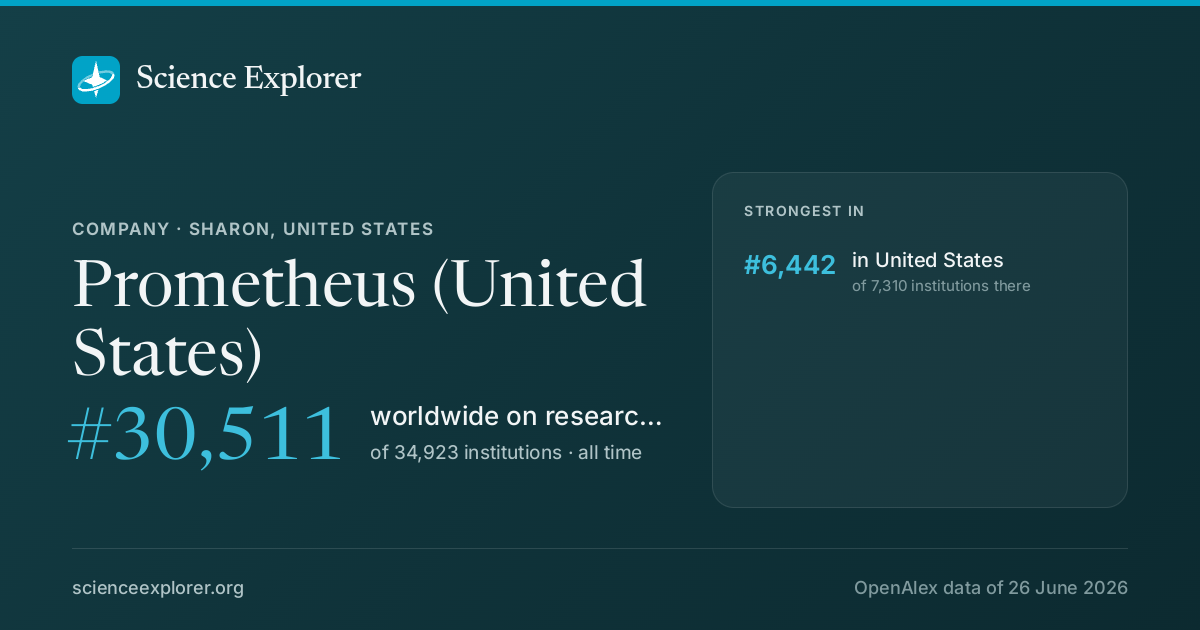
Prometheus (United States) on Science Explorer

A card with Prometheus (United States)'s standing and the fields it leads in, for a post or a slide. A link to this page previews as the same card.

Download the card

1200 × 630 PNG, sized for social posts, drawn from the latest snapshot.

Badges for a website1Each links back here and updates with every snapshot

Research measures only: rankings here say nothing about teaching, admissions or student experience. Comparable institutions and collaboration partners have tabs of their own, above.

Discussion

Ask a question or share a note about Prometheus (United States). Posts are plain text and can be reported.
