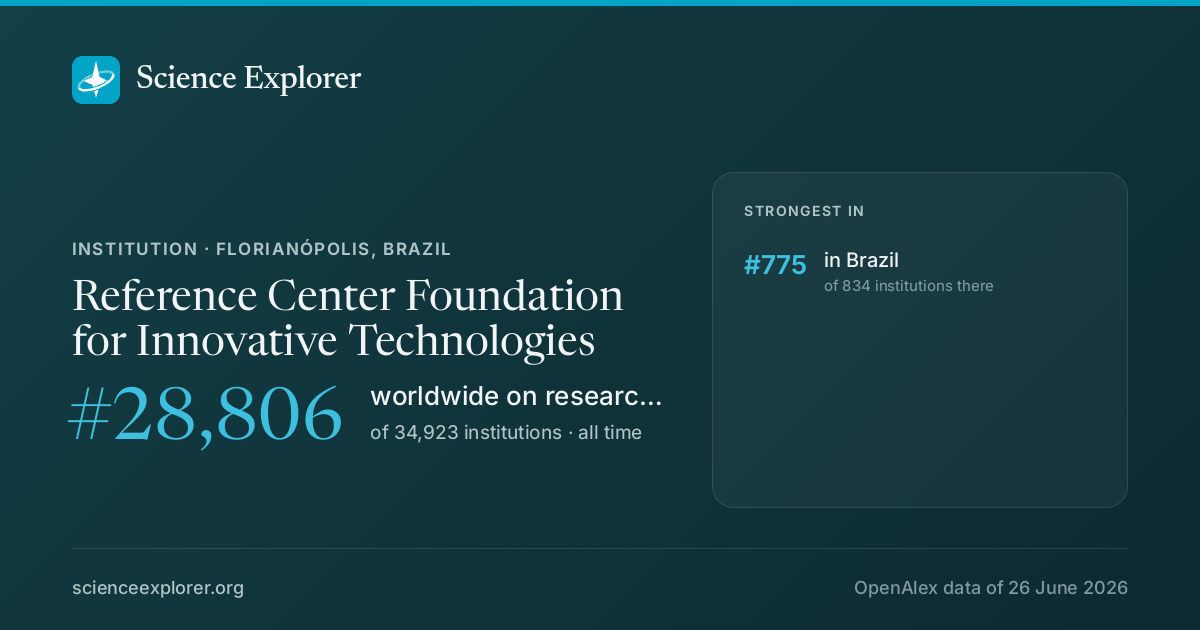
Reference Center Foundation for Innovative Technologies
- World rank, all time
- #28,806 of 34,923
- Rank in Brazil
- #775 of 834
- Research works
- 156 ▲ 12% vs 2018-21
- Citations
- 986 6.3 per fractional work
- Top-10% rate
- 4.8% all institutions 10.0%
- vs its own fields
- 0.97× 1.00× is exactly expected
- Open access
- 35% world 40%
- International
- 16% world 18%
Which fields of science does Reference Center Foundation for Innovative Technologies work in?
In 2022-now, 83% of research at Reference Center Foundation for Innovative Technologies is in Physical Sciences, 10% in Social Sciences. Its largest fields are Engineering (51%), Environmental Science (15%), Computer Science (9%). It does 2.0× the world's share of Physical Sciences.
Each ring splits the one inside it: the four domains of science, their fields, their subfields. Size is fractional works in 2022-now. Every slice is a page; the interactive view zooms down to single topics and colours each by how much more of it this institution does than the world.
Its 4 domains and 23 fields, with their numbers
- Physical Sciences5183.2%
- Engineering3151.0%
- Environmental Science915.1%
- Computer Science69.4%
- Energy23.1%
- Earth and Planetary Sciences11.9%
- Materials Science11.8%
- Physics and Astronomy00.5%
- Chemistry00.4%
- Chemical Engineering00.0%
- Social Sciences610.4%
- Health Sciences23.3%
- Medicine22.4%
- Health Professions00.7%
- Nursing00.1%
- Life Sciences23.2%
Field profile
Location quotient across every field it publishes in: outside the ring is more than an institution of this size would be expected to publish, inside it is less.
Rings at 0.5×, 1× and 2×. Widest outward: Engineering, 3.4×. Every wedge is a field page.
All 23 fields, with their numbers
- Engineering3.40×31 works
- Energy3.36×2 works
- Environmental Science3.03×9 works
- Decision Sciences2.24×1 works
- Pharmacology, Toxicology and Pharmaceutics1.79×0 works
- Computer Science1.21×6 works
- Earth and Planetary Sciences1.19×1 works
- Business, Management and Accounting1.08×2 works
- Materials Science0.50×1 works
- Immunology and Microbiology0.48×0 works
- Economics, Econometrics and Finance0.42×1 works
- Psychology0.40×1 works
- Health Professions0.27×0 works
- Chemistry0.26×0 works
- Agricultural and Biological Sciences0.25×1 works
- Physics and Astronomy0.24×0 works
- Nursing0.22×0 works
- Social Sciences0.20×2 works
- Chemical Engineering0.15×0 works
- Biochemistry, Genetics and Molecular Biology0.14×0 works
- Medicine0.13×2 works
- Neuroscience0.06×0 works
- Arts and Humanities0.05×0 works
- Engineering 3.4×
- Energy 3.4×
- Environmental Science 3.0×
- Decision Sciences 2.2×
- Pharmacology, Toxicology and Pharmaceutics 1.8×
- Computer Science 1.2×
- Earth and Planetary Sciences 1.2×
- Business, Management and Accounting 1.1×
- Materials Science 0.5×
- Immunology and Microbiology 0.5×
- Economics, Econometrics and Finance 0.4×
- Psychology 0.4×
- Health Professions 0.3×
- Chemistry 0.3×
- Agricultural and Biological Sciences 0.2×
- Physics and Astronomy 0.2×
- Nursing 0.2×
- Social Sciences 0.2×
- Chemical Engineering 0.1×
- Biochemistry, Genetics and Molecular Biology 0.1×
- Medicine 0.1×
- Neuroscience 0.1×
- Arts and Humanities 0.1×
Who are the top researchers at Reference Center Foundation for Innovative Technologies?
Ranked on the quality score, Silvia De Francisci, Carlos Alberto Schneider and Miguel Burg Demay lead among researchers whose main affiliation is Reference Center Foundation for Innovative Technologies.
- 1
Silvia De Francisci
 Brazil · #3,875,450 worldwide
111 citations · 29 works
- 2
Carlos Alberto Schneider
Brazil · #4,043,197 worldwide
24 citations · 24 works
- 3
Miguel Burg Demay
Brazil · #4,516,278 worldwide
42 citations · 15 works
- 4
Rodrigo Antonio Sbardeloto Kraemer
Brazil · #4,646,134 worldwide
58 citations · 18 works
- 5
Gabriel Pardini
Brazil · #4,708,602 worldwide
24 citations · 19 works
- 6
Kennedy Alves Martins
Brazil · #4,897,103 worldwide
56 citations · 16 works
- 7
Cesare Quinteiro Pica
Brazil · #5,181,132 worldwide
59 citations · 22 works
- 8
Beatriz Batista Cardoso
Brazil · #5,196,715 worldwide
110 citations · 40 works
- 9
Gustavo Daniel Donatelli
Brazil · #5,638,842 worldwide
98 citations · 32 works
- 10
Marcos Aurélio Izumida Martins
Brazil · #6,790,758 worldwide
340 citations · 73 works
Which keywords describe research at Reference Center Foundation for Innovative Technologies?
By fractional works in 2022-now, weighted toward what it does more of than the world: Smart Grid, Sustainability, Renewable Energy, Electric Vehicles, Renewable Energy Integration, Cyber-Physical Systems, Machine Learning and Life Cycle Assessment.
- Smart Cities
- Power Line Communications
- Grid-Connected Inverters
- Waste Management
- False Data Injection Attacks
- Communication Networks
- Lithium-ion Batteries
- Distributed Generation
- Battery Management Systems
- Privacy
- Utility Tunnels
- Game Theory
- Sustainability Assessment
- Vehicle-to-Grid
- Life Cycle Assessment
- Internet of Things
- Deep Learning
- Renewable Energy Integration
- Electric Vehicles
- Smart Grid
- Sustainability
- Renewable Energy
- Machine Learning
- Sustainable Development
- Cyber-Physical Systems
- Big Data
- Charging Infrastructure
- Energy Efficiency
- Security
- Urban Underground Space
- Remote Sensing
- Smart Grids
- Demand Response
- Energy Management
- Supply Chain Management
- Energy Storage Systems
- Water Resources
- Digital Twin
- Impulsive Noise
- Smart Manufacturing
Size is fractional works in 2022-now in the topics tagged with each word; colour is the word's share of this institution's work against its share of the world's. The 40 words are chosen for being large and distinctive. Each links to the topic it comes from most.
All 40 words, with their numbers
- Sustainability9▲ 6.0×13 topics
- Smart Grid9▲ 40×6 topics
- Renewable Energy7▲ 7.5×13 topics
- Electric Vehicles6▲ 33×3 topics
- Machine Learning6▲ 2.8×15 topics
- Renewable Energy Integration4▲ 22×3 topics
- Sustainable Development4▲ 4.3×5 topics
- Deep Learning4▲ 1.90×17 topics
- Cyber-Physical Systems4▲ 22×4 topics
- Internet of Things3▲ 6.5×5 topics
- Big Data3▲ 5.6×6 topics
- Life Cycle Assessment3▲ 19×3 topics
- Charging Infrastructure3▲ 68×1 topic
- Vehicle-to-Grid3▲ 68×1 topic
- Energy Efficiency3▲ 5.1×8 topics
- Sustainability Assessment3▲ 32×3 topics
- Security3▲ 6.3×5 topics
- Game Theory2▲ 24×2 topics
- Urban Underground Space2▲ 351×1 topic
- Utility Tunnels2▲ 351×1 topic
- Remote Sensing2▲ 3.2×9 topics
- Privacy2▲ 13×3 topics
- Smart Grids2▲ 99×3 topics
- Battery Management Systems2▲ 25×1 topic
- Demand Response2▲ 40×1 topic
- Distributed Generation2▲ 45×2 topics
- Energy Management2▲ 22×1 topic
- Lithium-ion Batteries2▲ 8.7×1 topic
- Supply Chain Management2▲ 3.8×4 topics
- Communication Networks2▲ 49×1 topic
- Energy Storage Systems2▲ 19×2 topics
- False Data Injection Attacks2▲ 49×1 topic
- Water Resources2▲ 11×5 topics
- Waste Management2▲ 6.5×3 topics
- Digital Twin2▲ 18×1 topic
- Grid-Connected Inverters2▲ 34×2 topics
- Impulsive Noise2▲ 160×1 topic
- Power Line Communications2▲ 160×1 topic
- Smart Manufacturing2▲ 27×1 topic
- Smart Cities1▲ 8.8×2 topics
Which research topics does Reference Center Foundation for Innovative Technologies publish most on?
By volume in 2022-now: Electric Vehicles and Infrastructure, Underground infrastructure and sustainability, Smart Grid Energy Management and Advanced Battery Technologies Research.
Area is fractional works; colour is the subfield each topic belongs to.
- 1 Electric Vehicles and Infrastructure Electrical and Electronic Engineering 3 works
- 2 Underground infrastructure and sustainability Building and Construction 2 works
- 3 Smart Grid Energy Management Electrical and Electronic Engineering 2 works
- 4 Advanced Battery Technologies Research Automotive Engineering 2 works
- 5 Smart Grid Security and Resilience Control and Systems Engineering 2 works
- 6 Power Line Communications and Noise Electrical and Electronic Engineering 2 works
- 7 Digital Transformation in Industry Industrial and Manufacturing Engineering 2 works
- 8 Islanding Detection in Power Systems Electrical and Electronic Engineering 1 works
- 9 Environmental Sustainability and Education Management, Monitoring, Policy and Law 1 works
- 10 Transportation and Mobility Innovations Automotive Engineering 1 works
How open and international is its research?
Against the world's own shares: the tick on each track. Both are shares of its output, so they sit on one scale and can be read against each other as well as against the world.
World: 40% of research is openly available.
World: 18% is written across borders.
How has Reference Center Foundation for Innovative Technologies's research output changed?
Output in 2022-2025 was 12% higher than in 2018-2021.
The same series as a ribbon: one cell per year, darker for more. The line above answers how much; this answers when.
Its share of all research
Growing output can still be a shrinking share: all of science grows. This is Reference Center Foundation for Innovative Technologies as a percentage of every work published that year, 0.00013% in 2024.
Fractional works of Reference Center Foundation for Innovative Technologies over all fractional works that year. How the balance of science has shifted.
Other research institutions in Florianópolis
- Universidade Federal de Santa Catarina
- Universidade do Estado de Santa Catarina
- Instituto Federal de Educação, Ciência e Tecnologia de Santa Catarina
- Empresa de Pesquisa Agropecuária e Extensão Rural de Santa Catarina
- Centro de Pesquisas Oncológicas
- Fundação de Amparo à Pesquisa e Inovação do Estado de Santa Catarina
- Governador Celso Ramos Hospital
- Hospital Infantil Joana de Gusmão


Share Reference Center Foundation for Innovative Technologies's ranking
Badges for a website1Each links back here and updates with every snapshot

Research measures only: rankings here say nothing about teaching, admissions or student experience. Comparable institutions and collaboration partners have tabs of their own, above.
Discussion
Ask a question or share a note about Reference Center Foundation for Innovative Technologies. Posts are plain text and can be reported.