Sankara Nethralaya
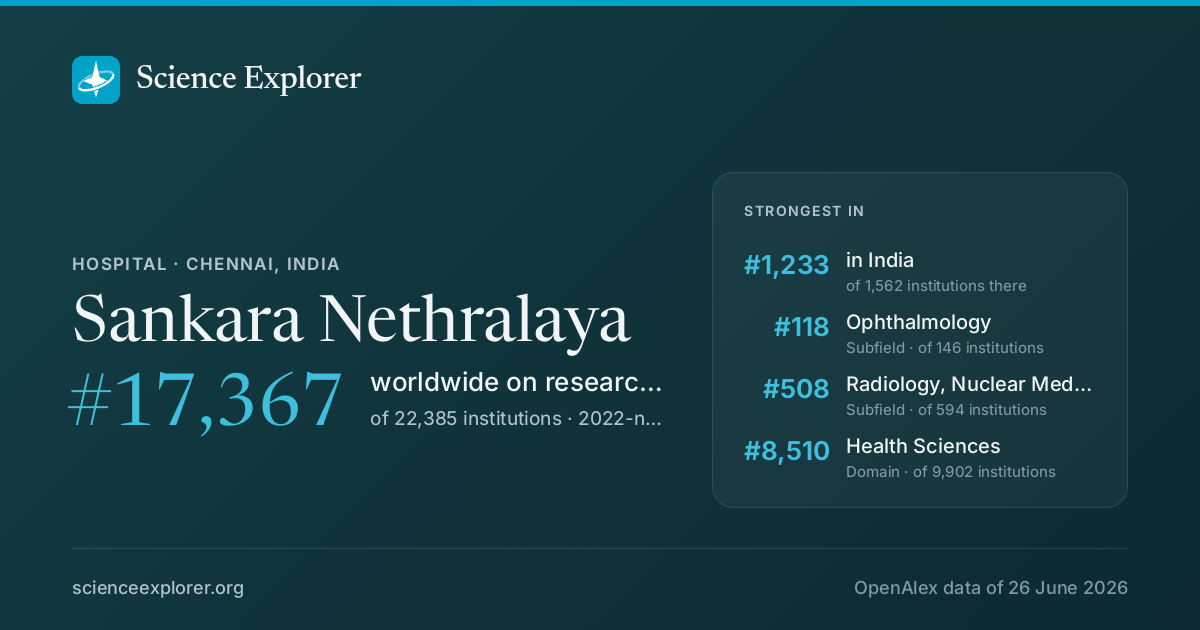
In research, Sankara Nethralaya stands highest in Ophthalmology (#118 of 146 worldwide), Radiology, Nuclear Medicine and Imaging (#508 of 594 worldwide) and Health Sciences (#8,510 of 9,902 worldwide), 2022-now. Relative to its size it is most specialised in Ophthalmology, Radiology, Nuclear Medicine and Imaging and Neurology (Ophthalmology is 119.1× its share of world research).
- World rank, 2022-now
- #17,367 of 22,385 · #21,852 all time
- Rank in India
- #1,233 of 1,562
- Research works
- 2.5k ▼ 3% vs 2018-21
- Citations
- 31k 12.3 per fractional work
- Top-10% rate
- 3.3% all institutions 10.0%
- vs its own fields
- 0.65× 1.00× is exactly expected
- Open access
- 60% world 40%
- International
- 14% world 18%
What is Sankara Nethralaya known for in research?
The fields where it stands highest, 2022-now, ranked among every institution above the floor in each field.
| Field | World rank | Where that sits | Top-10% rate | Works | All time |
|---|---|---|---|---|---|
| OphthalmologySubfield | #118 of 146 | 3.4% | 206 | #375 | |
| Radiology, Nuclear Medicine and ImagingSubfield | #508 of 594 | 2.3% | 83 | #866 | |
| Health SciencesDomain | #8,510 of 9,902 | 3.0% | 521 | #6127 | |
| MedicineField | #7,807 of 8,541 | 2.9% | 504 | #6626 | |
| Life SciencesDomain | #6,140 of 6,403 | 2.3% | 85 | #10461 |
Each strip is that field's whole ranked pool, with the notch where Sankara Nethralaya sits in it, in the colour of the band that rank falls in. The track under the rate is the rate itself: it carries no average mark, because the average differs by field (from about 6% in Dentistry to 21% in Economics).
Which of those standings moved
The same fields on both windows: where it stood over the whole record, and where it stands in 2022-now. The distance is the story, and it is the one thing the two rank columns above cannot show.
- Ophthalmology#375 #118
- Radiology, Nuclear Medicine and Imaging#866 #508
- Health Sciences#6,127 #8,510
- Medicine#6,626 #7,807
- Life Sciences#10,461 #6,140
A dot further right is a better standing. Fields it was not ranked in over the whole record are left out.
Which fields of science does Sankara Nethralaya work in?
In 2022-now, 80% of research at Sankara Nethralaya is in Health Sciences, 14% in Life Sciences. Its largest fields are Medicine (78%), Biochemistry, Genetics and Molecular Biology (9%), Immunology and Microbiology (2%). It does 3.4× the world's share of Health Sciences.
Each ring splits the one inside it: the four domains of science, their fields, their subfields. Size is fractional works in 2022-now. Every slice is a page; the interactive view zooms down to single topics and colours each by how much more of it this institution does than the world.
Its 4 domains and 25 fields, with their numbers
- Health Sciences59680.1%
- Medicine57977.7%
- Health Professions91.2%
- Veterinary50.7%
- Dentistry20.2%
- Nursing20.2%
- Life Sciences10514.1%
- Physical Sciences243.2%
- Engineering81.1%
- Environmental Science40.5%
- Computer Science40.5%
- Materials Science30.4%
- Chemistry30.4%
- Mathematics00.1%
- Energy00.0%
- Earth and Planetary Sciences00.0%
- Physics and Astronomy00.0%
- Social Sciences202.7%
What does Sankara Nethralaya specialise in?
Where its research is concentrated relative to its size: Ophthalmology takes 119.1× the share of its output that it takes of world research.
- OphthalmologySubfield · 236.9 works119×
- Radiology, Nuclear Medicine and ImagingSubfield · 97.1 works14×
- NeurologySubfield · 25.5 works6.0×
Location quotient, a volume reading rather than an impact one. It surfaces small, lopsided specialities.
Field profile
Location quotient across every field it publishes in: outside the ring is more than an institution of this size would be expected to publish, inside it is less.
Rings at 0.5×, 1× and 2×. Widest outward: Veterinary, 5.2×. Every wedge is a field page.
All 25 fields, with their numbers
- Veterinary5.24×5 works
- Medicine4.04×579 works
- Immunology and Microbiology1.96×15 works
- Biochemistry, Genetics and Molecular Biology1.75×70 works
- Pharmacology, Toxicology and Pharmaceutics0.84×2 works
- Neuroscience0.81×10 works
- Health Professions0.47×9 works
- Dentistry0.44×2 works
- Nursing0.41×2 works
- Psychology0.33×8 works
- Chemistry0.26×3 works
- Agricultural and Biological Sciences0.24×8 works
- Decision Sciences0.19×1 works
- Arts and Humanities0.14×3 works
- Materials Science0.13×3 works
- Environmental Science0.11×4 works
- Engineering0.08×8 works
- Computer Science0.07×4 works
- Economics, Econometrics and Finance0.07×1 works
- Social Sciences0.07×6 works
- Energy0.05×0 works
- Mathematics0.05×0 works
- Business, Management and Accounting0.04×1 works
- Earth and Planetary Sciences0.02×0 works
- Physics and Astronomy0.01×0 works
- Veterinary 5.2×
- Medicine 4.0×
- Immunology and Microbiology 2.0×
- Biochemistry, Genetics and Molecular Biology 1.8×
- Pharmacology, Toxicology and Pharmaceutics 0.8×
- Neuroscience 0.8×
- Health Professions 0.5×
- Dentistry 0.4×
- Nursing 0.4×
- Psychology 0.3×
- Chemistry 0.3×
- Agricultural and Biological Sciences 0.2×
- Decision Sciences 0.2×
- Arts and Humanities 0.1×
- Materials Science 0.1×
- Environmental Science 0.1×
- Engineering 0.1×
- Computer Science 0.1×
- Economics, Econometrics and Finance 0.1×
- Social Sciences 0.1×
- Energy 0.1×
- Mathematics 0.1×
- Business, Management and Accounting 0.0×
- Earth and Planetary Sciences 0.0×
- Physics and Astronomy 0.0×
Who are the top researchers at Sankara Nethralaya?
Ranked on the quality score, Rajiv Raman, Mamta Agarwal and Ronnie Jacob George lead among researchers whose main affiliation is Sankara Nethralaya.
- 1
Rajiv Raman
 India · #453,580 worldwide
16k citations · 342 works
- 2
Mamta Agarwal
India · #489,962 worldwide
2.7k citations · 40 works
- 3
Ronnie Jacob George
India · #696,919 worldwide
24k citations · 284 works
- 4
Lingam Vijaya
India · #737,820 worldwide
5.4k citations · 162 works
- 5
Janani Surya
India · #1,139,224 worldwide
484 citations · 47 works
- 6
Lingam Gopal
India · #1,166,325 worldwide
2.8k citations · 177 works
- 7
Suganeswari Ganesan
India · #1,377,626 worldwide
1.2k citations · 69 works
- 8
Vaitheeswaran Kulothungan
India · #1,490,345 worldwide
1.5k citations · 42 works
- 9
Vikas Khetan
India · #1,648,856 worldwide
3.8k citations · 224 works
- 10
Ambika Selvakumar
India · #1,727,949 worldwide
813 citations · 99 works
Which keywords describe research at Sankara Nethralaya?
By fractional works in 2022-now, weighted toward what it does more of than the world: Epidemiology, Glaucoma, Intravitreal Injection, Optical Coherence Tomography, Intraocular Pressure, Macular Degeneration, Juvenile Idiopathic Arthritis and Immunosuppressive Therapy.
- Ocular Surface
- Wound Healing
- Ocular Infections
- OCT Imaging
- Ocular Hypertension
- Intraocular Lens Implantation
- Neurodegeneration
- Retinal Artery Occlusion
- Keratoconus
- ACE2 Receptor
- Choroidal Thickness
- Endophthalmitis
- Optic Nerve
- Genetic Mutations
- Inflammation
- Diabetic Retinopathy
- Immunosuppressive Therapy
- Macular Degeneration
- Optical Coherence Tomography
- Glaucoma
- Epidemiology
- Intravitreal Injection
- Intraocular Pressure
- Juvenile Idiopathic Arthritis
- Behçet's Disease
- Uveitis
- Myopia
- Oxidative Stress
- Vascular Endothelial Growth Factor
- Antibiotic Resistance
- Retinal Pigment Epithelium
- Corneal Biomechanics
- Ocular Findings
- Prognostic Factors
- Femtosecond Laser
- Retinal Ganglion Cells
- Visual Field Progression
- Keratitis
- Inflammatory Cytokines
- Dry Eye Disease
Size is fractional works in 2022-now in the topics tagged with each word; colour is the word's share of this institution's work against its share of the world's. The 40 words are chosen for being large and distinctive. Each links to the topic it comes from most.
All 40 words, with their numbers
- Epidemiology142▲ 4.8×61 topics
- Glaucoma70▲ 63×4 topics
- Intravitreal Injection59▲ 109×2 topics
- Optical Coherence Tomography58▲ 78×3 topics
- Intraocular Pressure58▲ 88×2 topics
- Macular Degeneration58▲ 63×3 topics
- Juvenile Idiopathic Arthritis51▲ 133×2 topics
- Immunosuppressive Therapy50▲ 35×3 topics
- Behçet's Disease49▲ 233×1 topic
- Diabetic Retinopathy49▲ 65×2 topics
- Uveitis49▲ 233×1 topic
- Inflammation46▲ 2.9×30 topics
- Myopia44▲ 89×2 topics
- Genetic Mutations44▲ 14×15 topics
- Oxidative Stress43▲ 3.5×25 topics
- Optic Nerve42▲ 58×2 topics
- Vascular Endothelial Growth Factor40▲ 61×4 topics
- Endophthalmitis35▲ 128×2 topics
- Antibiotic Resistance34▲ 12×12 topics
- Choroidal Thickness34▲ 84×1 topic
- Retinal Pigment Epithelium34▲ 84×1 topic
- ACE2 Receptor32▲ 19×3 topics
- Corneal Biomechanics31▲ 112×1 topic
- Keratoconus31▲ 112×1 topic
- Ocular Findings30▲ 146×1 topic
- Retinal Artery Occlusion30▲ 146×1 topic
- Prognostic Factors29▲ 9.1×9 topics
- Neurodegeneration28▲ 12×5 topics
- Femtosecond Laser28▲ 71×1 topic
- Intraocular Lens Implantation28▲ 124×1 topic
- Retinal Ganglion Cells28▲ 34×3 topics
- Ocular Hypertension27▲ 71×1 topic
- Visual Field Progression27▲ 71×1 topic
- OCT Imaging26▲ 120×2 topics
- Keratitis25▲ 184×1 topic
- Ocular Infections25▲ 184×1 topic
- Inflammatory Cytokines24▲ 36×2 topics
- Wound Healing23▲ 12×5 topics
- Dry Eye Disease23▲ 92×1 topic
- Ocular Surface23▲ 92×1 topic
Which research topics does Sankara Nethralaya publish most on?
By volume in 2022-now: Ocular Diseases and Behçet’s Syndrome, Retinal Diseases and Treatments, Corneal surgery and disorders and Retinal and Optic Conditions.
Area is fractional works; colour is the subfield each topic belongs to.
- 1 Ocular Diseases and Behçet’s Syndrome Ophthalmology 49 works
- 2 Retinal Diseases and Treatments Ophthalmology 34 works
- 3 Corneal surgery and disorders Radiology, Nuclear Medicine and Imaging 31 works
- 4 Retinal and Optic Conditions Ophthalmology 30 works
- 5 Intraocular Surgery and Lenses Ophthalmology 28 works
- 6 Glaucoma and retinal disorders Ophthalmology 27 works
- 7 Ocular Infections and Treatments Ophthalmology 25 works
- 8 Ocular Surface and Contact Lens Public Health, Environmental and Occupational Health 23 works
- 9 Retinal and Macular Surgery Radiology, Nuclear Medicine and Imaging 22 works
- 10 Ophthalmology and Visual Impairment Studies Epidemiology 22 works
How open and international is its research?
Against the world's own shares: the tick on each track. Both are shares of its output, so they sit on one scale and can be read against each other as well as against the world.
World: 40% of research is openly available.
World: 18% is written across borders.
How has Sankara Nethralaya's research output changed?
Output in 2022-2025 was 3% lower than in 2018-2021.
The same series as a ribbon: one cell per year, darker for more. The line above answers how much; this answers when.
Its share of all research
Growing output can still be a shrinking share: all of science grows. This is Sankara Nethralaya as a percentage of every work published that year, 0.0030% in 2024.
Fractional works of Sankara Nethralaya over all fractional works that year. How the balance of science has shifted.
How much of it reaches the world top 10%
Year by year, against all institutions in the same year.
Of each year's output, the share that reached the world's 10% most cited for its field and year. Peak 10.4% in 2006.
Other research institutions in Chennai
- Indian Institute of Technology Madras
- SRM Institute of Science and Technology
- Saveetha University
- Anna University, Chennai
- University of Madras
- Sathyabama Institute of Science and Technology
- Vel Tech Rangarajan Dr. Sagunthala R&D Institute of Science and Technology
- Hindustan Institute of Technology and Science


Share Sankara Nethralaya's ranking
Badges for a website1Each links back here and updates with every snapshot

Research measures only: rankings here say nothing about teaching, admissions or student experience. Comparable institutions and collaboration partners have tabs of their own, above.
Discussion
Ask a question or share a note about Sankara Nethralaya. Posts are plain text and can be reported.