Science Explorer Back to mapMap
Discussion
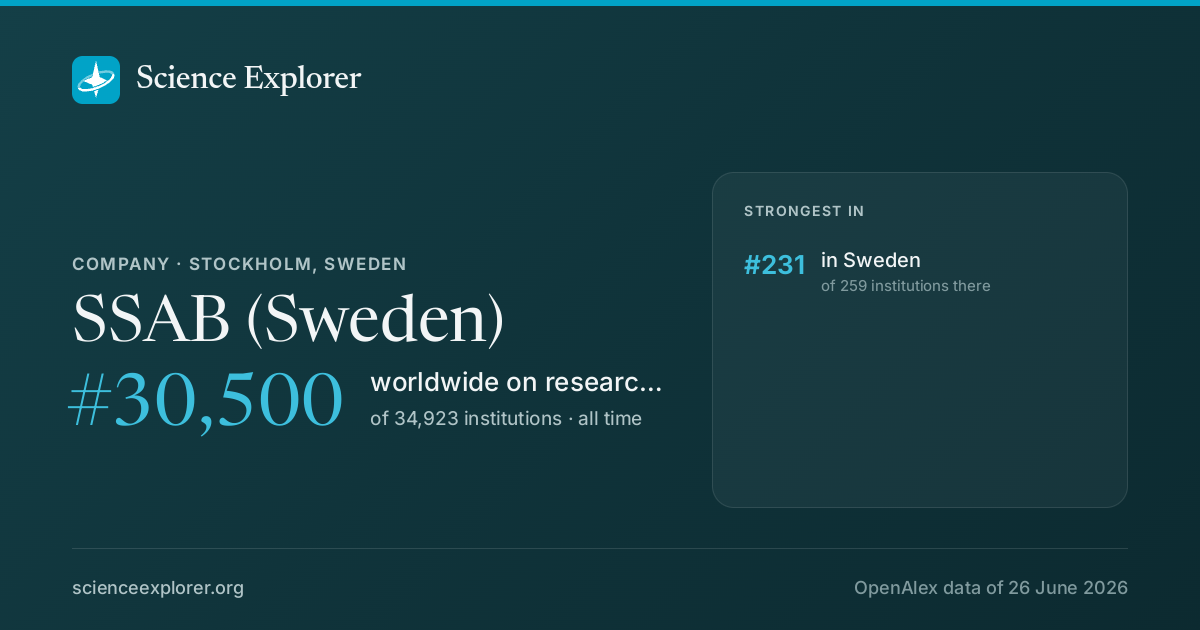
Company · Stockholm · Sweden

SSAB (Sweden)

World rank, all time
#30,500
of 34,923
Rank in Sweden
#231
of 259
Research works
158
▲ 85% vs 2018-21
Citations
2.9k
18.7 per fractional work
Top-10% rate
11.6%
all institutions 10.0%
vs its own fields
0.90×
1.00× is exactly expected
Open access
32%
world 40%
International
17%
world 18%

Which fields of science does SSAB (Sweden) work in?

In 2022-now, 78% of research at SSAB (Sweden) is in Physical Sciences, 12% in Social Sciences. Its largest fields are Engineering (57%), Computer Science (11%), Materials Science (6%). It does 1.8× the world's share of Physical Sciences.

Physical Sciences: 20 fractional works · 77.7% of its workEngineering: 15 fractional works · 56.9% of its workMechanical Engineering: 7 fractional works · 27.1% of its workElectrical and Electronic Engineering: 2 fractional works · 7.2% of its workMechanics of Materials: 2 fractional works · 7.1% of its workBiomedical Engineering: 1 fractional works · 5.3% of its workCivil and Structural Engineering: 1 fractional works · 3.3% of its workControl and Systems Engineering: 1 fractional works · 2.4% of its workAutomotive Engineering: 0 fractional works · 1.7% of its workIndustrial and Manufacturing Engineering: 0 fractional works · 1.5% of its workBuilding and Construction: 0 fractional works · 0.6% of its workAerospace Engineering: 0 fractional works · 0.3% of its workSafety, Risk, Reliability and Quality: 0 fractional works · 0.3% of its workComputer Science: 3 fractional works · 11.0% of its workInformation Systems: 1 fractional works · 4.5% of its workSignal Processing: 1 fractional works · 3.2% of its workArtificial Intelligence: 0 fractional works · 1.3% of its workComputer Networks and Communications: 0 fractional works · 1.3% of its workComputer Vision and Pattern Recognition: 0 fractional works · 0.4% of its workHuman-Computer Interaction: 0 fractional works · 0.4% of its workMaterials Science: 2 fractional works · 6.2% of its workMaterials Chemistry: 1 fractional works · 4.7% of its workMetals and Alloys: 0 fractional works · 1.1% of its workElectronic, Optical and Magnetic Materials: 0 fractional works · 0.4% of its workEnvironmental Science: 0 fractional works · 1.9% of its workManagement, Monitoring, Policy and Law: 0 fractional works · 1.3% of its workGlobal and Planetary Change: 0 fractional works · 0.3% of its workIndustrial and Manufacturing Engineering: 0 fractional works · 0.3% of its workSmaller subfields together: 0 fractional works · 0.0% of its workMathematics: 0 fractional works · 0.6% of its workStatistics and Probability: 0 fractional works · 0.6% of its workPhysics and Astronomy: 0 fractional works · 0.6% of its workAtomic and Molecular Physics, and Optics: 0 fractional works · 0.4% of its workAstronomy and Astrophysics: 0 fractional works · 0.2% of its workEnergy: 0 fractional works · 0.4% of its workRenewable Energy, Sustainability and the Environment: 0 fractional works · 0.4% of its workSocial Sciences: 3 fractional works · 12.4% of its workBusiness, Management and Accounting: 1 fractional works · 4.0% of its workMarketing: 0 fractional works · 1.3% of its workStrategy and Management: 0 fractional works · 1.3% of its workOrganizational Behavior and Human Resource Management: 0 fractional works · 0.8% of its workManagement of Technology and Innovation: 0 fractional works · 0.4% of its workSmaller subfields together: 0 fractional works · 0.2% of its workSocial Sciences: 1 fractional works · 3.5% of its workEducation: 0 fractional works · 1.9% of its workPolitical Science and International Relations: 0 fractional works · 1.3% of its workSociology and Political Science: 0 fractional works · 0.3% of its workSmaller subfields together: 0 fractional works · 0.0% of its workArts and Humanities: 1 fractional works · 2.6% of its workHistory: 1 fractional works · 2.6% of its workDecision Sciences: 0 fractional works · 1.3% of its workManagement Science and Operations Research: 0 fractional works · 0.6% of its workStatistics, Probability and Uncertainty: 0 fractional works · 0.6% of its workPsychology: 0 fractional works · 0.6% of its workSocial Psychology: 0 fractional works · 0.6% of its workEconomics, Econometrics and Finance: 0 fractional works · 0.5% of its workEconomics and Econometrics: 0 fractional works · 0.5% of its workHealth Sciences: 2 fractional works · 7.4% of its workMedicine: 1 fractional works · 5.4% of its workPhysiology: 0 fractional works · 1.5% of its workPulmonary and Respiratory Medicine: 0 fractional works · 1.3% of its workNeurology: 0 fractional works · 0.8% of its workSurgery: 0 fractional works · 0.6% of its workPharmacology: 0 fractional works · 0.3% of its workPathology and Forensic Medicine: 0 fractional works · 0.3% of its workPublic Health, Environmental and Occupational Health: 0 fractional works · 0.3% of its workSmaller subfields together: 0 fractional works · 0.4% of its workHealth Professions: 0 fractional works · 1.8% of its workHealth Information Management: 0 fractional works · 1.3% of its workGeneral Health Professions: 0 fractional works · 0.5% of its workSmaller subfields together: 0 fractional works · 0.0% of its workNursing: 0 fractional works · 0.2% of its workNutrition and Dietetics: 0 fractional works · 0.2% of its workLife Sciences: 1 fractional works · 2.4% of its workBiochemistry, Genetics and Molecular Biology: 0 fractional works · 1.7% of its workMolecular Biology: 0 fractional works · 1.3% of its workBiophysics: 0 fractional works · 0.3% of its workSmaller subfields together: 0 fractional works · 0.2% of its workNeuroscience: 0 fractional works · 0.6% of its workCellular and Molecular Neuroscience: 0 fractional works · 0.6% of its workImmunology and Microbiology: 0 fractional works · 0.2% of its workALL ITS WORKSSAB (Sweden)26fractional works, 2022-now
Life Sciences2%Physical Sciences78%Health Sciences7%Social Sciences12%

Each ring splits the one inside it: the four domains of science, their fields, their subfields. Size is fractional works in 2022-now. Every slice is a page; the interactive view zooms down to single topics and colours each by how much more of it this institution does than the world.

Its 4 domains and 19 fields, with their numbers
    1. Engineering1556.9%
    2. Computer Science311.0%
    3. Materials Science26.2%
    4. Environmental Science01.9%
    5. Mathematics00.6%
    6. Physics and Astronomy00.6%
    7. Energy00.4%
    1. Business, Management and Accounting14.0%
    2. Social Sciences13.5%
    3. Arts and Humanities12.6%
    4. Decision Sciences01.3%
    5. Psychology00.6%
    6. Economics, Econometrics and Finance00.5%
    1. Medicine15.4%
    2. Health Professions01.8%
    3. Nursing00.2%
    1. Biochemistry, Genetics and Molecular Biology01.7%
    2. Neuroscience00.6%
    3. Immunology and Microbiology00.2%
All of science, and how each field's share has moved since 1950: the Science domain explorer

Field profile

Location quotient across every field it publishes in: outside the ring is more than an institution of this size would be expected to publish, inside it is less.

Biochemistry, Genetics and Molecular Biology: 0.33× its world share, 0 worksBiochemistry, Geneti…Immunology and Microbiology: 0.14× its world share, 0 worksImmunology and Micro…Neuroscience: 0.35× its world share, 0 worksNeuroscienceComputer Science: 1.42× its world share, 3 worksComputer ScienceEnergy: 0.46× its world share, 0 worksEnergyEngineering: 3.80× its world share, 15 worksEngineeringEnvironmental Science: 0.38× its world share, 0 worksEnvironmental ScienceMaterials Science: 1.77× its world share, 2 worksMaterials ScienceMathematics: 0.54× its world share, 0 worksMathematicsPhysics and Astronomy: 0.29× its world share, 0 worksPhysics and AstronomyHealth Professions: 0.66× its world share, 0 worksHealth ProfessionsMedicine: 0.28× its world share, 1 worksMedicineNursing: 0.43× its world share, 0 worksNursingArts and Humanities: 0.88× its world share, 1 worksArts and HumanitiesBusiness, Management and Accounting: 1.24× its world share, 1 worksBusiness, Management…Decision Sciences: 1.32× its world share, 0 worksDecision SciencesEconomics, Econometrics and Finance: 0.22× its world share, 0 worksEconomics, Econometr…Psychology: 0.21× its world share, 0 worksPsychologySocial Sciences: 0.28× its world share, 1 worksSocial Sciences1×world share
more than its size predictsabout as predictedless

Rings at 0.5×, 1× and 2×. Widest outward: Engineering, 3.8×. Every wedge is a field page.

All 19 fields, with their numbers
  1. Engineering3.80×15 works
  2. Materials Science1.77×2 works
  3. Computer Science1.42×3 works
  4. Decision Sciences1.32×0 works
  5. Business, Management and Accounting1.24×1 works
  6. Arts and Humanities0.88×1 works
  7. Health Professions0.66×0 works
  8. Mathematics0.54×0 works
  9. Energy0.46×0 works
  10. Nursing0.43×0 works
  11. Environmental Science0.38×0 works
  12. Neuroscience0.35×0 works
  13. Biochemistry, Genetics and Molecular Biology0.33×0 works
  14. Physics and Astronomy0.29×0 works
  15. Medicine0.28×1 works
  16. Social Sciences0.28×1 works
  17. Economics, Econometrics and Finance0.22×0 works
  18. Psychology0.21×0 works
  19. Immunology and Microbiology0.14×0 works

Who are the top researchers at SSAB (Sweden)?

Ranked on the quality score, Karl-Erik Thelning, Niklas Kojola and J. Engdahl lead among researchers whose main affiliation is SSAB (Sweden).

  1. 1 Karl-Erik Thelning Sweden · #3,048,504 worldwide 268 citations · 18 works
  2. 2 Niklas Kojola Sweden · #3,382,565 worldwide 325 citations · 22 works
  3. 3 J. Engdahl Sweden · #3,719,313 worldwide 81 citations · 16 works
  4. 4 Christoffer Eklund Sweden · #5,094,472 worldwide 0 citations · 27 works
All ranked researchers at SSAB (Sweden)

What are the most cited papers from SSAB (Sweden)?

The most cited paper from SSAB (Sweden) is "Toward a Fossil Free Future with HYBRIT: Development of Iron and Steelmaking Technology in Sweden and Finland" (Martin Pei, Markus Petäjäniemi, Andreas Regnell et al., 2020), with 240 citations. Next come "BOREHOLE RADAR APPLIED TO THE CHARACTERIZATION OF HYDRAULICALLY CONDUCTIVE FRACTURE ZONES IN CRYSTALLINE ROCK1" (205) and "Abrasive wear resistance of some commercial abrasion resistant steels evaluated by laboratory test methods" (158).

Most cited papers
#PaperReleasedCitations
1 Toward a Fossil Free Future with HYBRIT: Development of Iron and Steelmaking Technology in Sweden and Finland Martin Pei, Markus Petäjäniemi, Andreas Regnell et al. · Metals Open access 18 Jul 2020 240
2 BOREHOLE RADAR APPLIED TO THE CHARACTERIZATION OF HYDRAULICALLY CONDUCTIVE FRACTURE ZONES IN CRYSTALLINE ROCK1 Olle Olsson, L. Falk, Olof Forslund et al. · Geophysical Prospecting Feb 1992 205
3 Abrasive wear resistance of some commercial abrasion resistant steels evaluated by laboratory test methods José Rendón, Mikael Olsson · Wear 14 Aug 2009 158
4 Wear behaviour of some low alloyed steels under combined impact/abrasion contact conditions Ann Sundström, José Rendón, Mikael Olsson · Wear Oct 2001 157
5 Methanol production from steel-work off-gases and biomass based synthesis gas Joakim Lundgren, Tomas Ekbom, Christian P. Hulteberg et al. · Applied Energy Open access 4 Apr 2013 141
All 60 most cited papers, with filters and sorting

Which keywords describe research at SSAB (Sweden)?

By fractional works in 2022-now, weighted toward what it does more of than the world: Microstructure, Energy Efficiency, Mechanical Properties, Metallurgy, Iron Oxides, Reduction Kinetics, Sustainability and Grain Refinement.

▲ more of its work than of the world's◆ about the world's share▼ less than the world's

Size is fractional works in 2022-now in the topics tagged with each word; colour is the word's share of this institution's work against its share of the world's. The 14 words are chosen for being large and distinctive. Each links to the topic it comes from most.

All 14 words, with their numbers
  1. Microstructure3▲ 19×8 topics
  2. Sustainability2▲ 3.1×3 topics
  3. Energy Efficiency2▲ 7.8×3 topics
  4. Mechanical Properties2▲ 7.4×10 topics
  5. Metallurgy2▲ 103×2 topics
  6. Iron Oxides2▲ 304×1 topic
  7. Reduction Kinetics2▲ 304×1 topic
  8. Grain Refinement1▲ 43×3 topics
  9. Machine Learning1▲ 1.53×3 topics
  10. Deep Learning1▲ 1.37×5 topics
  11. Internet of Things1▲ 5.2×2 topics
  12. Security1▲ 6.7×2 topics
  13. Fatigue Crack Closure1▲ 152×1 topic
  14. Fracture Toughness Testing1▲ 152×1 topic

Which research topics does SSAB (Sweden) publish most on?

By volume in 2022-now: Iron and Steelmaking Processes, Fatigue and fracture mechanics, Microstructure and Mechanical Properties of Steels and Digital and Cyber Forensics.

  1. 1 Iron and Steelmaking Processes Mechanical Engineering 2 works
  2. 2 Fatigue and fracture mechanics Mechanics of Materials 1 works
  3. 3 Microstructure and Mechanical Properties of Steels Mechanical Engineering 1 works
  4. 4 Digital and Cyber Forensics Information Systems 1 works
  5. 5 Metallurgical Processes and Thermodynamics Mechanical Engineering 1 works
  6. 6 Metal Extraction and Bioleaching Biomedical Engineering 1 works
  7. 7 Advanced Malware Detection Techniques Signal Processing 1 works
  8. 8 Welding Techniques and Residual Stresses Mechanical Engineering 1 works
  9. 9 Structural Load-Bearing Analysis Civil and Structural Engineering 0 works
  10. 10 Research in Social Sciences Education 0 works

How open and international is its research?

Against the world's own shares: the tick on each track. Both are shares of its output, so they sit on one scale and can be read against each other as well as against the world.

openly available32.0%not open68.0%

World: 40% of research is openly available.

with international co-authors17.4%domestic only82.6%

World: 18% is written across borders.

How has SSAB (Sweden)'s research output changed?

Output in 2022-2025 was 85% higher than in 2018-2021.

still counting1990200020102020
grewheldshrank

The same series as a ribbon: one cell per year, darker for more. The line above answers how much; this answers when.

Its share of all research

Growing output can still be a shrinking share: all of science grows. This is SSAB (Sweden) as a percentage of every work published that year, 0.000091% in 2024.

still counting0.00050%0.0010%SSAB (Sweden)0.00013% in 202519801990200020102020

Fractional works of SSAB (Sweden) over all fractional works that year. How the balance of science has shifted.

Other research institutions in Stockholm

All research institutions in Stockholm

Share SSAB (Sweden)'s ranking

SSAB (Sweden) on Science Explorer

A card with SSAB (Sweden)'s standing and the fields it leads in, for a post or a slide. A link to this page previews as the same card.

Download the card

1200 × 630 PNG, sized for social posts, drawn from the latest snapshot.

Badges for a website1Each links back here and updates with every snapshot

Research measures only: rankings here say nothing about teaching, admissions or student experience. Comparable institutions and collaboration partners have tabs of their own, above.

Discussion

Ask a question or share a note about SSAB (Sweden). Keep it to the research: no personal attacks, advertising or links. Any reader can report a post, which collapses it for everyone until it is opened.