Science Explorer Back to mapMap
Discussion
Archive · Worms · Germany

Stadtarchiv Worms

World rank, all time
#33,700
of 34,923
Rank in Germany
#1,566
of 1,603
Research works
122
fractional, all time
Citations
718
5.9 per fractional work
Top-10% rate
0.0%
all institutions 10.0%
vs its own fields
1.01×
1.00× is exactly expected
Open access
1%
world 40%
International
1%
world 18%

Which fields of science does Stadtarchiv Worms work in?

In all years, 77% of research at Stadtarchiv Worms is in Health Sciences, 16% in Social Sciences. Its largest fields are Medicine (70%), Psychology (7%), Health Professions (7%). It does 3.1× the world's share of Health Sciences.

Health Sciences: 94 fractional works · 77.5% of its workMedicine: 85 fractional works · 70.0% of its workPublic Health, Environmental and Occupational Health: 30 fractional works · 24.5% of its workSurgery: 14 fractional works · 11.3% of its workPulmonary and Respiratory Medicine: 7 fractional works · 5.5% of its workCardiology and Cardiovascular Medicine: 5 fractional works · 4.5% of its workEpidemiology: 5 fractional works · 4.0% of its workObstetrics and Gynecology: 4 fractional works · 3.3% of its workPediatrics, Perinatology and Child Health: 3 fractional works · 2.5% of its workInfectious Diseases: 2 fractional works · 2.0% of its workOncology: 2 fractional works · 1.7% of its workPathology and Forensic Medicine: 2 fractional works · 1.5% of its workReproductive Medicine: 1 fractional works · 1.1% of its workNeurology: 1 fractional works · 1.0% of its workRheumatology: 1 fractional works · 0.8% of its workGastroenterology: 1 fractional works · 0.8% of its workEmergency Medicine: 1 fractional works · 0.7% of its workUrology: 1 fractional works · 0.7% of its workRehabilitation: 1 fractional works · 0.6% of its workDermatology: 1 fractional works · 0.5% of its workPsychiatry and Mental health: 1 fractional works · 0.5% of its workEndocrinology, Diabetes and Metabolism: 1 fractional works · 0.5% of its workHepatology: 0 fractional works · 0.4% of its workNephrology: 0 fractional works · 0.4% of its workRadiology, Nuclear Medicine and Imaging: 0 fractional works · 0.3% of its workFamily Practice: 0 fractional works · 0.3% of its workMicrobiology: 0 fractional works · 0.3% of its workSmaller subfields together: 1 fractional works · 0.4% of its workHealth Professions: 8 fractional works · 6.7% of its workGeneral Health Professions: 6 fractional works · 4.7% of its workPhysical Therapy, Sports Therapy and Rehabilitation: 1 fractional works · 0.6% of its workComplementary and Manual Therapy: 0 fractional works · 0.4% of its workPharmacy: 0 fractional works · 0.4% of its workEmergency Medical Services: 0 fractional works · 0.3% of its workOccupational Therapy: 0 fractional works · 0.3% of its workVeterinary: 1 fractional works · 0.8% of its workSmall Animals: 1 fractional works · 0.8% of its workSocial Sciences: 20 fractional works · 16.1% of its workPsychology: 8 fractional works · 6.9% of its workClinical Psychology: 7 fractional works · 6.1% of its workSocial Psychology: 1 fractional works · 0.8% of its workEconomics, Econometrics and Finance: 7 fractional works · 6.1% of its workEconomics and Econometrics: 7 fractional works · 6.1% of its workArts and Humanities: 2 fractional works · 2.0% of its workHistory: 2 fractional works · 1.6% of its workClassics: 0 fractional works · 0.3% of its workSmaller subfields together: 0 fractional works · 0.1% of its workSocial Sciences: 1 fractional works · 0.8% of its workLaw: 0 fractional works · 0.4% of its workPolitical Science and International Relations: 0 fractional works · 0.4% of its workBusiness, Management and Accounting: 0 fractional works · 0.3% of its workManagement of Technology and Innovation: 0 fractional works · 0.3% of its workLife Sciences: 6 fractional works · 4.6% of its workBiochemistry, Genetics and Molecular Biology: 4 fractional works · 3.0% of its workGenetics: 2 fractional works · 1.2% of its workMolecular Biology: 1 fractional works · 1.0% of its workCancer Research: 1 fractional works · 0.6% of its workSmaller subfields together: 0 fractional works · 0.2% of its workImmunology and Microbiology: 2 fractional works · 1.4% of its workImmunology: 1 fractional works · 1.0% of its workVirology: 0 fractional works · 0.4% of its workAgricultural and Biological Sciences: 0 fractional works · 0.3% of its workAgronomy and Crop Science: 0 fractional works · 0.3% of its workPhysical Sciences: 2 fractional works · 1.8% of its workEngineering: 2 fractional works · 1.7% of its workComputational Mechanics: 1 fractional works · 0.8% of its workIndustrial and Manufacturing Engineering: 1 fractional works · 0.8% of its workSmaller subfields together: 0 fractional works · 0.1% of its workMaterials Science: 0 fractional works · 0.1% of its workALL ITS WORKStadtarchiv Worms122fractional works, all years
Life Sciences5%Physical Sciences2%Health Sciences77%Social Sciences16%

Each ring splits the one inside it: the four domains of science, their fields, their subfields. Size is fractional works in all years. Every slice is a page; the interactive view zooms down to single topics and colours each by how much more of it this institution does than the world.

Its 4 domains and 13 fields, with their numbers
    1. Medicine8570.0%
    2. Health Professions86.7%
    3. Veterinary10.8%
    1. Psychology86.9%
    2. Economics, Econometrics and Finance76.1%
    3. Arts and Humanities22.0%
    4. Social Sciences10.8%
    5. Business, Management and Accounting00.3%
    1. Biochemistry, Genetics and Molecular Biology43.0%
    2. Immunology and Microbiology21.4%
    3. Agricultural and Biological Sciences00.3%
    1. Engineering21.7%
    2. Materials Science00.1%
All of science, and how each field's share has moved since 1950: the Science domain explorer

What does Stadtarchiv Worms specialise in?

Where its research is concentrated relative to its size: Public Health, Environmental and Occupational Health takes 19.3× the share of its output that it takes of world research.

  1. Public Health, Environmental and Occupational HealthSubfield · 29.9 works19×
← less than its size predicts1×more →

Location quotient, a volume reading rather than an impact one. It surfaces small, lopsided specialities.

Field profile

Location quotient across every field it publishes in: outside the ring is more than an institution of this size would be expected to publish, inside it is less.

Who are the top researchers at Stadtarchiv Worms?

Ranked on the quality score, W. Jellinghaus lead among researchers whose main affiliation is Stadtarchiv Worms.

  1. 1 W. Jellinghaus Germany · #3,422,680 worldwide 278 citations · 33 works
All ranked researchers at Stadtarchiv Worms

What are the most cited papers from Stadtarchiv Worms?

The most cited paper from Stadtarchiv Worms is "More Rapid, Complete, and Stable Coronary Thrombolysis With Bolus Administration of Reteplase Compared With Alteplase Infusion in Acute Myocardial Infarction" (Richard W. Smalling, Christoph Bode, John M. Kalbfleisch et al., 1995), with 287 citations. Next come "Biventricular Versus Conventional Right Ventricular Stimulation for Patients With Standard Pacing Indication and Left Ventricular Dysfunction" (280) and "Cystinuria in childhood and adolescence: recommendations for diagnosis, treatment, and follow-up" (177).

Most cited papers
#PaperReleasedCitations
1 More Rapid, Complete, and Stable Coronary Thrombolysis With Bolus Administration of Reteplase Compared With Alteplase Infusion in Acute Myocardial Infarction Richard W. Smalling, Christoph Bode, John M. Kalbfleisch et al. · Circulation Jun 1995 287
2 Biventricular Versus Conventional Right Ventricular Stimulation for Patients With Standard Pacing Indication and Left Ventricular Dysfunction Michael Kindermann, Benno Hennen, Jens Jung et al. · Journal of the American College of Cardiology Open access 27 Apr 2006 280
3 Cystinuria in childhood and adolescence: recommendations for diagnosis, treatment, and follow-up Thomas Martin Knoll, Antonia Z�llner, Gunnar Wendt‐Nordahl et al. · Pediatric Nephrology 24 Nov 2004 177
4 Nephrectomy: A Comparative Study between the Transperitoneal and Retroperitoneal Laparoscopic versus the Open Approach Jens Jochen Rassweiler, Thomas Frede, Thomas Oliver Henkel et al. · European Urology 1998 144
5 Humeral nailing revisited Pol Maria Rommens, Raphael Kuechle, Th. Bord et al. · Injury 16 Apr 2008 130
All 63 most cited papers, with filters and sorting

Which keywords describe research at Stadtarchiv Worms?

By fractional works in all years, weighted toward what it does more of than the world: Medical Ethics, End-of-Life Care, Patient Rights, Genetic Testing, Healthcare Law, Reproductive Medicine, Quality of Life and Epidemiology.

▲ more of its work than of the world's◆ about the world's share▼ less than the world's

Size is fractional works in all years in the topics tagged with each word; colour is the word's share of this institution's work against its share of the world's. The 40 words are chosen for being large and distinctive. Each links to the topic it comes from most.

All 40 words, with their numbers
  1. Medical Ethics30▲ 140×4 topics
  2. End-of-Life Care28▲ 163×2 topics
  3. Patient Rights28▲ 243×2 topics
  4. Genetic Testing27▲ 138×2 topics
  5. Healthcare Law27▲ 890×1 topic
  6. Reproductive Medicine27▲ 890×1 topic
  7. Epidemiology14▲ 2.8×28 topics
  8. Quality of Life10▲ 6.1×7 topics
  9. Mental Health8▲ 5.9×2 topics
  10. Psychiatry8▲ 194×2 topics
  11. Economic Evaluation7▲ 46×2 topics
  12. Cost-effectiveness Analysis7▲ 72×1 topic
  13. Health Utility Measures7▲ 72×1 topic
  14. History7▲ 7.0×1 topic
  15. Psychopharmacology7▲ 412×1 topic
  16. Diagnosis6▲ 4.8×10 topics
  17. Genetic Mutations5▲ 8.5×8 topics
  18. Treatment5▲ 3.1×10 topics
  19. Public Health5▲ 2.9×6 topics
  20. Complications4▲ 7.0×8 topics
  21. Primary Care4▲ 7.1×5 topics
  22. Surgical Treatment4▲ 14×5 topics
  23. Immunotherapy3▲ 4.0×7 topics
  24. Guidelines3▲ 5.3×7 topics
  25. Management3▲ 2.9×7 topics
  26. Prognostic Factors3▲ 4.9×6 topics
  27. Autoimmune Disease3▲ 31×2 topics
  28. Intrauterine Infection2▲ 46×2 topics
  29. Pregnancy Complications2▲ 23×2 topics
  30. Training2▲ 10×2 topics
  31. Prenatal Diagnosis2▲ 10.0×4 topics
  32. Children2▲ 6.4×2 topics
  33. Fetal Hydrops2▲ 80×1 topic
  34. Parvovirus B192▲ 80×1 topic
  35. Cesarean Section2▲ 38×1 topic
  36. Community Health2▲ 9.7×1 topic
  37. Intussusception2▲ 31×1 topic
  38. Meckel's Diverticulum2▲ 31×1 topic
  39. Pediatrics2▲ 32×1 topic
  40. Vaginal Birth2▲ 38×1 topic

Which research topics does Stadtarchiv Worms publish most on?

By volume in 2022-now: Law and Political Science.

  1. 1 Law and Political Science Law 0 works

How open and international is its research?

Against the world's own shares: the tick on each track. Both are shares of its output, so they sit on one scale and can be read against each other as well as against the world.

openly available0.8%not open99.2%

World: 40% of research is openly available.

with international co-authors1.1%domestic only98.9%

World: 18% is written across borders.

How has Stadtarchiv Worms's research output changed?

1990200020102020
grewheldshrank

The same series as a ribbon: one cell per year, darker for more. The line above answers how much; this answers when.

Its share of all research

Growing output can still be a shrinking share: all of science grows. This is Stadtarchiv Worms as a percentage of every work published that year, 0.0000088% in 2016.

0.0010%0.0020%Stadtarchiv Worms0.0000093% in 20231990200020102020

Fractional works of Stadtarchiv Worms over all fractional works that year. How the balance of science has shifted.

Other research institutions in Worms

All research institutions in Worms

Share Stadtarchiv Worms's ranking
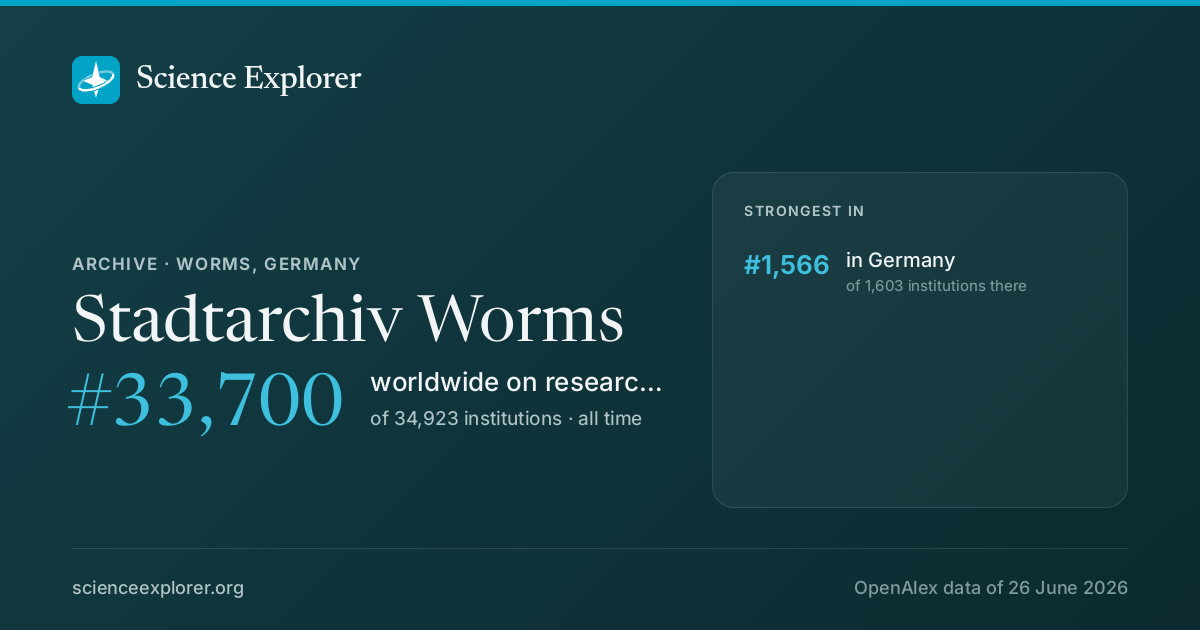
Stadtarchiv Worms on Science Explorer

A card with Stadtarchiv Worms's standing and the fields it leads in, for a post or a slide. A link to this page previews as the same card.

Download the card

1200 × 630 PNG, sized for social posts, drawn from the latest snapshot.

Badges for a website1Each links back here and updates with every snapshot

Research measures only: rankings here say nothing about teaching, admissions or student experience. Comparable institutions and collaboration partners have tabs of their own, above.

Discussion

Ask a question or share a note about Stadtarchiv Worms. Keep it to the research: no personal attacks, advertising or links. Any reader can report a post, which collapses it for everyone until it is opened.
