Sumitomo Heavy Industries (Japan)
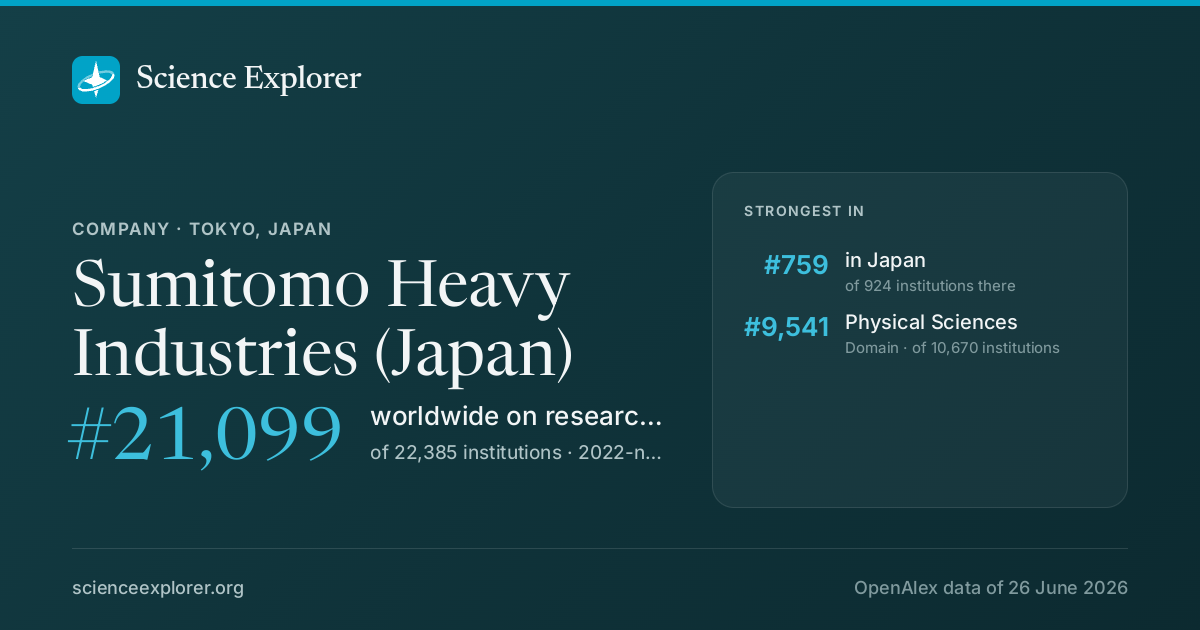
In research, Sumitomo Heavy Industries (Japan) stands highest in Physical Sciences (#9,541 of 10,670 worldwide), 2022-now.
- World rank, 2022-now
- #21,099 of 22,385 · #18,580 all time
- Rank in Japan
- #759 of 924
- Research works
- 1.1k ▲ 9% vs 2018-21
- Citations
- 8.5k 8.1 per fractional work
- Top-10% rate
- 3.0% all institutions 10.0%
- vs its own fields
- 0.99× 1.00× is exactly expected
- Open access
- 44% world 40%
- International
- 19% world 18%
What is Sumitomo Heavy Industries (Japan) known for in research?
The fields where it stands highest, 2022-now, ranked among every institution above the floor in each field.
| Field | World rank | Where that sits | Top-10% rate | Works | All time |
|---|---|---|---|---|---|
| Physical SciencesDomain | #9,541 of 10,670 | 2.1% | 78 | #8950 |
Each strip is that field's whole ranked pool, with the notch where Sumitomo Heavy Industries (Japan) sits in it, in the colour of the band that rank falls in. The track under the rate is the rate itself: it carries no average mark, because the average differs by field (from about 6% in Dentistry to 21% in Economics).
Which fields of science does Sumitomo Heavy Industries (Japan) work in?
In 2022-now, 83% of research at Sumitomo Heavy Industries (Japan) is in Physical Sciences, 10% in Health Sciences. Its largest fields are Engineering (61%), Physics and Astronomy (12%), Medicine (10%). It does 2.1× the world's share of Physical Sciences.
Each ring splits the one inside it: the four domains of science, their fields, their subfields. Size is fractional works in 2022-now. Every slice is a page; the interactive view zooms down to single topics and colours each by how much more of it this institution does than the world.
Its 4 domains and 17 fields, with their numbers
- Physical Sciences8583.4%
- Engineering6260.9%
- Physics and Astronomy1211.9%
- Materials Science65.6%
- Computer Science21.8%
- Energy11.2%
- Chemical Engineering10.9%
- Chemistry10.6%
- Environmental Science10.6%
- Health Sciences1010.0%
- Medicine109.9%
- Health Professions00.1%
- Life Sciences43.5%
- Social Sciences33.1%
- Decision Sciences21.5%
- Social Sciences10.9%
- Arts and Humanities10.7%
Field profile
Location quotient across every field it publishes in: outside the ring is more than an institution of this size would be expected to publish, inside it is less.
Rings at 0.5×, 1× and 2×. Widest outward: Physics and Astronomy, 5.3×. Every wedge is a field page.
All 17 fields, with their numbers
- Physics and Astronomy5.34×12 works
- Engineering4.06×62 works
- Chemical Engineering2.58×1 works
- Pharmacology, Toxicology and Pharmaceutics1.87×1 works
- Materials Science1.60×6 works
- Decision Sciences1.54×2 works
- Energy1.25×1 works
- Neuroscience0.57×1 works
- Medicine0.52×10 works
- Chemistry0.41×1 works
- Agricultural and Biological Sciences0.26×1 works
- Computer Science0.23×2 works
- Arts and Humanities0.23×1 works
- Biochemistry, Genetics and Molecular Biology0.14×1 works
- Environmental Science0.11×1 works
- Social Sciences0.07×1 works
- Health Professions0.05×0 works
- Physics and Astronomy 5.3×
- Engineering 4.1×
- Chemical Engineering 2.6×
- Pharmacology, Toxicology and Pharmaceutics 1.9×
- Materials Science 1.6×
- Decision Sciences 1.5×
- Energy 1.2×
- Neuroscience 0.6×
- Medicine 0.5×
- Chemistry 0.4×
- Agricultural and Biological Sciences 0.3×
- Computer Science 0.2×
- Arts and Humanities 0.2×
- Biochemistry, Genetics and Molecular Biology 0.1×
- Environmental Science 0.1×
- Social Sciences 0.1×
- Health Professions 0.1×
Who are the top researchers at Sumitomo Heavy Industries (Japan)?
Ranked on the quality score, Tomohiro Koyama, Kenzo Sasai and K. Awai lead among researchers whose main affiliation is Sumitomo Heavy Industries (Japan).
- 1
Tomohiro Koyama
 Japan · #2,200,899 worldwide
423 citations · 15 works
- 2
Kenzo Sasai
Japan · #2,774,820 worldwide
204 citations · 17 works
- 3
K. Awai
Japan · #3,561,898 worldwide
517 citations · 19 works
- 4
Daizo Amano
Japan · #4,120,489 worldwide
143 citations · 29 works
- 5
Nagaaki Kamiguchi
Japan · #4,397,450 worldwide
53 citations · 24 works
- 6
Yuta Ebara
Japan · #4,622,839 worldwide
121 citations · 23 works
- 7
Yoshiaki Kanazawa
Japan · #4,708,556 worldwide
158 citations · 17 works
- 8
T. Katoh
Japan · #4,982,434 worldwide
448 citations · 27 works
- 9
T. Hasebe
Japan · #5,029,350 worldwide
433 citations · 37 works
- 10
Toshinobu Sasano
Japan · #5,141,147 worldwide
68 citations · 15 works
Which keywords describe research at Sumitomo Heavy Industries (Japan)?
By fractional works in 2022-now, weighted toward what it does more of than the world: Thermodynamic Analysis, Optimization, Performance Optimization, Solar Cells, Stirling Engines, Thermoacoustic, Nanostructures and Critical Current Density.
- Tool Wear
- Refrigerants
- Liquefied Natural Gas (LNG)
- Cryogenic Storage
- Superconducting Magnets
- Nb3Sn Conductor
- Welding
- Machine Vision
- Surface Analysis
- Photovoltaics
- Grasping
- Superconducting Cavities
- Molecular Imaging
- Proton Therapy
- Failure Analysis
- Critical Current Density
- Energy Efficiency
- Stirling Engines
- Performance Optimization
- Deep Learning
- Thermodynamic Analysis
- Optimization
- Solar Cells
- Thermoacoustic
- Nanostructures
- Mechanical Properties
- Particle Therapy
- Cancer Treatment
- Negative Ion Sources
- Dosimetry
- Ion Beam
- Robot Learning
- Integrated Circuits
- Photon Emission Microscopy
- Efficiency
- Silicon
- Chemical Synthesis
- Ejectors
- Medicinal Chemistry
- Biological Applications
Size is fractional works in 2022-now in the topics tagged with each word; colour is the word's share of this institution's work against its share of the world's. The 40 words are chosen for being large and distinctive. Each links to the topic it comes from most.
All 40 words, with their numbers
- Thermodynamic Analysis7▲ 104×3 topics
- Deep Learning5▲ 1.54×10 topics
- Optimization5▲ 10×4 topics
- Performance Optimization4▲ 70×3 topics
- Solar Cells4▲ 20×4 topics
- Stirling Engines4▲ 411×1 topic
- Thermoacoustic4▲ 411×1 topic
- Energy Efficiency4▲ 4.3×9 topics
- Nanostructures4▲ 9.2×6 topics
- Critical Current Density4▲ 147×2 topics
- Mechanical Properties4▲ 3.8×9 topics
- Failure Analysis4▲ 38×2 topics
- Particle Therapy3▲ 134×1 topic
- Proton Therapy3▲ 134×1 topic
- Cancer Treatment3▲ 14×2 topics
- Molecular Imaging3▲ 36×2 topics
- Negative Ion Sources3▲ 167×1 topic
- Superconducting Cavities3▲ 167×1 topic
- Dosimetry3▲ 37×2 topics
- Grasping3▲ 70×1 topic
- Ion Beam3▲ 186×1 topic
- Photovoltaics3▲ 17×2 topics
- Robot Learning3▲ 70×1 topic
- Surface Analysis3▲ 186×1 topic
- Integrated Circuits2▲ 17×1 topic
- Machine Vision2▲ 12×2 topics
- Photon Emission Microscopy2▲ 93×1 topic
- Welding2▲ 39×2 topics
- Efficiency2▲ 7.7×1 topic
- Nb3Sn Conductor2▲ 129×1 topic
- Silicon2▲ 65×1 topic
- Superconducting Magnets2▲ 129×1 topic
- Chemical Synthesis2▲ 27×2 topics
- Cryogenic Storage2▲ 82×1 topic
- Ejectors2▲ 72×1 topic
- Liquefied Natural Gas (LNG)2▲ 82×1 topic
- Medicinal Chemistry2▲ 7.9×2 topics
- Refrigerants2▲ 72×1 topic
- Biological Applications2▲ 29×2 topics
- Tool Wear2▲ 16×2 topics
Which research topics does Sumitomo Heavy Industries (Japan) publish most on?
By volume in 2022-now: Advanced Thermodynamic Systems and Engines, Radiation Therapy and Dosimetry, Particle accelerators and beam dynamics and Ion-surface interactions and analysis.
Area is fractional works; colour is the subfield each topic belongs to.
- 1 Advanced Thermodynamic Systems and Engines Mechanical Engineering 4 works
- 2 Radiation Therapy and Dosimetry Pulmonary and Respiratory Medicine 3 works
- 3 Particle accelerators and beam dynamics Aerospace Engineering 3 works
- 4 Ion-surface interactions and analysis Computational Mechanics 3 works
- 5 Robot Manipulation and Learning Control and Systems Engineering 3 works
- 6 Integrated Circuits and Semiconductor Failure Analysis Electrical and Electronic Engineering 2 works
- 7 Superconducting Materials and Applications Biomedical Engineering 2 works
- 8 Spacecraft and Cryogenic Technologies Aerospace Engineering 2 works
- 9 Silicon and Solar Cell Technologies Electrical and Electronic Engineering 2 works
- 10 Refrigeration and Air Conditioning Technologies Mechanical Engineering 2 works
How open and international is its research?
Against the world's own shares: the tick on each track. Both are shares of its output, so they sit on one scale and can be read against each other as well as against the world.
World: 40% of research is openly available.
World: 18% is written across borders.
How has Sumitomo Heavy Industries (Japan)'s research output changed?
Output in 2022-2025 was 9% higher than in 2018-2021.
The same series as a ribbon: one cell per year, darker for more. The line above answers how much; this answers when.
Its share of all research
Growing output can still be a shrinking share: all of science grows. This is Sumitomo Heavy Industries (Japan) as a percentage of every work published that year, 0.00035% in 2024.
Fractional works of Sumitomo Heavy Industries (Japan) over all fractional works that year. How the balance of science has shifted.
How much of it reaches the world top 10%
Year by year, against all institutions in the same year.
Of each year's output, the share that reached the world's 10% most cited for its field and year. Peak 10.7% in 1994.
Other research institutions in Tokyo
- The University of Tokyo
- Tokyo Institute of Technology
- Keio University
- Waseda University
- Tokyo University of Science
- Nihon University
- Hitachi (Japan)
- NTT (Japan)


Share Sumitomo Heavy Industries (Japan)'s ranking
Badges for a website1Each links back here and updates with every snapshot

Research measures only: rankings here say nothing about teaching, admissions or student experience. Comparable institutions and collaboration partners have tabs of their own, above.
Discussion
Ask a question or share a note about Sumitomo Heavy Industries (Japan). Keep it to the research: no personal attacks, advertising or links. Any reader can report a post, which collapses it for everyone until it is opened.