Science Explorer Back to mapMap
Discussion
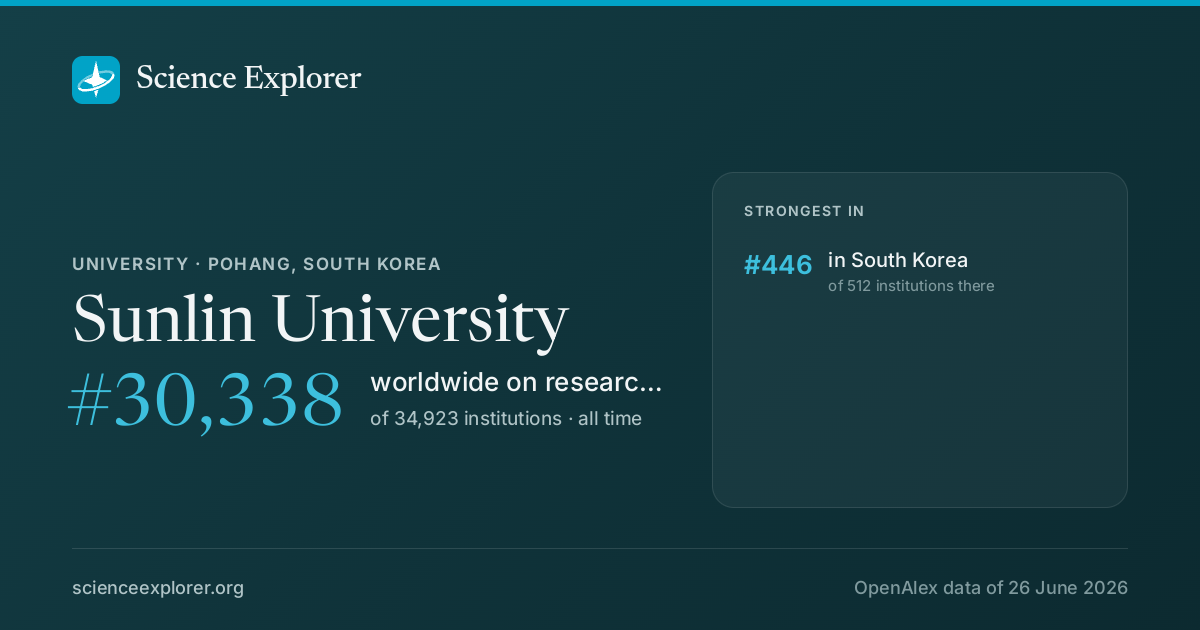
University · Pohang · South Korea

Sunlin University

World rank, all time
#30,338
of 34,923
Rank in South Korea
#446
of 512
Research works
139
▲ 11% vs 2018-21
Citations
959
6.9 per fractional work
Top-10% rate
17.2%
all institutions 10.0%
vs its own fields
0.95×
1.00× is exactly expected
Open access
53%
world 40%
International
13%
world 18%

Which fields of science does Sunlin University work in?

In 2022-now, 59% of research at Sunlin University is in Health Sciences, 22% in Physical Sciences. Its largest fields are Medicine (50%), Engineering (9%), Health Professions (7%). It does 2.0× the world's share of Health Sciences.

Health Sciences: 13 fractional works · 59.3% of its workMedicine: 11 fractional works · 49.5% of its workDermatology: 3 fractional works · 12.3% of its workSurgery: 1 fractional works · 6.5% of its workNeurology: 1 fractional works · 5.6% of its workRehabilitation: 1 fractional works · 4.7% of its workEpidemiology: 1 fractional works · 3.4% of its workUrology: 1 fractional works · 2.6% of its workPublic Health, Environmental and Occupational Health: 0 fractional works · 2.1% of its workInfectious Diseases: 0 fractional works · 1.7% of its workPhysiology: 0 fractional works · 1.7% of its workCardiology and Cardiovascular Medicine: 0 fractional works · 1.2% of its workPsychiatry and Mental health: 0 fractional works · 1.0% of its workPulmonary and Respiratory Medicine: 0 fractional works · 1.0% of its workPathology and Forensic Medicine: 0 fractional works · 0.9% of its workOrthopedics and Sports Medicine: 0 fractional works · 0.8% of its workRadiology, Nuclear Medicine and Imaging: 0 fractional works · 0.8% of its workGastroenterology: 0 fractional works · 0.8% of its workPharmacology: 0 fractional works · 0.7% of its workRheumatology: 0 fractional works · 0.5% of its workEmergency Medicine: 0 fractional works · 0.4% of its workOncology: 0 fractional works · 0.4% of its workAnesthesiology and Pain Medicine: 0 fractional works · 0.2% of its workHealth Professions: 2 fractional works · 7.2% of its workGeneral Health Professions: 1 fractional works · 4.2% of its workHealth Information Management: 0 fractional works · 1.3% of its workMedical Laboratory Technology: 0 fractional works · 0.5% of its workOccupational Therapy: 0 fractional works · 0.4% of its workRadiological and Ultrasound Technology: 0 fractional works · 0.4% of its workPhysical Therapy, Sports Therapy and Rehabilitation: 0 fractional works · 0.3% of its workComplementary and Manual Therapy: 0 fractional works · 0.3% of its workDentistry: 0 fractional works · 1.7% of its workOrthodontics: 0 fractional works · 0.8% of its workOral Surgery: 0 fractional works · 0.8% of its workVeterinary: 0 fractional works · 0.9% of its workSmall Animals: 0 fractional works · 0.9% of its workPhysical Sciences: 5 fractional works · 21.5% of its workEngineering: 2 fractional works · 9.1% of its workAerospace Engineering: 1 fractional works · 3.1% of its workBiomedical Engineering: 1 fractional works · 2.4% of its workMechanical Engineering: 0 fractional works · 2.2% of its workIndustrial and Manufacturing Engineering: 0 fractional works · 1.0% of its workControl and Systems Engineering: 0 fractional works · 0.3% of its workEnvironmental Science: 1 fractional works · 3.5% of its workManagement, Monitoring, Policy and Law: 0 fractional works · 2.2% of its workHealth, Toxicology and Mutagenesis: 0 fractional works · 0.8% of its workIndustrial and Manufacturing Engineering: 0 fractional works · 0.5% of its workChemistry: 1 fractional works · 2.5% of its workOrganic Chemistry: 0 fractional works · 1.3% of its workPhysical and Theoretical Chemistry: 0 fractional works · 1.3% of its workComputer Science: 1 fractional works · 2.3% of its workArtificial Intelligence: 0 fractional works · 1.3% of its workInformation Systems: 0 fractional works · 1.0% of its workMaterials Science: 0 fractional works · 1.4% of its workBiomaterials: 0 fractional works · 0.9% of its workMaterials Chemistry: 0 fractional works · 0.5% of its workEarth and Planetary Sciences: 0 fractional works · 1.0% of its workAtmospheric Science: 0 fractional works · 0.8% of its workGeophysics: 0 fractional works · 0.3% of its workPhysics and Astronomy: 0 fractional works · 1.0% of its workStatistical and Nonlinear Physics: 0 fractional works · 0.8% of its workRadiation: 0 fractional works · 0.3% of its workChemical Engineering: 0 fractional works · 0.8% of its workFiltration and Separation: 0 fractional works · 0.8% of its workSocial Sciences: 2 fractional works · 11.0% of its workSocial Sciences: 1 fractional works · 5.1% of its workSociology and Political Science: 1 fractional works · 3.1% of its workEducation: 0 fractional works · 1.0% of its workCultural Studies: 0 fractional works · 0.5% of its workSafety Research: 0 fractional works · 0.5% of its workSmaller subfields together: 0 fractional works · 0.0% of its workPsychology: 1 fractional works · 2.7% of its workClinical Psychology: 0 fractional works · 1.5% of its workSocial Psychology: 0 fractional works · 0.8% of its workDevelopmental and Educational Psychology: 0 fractional works · 0.5% of its workEconomics, Econometrics and Finance: 0 fractional works · 1.7% of its workGeneral Economics, Econometrics and Finance: 0 fractional works · 0.8% of its workEconomics and Econometrics: 0 fractional works · 0.6% of its workFinance: 0 fractional works · 0.3% of its workArts and Humanities: 0 fractional works · 1.5% of its workHistory and Philosophy of Science: 0 fractional works · 0.8% of its workPhilosophy: 0 fractional works · 0.8% of its workLife Sciences: 2 fractional works · 8.2% of its workBiochemistry, Genetics and Molecular Biology: 1 fractional works · 4.3% of its workMolecular Medicine: 0 fractional works · 1.5% of its workMolecular Biology: 0 fractional works · 1.1% of its workCell Biology: 0 fractional works · 0.8% of its workGenetics: 0 fractional works · 0.8% of its workBiochemistry: 0 fractional works · 0.2% of its workNeuroscience: 1 fractional works · 2.5% of its workCellular and Molecular Neuroscience: 0 fractional works · 1.0% of its workBiological Psychiatry: 0 fractional works · 0.8% of its workDevelopmental Neuroscience: 0 fractional works · 0.4% of its workCognitive Neuroscience: 0 fractional works · 0.4% of its workImmunology and Microbiology: 0 fractional works · 0.8% of its workMicrobiology: 0 fractional works · 0.8% of its workPharmacology, Toxicology and Pharmaceutics: 0 fractional works · 0.6% of its workPharmacology: 0 fractional works · 0.2% of its workToxicology: 0 fractional works · 0.2% of its workSmaller subfields together: 0 fractional works · 0.1% of its workALL ITS WORKSunlin University22fractional works, 2022-now
Life Sciences8%Physical Sciences22%Health Sciences59%Social Sciences11%

Each ring splits the one inside it: the four domains of science, their fields, their subfields. Size is fractional works in 2022-now. Every slice is a page; the interactive view zooms down to single topics and colours each by how much more of it this institution does than the world.

Its 4 domains and 20 fields, with their numbers
    1. Medicine1149.5%
    2. Health Professions27.2%
    3. Dentistry01.7%
    4. Veterinary00.9%
    1. Engineering29.1%
    2. Environmental Science13.5%
    3. Chemistry12.5%
    4. Computer Science12.3%
    5. Materials Science01.4%
    6. Earth and Planetary Sciences01.0%
    7. Physics and Astronomy01.0%
    8. Chemical Engineering00.8%
    1. Social Sciences15.1%
    2. Psychology12.7%
    3. Economics, Econometrics and Finance01.7%
    4. Arts and Humanities01.5%
    1. Biochemistry, Genetics and Molecular Biology14.3%
    2. Neuroscience12.5%
    3. Immunology and Microbiology00.8%
    4. Pharmacology, Toxicology and Pharmaceutics00.6%
All of science, and how each field's share has moved since 1950: the Science domain explorer

Field profile

Location quotient across every field it publishes in: outside the ring is more than an institution of this size would be expected to publish, inside it is less.

Biochemistry, Genetics and Molecular Biology: 0.81× its world share, 1 worksBiochemistry, Geneti…Immunology and Microbiology: 0.74× its world share, 0 worksImmunology and Micro…Neuroscience: 1.58× its world share, 1 worksNeurosciencePharmacology, Toxicology and Pharmaceutics: 1.68× its world share, 0 worksPharmacology, Toxico…Chemical Engineering: 2.13× its world share, 0 worksChemical EngineeringChemistry: 1.58× its world share, 1 worksChemistryComputer Science: 0.29× its world share, 0 worksComputer ScienceEarth and Planetary Sciences: 0.67× its world share, 0 worksEarth and Planetary …Engineering: 0.60× its world share, 2 worksEngineeringEnvironmental Science: 0.70× its world share, 1 worksEnvironmental ScienceMaterials Science: 0.40× its world share, 0 worksMaterials SciencePhysics and Astronomy: 0.45× its world share, 0 worksPhysics and AstronomyDentistry: 3.43× its world share, 0 worksDentistryHealth Professions: 2.74× its world share, 2 worksHealth ProfessionsMedicine: 2.57× its world share, 11 worksMedicineVeterinary: 7.05× its world share, 0 worksVeterinaryArts and Humanities: 0.52× its world share, 0 worksArts and HumanitiesEconomics, Econometrics and Finance: 0.77× its world share, 0 worksEconomics, Econometr…Psychology: 0.90× its world share, 1 worksPsychologySocial Sciences: 0.40× its world share, 1 worksSocial Sciences1×world share
more than its size predictsabout as predictedless

Rings at 0.5×, 1× and 2×. Widest outward: Veterinary, 7.0×. Every wedge is a field page.

All 20 fields, with their numbers
  1. Veterinary7.05×0 works
  2. Dentistry3.43×0 works
  3. Health Professions2.74×2 works
  4. Medicine2.57×11 works
  5. Chemical Engineering2.13×0 works
  6. Pharmacology, Toxicology and Pharmaceutics1.68×0 works
  7. Neuroscience1.58×1 works
  8. Chemistry1.58×1 works
  9. Psychology0.90×1 works
  10. Biochemistry, Genetics and Molecular Biology0.81×1 works
  11. Economics, Econometrics and Finance0.77×0 works
  12. Immunology and Microbiology0.74×0 works
  13. Environmental Science0.70×1 works
  14. Earth and Planetary Sciences0.67×0 works
  15. Engineering0.60×2 works
  16. Arts and Humanities0.52×0 works
  17. Physics and Astronomy0.45×0 works
  18. Materials Science0.40×0 works
  19. Social Sciences0.40×1 works
  20. Computer Science0.29×0 works

Who are the top researchers at Sunlin University?

Ranked on the quality score, Soo Won Lee and Choong Gil Lee lead among researchers whose main affiliation is Sunlin University.

  1. 1 Soo Won Lee South Korea · #2,588,221 worldwide 837 citations · 31 works
  2. 2 Choong Gil Lee South Korea · #4,652,914 worldwide 12 citations · 17 works
All ranked researchers at Sunlin University

What are the most cited papers from Sunlin University?

The most cited paper from Sunlin University is "Medial Meniscus Root Tear Refixation: Comparison of Clinical, Radiologic, and Arthroscopic Findings With Medial Meniscectomy" (Sang Bum Kim, Jeong Ku Ha, Soo Won Lee et al., 2010), with 302 citations. Next come "A meta‐analysis of the effect of neuromuscular training on the prevention of the anterior cruciate ligament injury in female athletes" (192) and "H‐Aggregation Strategy in the Design of Molecular Semiconductors for Highly Reliable Organic Thin Film Transistors" (168).

Most cited papers
#PaperReleasedCitations
1 Medial Meniscus Root Tear Refixation: Comparison of Clinical, Radiologic, and Arthroscopic Findings With Medial Meniscectomy Sang Bum Kim, Jeong Ku Ha, Soo Won Lee et al. · Arthroscopy The Journal of Arthroscopic and Related Surgery 30 Oct 2010 302
2 A meta‐analysis of the effect of neuromuscular training on the prevention of the anterior cruciate ligament injury in female athletes Jae Ho Yoo, Bee Oh Lim, Mina Ha et al. · Knee Surgery Sports Traumatology Arthroscopy 3 Sep 2009 192
3 H‐Aggregation Strategy in the Design of Molecular Semiconductors for Highly Reliable Organic Thin Film Transistors Seul‐Ong Kim, Tae Kyu An, Jun Chen et al. · Advanced Functional Materials 17 Mar 2011 168
4 Impact of caregivers’ unmet needs for supportive care on quality of terminal cancer care delivered and caregiver’s workforce performance Sang Min Park, Young Jin Kim, Samyong Kim et al. · Supportive Care in Cancer 30 May 2009 85
5 Psychometric Properties of Korean Version of the Second Victim Experience and Support Tool (K-SVEST) Eun‐Mi Kim, Sun-Aee Kim, Ju‐Ry Lee et al. · Journal of Patient Safety Open access 14 Feb 2018 80
All 59 most cited papers, with filters and sorting

Which keywords describe research at Sunlin University?

By fractional works in 2022-now, weighted toward what it does more of than the world: Anatomy, Complications, Quality of Life, Dermal Fillers, Hyaluronic Acid, Treatment, Inflammation and Epidemiology.

▲ more of its work than of the world's◆ about the world's share▼ less than the world's

Size is fractional works in 2022-now in the topics tagged with each word; colour is the word's share of this institution's work against its share of the world's. The 8 words are chosen for being large and distinctive. Each links to the topic it comes from most.

All 8 words, with their numbers
  1. Anatomy2▲ 121×2 topics
  2. Complications2▲ 17×3 topics
  3. Quality of Life2▲ 6.0×8 topics
  4. Dermal Fillers2▲ 315×1 topic
  5. Hyaluronic Acid2▲ 315×1 topic
  6. Treatment2▲ 5.4×4 topics
  7. Epidemiology1▲ 1.44×9 topics
  8. Inflammation1▲ 2.2×9 topics

Which research topics does Sunlin University publish most on?

By volume in 2022-now: Facial Rejuvenation and Surgery Techniques, Stroke Rehabilitation and Recovery, Facial Nerve Paralysis Treatment and Research and Dermatologic Treatments and Research.

  1. 1 Facial Rejuvenation and Surgery Techniques Dermatology 2 works
  2. 2 Stroke Rehabilitation and Recovery Rehabilitation 1 works
  3. 3 Facial Nerve Paralysis Treatment and Research Neurology 1 works
  4. 4 Dermatologic Treatments and Research Dermatology 1 works
  5. 5 Health and Wellbeing Research General Health Professions 1 works
  6. 6 Acute Ischemic Stroke Management Epidemiology 1 works
  7. 7 Botulinum Toxin and Related Neurological Disorders Neurology 0 works
  8. 8 Water and Land Management Management, Monitoring, Policy and Law 0 works
  9. 9 Reconstructive Facial Surgery Techniques Surgery 0 works
  10. 10 Surfactants and Colloidal Systems Organic Chemistry 0 works

How open and international is its research?

Against the world's own shares: the tick on each track. Both are shares of its output, so they sit on one scale and can be read against each other as well as against the world.

openly available53.2%not open46.8%

World: 40% of research is openly available.

with international co-authors13.2%domestic only86.8%

World: 18% is written across borders.

How has Sunlin University's research output changed?

Output in 2022-2025 was 11% higher than in 2018-2021.

still counting200020102020
grewheldshrank

The same series as a ribbon: one cell per year, darker for more. The line above answers how much; this answers when.

Its share of all research

Growing output can still be a shrinking share: all of science grows. This is Sunlin University as a percentage of every work published that year, 0.00012% in 2024.

still counting0.00020%0.00040%0.00060%Sunlin University0.00010% in 2025200020102020

Fractional works of Sunlin University over all fractional works that year. How the balance of science has shifted.

Other research institutions in Pohang

All research institutions in Pohang

Share Sunlin University's ranking

Sunlin University on Science Explorer

A card with Sunlin University's standing and the fields it leads in, for a post or a slide. A link to this page previews as the same card.

Download the card

1200 × 630 PNG, sized for social posts, drawn from the latest snapshot.

Badges for a website1Each links back here and updates with every snapshot

Research measures only: rankings here say nothing about teaching, admissions or student experience. Comparable institutions and collaboration partners have tabs of their own, above.

Discussion

Ask a question or share a note about Sunlin University. Posts are plain text and can be reported.