Science Explorer Back to mapMap
Institution · Lucerne · Switzerland

Suva

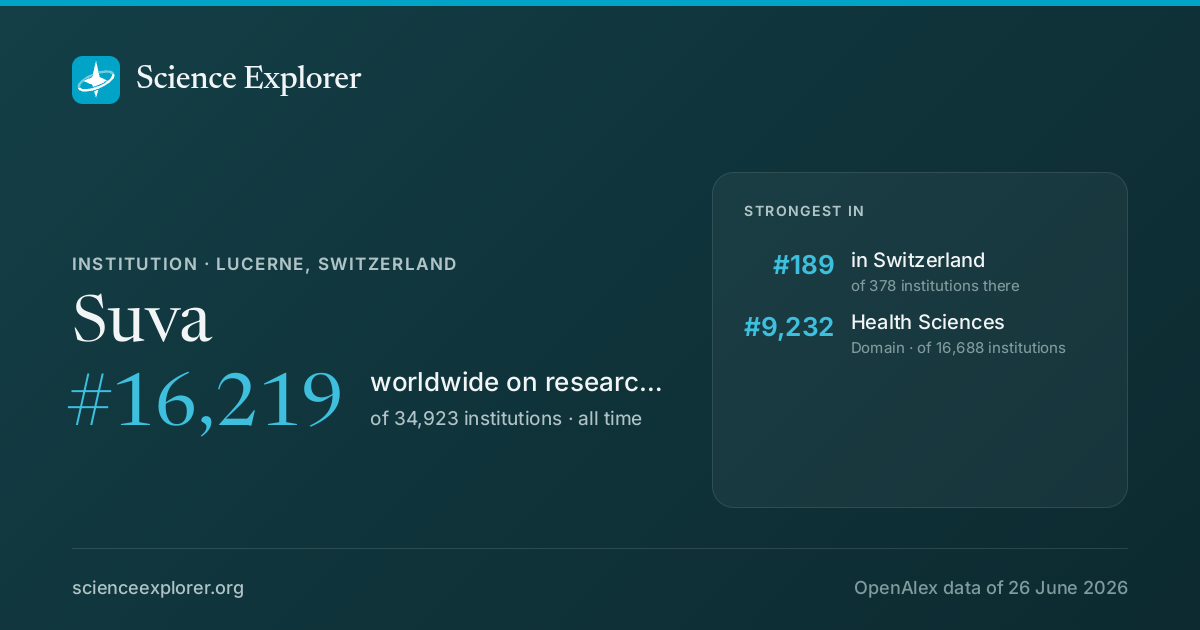
In research, Suva stands highest in Health Sciences (#9,232 of 16,688 worldwide), over all time.

World rank, all time
#16,219
of 34,923
Rank in Switzerland
#189
of 378
Research works
310
▼ 50% vs 2018-21
Citations
1.7k
5.5 per fractional work
Top-10% rate
9.8%
all institutions 10.0%
vs its own fields
0.94×
1.00× is exactly expected
Open access
42%
world 40%
International
18%
world 18%

What is Suva known for in research?

The fields where it stands highest, over all time, ranked among every institution above the floor in each field.

FieldWorld rankWhere that sitsTop-10% rateWorks
Health SciencesDomain #9,232 of 16,688 5.4%157

Each strip is that field's whole ranked pool, with the notch where Suva sits in it, in the colour of the band that rank falls in. The track under the rate is the rate itself: it carries no average mark, because the average differs by field (from about 6% in Dentistry to 21% in Economics).

Which fields of science does Suva work in?

In 2022-now, 50% of research at Suva is in Health Sciences, 28% in Social Sciences. Its largest fields are Health Professions (25%), Medicine (24%), Social Sciences (15%). It does 1.9× the world's share of Health Sciences.

Health Sciences: 18 fractional works · 50.4% of its workHealth Professions: 9 fractional works · 25.4% of its workGeneral Health Professions: 6 fractional works · 16.0% of its workRadiological and Ultrasound Technology: 2 fractional works · 5.7% of its workSpeech and Hearing: 1 fractional works · 1.7% of its workOccupational Therapy: 0 fractional works · 0.9% of its workPhysical Therapy, Sports Therapy and Rehabilitation: 0 fractional works · 0.9% of its workMedicine: 9 fractional works · 24.1% of its workSurgery: 2 fractional works · 4.5% of its workEpidemiology: 1 fractional works · 3.1% of its workPublic Health, Environmental and Occupational Health: 1 fractional works · 2.1% of its workDermatology: 1 fractional works · 1.9% of its workPulmonary and Respiratory Medicine: 1 fractional works · 1.7% of its workPharmacology: 1 fractional works · 1.6% of its workRehabilitation: 1 fractional works · 1.5% of its workHematology: 1 fractional works · 1.4% of its workOncology: 0 fractional works · 1.2% of its workOrthopedics and Sports Medicine: 0 fractional works · 1.2% of its workRheumatology: 0 fractional works · 0.9% of its workPhysiology: 0 fractional works · 0.9% of its workEmergency Medicine: 0 fractional works · 0.6% of its workAnesthesiology and Pain Medicine: 0 fractional works · 0.5% of its workPathology and Forensic Medicine: 0 fractional works · 0.3% of its workPediatrics, Perinatology and Child Health: 0 fractional works · 0.3% of its workSmaller subfields together: 0 fractional works · 0.5% of its workNursing: 0 fractional works · 0.9% of its workNutrition and Dietetics: 0 fractional works · 0.7% of its workIssues, ethics and legal aspects: 0 fractional works · 0.2% of its workSocial Sciences: 10 fractional works · 28.0% of its workSocial Sciences: 5 fractional works · 15.1% of its workSociology and Political Science: 4 fractional works · 10.9% of its workEducation: 0 fractional works · 1.4% of its workHealth: 0 fractional works · 1.4% of its workLaw: 0 fractional works · 0.9% of its workPolitical Science and International Relations: 0 fractional works · 0.6% of its workArts and Humanities: 2 fractional works · 5.7% of its workPhilosophy: 1 fractional works · 4.0% of its workGeneral Arts and Humanities: 0 fractional works · 0.8% of its workHistory: 0 fractional works · 0.6% of its workReligious studies: 0 fractional works · 0.3% of its workPsychology: 2 fractional works · 5.0% of its workSocial Psychology: 1 fractional works · 2.2% of its workClinical Psychology: 1 fractional works · 1.6% of its workExperimental and Cognitive Psychology: 0 fractional works · 1.3% of its workBusiness, Management and Accounting: 0 fractional works · 1.4% of its workOrganizational Behavior and Human Resource Management: 0 fractional works · 0.9% of its workStrategy and Management: 0 fractional works · 0.5% of its workEconomics, Econometrics and Finance: 0 fractional works · 0.8% of its workEconomics and Econometrics: 0 fractional works · 0.5% of its workFinance: 0 fractional works · 0.2% of its workSmaller subfields together: 0 fractional works · 0.0% of its workPhysical Sciences: 6 fractional works · 16.9% of its workEngineering: 3 fractional works · 9.6% of its workCivil and Structural Engineering: 1 fractional works · 3.5% of its workMechanical Engineering: 1 fractional works · 3.5% of its workControl and Systems Engineering: 0 fractional works · 1.2% of its workAerospace Engineering: 0 fractional works · 0.5% of its workBuilding and Construction: 0 fractional works · 0.5% of its workMechanics of Materials: 0 fractional works · 0.4% of its workSmaller subfields together: 0 fractional works · 0.2% of its workEarth and Planetary Sciences: 1 fractional works · 2.5% of its workGeology: 0 fractional works · 0.9% of its workSpace and Planetary Science: 0 fractional works · 0.9% of its workEarth-Surface Processes: 0 fractional works · 0.2% of its workGeophysics: 0 fractional works · 0.2% of its workSmaller subfields together: 0 fractional works · 0.2% of its workEnvironmental Science: 1 fractional works · 1.8% of its workHealth, Toxicology and Mutagenesis: 0 fractional works · 0.5% of its workManagement, Monitoring, Policy and Law: 0 fractional works · 0.4% of its workEcology: 0 fractional works · 0.3% of its workEnvironmental Chemistry: 0 fractional works · 0.2% of its workSmaller subfields together: 0 fractional works · 0.4% of its workChemical Engineering: 0 fractional works · 1.0% of its workFluid Flow and Transfer Processes: 0 fractional works · 0.7% of its workCatalysis: 0 fractional works · 0.2% of its workSmaller subfields together: 0 fractional works · 0.1% of its workComputer Science: 0 fractional works · 0.9% of its workComputer Vision and Pattern Recognition: 0 fractional works · 0.5% of its workArtificial Intelligence: 0 fractional works · 0.2% of its workSignal Processing: 0 fractional works · 0.2% of its workEnergy: 0 fractional works · 0.7% of its workEnergy Engineering and Power Technology: 0 fractional works · 0.5% of its workRenewable Energy, Sustainability and the Environment: 0 fractional works · 0.2% of its workMaterials Science: 0 fractional works · 0.4% of its workMaterials Chemistry: 0 fractional works · 0.4% of its workPhysics and Astronomy: 0 fractional works · 0.0% of its workLife Sciences: 2 fractional works · 4.8% of its workNeuroscience: 1 fractional works · 2.7% of its workCognitive Neuroscience: 1 fractional works · 2.3% of its workSensory Systems: 0 fractional works · 0.4% of its workBiochemistry, Genetics and Molecular Biology: 0 fractional works · 0.7% of its workGenetics: 0 fractional works · 0.7% of its workSmaller subfields together: 0 fractional works · 0.1% of its workAgricultural and Biological Sciences: 0 fractional works · 0.6% of its workPlant Science: 0 fractional works · 0.3% of its workSoil Science: 0 fractional works · 0.2% of its workSmaller subfields together: 0 fractional works · 0.0% of its workImmunology and Microbiology: 0 fractional works · 0.6% of its workParasitology: 0 fractional works · 0.3% of its workImmunology: 0 fractional works · 0.2% of its workPharmacology, Toxicology and Pharmaceutics: 0 fractional works · 0.2% of its workALL ITS WORKSuva36fractional works, 2022-now
Life Sciences5%Physical Sciences17%Health Sciences50%Social Sciences28%

Each ring splits the one inside it: the four domains of science, their fields, their subfields. Size is fractional works in 2022-now. Every slice is a page; the interactive view zooms down to single topics and colours each by how much more of it this institution does than the world.

Its 4 domains and 21 fields, with their numbers
    1. Health Professions925.4%
    2. Medicine924.1%
    3. Nursing00.9%
    1. Social Sciences515.1%
    2. Arts and Humanities25.7%
    3. Psychology25.0%
    4. Business, Management and Accounting01.4%
    5. Economics, Econometrics and Finance00.8%
    1. Engineering39.6%
    2. Earth and Planetary Sciences12.5%
    3. Environmental Science11.8%
    4. Chemical Engineering01.0%
    5. Computer Science00.9%
    6. Energy00.7%
    7. Materials Science00.4%
    8. Physics and Astronomy00.0%
    1. Neuroscience12.7%
    2. Biochemistry, Genetics and Molecular Biology00.7%
    3. Agricultural and Biological Sciences00.6%
    4. Immunology and Microbiology00.6%
    5. Pharmacology, Toxicology and Pharmaceutics00.2%
All of science, and how each field's share has moved since 1950: the Science domain explorer

Field profile

Location quotient across every field it publishes in: outside the ring is more than an institution of this size would be expected to publish, inside it is less.

Agricultural and Biological Sciences: 0.12× its world share, 0 worksAgricultural and Bio…Biochemistry, Genetics and Molecular Biology: 0.14× its world share, 0 worksBiochemistry, Geneti…Immunology and Microbiology: 0.54× its world share, 0 worksImmunology and Micro…Neuroscience: 1.67× its world share, 1 worksNeurosciencePharmacology, Toxicology and Pharmaceutics: 0.52× its world share, 0 worksPharmacology, Toxico…Chemical Engineering: 2.75× its world share, 0 worksChemical EngineeringComputer Science: 0.12× its world share, 0 worksComputer ScienceEarth and Planetary Sciences: 1.58× its world share, 1 worksEarth and Planetary …Energy: 0.75× its world share, 0 worksEnergyEngineering: 0.64× its world share, 4 worksEngineeringEnvironmental Science: 0.35× its world share, 1 worksEnvironmental ScienceMaterials Science: 0.12× its world share, 0 worksMaterials SciencePhysics and Astronomy: 0.01× its world share, 0 worksPhysics and AstronomyHealth Professions: 9.63× its world share, 9 worksHealth ProfessionsMedicine: 1.25× its world share, 9 worksMedicineNursing: 1.81× its world share, 0 worksNursingArts and Humanities: 1.96× its world share, 2 worksArts and HumanitiesBusiness, Management and Accounting: 0.43× its world share, 0 worksBusiness, Management…Economics, Econometrics and Finance: 0.36× its world share, 0 worksEconomics, Econometr…Psychology: 1.66× its world share, 2 worksPsychologySocial Sciences: 1.20× its world share, 6 worksSocial Sciences1×world share
more than its size predictsabout as predictedless

Rings at 0.5×, 1× and 2×. Widest outward: Health Professions, 9.6×. Every wedge is a field page.

All 21 fields, with their numbers
  1. Health Professions9.63×9 works
  2. Chemical Engineering2.75×0 works
  3. Arts and Humanities1.96×2 works
  4. Nursing1.81×0 works
  5. Neuroscience1.67×1 works
  6. Psychology1.66×2 works
  7. Earth and Planetary Sciences1.58×1 works
  8. Medicine1.25×9 works
  9. Social Sciences1.20×6 works
  10. Energy0.75×0 works
  11. Engineering0.64×4 works
  12. Immunology and Microbiology0.54×0 works
  13. Pharmacology, Toxicology and Pharmaceutics0.52×0 works
  14. Business, Management and Accounting0.43×0 works
  15. Economics, Econometrics and Finance0.36×0 works
  16. Environmental Science0.35×1 works
  17. Biochemistry, Genetics and Molecular Biology0.14×0 works
  18. Agricultural and Biological Sciences0.12×0 works
  19. Computer Science0.12×0 works
  20. Materials Science0.12×0 works
  21. Physics and Astronomy0.01×0 works

Who are the top researchers at Suva?

Ranked on the quality score, Stefan Scholz, Hanspeter Rast and U Glück lead among researchers whose main affiliation is Suva.

  1. 1 Stefan Scholz Switzerland · #915,036 worldwide 874 citations · 66 works
  2. 2 Hanspeter Rast Switzerland · #2,225,829 worldwide 199 citations · 18 works
  3. 3 U Glück Switzerland · #2,551,762 worldwide 582 citations · 20 works
  4. 4 Christian Huldi Switzerland · #2,783,721 worldwide 38 citations · 24 works
  5. 5 Patrick Steinle Switzerland · #2,919,566 worldwide 424 citations · 15 works
  6. 6 Beat W. Hohmann Switzerland · #4,367,921 worldwide 185 citations · 21 works
  7. 7 Rudolf Rometsch Switzerland · #4,398,461 worldwide 4 citations · 17 works
  8. 8 Jean-Pierre Zana Switzerland · #4,550,101 worldwide 14 citations · 24 works
  9. 9 Michael F. Koller Switzerland · #4,660,709 worldwide 279 citations · 42 works
All ranked researchers at Suva

What are the most cited papers from Suva?

The most cited paper from Suva is "Countrywide Campaign to Prevent Soccer Injuries in Swiss Amateur Players" (Astrid Junge, Markus Lamprecht, Hanspeter Stamm et al., 2010), with 198 citations. Next come "Ingested probiotics reduce nasal colonization with pathogenic bacteria (Staphylococcus aureus, Streptococcus pneumoniae, and β-hemolytic streptococci)" (192) and "Occupational Exposure to Dusts, Gases, and Fumes and Incidence of Chronic Obstructive Pulmonary Disease in the Swiss Cohort Study on Air Pollution and Lung and Heart Diseases in Adults" (191).

Most cited papers
#PaperReleasedCitations
1 Countrywide Campaign to Prevent Soccer Injuries in Swiss Amateur Players Astrid Junge, Markus Lamprecht, Hanspeter Stamm et al. · The American Journal of Sports Medicine 17 Oct 2010 198
2 Ingested probiotics reduce nasal colonization with pathogenic bacteria (Staphylococcus aureus, Streptococcus pneumoniae, and β-hemolytic streptococci) U Glück, Jan‐Olaf Gebbers · American Journal of Clinical Nutrition Open access Feb 2003 192
3 Occupational Exposure to Dusts, Gases, and Fumes and Incidence of Chronic Obstructive Pulmonary Disease in the Swiss Cohort Study on Air Pollution and Lung and Heart Diseases in Adults Amar Jayant Mehta, David Miedinger, Dirk Keidel et al. · American Journal of Respiratory and Critical Care Medicine 8 Apr 2012 191
4 Characterization of emissions from a desktop 3D printer and indoor air measurements in office settings Patrick Steinle · Journal of Occupational and Environmental Hygiene 9 Nov 2015 185
5 A review of long-term pesticide monitoring studies to assess surface water quality trends Reynold Chow, Ruth Scheidegger, Tobias Doppler et al. · Water Research X Open access 6 Sep 2020 155
All 60 most cited papers, with filters and sorting

Which keywords describe research at Suva?

By fractional works in 2022-now, weighted toward what it does more of than the world: Public Health, Risk Perception, Chronic Diseases, Germany, Health Surveys, Workplace Safety, Epidemiology and Accident Prevention.

▲ more of its work than of the world's◆ about the world's share▼ less than the world's

Size is fractional works in 2022-now in the topics tagged with each word; colour is the word's share of this institution's work against its share of the world's. The 30 words are chosen for being large and distinctive. Each links to the topic it comes from most.

All 30 words, with their numbers
  1. Epidemiology4▲ 2.6×16 topics
  2. Public Health3▲ 5.8×4 topics
  3. Risk Perception3▲ 27×2 topics
  4. Chronic Diseases2▲ 26×2 topics
  5. Germany2▲ 346×1 topic
  6. Health Surveys2▲ 346×1 topic
  7. Workplace Safety2▲ 45×2 topics
  8. Accident Prevention2▲ 84×2 topics
  9. Occupational Safety2▲ 61×1 topic
  10. Safety Climate2▲ 67×1 topic
  11. Safety Culture2▲ 84×2 topics
  12. Social Determinants of Health2▲ 27×3 topics
  13. Risk Factors2▲ 3.7×4 topics
  14. Constitutional Law1▲ 29×3 topics
  15. Education1▲ 2.1×4 topics
  16. Prevention Strategies1▲ 36×2 topics
  17. Machine Learning1◆ 0.97×5 topics
  18. Aging Population1▲ 35×2 topics
  19. Argumentation1▲ 108×1 topic
  20. Discourse Analysis1▲ 13×1 topic
  21. Elderly Care1▲ 20×2 topics
  22. Health Outcomes1▲ 12×3 topics
  23. Mental Health1▲ 2.1×2 topics
  24. Criminal Law1▲ 18×1 topic
  25. Cultural Heritage1▲ 5.3×5 topics
  26. Demographic Transition1▲ 45×1 topic
  27. Infanticide1▲ 232×1 topic
  28. Maternal Filicide1▲ 232×1 topic
  29. Migrant Health1▲ 376×1 topic
  30. Prison System1▲ 50×1 topic

Which research topics does Suva publish most on?

By volume in 2022-now: Health and Medical Studies, Occupational Health and Safety Research, Linguistics and Discourse Analysis and Criminal Law and Policy.

  1. 1 Health and Medical Studies General Health Professions 2 works
  2. 2 Occupational Health and Safety Research Radiological and Ultrasound Technology 2 works
  3. 3 Linguistics and Discourse Analysis Philosophy 1 works
  4. 4 Criminal Law and Policy Sociology and Political Science 1 works
  5. 5 Social and Demographic Issues in Germany General Health Professions 1 works
  6. 6 Homicide, Infanticide, and Child Abuse Sociology and Political Science 1 works
  7. 7 Employment and Welfare Studies General Health Professions 1 works
  8. 8 Social Policies and Family Sociology and Political Science 1 works
  9. 9 Surgical Sutures and Adhesives Surgery 1 works
  10. 10 Structural Health Monitoring Techniques Civil and Structural Engineering 0 works

How open and international is its research?

Against the world's own shares: the tick on each track. Both are shares of its output, so they sit on one scale and can be read against each other as well as against the world.

openly available41.8%not open58.2%

World: 40% of research is openly available.

with international co-authors18.2%domestic only81.8%

World: 18% is written across borders.

How has Suva's research output changed?

Output in 2022-2025 was 50% lower than in 2018-2021.

still counting1990200020102020
grewheldshrank

The same series as a ribbon: one cell per year, darker for more. The line above answers how much; this answers when.

Its share of all research

Growing output can still be a shrinking share: all of science grows. This is Suva as a percentage of every work published that year, 0.000083% in 2024.

still counting0.0010%0.0020%Suva0.00011% in 202519801990200020102020

Fractional works of Suva over all fractional works that year. How the balance of science has shifted.

Other research institutions in Lucerne

All research institutions in Lucerne

Share Suva's ranking

Suva on Science Explorer

A card with Suva's standing and the fields it leads in, for a post or a slide. A link to this page previews as the same card.

Download the card

1200 × 630 PNG, sized for social posts, drawn from the latest snapshot.

Badges for a website1Each links back here and updates with every snapshot

Research measures only: rankings here say nothing about teaching, admissions or student experience. Comparable institutions and collaboration partners have tabs of their own, above.

Discussion

Ask a question or share a note about Suva. Posts are plain text and can be reported.