Technicolor (France)
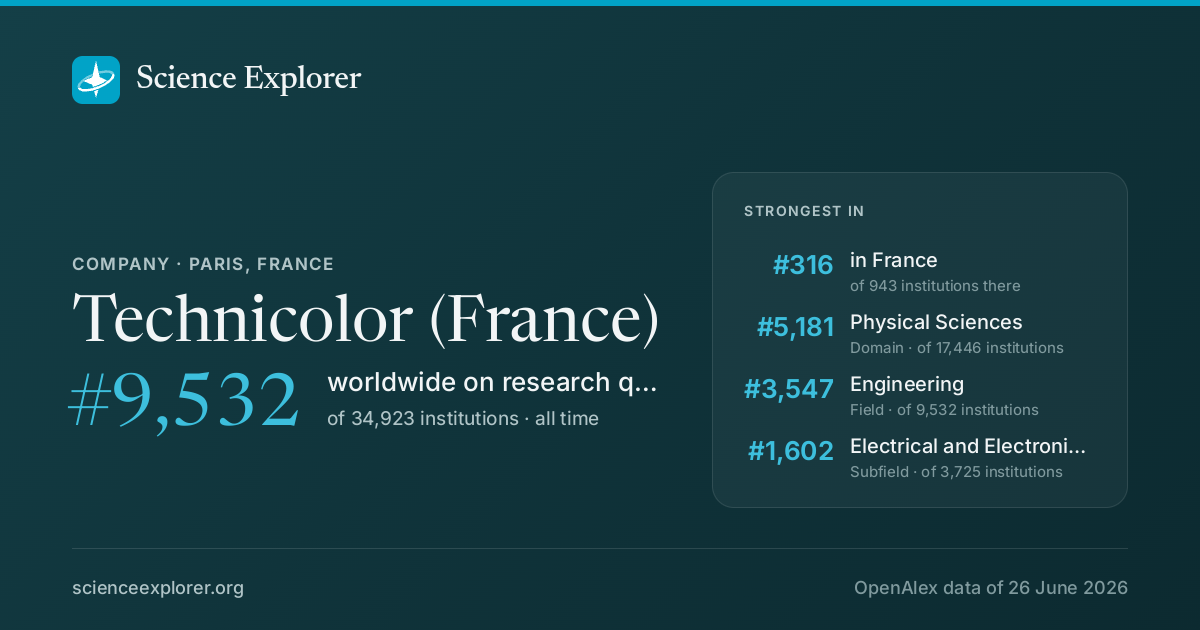
In research, Technicolor (France) stands highest in Physical Sciences (#5,181 of 17,446 worldwide), Engineering (#3,547 of 9,532 worldwide) and Electrical and Electronic Engineering (#1,602 of 3,725 worldwide), over all time.
- World rank, all time
- #9,532 of 34,923
- Rank in France
- #316 of 943
- Research works
- 2.1k ▼ 74% vs 2018-21
- Citations
- 32k 15.5 per fractional work
- Top-10% rate
- 7.3% all institutions 10.0%
- vs its own fields
- 0.85× 1.00× is exactly expected
- Open access
- 12% world 40%
- International
- 15% world 18%
What is Technicolor (France) known for in research?
The fields where it stands highest, over all time, ranked among every institution above the floor in each field.
| Field | World rank | Where that sits | Top-10% rate | Works |
|---|---|---|---|---|
| Physical SciencesDomain | #5,181 of 17,446 | 8.0% | 1,912 | |
| EngineeringField | #3,547 of 9,532 | 5.9% | 948 | |
| Electrical and Electronic EngineeringSubfield | #1,602 of 3,725 | 5.8% | 558 | |
| Computer ScienceField | #3,281 of 6,336 | 13.0% | 511 | |
| Computer Vision and Pattern RecognitionSubfield | #1,042 of 1,718 | 7.4% | 201 | |
| Physics and AstronomyField | #1,919 of 2,917 | 6.7% | 276 | |
| Atomic and Molecular Physics, and OpticsSubfield | #1,080 of 1,567 | 7.2% | 218 | |
| Aerospace EngineeringSubfield | #1,374 of 1,601 | 5.5% | 126 |
Each strip is that field's whole ranked pool, with the notch where Technicolor (France) sits in it, in the colour of the band that rank falls in. The track under the rate is the rate itself: it carries no average mark, because the average differs by field (from about 6% in Dentistry to 21% in Economics).
Which fields of science does Technicolor (France) work in?
In all years, 91% of research at Technicolor (France) is in Physical Sciences, 4% in Social Sciences. Its largest fields are Engineering (45%), Computer Science (24%), Physics and Astronomy (13%). It does 2.2× the world's share of Physical Sciences.
Each ring splits the one inside it: the four domains of science, their fields, their subfields. Size is fractional works in all years. Every slice is a page; the interactive view zooms down to single topics and colours each by how much more of it this institution does than the world.
Its 4 domains and 25 fields, with their numbers
- Physical Sciences1,91291.5%
- Engineering94845.4%
- Computer Science51124.5%
- Physics and Astronomy27613.2%
- Materials Science1004.8%
- Earth and Planetary Sciences221.1%
- Chemistry221.1%
- Mathematics120.6%
- Environmental Science110.5%
- Chemical Engineering70.4%
- Energy20.1%
- Social Sciences904.3%
- Social Sciences422.0%
- Decision Sciences110.5%
- Business, Management and Accounting100.5%
- Arts and Humanities90.4%
- Psychology90.4%
- Economics, Econometrics and Finance80.4%
- Health Sciences643.1%
- Medicine522.5%
- Health Professions100.5%
- Dentistry10.0%
- Nursing00.0%
- Life Sciences251.2%
Field profile
Location quotient across every field it publishes in: outside the ring is more than an institution of this size would be expected to publish, inside it is less.
Rings at 0.5×, 1× and 2×. Widest outward: Pharmacology, Toxicology and Pharmaceutics, 2.7×. Every wedge is a field page.
All 18 fields, with their numbers
- Pharmacology, Toxicology and Pharmaceutics2.67×0 works
- Engineering2.52×7 works
- Computer Science2.44×3 works
- Psychology1.68×1 works
- Materials Science0.99×1 works
- Physics and Astronomy0.85×0 works
- Medicine0.85×3 works
- Health Professions0.77×0 works
- Environmental Science0.67×1 works
- Arts and Humanities0.65×0 works
- Decision Sciences0.65×0 works
- Mathematics0.53×0 works
- Nursing0.43×0 works
- Social Sciences0.41×1 works
- Immunology and Microbiology0.37×0 works
- Earth and Planetary Sciences0.33×0 works
- Energy0.32×0 works
- Neuroscience0.14×0 works
- Pharmacology, Toxicology and Pharmaceutics 2.7×
- Engineering 2.5×
- Computer Science 2.4×
- Psychology 1.7×
- Materials Science 1.0×
- Physics and Astronomy 0.8×
- Medicine 0.8×
- Health Professions 0.8×
- Environmental Science 0.7×
- Arts and Humanities 0.7×
- Decision Sciences 0.7×
- Mathematics 0.5×
- Nursing 0.4×
- Social Sciences 0.4×
- Immunology and Microbiology 0.4×
- Earth and Planetary Sciences 0.3×
- Energy 0.3×
- Neuroscience 0.1×
Who are the top researchers at Technicolor (France)?
Ranked on the quality score, Laurent Massoulié, Patrick Pérez and Marc Jóye lead among researchers whose main affiliation is Technicolor (France).
- 1
Laurent Massoulié
 France · #302,042 worldwide
13k citations · 283 works
- 2
Patrick Pérez
France · #455,435 worldwide
16k citations · 205 works
- 3
Marc Jóye
France · #465,179 worldwide
8.5k citations · 218 works
- 4
J. P. Herriau
France · #1,200,836 worldwide
1.2k citations · 43 works
- 5
Henrik Lundgren
France · #1,539,154 worldwide
1.5k citations · 49 works
- 6
Quan Huynh‐Thu
France · #1,632,713 worldwide
4k citations · 29 works
- 7
Alexey Ozerov
France · #1,747,847 worldwide
3.5k citations · 132 works
- 8
Gwenaël Doërr
France · #1,916,915 worldwide
2k citations · 107 works
- 9
Nuyen T. Linh
France · #2,026,874 worldwide
2.2k citations · 69 works
- 10
Sébastien Lasserre
France · #2,047,179 worldwide
2.6k citations · 24 works
Which keywords describe research at Technicolor (France)?
By fractional works in all years, weighted toward what it does more of than the world: Deep Learning, Integrated Circuits, Optical Modulators, Raman Lasers, Silicon Photonics, Biosensors, Semiconductor Lasers and Nonlinear Optics.
- Substrate Integrated Waveguide
- Stereo Vision
- Wireless Networks
- Sparse Representation
- High-k Dielectrics
- Semiconductor Devices
- Excitons
- Quantum Dots
- Photonic Crystals
- Convolutional Networks
- Artificial Neural Networks
- Photovoltaics
- Nanowires
- Nanophotonic Waveguides
- Microresonators
- Optical Interconnects
- Semiconductor Lasers
- Biosensors
- Neural Networks
- Integrated Circuits
- Deep Learning
- Optical Modulators
- Raman Lasers
- Silicon Photonics
- Nonlinear Optics
- Vertical-Cavity Surface-Emitting Lasers (VCSELs)
- Microcavities
- Whispering Gallery Mode
- Frequency Conversion
- Band Parameters
- Semiconductor
- Depth Estimation
- Solar Cells
- Nanoelectronics
- Single-Photon Source
- Atomic Layer Deposition
- Video Coding
- Unsupervised Learning
- Optical Flow
- Microwave Filters
Size is fractional works in all years in the topics tagged with each word; colour is the word's share of this institution's work against its share of the world's. The 40 words are chosen for being large and distinctive. Each links to the topic it comes from most.
All 40 words, with their numbers
- Deep Learning183▲ 4.1×54 topics
- Integrated Circuits106▲ 22×3 topics
- Optical Modulators96▲ 22×3 topics
- Neural Networks78▲ 3.5×20 topics
- Raman Lasers76▲ 21×2 topics
- Biosensors72▲ 6.0×8 topics
- Silicon Photonics67▲ 20×2 topics
- Semiconductor Lasers64▲ 32×2 topics
- Nonlinear Optics63▲ 17×4 topics
- Optical Interconnects63▲ 38×1 topic
- Vertical-Cavity Surface-Emitting Lasers (VCSELs)63▲ 38×1 topic
- Microresonators63▲ 24×3 topics
- Microcavities62▲ 19×2 topics
- Nanophotonic Waveguides61▲ 21×1 topic
- Whispering Gallery Mode61▲ 21×1 topic
- Nanowires61▲ 12×4 topics
- Frequency Conversion59▲ 28×3 topics
- Photovoltaics59▲ 11×4 topics
- Band Parameters54▲ 21×2 topics
- Artificial Neural Networks51▲ 5.8×5 topics
- Semiconductor49▲ 7.1×6 topics
- Convolutional Networks48▲ 20×3 topics
- Depth Estimation46▲ 23×2 topics
- Photonic Crystals46▲ 14×5 topics
- Solar Cells46▲ 7.2×6 topics
- Quantum Dots45▲ 14×3 topics
- Nanoelectronics44▲ 14×2 topics
- Excitons42▲ 26×1 topic
- Single-Photon Source42▲ 26×1 topic
- Semiconductor Devices42▲ 15×2 topics
- Atomic Layer Deposition42▲ 15×1 topic
- High-k Dielectrics42▲ 15×1 topic
- Video Coding42▲ 43×2 topics
- Sparse Representation41▲ 11×6 topics
- Unsupervised Learning40▲ 20×3 topics
- Wireless Networks38▲ 8.0×9 topics
- Optical Flow37▲ 29×1 topic
- Stereo Vision37▲ 29×1 topic
- Microwave Filters36▲ 25×1 topic
- Substrate Integrated Waveguide36▲ 25×1 topic
Which research topics does Technicolor (France) publish most on?
By volume in 2022-now: Structural Health Monitoring Techniques, Combustion and Detonation Processes, Dynamics and Control of Mechanical Systems and Vibration and Dynamic Analysis.
Area is fractional works; colour is the subfield each topic belongs to.
- 1 Structural Health Monitoring Techniques Civil and Structural Engineering 1 works
- 2 Combustion and Detonation Processes Aerospace Engineering 0 works
- 3 Dynamics and Control of Mechanical Systems Control and Systems Engineering 0 works
- 4 Vibration and Dynamic Analysis Control and Systems Engineering 0 works
- 5 Electromagnetic Launch and Propulsion Technology Aerospace Engineering 0 works
- 6 Advanced MIMO Systems Optimization Electrical and Electronic Engineering 0 works
- 7 Control Systems and Identification Control and Systems Engineering 0 works
- 8 Sport Psychology and Performance Developmental and Educational Psychology 0 works
- 9 Attention Deficit Hyperactivity Disorder Psychiatry and Mental health 0 works
- 10 Laser-Plasma Interactions and Diagnostics Nuclear and High Energy Physics 0 works
How open and international is its research?
Against the world's own shares: the tick on each track. Both are shares of its output, so they sit on one scale and can be read against each other as well as against the world.
World: 40% of research is openly available.
World: 18% is written across borders.
How has Technicolor (France)'s research output changed?
Output in 2022-2025 was 74% lower than in 2018-2021.
The same series as a ribbon: one cell per year, darker for more. The line above answers how much; this answers when.
Its share of all research
Growing output can still be a shrinking share: all of science grows. This is Technicolor (France) as a percentage of every work published that year, 0.00016% in 2024.
Fractional works of Technicolor (France) over all fractional works that year. How the balance of science has shifted.
How much of it reaches the world top 10%
Year by year, against all institutions in the same year.
Of each year's output, the share that reached the world's 10% most cited for its field and year. Peak 27.3% in 2007.
Other research institutions in Paris
- International and European Law School
- Issy Media (France)
- École de Formation Professionnelle des Barreaux de la Cour d'Appel de Paris
- Cisco Systems (France)
- Itron (France)
- Intempora (France)
- ITEMS International
Share Technicolor (France)'s ranking
Badges for a website1Each links back here and updates with every snapshot

Research measures only: rankings here say nothing about teaching, admissions or student experience. Comparable institutions and collaboration partners have tabs of their own, above.
Discussion
Ask a question or share a note about Technicolor (France). Keep it to the research: no personal attacks, advertising or links. Any reader can report a post, which collapses it for everyone until it is opened.