TechnipFMC (United States)
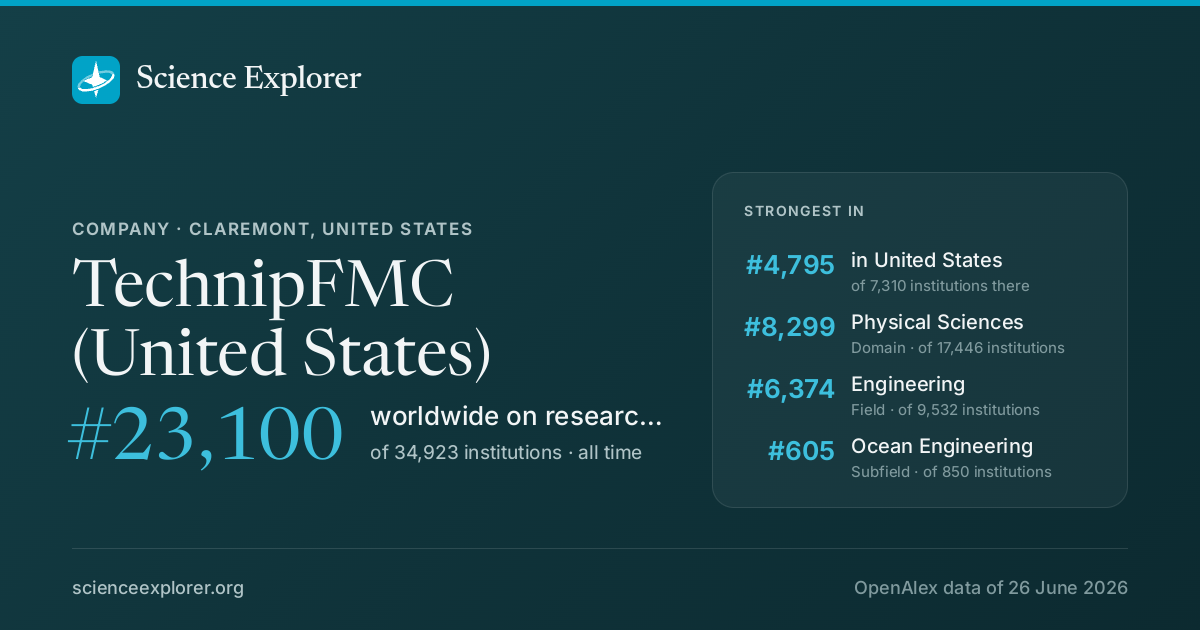
In research, TechnipFMC (United States) stands highest in Physical Sciences (#8,299 of 17,446 worldwide), Engineering (#6,374 of 9,532 worldwide) and Ocean Engineering (#605 of 850 worldwide), over all time. Relative to its size it is most specialised in Engineering (Engineering is 5.6× its share of world research).
- World rank, all time
- #23,100 of 34,923
- Rank in United States
- #4,795 of 7,310
- Research works
- 377 ▼ 8% vs 2018-21
- Citations
- 3k 8.1 per fractional work
- Top-10% rate
- 2.3% all institutions 10.0%
- vs its own fields
- 0.96× 1.00× is exactly expected
- Open access
- 8% world 40%
- International
- 20% world 18%
What is TechnipFMC (United States) known for in research?
The fields where it stands highest, over all time, ranked among every institution above the floor in each field.
| Field | World rank | Where that sits | Top-10% rate | Works |
|---|---|---|---|---|
| Physical SciencesDomain | #8,299 of 17,446 | 6.3% | 354 | |
| EngineeringField | #6,374 of 9,532 | 6.4% | 299 | |
| Ocean EngineeringSubfield | #605 of 850 | 7.9% | 171 |
Each strip is that field's whole ranked pool, with the notch where TechnipFMC (United States) sits in it, in the colour of the band that rank falls in. The track under the rate is the rate itself: it carries no average mark, because the average differs by field (from about 6% in Dentistry to 21% in Economics).
Which fields of science does TechnipFMC (United States) work in?
In 2022-now, 97% of research at TechnipFMC (United States) is in Physical Sciences, 1% in Health Sciences. Its largest fields are Engineering (84%), Materials Science (5%), Earth and Planetary Sciences (3%). It does 2.3× the world's share of Physical Sciences.
Each ring splits the one inside it: the four domains of science, their fields, their subfields. Size is fractional works in 2022-now. Every slice is a page; the interactive view zooms down to single topics and colours each by how much more of it this institution does than the world.
Its 4 domains and 15 fields, with their numbers
- Physical Sciences4597.3%
- Engineering3984.0%
- Materials Science25.0%
- Earth and Planetary Sciences23.3%
- Computer Science11.9%
- Chemistry11.2%
- Environmental Science01.0%
- Energy00.5%
- Chemical Engineering00.3%
- Mathematics00.1%
- Health Sciences11.5%
- Medicine00.7%
- Dentistry00.4%
- Health Professions00.4%
- Life Sciences00.9%
- Social Sciences00.4%
- Social Sciences00.4%
What does TechnipFMC (United States) specialise in?
Where its research is concentrated relative to its size: Engineering takes 5.6× the share of its output that it takes of world research.
- EngineeringField · 38.6 works5.6×
Location quotient, a volume reading rather than an impact one. It surfaces small, lopsided specialities.
Field profile
Location quotient across every field it publishes in: outside the ring is more than an institution of this size would be expected to publish, inside it is less.
Rings at 0.5×, 1× and 2×. Widest outward: Engineering, 5.6×. Every wedge is a field page.
All 15 fields, with their numbers
- Engineering5.60×39 works
- Earth and Planetary Sciences2.08×2 works
- Materials Science1.43×2 works
- Chemical Engineering0.82×0 works
- Chemistry0.76×0 works
- Dentistry0.75×0 works
- Energy0.58×0 works
- Computer Science0.24×1 works
- Environmental Science0.21×0 works
- Health Professions0.14×0 works
- Biochemistry, Genetics and Molecular Biology0.10×0 works
- Mathematics0.09×0 works
- Agricultural and Biological Sciences0.08×0 works
- Medicine0.04×0 works
- Social Sciences0.03×0 works
- Engineering 5.6×
- Earth and Planetary Sciences 2.1×
- Materials Science 1.4×
- Chemical Engineering 0.8×
- Chemistry 0.8×
- Dentistry 0.8×
- Energy 0.6×
- Computer Science 0.2×
- Environmental Science 0.2×
- Health Professions 0.1×
- Biochemistry, Genetics and Molecular Biology 0.1×
- Mathematics 0.1×
- Agricultural and Biological Sciences 0.1×
- Medicine 0.0×
- Social Sciences 0.0×
Who are the top researchers at TechnipFMC (United States)?
Ranked on the quality score, Bonjun J. Koo, Jang Hwan Kim and Bernard R. McCoy lead among researchers whose main affiliation is TechnipFMC (United States).
- 1
Bonjun J. Koo
 United States · #1,831,164 worldwide
1.7k citations · 66 works
- 2
Jang Hwan Kim
United States · #2,202,758 worldwide
857 citations · 70 works
- 3
Bernard R. McCoy
United States · #2,722,359 worldwide
298 citations · 17 works
- 4
Djoni Eka Sidarta
United States · #3,356,631 worldwide
545 citations · 26 works
- 5
Kostas F. Lambrakos
United States · #3,604,175 worldwide
1.1k citations · 66 works
- 6
Mark Chang
United States · #3,684,609 worldwide
110 citations · 24 works
- 7
Ho‐Joon Lim
United States · #3,793,030 worldwide
627 citations · 37 works
- 8
Janardhan Davalath
United States · #3,813,297 worldwide
313 citations · 21 works
- 9
Mayank Lal
United States · #3,935,516 worldwide
50 citations · 17 works
- 10
Paul N. Stanton
United States · #4,048,949 worldwide
173 citations · 25 works
Which keywords describe research at TechnipFMC (United States)?
By fractional works in 2022-now, weighted toward what it does more of than the world: Renewable Energy, Oil and Gas, Subsea, Pipeline, Control Strategies, Power Take-Off, Wave Energy and Numerical Simulation.
- Vibration Analysis
- Thermal Management
- Ensemble Kalman Filter
- Finite Element Simulation
- Coastal Dynamics
- SPH Method
- Vortex-Induced Vibrations
- Flow Control
- Remote Sensing
- Artificial Lift Systems
- Seismic
- Reliability Assessment
- Machine Learning
- Ship Recycling
- Fluid-Structure Interaction
- Finite Element Analysis
- Numerical Simulation
- Power Take-Off
- Pipeline
- Oil and Gas
- Renewable Energy
- Subsea
- Control Strategies
- Wave Energy
- Sustainability
- Environmental Impact
- Offshore Decommissioning
- Corrosion
- Pitting Corrosion
- Risk Analysis
- Tunnel
- Fault Diagnosis
- Heat Transfer
- Turbulent Flow
- Wave Modeling
- Smoothed Particle Hydrodynamics
- Sea-Level Rise
- Fretting Wear
- High-Temperature Electronics
- Failure Analysis
Size is fractional works in 2022-now in the topics tagged with each word; colour is the word's share of this institution's work against its share of the world's. The 40 words are chosen for being large and distinctive. Each links to the topic it comes from most.
All 40 words, with their numbers
- Renewable Energy11▲ 16×3 topics
- Oil and Gas6▲ 395×1 topic
- Subsea6▲ 1478×1 topic
- Pipeline5▲ 97×3 topics
- Control Strategies4▲ 64×2 topics
- Power Take-Off4▲ 428×1 topic
- Wave Energy4▲ 428×1 topic
- Numerical Simulation4▲ 27×4 topics
- Sustainability3▲ 2.9×3 topics
- Finite Element Analysis3▲ 29×2 topics
- Environmental Impact3▲ 3.8×2 topics
- Fluid-Structure Interaction3▲ 44×2 topics
- Offshore Decommissioning3▲ 701×1 topic
- Ship Recycling3▲ 701×1 topic
- Corrosion3▲ 50×4 topics
- Machine Learning3▲ 1.73×3 topics
- Pitting Corrosion2▲ 99×2 topics
- Reliability Assessment2▲ 114×1 topic
- Risk Analysis2▲ 48×1 topic
- Seismic2▲ 88×1 topic
- Tunnel2▲ 58×1 topic
- Artificial Lift Systems2▲ 161×1 topic
- Fault Diagnosis2▲ 31×1 topic
- Remote Sensing2▲ 3.5×3 topics
- Heat Transfer2▲ 8.1×2 topics
- Flow Control2▲ 66×1 topic
- Turbulent Flow2▲ 31×2 topics
- Vortex-Induced Vibrations2▲ 106×1 topic
- Wave Modeling2▲ 63×2 topics
- SPH Method1▲ 104×1 topic
- Smoothed Particle Hydrodynamics1▲ 104×1 topic
- Coastal Dynamics1▲ 102×1 topic
- Sea-Level Rise1▲ 25×1 topic
- Finite Element Simulation1▲ 88×1 topic
- Fretting Wear1▲ 120×1 topic
- Ensemble Kalman Filter1▲ 23×1 topic
- High-Temperature Electronics1▲ 38×2 topics
- Thermal Management1▲ 7.1×2 topics
- Failure Analysis1▲ 25×4 topics
- Vibration Analysis1▲ 8.1×2 topics
Which research topics does TechnipFMC (United States) publish most on?
By volume in 2022-now: Offshore Engineering and Technologies, Wave and Wind Energy Systems, Marine and Offshore Engineering Studies and Structural Integrity and Reliability Analysis.
Area is fractional works; colour is the subfield each topic belongs to.
- 1 Offshore Engineering and Technologies Ocean Engineering 6 works
- 2 Wave and Wind Energy Systems Ocean Engineering 4 works
- 3 Marine and Offshore Engineering Studies Ocean Engineering 3 works
- 4 Structural Integrity and Reliability Analysis Mechanical Engineering 2 works
- 5 Geotechnical Engineering and Underground Structures Civil and Structural Engineering 2 works
- 6 Oil and Gas Production Techniques Ocean Engineering 2 works
- 7 Fluid Dynamics and Vibration Analysis Computational Mechanics 2 works
- 8 Fluid Dynamics Simulations and Interactions Computational Mechanics 1 works
- 9 Coastal and Marine Dynamics Earth-Surface Processes 1 works
- 10 Mechanical stress and fatigue analysis Mechanics of Materials 1 works
How open and international is its research?
Against the world's own shares: the tick on each track. Both are shares of its output, so they sit on one scale and can be read against each other as well as against the world.
World: 40% of research is openly available.
World: 18% is written across borders.
How has TechnipFMC (United States)'s research output changed?
Output in 2022-2025 was 8% lower than in 2018-2021.
The same series as a ribbon: one cell per year, darker for more. The line above answers how much; this answers when.
Its share of all research
Growing output can still be a shrinking share: all of science grows. This is TechnipFMC (United States) as a percentage of every work published that year, 0.00023% in 2024.
Fractional works of TechnipFMC (United States) over all fractional works that year. How the balance of science has shifted.
How much of it reaches the world top 10%
Year by year, against all institutions in the same year.
Of each year's output, the share that reached the world's 10% most cited for its field and year. Peak 10.2% in 2013.
Other research institutions in Claremont
- Claremont Colleges
- Rancho Santa Ana Botanic Garden
- Redwood Scientific (United States)
- Claremont Institute
- W.M. Keck Science Center
- Claremont Lincoln University
- Ancient Biblical Manuscript Center
- Uncommon Good
Share TechnipFMC (United States)'s ranking
Badges for a website1Each links back here and updates with every snapshot

Research measures only: rankings here say nothing about teaching, admissions or student experience. Comparable institutions and collaboration partners have tabs of their own, above.
Discussion
Ask a question or share a note about TechnipFMC (United States). Posts are plain text and can be reported.