Science Explorer Back to mapMap
Discussion
Institution · Apeldoorn · Netherlands

TNO Management Consultants

In research, TNO Management Consultants stands highest in Physical Sciences (#10,354 of 17,446 worldwide), over all time.

World rank, all time
#27,596
of 34,923
Rank in Netherlands
#355
of 407
Research works
208
▲ 19% vs 2018-21
Citations
5.8k
28.0 per fractional work
Top-10% rate
7.0%
all institutions 10.0%
vs its own fields
1.05×
1.00× is exactly expected
Open access
10%
world 40%
International
14%
world 18%

What is TNO Management Consultants known for in research?

The fields where it stands highest, over all time, ranked among every institution above the floor in each field.

FieldWorld rankWhere that sitsTop-10% rateWorks
Physical SciencesDomain #10,354 of 17,446 10.7%175

Each strip is that field's whole ranked pool, with the notch where TNO Management Consultants sits in it, in the colour of the band that rank falls in. The track under the rate is the rate itself: it carries no average mark, because the average differs by field (from about 6% in Dentistry to 21% in Economics).

Which fields of science does TNO Management Consultants work in?

In all years, 84% of research at TNO Management Consultants is in Physical Sciences, 10% in Social Sciences. Its largest fields are Engineering (50%), Environmental Science (19%), Materials Science (6%). It does 2.0× the world's share of Physical Sciences.

Physical Sciences: 175 fractional works · 84.2% of its workEngineering: 104 fractional works · 49.8% of its workMechanical Engineering: 36 fractional works · 17.5% of its workMechanics of Materials: 13 fractional works · 6.4% of its workBiomedical Engineering: 10 fractional works · 4.9% of its workAerospace Engineering: 9 fractional works · 4.3% of its workElectrical and Electronic Engineering: 6 fractional works · 2.8% of its workBuilding and Construction: 5 fractional works · 2.5% of its workComputational Mechanics: 5 fractional works · 2.4% of its workControl and Systems Engineering: 5 fractional works · 2.4% of its workAutomotive Engineering: 4 fractional works · 1.9% of its workCivil and Structural Engineering: 3 fractional works · 1.7% of its workIndustrial and Manufacturing Engineering: 2 fractional works · 1.2% of its workOcean Engineering: 2 fractional works · 1.0% of its workSafety, Risk, Reliability and Quality: 2 fractional works · 0.9% of its workEnvironmental Science: 39 fractional works · 18.6% of its workPollution: 7 fractional works · 3.6% of its workEnvironmental Engineering: 7 fractional works · 3.5% of its workGlobal and Planetary Change: 6 fractional works · 2.8% of its workWater Science and Technology: 6 fractional works · 2.7% of its workIndustrial and Manufacturing Engineering: 4 fractional works · 2.1% of its workHealth, Toxicology and Mutagenesis: 4 fractional works · 2.0% of its workEcology: 2 fractional works · 0.8% of its workEnvironmental Chemistry: 1 fractional works · 0.4% of its workEcological Modeling: 1 fractional works · 0.3% of its workNature and Landscape Conservation: 0 fractional works · 0.2% of its workSmaller subfields together: 0 fractional works · 0.2% of its workMaterials Science: 12 fractional works · 5.7% of its workMaterials Chemistry: 8 fractional works · 3.8% of its workPolymers and Plastics: 1 fractional works · 0.4% of its workSurfaces, Coatings and Films: 1 fractional works · 0.3% of its workMetals and Alloys: 1 fractional works · 0.3% of its workBiomaterials: 1 fractional works · 0.3% of its workGeneral Materials Science: 1 fractional works · 0.3% of its workSmaller subfields together: 0 fractional works · 0.2% of its workEarth and Planetary Sciences: 10 fractional works · 4.9% of its workAtmospheric Science: 10 fractional works · 4.7% of its workSmaller subfields together: 0 fractional works · 0.2% of its workPhysics and Astronomy: 4 fractional works · 1.8% of its workAtomic and Molecular Physics, and Optics: 2 fractional works · 0.8% of its workRadiation: 1 fractional works · 0.6% of its workStatistical and Nonlinear Physics: 1 fractional works · 0.3% of its workSmaller subfields together: 0 fractional works · 0.1% of its workComputer Science: 2 fractional works · 1.0% of its workArtificial Intelligence: 1 fractional works · 0.6% of its workComputer Science Applications: 1 fractional works · 0.3% of its workSmaller subfields together: 0 fractional works · 0.2% of its workChemistry: 2 fractional works · 0.8% of its workOrganic Chemistry: 1 fractional works · 0.3% of its workInorganic Chemistry: 0 fractional works · 0.2% of its workSmaller subfields together: 1 fractional works · 0.3% of its workEnergy: 1 fractional works · 0.7% of its workRenewable Energy, Sustainability and the Environment: 1 fractional works · 0.7% of its workChemical Engineering: 1 fractional works · 0.6% of its workChemical Health and Safety: 1 fractional works · 0.4% of its workProcess Chemistry and Technology: 0 fractional works · 0.2% of its workMathematics: 1 fractional works · 0.3% of its workSocial Sciences: 21 fractional works · 10.0% of its workDecision Sciences: 7 fractional works · 3.5% of its workStatistics, Probability and Uncertainty: 4 fractional works · 2.1% of its workManagement Science and Operations Research: 2 fractional works · 1.1% of its workSmaller subfields together: 0 fractional works · 0.2% of its workBusiness, Management and Accounting: 5 fractional works · 2.4% of its workStrategy and Management: 3 fractional works · 1.3% of its workOrganizational Behavior and Human Resource Management: 1 fractional works · 0.5% of its workMarketing: 1 fractional works · 0.4% of its workManagement Information Systems: 0 fractional works · 0.2% of its workSocial Sciences: 5 fractional works · 2.3% of its workGeography, Planning and Development: 1 fractional works · 0.6% of its workSociology and Political Science: 1 fractional works · 0.5% of its workPublic Administration: 1 fractional works · 0.4% of its workCommunication: 1 fractional works · 0.3% of its workGender Studies: 0 fractional works · 0.2% of its workSmaller subfields together: 1 fractional works · 0.4% of its workEconomics, Econometrics and Finance: 2 fractional works · 1.0% of its workEconomics and Econometrics: 2 fractional works · 1.0% of its workSmaller subfields together: 0 fractional works · 0.1% of its workPsychology: 1 fractional works · 0.6% of its workDevelopmental and Educational Psychology: 0 fractional works · 0.2% of its workSocial Psychology: 0 fractional works · 0.2% of its workSmaller subfields together: 0 fractional works · 0.2% of its workArts and Humanities: 0 fractional works · 0.1% of its workHealth Sciences: 6 fractional works · 2.9% of its workMedicine: 3 fractional works · 1.5% of its workSurgery: 1 fractional works · 0.5% of its workInfectious Diseases: 0 fractional works · 0.2% of its workOrthopedics and Sports Medicine: 0 fractional works · 0.2% of its workSmaller subfields together: 1 fractional works · 0.5% of its workHealth Professions: 2 fractional works · 1.1% of its workRadiological and Ultrasound Technology: 1 fractional works · 0.4% of its workSpeech and Hearing: 1 fractional works · 0.3% of its workMedical Laboratory Technology: 0 fractional works · 0.2% of its workSmaller subfields together: 0 fractional works · 0.1% of its workNursing: 0 fractional works · 0.2% of its workVeterinary: 0 fractional works · 0.1% of its workLife Sciences: 6 fractional works · 2.8% of its workBiochemistry, Genetics and Molecular Biology: 3 fractional works · 1.6% of its workMolecular Biology: 3 fractional works · 1.3% of its workSmaller subfields together: 1 fractional works · 0.3% of its workAgricultural and Biological Sciences: 2 fractional works · 0.9% of its workPlant Science: 1 fractional works · 0.6% of its workEcology, Evolution, Behavior and Systematics: 0 fractional works · 0.2% of its workSmaller subfields together: 0 fractional works · 0.1% of its workPharmacology, Toxicology and Pharmaceutics: 1 fractional works · 0.3% of its workPharmaceutical Science: 1 fractional works · 0.3% of its workALL ITS WORKTNO ManagementConsultants208fractional works, all years
Life Sciences3%Physical Sciences84%Health Sciences3%Social Sciences10%

Each ring splits the one inside it: the four domains of science, their fields, their subfields. Size is fractional works in all years. Every slice is a page; the interactive view zooms down to single topics and colours each by how much more of it this institution does than the world.

Its 4 domains and 23 fields, with their numbers
    1. Engineering10449.8%
    2. Environmental Science3918.6%
    3. Materials Science125.7%
    4. Earth and Planetary Sciences104.9%
    5. Physics and Astronomy41.8%
    6. Computer Science21.0%
    7. Chemistry20.8%
    8. Energy10.7%
    9. Chemical Engineering10.6%
    10. Mathematics10.3%
    1. Decision Sciences73.5%
    2. Business, Management and Accounting52.4%
    3. Social Sciences52.3%
    4. Economics, Econometrics and Finance21.0%
    5. Psychology10.6%
    6. Arts and Humanities00.1%
    1. Medicine31.5%
    2. Health Professions21.1%
    3. Nursing00.2%
    4. Veterinary00.1%
    1. Biochemistry, Genetics and Molecular Biology31.6%
    2. Agricultural and Biological Sciences20.9%
    3. Pharmacology, Toxicology and Pharmaceutics10.3%
All of science, and how each field's share has moved since 1950: the Science domain explorer

Field profile

Location quotient across every field it publishes in: outside the ring is more than an institution of this size would be expected to publish, inside it is less.

Agricultural and Biological Sciences: 0.86× its world share, 0 worksAgricultural and Bio…Engineering: 0.55× its world share, 0 worksEngineeringEnvironmental Science: 6.60× its world share, 1 worksEnvironmental ScienceHealth Professions: 2.33× its world share, 0 worksHealth ProfessionsMedicine: 1.58× its world share, 1 worksMedicineVeterinary: 45.27× its world share, 0 worksVeterinaryPsychology: 4.04× its world share, 0 worksPsychology1×world share
more than its size predictsabout as predictedless

Rings at 0.5×, 1× and 2×. Widest outward: Veterinary, 45.3×. Every wedge is a field page.

All 7 fields, with their numbers
  1. Veterinary45.27×0 works
  2. Environmental Science6.60×1 works
  3. Psychology4.04×0 works
  4. Health Professions2.33×0 works
  5. Medicine1.58×1 works
  6. Agricultural and Biological Sciences0.86×0 works
  7. Engineering0.55×0 works

Who are the top researchers at TNO Management Consultants?

Ranked on the quality score, Albert E. Jansen, H.C. Ünal and Evert Mulder lead among researchers whose main affiliation is TNO Management Consultants.

  1. 1 Albert E. Jansen Netherlands · #720,140 worldwide 1.2k citations · 30 works
  2. 2 H.C. Ünal Netherlands · #1,074,895 worldwide 1k citations · 18 works
  3. 3 Evert Mulder Netherlands · #3,205,159 worldwide 472 citations · 33 works
  4. 4 H. J. van Veen Netherlands · #3,800,694 worldwide 80 citations · 19 works
  5. 5 A. Begelinger Netherlands · #4,164,690 worldwide 374 citations · 26 works
  6. 6 A. W. J. de Gee Netherlands · #4,217,568 worldwide 1.1k citations · 93 works
  7. 7 Andreas Rosenstiel Netherlands · #4,235,440 worldwide 189 citations · 29 works
  8. 8 Hans Oonk Netherlands · #4,938,230 worldwide 243 citations · 28 works
All ranked researchers at TNO Management Consultants

What are the most cited papers from TNO Management Consultants?

The most cited paper from TNO Management Consultants is "Global wildland fire emissions from 1960 to 2000" (Martin G. Schultz, Angelika Heil, Judith Johanna Hoelzemann et al., 2008), with 520 citations. Next come "Effect of pretreatment severity on xylan solubility and enzymatic breakdown of the remaining cellulose from wheat straw" (461) and "Experimental comparison of biomass chars with other catalysts for tar reduction" (442).

Most cited papers
#PaperReleasedCitations
1 Global wildland fire emissions from 1960 to 2000 Martin G. Schultz, Angelika Heil, Judith Johanna Hoelzemann et al. · Global Biogeochemical Cycles Open access 8 Apr 2008 520
2 Effect of pretreatment severity on xylan solubility and enzymatic breakdown of the remaining cellulose from wheat straw Mirjam A. Kabel, G.J. Klaasse Bos, Jan Zeevalking et al. · Bioresource Technology Open access 10 Oct 2006 461
3 Experimental comparison of biomass chars with other catalysts for tar reduction Ziad Abu El-Rub, Eduard A. Bramer, Gerrit Brem · Fuel 6 Feb 2008 442
4 Maximum bubble diameter, maximum bubble-growth time and bubble-growth rate during the subcooled nucleate flow boiling of water up to 17.7 MN/m2 H.C. Ünal · International Journal of Heat and Mass Transfer Jun 1976 397
5 Hydrogen transport near a blunting crack tip A.H.M. Krom, R. W. J. Koers, A. Bakker · Journal of the Mechanics and Physics of Solids Feb 1999 395
All 60 most cited papers, with filters and sorting

Which keywords describe research at TNO Management Consultants?

By fractional works in all years, weighted toward what it does more of than the world: Heat Transfer, Air Quality, Mechanical Properties, CFD Simulation, Large-Eddy Simulation, Friction, Heat Exchangers and Microstructure.

▲ more of its work than of the world's◆ about the world's share▼ less than the world's

Size is fractional works in all years in the topics tagged with each word; colour is the word's share of this institution's work against its share of the world's. The 40 words are chosen for being large and distinctive. Each links to the topic it comes from most.

All 40 words, with their numbers
  1. Heat Transfer14▲ 14×12 topics
  2. Air Quality13▲ 33×4 topics
  3. Mechanical Properties12▲ 6.2×14 topics
  4. CFD Simulation10▲ 39×5 topics
  5. Machine Learning8▲ 1.77×15 topics
  6. Environmental Impact8▲ 2.9×15 topics
  7. Renewable Energy8▲ 3.6×16 topics
  8. Large-Eddy Simulation7▲ 15×5 topics
  9. Nanoparticles7▲ 2.7×11 topics
  10. Microstructure7▲ 6.8×8 topics
  11. Friction7▲ 47×2 topics
  12. Heat Exchangers7▲ 44×2 topics
  13. Atmospheric Aerosols7▲ 46×1 topic
  14. Black Carbon7▲ 46×1 topic
  15. Numerical Simulation6▲ 9.4×7 topics
  16. Tribological Performance6▲ 46×2 topics
  17. Wastewater Treatment6▲ 14×6 topics
  18. Boundary Layer5▲ 19×3 topics
  19. Membrane Distillation5▲ 44×2 topics
  20. Turbulent Flow5▲ 18×4 topics
  21. Graphene5▲ 4.4×4 topics
  22. Two-Phase Flow5▲ 25×3 topics
  23. Turbulent Flows4▲ 16×3 topics
  24. Membrane Technology4▲ 28×2 topics
  25. Boiling Heat Transfer4▲ 78×1 topic
  26. Desalination4▲ 47×1 topic
  27. Microchannels4▲ 78×1 topic
  28. Nanofiltration4▲ 47×1 topic
  29. Bayesian Networks4▲ 24×1 topic
  30. Fault Tree Analysis4▲ 44×1 topic
  31. Heavy Metals4▲ 11×3 topics
  32. Circular Economy4▲ 10×5 topics
  33. Ionic Liquids4▲ 6.1×4 topics
  34. Renewable Resources4▲ 15×3 topics
  35. Surface Roughness4▲ 14×2 topics
  36. Pedestrian Wind Comfort4▲ 37×1 topic
  37. Tribology4▲ 50×2 topics
  38. Urban Microclimate4▲ 37×1 topic
  39. Satellite Observations4▲ 16×2 topics
  40. Additives4▲ 83×1 topic

Which research topics does TNO Management Consultants publish most on?

By volume in 2022-now: Sustainable Building Design and Assessment, Sports injuries and prevention, Remote Sensing and LiDAR Applications and Soil Geostatistics and Mapping.

  1. 1 Sustainable Building Design and Assessment Building and Construction 0 works
  2. 2 Sports injuries and prevention Orthopedics and Sports Medicine 0 works
  3. 3 Remote Sensing and LiDAR Applications Environmental Engineering 0 works
  4. 4 Soil Geostatistics and Mapping Environmental Engineering 0 works
  5. 5 Noise Effects and Management Speech and Hearing 0 works
  6. 6 Primate Behavior and Ecology Social Psychology 0 works
  7. 7 Animal Behavior and Welfare Studies Small Animals 0 works
  8. 8 Remote Sensing in Agriculture Ecology 0 works
  9. 9 Facilities and Workplace Management Social Psychology 0 works
  10. 10 Amphibian and Reptile Biology Global and Planetary Change 0 works

How open and international is its research?

Against the world's own shares: the tick on each track. Both are shares of its output, so they sit on one scale and can be read against each other as well as against the world.

openly available10.2%not open89.8%

World: 40% of research is openly available.

with international co-authors13.9%domestic only86.1%

World: 18% is written across borders.

How has TNO Management Consultants's research output changed?

Output in 2022-2025 was 19% higher than in 2018-2021.

still counting1990200020102020
grewheldshrank

The same series as a ribbon: one cell per year, darker for more. The line above answers how much; this answers when.

Its share of all research

Growing output can still be a shrinking share: all of science grows. This is TNO Management Consultants as a percentage of every work published that year, 0.000018% in 2024.

still counting0.0010%0.0020%0.0030%TNO Management Consultants0.0000056% in 202519801990200020102020

Fractional works of TNO Management Consultants over all fractional works that year. How the balance of science has shifted.

Other research institutions in Apeldoorn

All research institutions in Apeldoorn

Share TNO Management Consultants's ranking
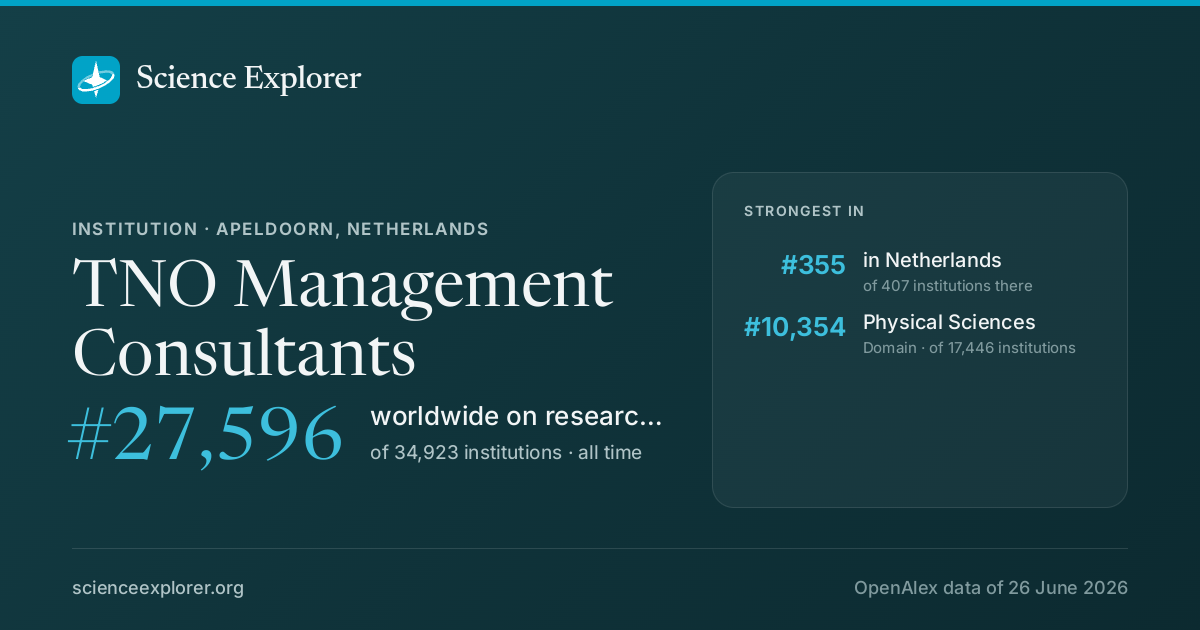
TNO Management Consultants on Science Explorer

A card with TNO Management Consultants's standing and the fields it leads in, for a post or a slide. A link to this page previews as the same card.

Download the card

1200 × 630 PNG, sized for social posts, drawn from the latest snapshot.

Badges for a website1Each links back here and updates with every snapshot

Research measures only: rankings here say nothing about teaching, admissions or student experience. Comparable institutions and collaboration partners have tabs of their own, above.

Discussion

Ask a question or share a note about TNO Management Consultants. Posts are plain text and can be reported.
