Science Explorer Back to mapMap
Discussion
Company · Milan · Italy

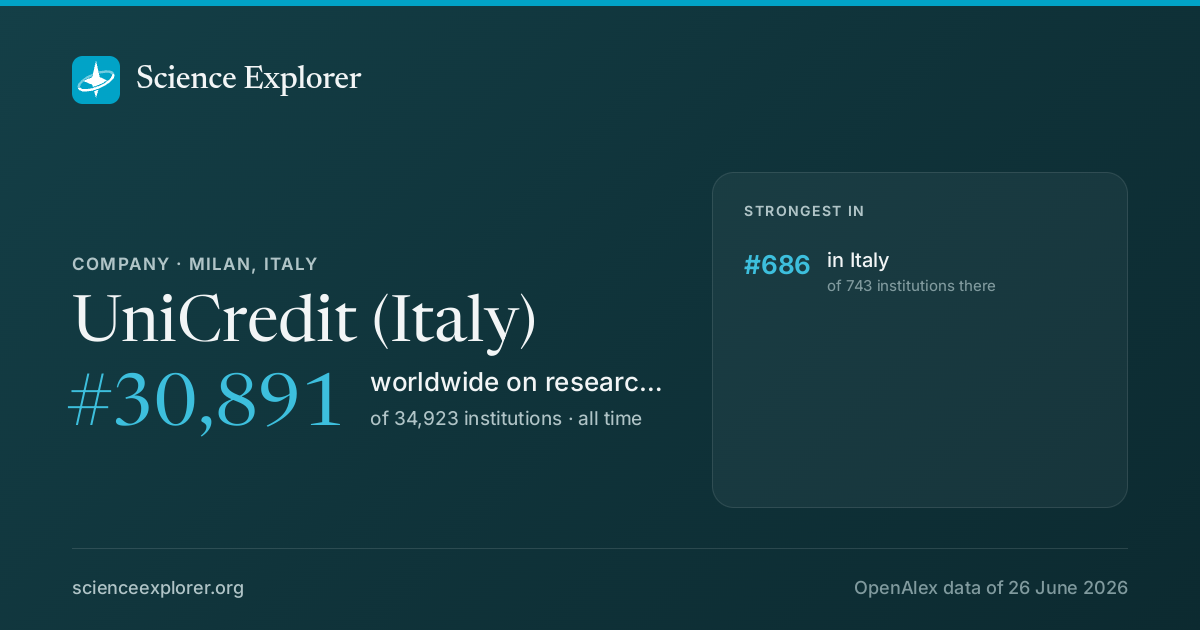
UniCredit (Italy)

World rank, all time
#30,891
of 34,923
Rank in Italy
#686
of 743
Research works
141
▲ 6% vs 2018-21
Citations
1.3k
9.6 per fractional work
Top-10% rate
3.2%
all institutions 10.0%
vs its own fields
0.98×
1.00× is exactly expected
Open access
52%
world 40%
International
34%
world 18%

Which fields of science does UniCredit (Italy) work in?

In 2022-now, 51% of research at UniCredit (Italy) is in Physical Sciences, 37% in Social Sciences. Its largest fields are Computer Science (30%), Social Sciences (14%), Engineering (12%). It does 1.3× the world's share of Social Sciences.

Physical Sciences: 14 fractional works · 50.7% of its workComputer Science: 8 fractional works · 29.9% of its workArtificial Intelligence: 4 fractional works · 15.8% of its workComputer Vision and Pattern Recognition: 2 fractional works · 5.7% of its workInformation Systems: 1 fractional works · 2.4% of its workComputational Theory and Mathematics: 1 fractional works · 2.1% of its workComputer Networks and Communications: 1 fractional works · 2.1% of its workSignal Processing: 0 fractional works · 1.4% of its workHardware and Architecture: 0 fractional works · 0.4% of its workEngineering: 3 fractional works · 12.5% of its workElectrical and Electronic Engineering: 2 fractional works · 5.6% of its workIndustrial and Manufacturing Engineering: 1 fractional works · 2.6% of its workCivil and Structural Engineering: 0 fractional works · 1.2% of its workMechanical Engineering: 0 fractional works · 1.2% of its workBiomedical Engineering: 0 fractional works · 0.6% of its workControl and Systems Engineering: 0 fractional works · 0.6% of its workAutomotive Engineering: 0 fractional works · 0.4% of its workBuilding and Construction: 0 fractional works · 0.2% of its workMathematics: 1 fractional works · 3.0% of its workStatistics and Probability: 1 fractional works · 3.0% of its workPhysics and Astronomy: 1 fractional works · 2.2% of its workStatistical and Nonlinear Physics: 0 fractional works · 1.8% of its workAstronomy and Astrophysics: 0 fractional works · 0.4% of its workEarth and Planetary Sciences: 0 fractional works · 1.2% of its workAtmospheric Science: 0 fractional works · 0.4% of its workOceanography: 0 fractional works · 0.4% of its workPaleontology: 0 fractional works · 0.4% of its workEnvironmental Science: 0 fractional works · 1.1% of its workEnvironmental Engineering: 0 fractional works · 0.5% of its workPollution: 0 fractional works · 0.3% of its workGlobal and Planetary Change: 0 fractional works · 0.2% of its workSmaller subfields together: 0 fractional works · 0.1% of its workMaterials Science: 0 fractional works · 0.7% of its workMaterials Chemistry: 0 fractional works · 0.6% of its workSmaller subfields together: 0 fractional works · 0.1% of its workEnergy: 0 fractional works · 0.1% of its workSocial Sciences: 10 fractional works · 36.6% of its workSocial Sciences: 4 fractional works · 13.9% of its workPolitical Science and International Relations: 1 fractional works · 3.4% of its workSociology and Political Science: 1 fractional works · 3.2% of its workSafety Research: 1 fractional works · 2.8% of its workEducation: 1 fractional works · 2.4% of its workGender Studies: 0 fractional works · 1.0% of its workTransportation: 0 fractional works · 0.6% of its workCommunication: 0 fractional works · 0.4% of its workEconomics, Econometrics and Finance: 3 fractional works · 10.0% of its workFinance: 2 fractional works · 6.7% of its workEconomics and Econometrics: 1 fractional works · 3.3% of its workBusiness, Management and Accounting: 2 fractional works · 7.3% of its workStrategy and Management: 1 fractional works · 2.2% of its workAccounting: 0 fractional works · 1.6% of its workBusiness and International Management: 0 fractional works · 1.2% of its workManagement Information Systems: 0 fractional works · 0.7% of its workMarketing: 0 fractional works · 0.6% of its workOrganizational Behavior and Human Resource Management: 0 fractional works · 0.6% of its workManagement of Technology and Innovation: 0 fractional works · 0.4% of its workDecision Sciences: 1 fractional works · 5.1% of its workManagement Science and Operations Research: 1 fractional works · 3.6% of its workStatistics, Probability and Uncertainty: 0 fractional works · 1.2% of its workInformation Systems and Management: 0 fractional works · 0.3% of its workSmaller subfields together: 0 fractional works · 0.0% of its workPsychology: 0 fractional works · 0.3% of its workClinical Psychology: 0 fractional works · 0.3% of its workLife Sciences: 2 fractional works · 7.5% of its workNeuroscience: 1 fractional works · 2.8% of its workCognitive Neuroscience: 1 fractional works · 2.1% of its workCellular and Molecular Neuroscience: 0 fractional works · 0.6% of its workSmaller subfields together: 0 fractional works · 0.1% of its workAgricultural and Biological Sciences: 1 fractional works · 2.6% of its workFood Science: 1 fractional works · 2.4% of its workSmaller subfields together: 0 fractional works · 0.2% of its workBiochemistry, Genetics and Molecular Biology: 1 fractional works · 2.1% of its workMolecular Biology: 0 fractional works · 1.4% of its workCell Biology: 0 fractional works · 0.6% of its workSmaller subfields together: 0 fractional works · 0.1% of its workHealth Sciences: 1 fractional works · 5.2% of its workMedicine: 1 fractional works · 3.8% of its workNeurology: 0 fractional works · 0.7% of its workHealth Informatics: 0 fractional works · 0.6% of its workOncology: 0 fractional works · 0.5% of its workImmunology and Allergy: 0 fractional works · 0.4% of its workCardiology and Cardiovascular Medicine: 0 fractional works · 0.3% of its workPharmacology: 0 fractional works · 0.3% of its workReproductive Medicine: 0 fractional works · 0.3% of its workRheumatology: 0 fractional works · 0.3% of its workSurgery: 0 fractional works · 0.3% of its workSmaller subfields together: 0 fractional works · 0.1% of its workHealth Professions: 0 fractional works · 1.4% of its workHealth Information Management: 0 fractional works · 1.2% of its workGeneral Health Professions: 0 fractional works · 0.2% of its workALL ITS WORKUniCredit (Italy)28fractional works, 2022-now
Life Sciences8%Physical Sciences51%Health Sciences5%Social Sciences37%

Each ring splits the one inside it: the four domains of science, their fields, their subfields. Size is fractional works in 2022-now. Every slice is a page; the interactive view zooms down to single topics and colours each by how much more of it this institution does than the world.

Its 4 domains and 18 fields, with their numbers
    1. Computer Science829.9%
    2. Engineering312.5%
    3. Mathematics13.0%
    4. Physics and Astronomy12.2%
    5. Earth and Planetary Sciences01.2%
    6. Environmental Science01.1%
    7. Materials Science00.7%
    8. Energy00.1%
    1. Social Sciences413.9%
    2. Economics, Econometrics and Finance310.0%
    3. Business, Management and Accounting27.3%
    4. Decision Sciences15.1%
    5. Psychology00.3%
    1. Neuroscience12.8%
    2. Agricultural and Biological Sciences12.6%
    3. Biochemistry, Genetics and Molecular Biology12.1%
    1. Medicine13.8%
    2. Health Professions01.4%
All of science, and how each field's share has moved since 1950: the Science domain explorer

Field profile

Location quotient across every field it publishes in: outside the ring is more than an institution of this size would be expected to publish, inside it is less.

Agricultural and Biological Sciences: 0.55× its world share, 1 worksAgricultural and Bio…Biochemistry, Genetics and Molecular Biology: 0.40× its world share, 1 worksBiochemistry, Geneti…Neuroscience: 1.72× its world share, 1 worksNeuroscienceComputer Science: 3.84× its world share, 8 worksComputer ScienceEarth and Planetary Sciences: 0.77× its world share, 0 worksEarth and Planetary …Energy: 0.17× its world share, 0 worksEnergyEngineering: 0.83× its world share, 3 worksEngineeringEnvironmental Science: 0.22× its world share, 0 worksEnvironmental ScienceMaterials Science: 0.19× its world share, 0 worksMaterials ScienceMathematics: 2.56× its world share, 1 worksMathematicsPhysics and Astronomy: 0.99× its world share, 1 worksPhysics and AstronomyHealth Professions: 0.53× its world share, 0 worksHealth ProfessionsMedicine: 0.20× its world share, 1 worksMedicineBusiness, Management and Accounting: 2.28× its world share, 2 worksBusiness, Management…Decision Sciences: 5.30× its world share, 1 worksDecision SciencesEconomics, Econometrics and Finance: 4.66× its world share, 3 worksEconomics, Econometr…Psychology: 0.10× its world share, 0 worksPsychologySocial Sciences: 1.10× its world share, 4 worksSocial Sciences1×world share
more than its size predictsabout as predictedless

Rings at 0.5×, 1× and 2×. Widest outward: Decision Sciences, 5.3×. Every wedge is a field page.

All 18 fields, with their numbers
  1. Decision Sciences5.30×1 works
  2. Economics, Econometrics and Finance4.66×3 works
  3. Computer Science3.84×8 works
  4. Mathematics2.56×1 works
  5. Business, Management and Accounting2.28×2 works
  6. Neuroscience1.72×1 works
  7. Social Sciences1.10×4 works
  8. Physics and Astronomy0.99×1 works
  9. Engineering0.83×3 works
  10. Earth and Planetary Sciences0.77×0 works
  11. Agricultural and Biological Sciences0.55×1 works
  12. Health Professions0.53×0 works
  13. Biochemistry, Genetics and Molecular Biology0.40×1 works
  14. Environmental Science0.22×0 works
  15. Medicine0.20×1 works
  16. Materials Science0.19×0 works
  17. Energy0.17×0 works
  18. Psychology0.10×0 works

Who are the top researchers at UniCredit (Italy)?

Ranked on the quality score, Francesco Gullo, Zeno Rotondi and Klaus Sandbiller lead among researchers whose main affiliation is UniCredit (Italy).

  1. 1 Francesco Gullo Italy · #1,543,919 worldwide 2.1k citations · 111 works
  2. 2 Zeno Rotondi Italy · #1,749,491 worldwide 717 citations · 76 works
  3. 3 Klaus Sandbiller Italy · #3,568,356 worldwide 51 citations · 20 works
  4. 4 Flavia Barsotti Italy · #3,704,355 worldwide 101 citations · 30 works
  5. 5 Fabio Piacenza Italy · #3,926,161 worldwide 59 citations · 21 works
  6. 6 Chiara Sabelli Italy · #5,096,857 worldwide 17 citations · 28 works
All ranked researchers at UniCredit (Italy)

What are the most cited papers from UniCredit (Italy)?

The most cited paper from UniCredit (Italy) is "Scenarios for Multistage Stochastic Programs" (Jitka Dupačová, Giorgio Consigli, Stein W. Wallace, 2000), with 475 citations. Next come "Measuring Organizational Legitimacy in Social Media: Assessing Citizens’ Judgments With Sentiment Analysis" (257) and "Equity and Bond Market Signals as Leading Indicators of Bank Fragility" (195).

Most cited papers
#PaperReleasedCitations
1 Scenarios for Multistage Stochastic Programs Jitka Dupačová, Giorgio Consigli, Stein W. Wallace · Annals of Operations Research Dec 2000 475
2 Measuring Organizational Legitimacy in Social Media: Assessing Citizens’ Judgments With Sentiment Analysis Michael Andreas Etter, Elanor Colleoni, Laura Illia et al. · Business & Society Open access 20 Dec 2016 257
3 Equity and Bond Market Signals as Leading Indicators of Bank Fragility Reint Gropp, Jukka M. Vesala, Giuseppe Vulpes · SSRN Electronic Journal PreprintOpen access 2002 195
4 Control of magnetorheological dampers for vibration reduction in a washing machine Cristiano Spelta, Fabio Previdi, Sergio M. Savaresi et al. · Mechatronics 30 Oct 2008 124
5 SME financing and the choice of lending technology in Italy: Complementarity or substitutability? Francesca Bartoli, Giovanni Ferri, Pierluigi Murro et al. · Journal of Banking & Finance 8 Sep 2013 107
All 57 most cited papers, with filters and sorting

Which keywords describe research at UniCredit (Italy)?

By fractional works in 2022-now, weighted toward what it does more of than the world: Neural Networks, Big Data, High-Dimensional Data, Clustering Algorithms, Risk Management, Machine Learning, Cluster Validation and K-means.

▲ more of its work than of the world's◆ about the world's share▼ less than the world's

Size is fractional works in 2022-now in the topics tagged with each word; colour is the word's share of this institution's work against its share of the world's. The 14 words are chosen for being large and distinctive. Each links to the topic it comes from most.

All 14 words, with their numbers
  1. Neural Networks2▲ 5.5×10 topics
  2. Machine Learning2▲ 2.4×11 topics
  3. Big Data2▲ 7.0×6 topics
  4. Deep Learning2▲ 1.92×8 topics
  5. Clustering Algorithms2▲ 82×2 topics
  6. High-Dimensional Data2▲ 39×3 topics
  7. Cluster Validation1▲ 344×1 topic
  8. K-means1▲ 344×1 topic
  9. Risk Management1▲ 9.3×4 topics
  10. Sustainability1▲ 1.71×5 topics
  11. Corporate Governance1▲ 5.3×7 topics
  12. Education1▲ 2.4×3 topics
  13. Neural Machine Translation1▲ 44×1 topic
  14. Statistical Machine Translation1▲ 44×1 topic

Which research topics does UniCredit (Italy) publish most on?

By volume in 2022-now: Advanced Clustering Algorithms Research, Natural Language Processing Techniques, Ethics and Social Impacts of AI and Multimodal Machine Learning Applications.

  1. 1 Advanced Clustering Algorithms Research Artificial Intelligence 1 works
  2. 2 Natural Language Processing Techniques Artificial Intelligence 1 works
  3. 3 Ethics and Social Impacts of AI Safety Research 1 works
  4. 4 Multimodal Machine Learning Applications Computer Vision and Pattern Recognition 1 works
  5. 5 Handwritten Text Recognition Techniques Computer Vision and Pattern Recognition 1 works
  6. 6 Education and Critical Thinking Development Education 1 works
  7. 7 Digital Economy and Work Transformation Sociology and Political Science 0 works
  8. 8 Advanced Graph Theory Research Computational Theory and Mathematics 0 works
  9. 9 Digital Transformation in Industry Industrial and Manufacturing Engineering 0 works
  10. 10 Educational Challenges and Innovations Information Systems 0 works

How open and international is its research?

Against the world's own shares: the tick on each track. Both are shares of its output, so they sit on one scale and can be read against each other as well as against the world.

openly available52.4%not open47.6%

World: 40% of research is openly available.

with international co-authors33.8%domestic only66.2%

World: 18% is written across borders.

How has UniCredit (Italy)'s research output changed?

Output in 2022-2025 was 6% higher than in 2018-2021.

still counting1990200020102020
grewheldshrank

The same series as a ribbon: one cell per year, darker for more. The line above answers how much; this answers when.

Its share of all research

Growing output can still be a shrinking share: all of science grows. This is UniCredit (Italy) as a percentage of every work published that year, 0.000066% in 2024.

still counting0.00020%0.00040%UniCredit (Italy)0.00012% in 20251990200020102020

Fractional works of UniCredit (Italy) over all fractional works that year. How the balance of science has shifted.

Other research institutions in Milan

All research institutions in Milan

Share UniCredit (Italy)'s ranking

UniCredit (Italy) on Science Explorer

A card with UniCredit (Italy)'s standing and the fields it leads in, for a post or a slide. A link to this page previews as the same card.

Download the card

1200 × 630 PNG, sized for social posts, drawn from the latest snapshot.

Badges for a website1Each links back here and updates with every snapshot

Research measures only: rankings here say nothing about teaching, admissions or student experience. Comparable institutions and collaboration partners have tabs of their own, above.

Discussion

Ask a question or share a note about UniCredit (Italy). Keep it to the research: no personal attacks, advertising or links. Any reader can report a post, which collapses it for everyone until it is opened.