Science Explorer Back to mapMap

Université de Cepromad

World rank, all time
#25,463
of 34,923
Rank in Democratic Republic of the Congo
#16
of 23
Research works
153
▲ 56% vs 2018-21
Citations
609
4.0 per fractional work
Top-10% rate
7.0%
all institutions 10.0%
vs its own fields
1.02×
1.00× is exactly expected
Open access
69%
world 40%
International
51%
world 18%

Which fields of science does Université de Cepromad work in?

In 2022-now, 48% of research at Université de Cepromad is in Social Sciences, 29% in Health Sciences. Its largest fields are Social Sciences (32%), Medicine (22%), Arts and Humanities (8%). It does 1.8× the world's share of Social Sciences.

Social Sciences: 27 fractional works · 48.1% of its workSocial Sciences: 18 fractional works · 31.6% of its workSociology and Political Science: 6 fractional works · 11.4% of its workEducation: 6 fractional works · 10.7% of its workPolitical Science and International Relations: 1 fractional works · 2.4% of its workAnthropology: 1 fractional works · 1.5% of its workDemography: 1 fractional works · 1.3% of its workGeography, Planning and Development: 1 fractional works · 1.2% of its workHealth: 1 fractional works · 1.2% of its workUrban Studies: 1 fractional works · 0.9% of its workGeneral Social Sciences: 0 fractional works · 0.6% of its workSmaller subfields together: 0 fractional works · 0.5% of its workArts and Humanities: 4 fractional works · 7.7% of its workLiterature and Literary Theory: 3 fractional works · 4.6% of its workReligious studies: 1 fractional works · 1.8% of its workGeneral Arts and Humanities: 0 fractional works · 0.6% of its workHistory: 0 fractional works · 0.6% of its workSmaller subfields together: 0 fractional works · 0.2% of its workBusiness, Management and Accounting: 1 fractional works · 2.5% of its workAccounting: 1 fractional works · 1.8% of its workManagement Information Systems: 0 fractional works · 0.8% of its workDecision Sciences: 1 fractional works · 2.5% of its workInformation Systems and Management: 1 fractional works · 1.6% of its workManagement Science and Operations Research: 0 fractional works · 0.8% of its workSmaller subfields together: 0 fractional works · 0.1% of its workPsychology: 1 fractional works · 2.4% of its workSocial Psychology: 1 fractional works · 1.4% of its workApplied Psychology: 0 fractional works · 0.8% of its workClinical Psychology: 0 fractional works · 0.3% of its workEconomics, Econometrics and Finance: 1 fractional works · 1.3% of its workEconomics and Econometrics: 1 fractional works · 1.3% of its workHealth Sciences: 16 fractional works · 29.4% of its workMedicine: 12 fractional works · 21.7% of its workPublic Health, Environmental and Occupational Health: 3 fractional works · 6.1% of its workCardiology and Cardiovascular Medicine: 2 fractional works · 3.1% of its workSurgery: 1 fractional works · 2.1% of its workOphthalmology: 1 fractional works · 1.8% of its workPediatrics, Perinatology and Child Health: 1 fractional works · 1.5% of its workInfectious Diseases: 1 fractional works · 1.1% of its workHematology: 0 fractional works · 0.7% of its workEpidemiology: 0 fractional works · 0.6% of its workComplementary and alternative medicine: 0 fractional works · 0.6% of its workObstetrics and Gynecology: 0 fractional works · 0.6% of its workPhysiology: 0 fractional works · 0.6% of its workUrology: 0 fractional works · 0.4% of its workDermatology: 0 fractional works · 0.4% of its workRehabilitation: 0 fractional works · 0.4% of its workRheumatology: 0 fractional works · 0.4% of its workEndocrinology, Diabetes and Metabolism: 0 fractional works · 0.3% of its workSmaller subfields together: 1 fractional works · 1.2% of its workHealth Professions: 4 fractional works · 7.2% of its workGeneral Health Professions: 3 fractional works · 5.1% of its workSpeech and Hearing: 0 fractional works · 0.9% of its workHealth Information Management: 0 fractional works · 0.8% of its workOccupational Therapy: 0 fractional works · 0.3% of its workSmaller subfields together: 0 fractional works · 0.2% of its workNursing: 0 fractional works · 0.5% of its workNutrition and Dietetics: 0 fractional works · 0.5% of its workPhysical Sciences: 7 fractional works · 12.7% of its workComputer Science: 3 fractional works · 5.2% of its workInformation Systems: 1 fractional works · 2.5% of its workArtificial Intelligence: 1 fractional works · 1.5% of its workComputer Networks and Communications: 1 fractional works · 1.1% of its workSmaller subfields together: 0 fractional works · 0.2% of its workEnvironmental Science: 2 fractional works · 4.2% of its workGlobal and Planetary Change: 1 fractional works · 1.2% of its workManagement, Monitoring, Policy and Law: 1 fractional works · 1.2% of its workWater Science and Technology: 0 fractional works · 0.6% of its workEcology: 0 fractional works · 0.5% of its workEnvironmental Engineering: 0 fractional works · 0.3% of its workPollution: 0 fractional works · 0.3% of its workEngineering: 1 fractional works · 2.2% of its workBiomedical Engineering: 0 fractional works · 0.6% of its workElectrical and Electronic Engineering: 0 fractional works · 0.5% of its workAerospace Engineering: 0 fractional works · 0.4% of its workBuilding and Construction: 0 fractional works · 0.4% of its workSmaller subfields together: 0 fractional works · 0.3% of its workEarth and Planetary Sciences: 0 fractional works · 0.6% of its workAtmospheric Science: 0 fractional works · 0.3% of its workSmaller subfields together: 0 fractional works · 0.3% of its workMaterials Science: 0 fractional works · 0.3% of its workMaterials Chemistry: 0 fractional works · 0.3% of its workMathematics: 0 fractional works · 0.2% of its workModeling and Simulation: 0 fractional works · 0.2% of its workLife Sciences: 5 fractional works · 9.8% of its workAgricultural and Biological Sciences: 4 fractional works · 6.3% of its workPlant Science: 2 fractional works · 3.1% of its workForestry: 1 fractional works · 1.9% of its workEcology, Evolution, Behavior and Systematics: 0 fractional works · 0.4% of its workAquatic Science: 0 fractional works · 0.3% of its workFood Science: 0 fractional works · 0.3% of its workGeneral Agricultural and Biological Sciences: 0 fractional works · 0.3% of its workBiochemistry, Genetics and Molecular Biology: 1 fractional works · 2.2% of its workGenetics: 1 fractional works · 1.4% of its workMolecular Biology: 0 fractional works · 0.6% of its workSmaller subfields together: 0 fractional works · 0.2% of its workNeuroscience: 0 fractional works · 0.8% of its workCognitive Neuroscience: 0 fractional works · 0.8% of its workImmunology and Microbiology: 0 fractional works · 0.6% of its workALL ITS WORKUniversité deCepromad56fractional works, 2022-now
Life Sciences10%Physical Sciences13%Health Sciences29%Social Sciences48%

Each ring splits the one inside it: the four domains of science, their fields, their subfields. Size is fractional works in 2022-now. Every slice is a page; the interactive view zooms down to single topics and colours each by how much more of it this institution does than the world.

Its 4 domains and 19 fields, with their numbers
    1. Social Sciences1831.6%
    2. Arts and Humanities47.7%
    3. Business, Management and Accounting12.5%
    4. Decision Sciences12.5%
    5. Psychology12.4%
    6. Economics, Econometrics and Finance11.3%
    1. Medicine1221.7%
    2. Health Professions47.2%
    3. Nursing00.5%
    1. Computer Science35.2%
    2. Environmental Science24.2%
    3. Engineering12.2%
    4. Earth and Planetary Sciences00.6%
    5. Materials Science00.3%
    6. Mathematics00.2%
    1. Agricultural and Biological Sciences46.3%
    2. Biochemistry, Genetics and Molecular Biology12.2%
    3. Neuroscience00.8%
    4. Immunology and Microbiology00.6%
All of science, and how each field's share has moved since 1950: the Science domain explorer

Field profile

Location quotient across every field it publishes in: outside the ring is more than an institution of this size would be expected to publish, inside it is less.

Agricultural and Biological Sciences: 1.32× its world share, 4 worksAgricultural and Bio…Biochemistry, Genetics and Molecular Biology: 0.41× its world share, 1 worksBiochemistry, Geneti…Immunology and Microbiology: 0.56× its world share, 0 worksImmunology and Micro…Neuroscience: 0.48× its world share, 0 worksNeuroscienceComputer Science: 0.68× its world share, 3 worksComputer ScienceEarth and Planetary Sciences: 0.37× its world share, 0 worksEarth and Planetary …Engineering: 0.15× its world share, 1 worksEngineeringEnvironmental Science: 0.84× its world share, 2 worksEnvironmental ScienceMaterials Science: 0.09× its world share, 0 worksMaterials ScienceMathematics: 0.17× its world share, 0 worksMathematicsHealth Professions: 2.75× its world share, 4 worksHealth ProfessionsMedicine: 1.13× its world share, 12 worksMedicineNursing: 0.97× its world share, 0 worksNursingArts and Humanities: 2.66× its world share, 4 worksArts and HumanitiesBusiness, Management and Accounting: 0.79× its world share, 1 worksBusiness, Management…Decision Sciences: 2.59× its world share, 1 worksDecision SciencesEconomics, Econometrics and Finance: 0.63× its world share, 1 worksEconomics, Econometr…Psychology: 0.79× its world share, 1 worksPsychologySocial Sciences: 2.50× its world share, 18 worksSocial Sciences1×world share
more than its size predictsabout as predictedless

Rings at 0.5×, 1× and 2×. Widest outward: Health Professions, 2.8×. Every wedge is a field page.

All 19 fields, with their numbers
  1. Health Professions2.75×4 works
  2. Arts and Humanities2.66×4 works
  3. Decision Sciences2.59×1 works
  4. Social Sciences2.50×18 works
  5. Agricultural and Biological Sciences1.32×4 works
  6. Medicine1.13×12 works
  7. Nursing0.97×0 works
  8. Environmental Science0.84×2 works
  9. Business, Management and Accounting0.79×1 works
  10. Psychology0.79×1 works
  11. Computer Science0.68×3 works
  12. Economics, Econometrics and Finance0.63×1 works
  13. Immunology and Microbiology0.56×0 works
  14. Neuroscience0.48×0 works
  15. Biochemistry, Genetics and Molecular Biology0.41×1 works
  16. Earth and Planetary Sciences0.37×0 works
  17. Mathematics0.17×0 works
  18. Engineering0.15×1 works
  19. Materials Science0.09×0 works

Who are the top researchers at Université de Cepromad?

Ranked on the quality score, Iasmim Medeiros lead among researchers whose main affiliation is Université de Cepromad.

  1. 1 Iasmim Medeiros Democratic Republic of the Congo · #4,510,621 worldwide 6 citations · 23 works
All ranked researchers at Université de Cepromad

What are the most cited papers from Université de Cepromad?

The most cited paper from Université de Cepromad is "Deliberative or Agonistic Democracy?" (Loïc Blondiaux, 2008), with 105 citations. Next come "Perfil epidemiológico dos pacientes portadores de doença inflamatória intestinal do estado de Mato Grosso" (44) and "Heavy metals and persistent organic pollutants contamination in river, estuary, and marine sediments from Atlantic Coast of Democratic Republic of the Congo" (33).

Most cited papers
#PaperReleasedCitations
1 Deliberative or Agonistic Democracy? Loïc Blondiaux · Cairn.info 2008 105
2 Perfil epidemiológico dos pacientes portadores de doença inflamatória intestinal do estado de Mato Grosso Mardem Machado de Souza, Angélica Gonçalves Silva Belasco, José Eduardo de Aguilar‐Nascimento · Revista Brasileira de Coloproctologia Open access Sep 2008 44
3 Heavy metals and persistent organic pollutants contamination in river, estuary, and marine sediments from Atlantic Coast of Democratic Republic of the Congo Robert Bueya Suami, Periyasamy Sivalingam, Dhafer Mohammed Al Salah et al. · Environmental Science and Pollution Research Open access 30 Mar 2020 33
4 α-methylation and α-fluorination electronic effects on the regioselectivity of carbonyl groups of uracil by H and triel bonds in the interaction of U, T and 5FU with HCl and TrH3 (Tr = B, Al) Aristote P. Matondo, Renjith Thomas, Philippe Vuka Tsalu et al. · Journal of Molecular Graphics and Modelling 10 Feb 2019 31
5 Dental transposition of canine and lateral incisor and impacted central incisor treatment: A case report Tarcisio Jacinto Gebert, Vinícius Canavarros Palma, Álvaro Henrique Borges et al. · Dental Press Journal of Orthodontics Open access 2014 25
All 68 most cited papers, with filters and sorting

Which keywords describe research at Université de Cepromad?

By fractional works in 2022-now, weighted toward what it does more of than the world: Teacher Training, Qualitative Research, Educational Technology, Social Inequality, Online Learning, Epidemiology, Social Network Analysis and WebQuests.

▲ more of its work than of the world's◆ about the world's share▼ less than the world's

Size is fractional works in 2022-now in the topics tagged with each word; colour is the word's share of this institution's work against its share of the world's. The 40 words are chosen for being large and distinctive. Each links to the topic it comes from most.

All 40 words, with their numbers
  1. Teacher Training6▲ 17×4 topics
  2. Epidemiology6▲ 2.6×25 topics
  3. Educational Technology5▲ 7.0×4 topics
  4. Qualitative Research4▲ 9.1×5 topics
  5. Social Inequality4▲ 26×5 topics
  6. Online Learning4▲ 7.9×4 topics
  7. Public Health4▲ 4.5×14 topics
  8. Discourse Analysis3▲ 21×3 topics
  9. Rhetoric3▲ 51×2 topics
  10. Social Network Analysis3▲ 44×1 topic
  11. WebQuests3▲ 102×1 topic
  12. Educational Reform3▲ 40×2 topics
  13. Inclusive Education3▲ 14×3 topics
  14. Curriculum Development3▲ 6.9×3 topics
  15. Distance Learning2▲ 13×2 topics
  16. Educational Policies2▲ 42×2 topics
  17. Critical Pedagogy2▲ 50×1 topic
  18. Pedagogical Practices2▲ 47×1 topic
  19. Literacy2▲ 54×1 topic
  20. Textual Production2▲ 124×1 topic
  21. Education2▲ 2.2×11 topics
  22. Migration2▲ 9.6×3 topics
  23. Sustainable Development2▲ 2.1×9 topics
  24. Vaccine Development2▲ 12×3 topics
  25. Arboviral Diseases2▲ 46×1 topic
  26. Zika Virus2▲ 46×1 topic
  27. Religion2▲ 6.1×4 topics
  28. Social Change2▲ 22×2 topics
  29. Health Inequalities1▲ 18×2 topics
  30. Biodiversity Conservation1▲ 5.9×4 topics
  31. Healthcare Access1▲ 8.2×4 topics
  32. Injury Prevention1▲ 17×2 topics
  33. Social Determinants1▲ 11×2 topics
  34. Socioeconomic Factors1▲ 17×2 topics
  35. Territorial Governance1▲ 19×3 topics
  36. Communication1▲ 6.1×3 topics
  37. Child Injury1▲ 64×1 topic
  38. Maternal Health1▲ 7.2×2 topics
  39. Media1▲ 12×2 topics
  40. Unintentional Injuries1▲ 64×1 topic

Which research topics does Université de Cepromad publish most on?

By volume in 2022-now: Education and Digital Technologies, Education Pedagogy and Practices, Linguistics and Education Research and Mosquito-borne diseases and control.

  1. 1 Education and Digital Technologies Sociology and Political Science 3 works
  2. 2 Education Pedagogy and Practices Education 2 works
  3. 3 Linguistics and Education Research Literature and Literary Theory 2 works
  4. 4 Mosquito-borne diseases and control Public Health, Environmental and Occupational Health 2 works
  5. 5 Maternal and Neonatal Healthcare General Health Professions 1 works
  6. 6 Injury Epidemiology and Prevention Public Health, Environmental and Occupational Health 1 works
  7. 7 Business and Management Studies Information Systems and Management 1 works
  8. 8 African Botany and Ecology Studies Forestry 1 works
  9. 9 Multiculturalism, Politics, Migration, Gender Political Science and International Relations 1 works
  10. 10 Education during COVID-19 pandemic Education 1 works

How open and international is its research?

Against the world's own shares: the tick on each track. Both are shares of its output, so they sit on one scale and can be read against each other as well as against the world.

openly available69.4%not open30.6%

World: 40% of research is openly available.

with international co-authors50.6%domestic only49.4%

World: 18% is written across borders.

How has Université de Cepromad's research output changed?

Output in 2022-2025 was 56% higher than in 2018-2021.

still counting1990200020102020
grewheldshrank

The same series as a ribbon: one cell per year, darker for more. The line above answers how much; this answers when.

Its share of all research

Growing output can still be a shrinking share: all of science grows. This is Université de Cepromad as a percentage of every work published that year, 0.00026% in 2024.

still counting0.00020%0.00040%Université de Cepromad0.00023% in 202519801990200020102020

Fractional works of Université de Cepromad over all fractional works that year. How the balance of science has shifted.

Other research institutions in Kinshasa

All research institutions in Kinshasa

Share Université de Cepromad's ranking
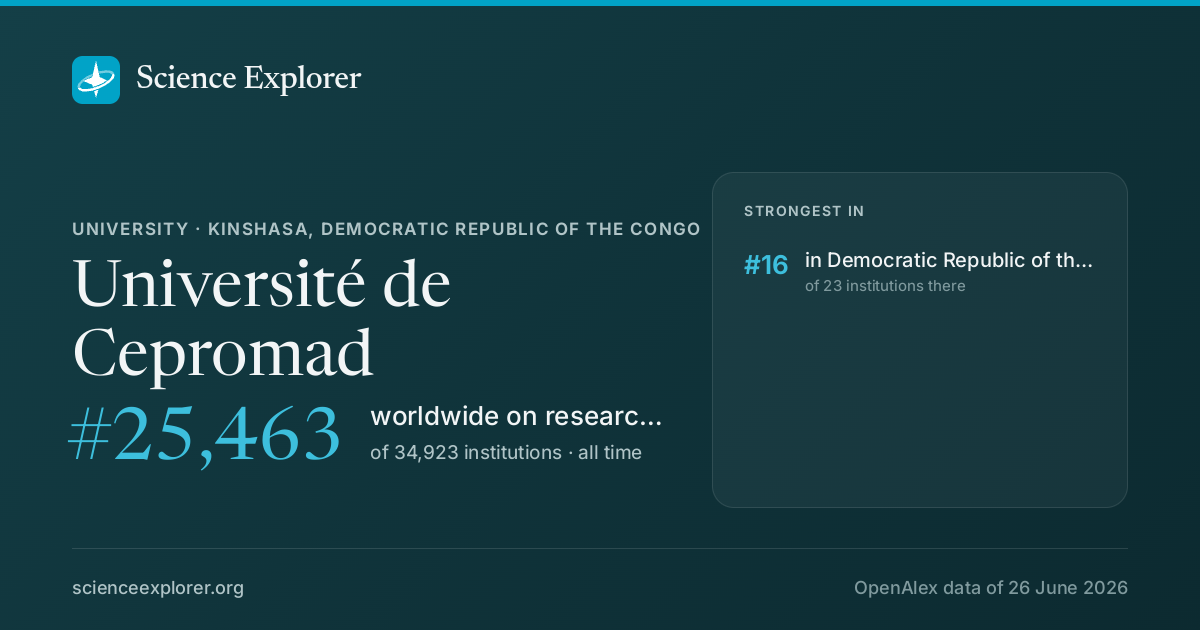
Université de Cepromad on Science Explorer

A card with Université de Cepromad's standing and the fields it leads in, for a post or a slide. A link to this page previews as the same card.

Download the card

1200 × 630 PNG, sized for social posts, drawn from the latest snapshot.

Badges for a website1Each links back here and updates with every snapshot

Research measures only: rankings here say nothing about teaching, admissions or student experience. Comparable institutions and collaboration partners have tabs of their own, above.

Discussion

Ask a question or share a note about Université de Cepromad. Posts are plain text and can be reported.