Wacker (United States)
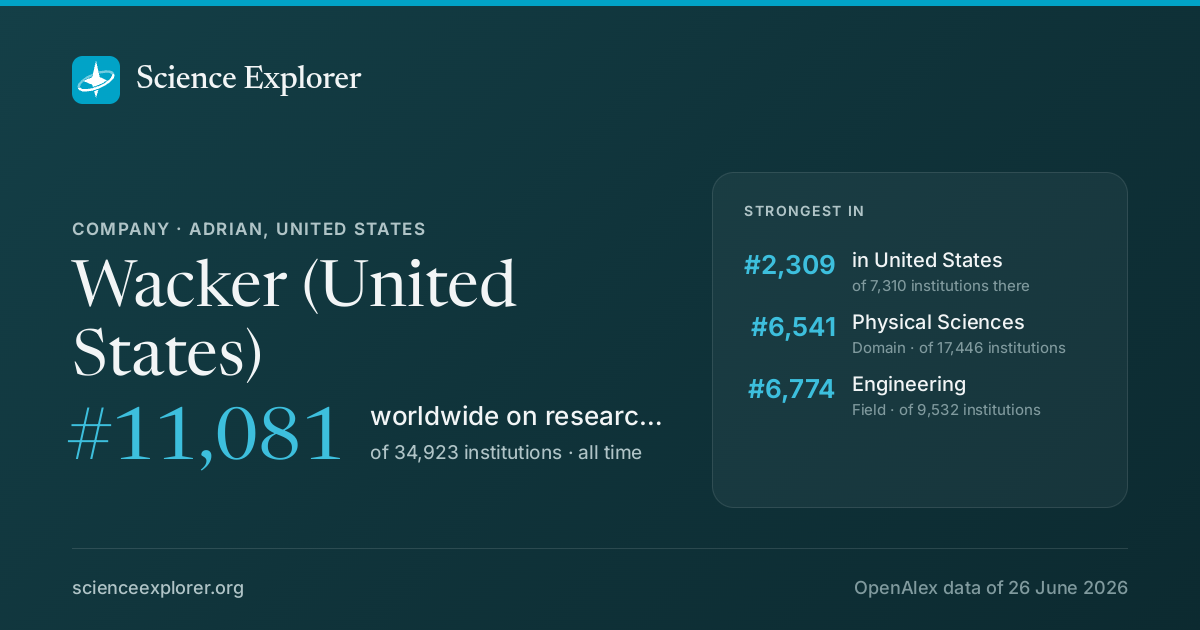
In research, Wacker (United States) stands highest in Physical Sciences (#6,541 of 17,446 worldwide) and Engineering (#6,774 of 9,532 worldwide), over all time.
- World rank, all time
- #11,081 of 34,923
- Rank in United States
- #2,309 of 7,310
- Research works
- 496 ▲ 61% vs 2018-21
- Citations
- 7.6k 15.3 per fractional work
- Top-10% rate
- 7.5% all institutions 10.0%
- vs its own fields
- 0.96× 1.00× is exactly expected
- Open access
- 16% world 40%
- International
- 24% world 18%
What is Wacker (United States) known for in research?
The fields where it stands highest, over all time, ranked among every institution above the floor in each field.
| Field | World rank | Where that sits | Top-10% rate | Works |
|---|---|---|---|---|
| Physical SciencesDomain | #6,541 of 17,446 | 6.4% | 330 | |
| EngineeringField | #6,774 of 9,532 | 7.2% | 137 |
Each strip is that field's whole ranked pool, with the notch where Wacker (United States) sits in it, in the colour of the band that rank falls in. The track under the rate is the rate itself: it carries no average mark, because the average differs by field (from about 6% in Dentistry to 21% in Economics).
Which fields of science does Wacker (United States) work in?
In 2022-now, 55% of research at Wacker (United States) is in Physical Sciences, 24% in Social Sciences. Its largest fields are Engineering (24%), Business, Management and Accounting (13%), Materials Science (8%). It does 1.4× the world's share of Physical Sciences.
Each ring splits the one inside it: the four domains of science, their fields, their subfields. Size is fractional works in 2022-now. Every slice is a page; the interactive view zooms down to single topics and colours each by how much more of it this institution does than the world.
Its 4 domains and 24 fields, with their numbers
- Physical Sciences2755.0%
- Engineering1223.8%
- Materials Science47.9%
- Computer Science47.2%
- Environmental Science35.2%
- Energy24.0%
- Chemistry23.6%
- Chemical Engineering12.0%
- Physics and Astronomy00.8%
- Earth and Planetary Sciences00.5%
- Social Sciences1223.6%
- Life Sciences510.7%
- Health Sciences510.6%
- Medicine47.4%
- Health Professions11.7%
- Veterinary00.9%
- Nursing00.5%
- Dentistry00.1%
Field profile
Location quotient across every field it publishes in: outside the ring is more than an institution of this size would be expected to publish, inside it is less.
Rings at 0.5×, 1× and 2×. Widest outward: Veterinary, 6.6×. Every wedge is a field page.
All 24 fields, with their numbers
- Veterinary6.59×0 works
- Chemical Engineering5.70×1 works
- Energy4.34×2 works
- Business, Management and Accounting4.04×6 works
- Pharmacology, Toxicology and Pharmaceutics2.29×0 works
- Chemistry2.28×2 works
- Materials Science2.27×4 works
- Arts and Humanities1.80×3 works
- Engineering1.59×12 works
- Environmental Science1.05×3 works
- Nursing1.03×0 works
- Biochemistry, Genetics and Molecular Biology0.97×3 works
- Computer Science0.93×4 works
- Agricultural and Biological Sciences0.90×2 works
- Health Professions0.64×1 works
- Immunology and Microbiology0.46×0 works
- Medicine0.39×4 works
- Physics and Astronomy0.35×0 works
- Social Sciences0.35×2 works
- Earth and Planetary Sciences0.32×0 works
- Decision Sciences0.26×0 works
- Dentistry0.23×0 works
- Economics, Econometrics and Finance0.16×0 works
- Psychology0.11×0 works
- Veterinary 6.6×
- Chemical Engineering 5.7×
- Energy 4.3×
- Business, Management and Accounting 4.0×
- Pharmacology, Toxicology and Pharmaceutics 2.3×
- Chemistry 2.3×
- Materials Science 2.3×
- Arts and Humanities 1.8×
- Engineering 1.6×
- Environmental Science 1.1×
- Nursing 1.0×
- Biochemistry, Genetics and Molecular Biology 1.0×
- Computer Science 0.9×
- Agricultural and Biological Sciences 0.9×
- Health Professions 0.6×
- Immunology and Microbiology 0.5×
- Medicine 0.4×
- Physics and Astronomy 0.3×
- Social Sciences 0.3×
- Earth and Planetary Sciences 0.3×
- Decision Sciences 0.3×
- Dentistry 0.2×
- Economics, Econometrics and Finance 0.2×
- Psychology 0.1×
Who are the top researchers at Wacker (United States)?
Ranked on the quality score, Reinhard Jira, Ludwig Kotz and Hermann Bräunling lead among researchers whose main affiliation is Wacker (United States).
- 1
Reinhard Jira
 United States · #369,088 worldwide
2.5k citations · 68 works
- 2
Ludwig Kotz
United States · #1,964,501 worldwide
765 citations · 19 works
- 3
Hermann Bräunling
United States · #2,138,413 worldwide
406 citations · 17 works
- 4
Johann Weis
United States · #2,523,777 worldwide
1.3k citations · 127 works
- 5
Herbert Barthel
United States · #2,945,158 worldwide
1.2k citations · 67 works
- 6
Franz‐Heinrich Kreuzer
United States · #3,278,661 worldwide
1.3k citations · 34 works
- 7
Torsten Gottschalk‐Gaudig
United States · #3,538,409 worldwide
666 citations · 45 works
- 8
Werner Zschau
United States · #3,598,526 worldwide
163 citations · 21 works
- 9
Franz Sedlmeier
United States · #3,776,336 worldwide
13 citations · 33 works
- 10
Diethard Huber
United States · #4,787,164 worldwide
171 citations · 20 works
Which keywords describe research at Wacker (United States)?
By fractional works in 2022-now, weighted toward what it does more of than the world: Catalysis, Sustainability, Renewable Resources, Energy Storage, Sustainable Development, Digital Transformation, Environmental Impact and Lithium-ion Batteries.
- Green Consumption
- Customer Experience
- Business Models
- Structural Health Monitoring
- Porous Media
- Hydrogenation
- Construction
- Carbon Dioxide
- Thermal Management
- Hydrogen
- Civil Engineering
- Environmental Management
- Material Properties
- Value Chains
- Lithium-ion Batteries
- Renewable Energy
- Digital Transformation
- Renewable Resources
- Environmental Impact
- Sustainable Development
- Sustainability
- Catalysis
- Energy Storage
- Big Data
- Energy Efficiency
- Information Technology
- Nanocomposites
- Distributed Systems
- Cathode Materials
- Stakeholder Engagement
- Electrolysis
- Resource Management
- Biodegradable Polymers
- Circular Economy
- Cultural History
- Medieval Literature
- Social Innovation
- Business Ethics
- Corporate Social Responsibility
- Environmental Innovation
Size is fractional works in 2022-now in the topics tagged with each word; colour is the word's share of this institution's work against its share of the world's. The 40 words are chosen for being large and distinctive. Each links to the topic it comes from most.
All 40 words, with their numbers
- Sustainability4▲ 3.2×9 topics
- Sustainable Development3▲ 3.7×4 topics
- Catalysis3▲ 8.3×10 topics
- Environmental Impact3▲ 3.1×5 topics
- Energy Storage2▲ 7.2×4 topics
- Renewable Resources2▲ 26×5 topics
- Big Data2▲ 4.2×5 topics
- Digital Transformation2▲ 7.5×2 topics
- Energy Efficiency2▲ 4.3×5 topics
- Renewable Energy2▲ 2.7×4 topics
- Information Technology2▲ 7.1×1 topic
- Lithium-ion Batteries2▲ 8.3×3 topics
- Nanocomposites2▲ 4.3×4 topics
- Value Chains2▲ 192×1 topic
- Distributed Systems2▲ 18×3 topics
- Material Properties1▲ 30×2 topics
- Cathode Materials1▲ 6.5×3 topics
- Environmental Management1▲ 6.6×2 topics
- Stakeholder Engagement1▲ 30×2 topics
- Civil Engineering1▲ 47×2 topics
- Electrolysis1▲ 36×1 topic
- Hydrogen1▲ 28×1 topic
- Resource Management1▲ 15×2 topics
- Thermal Management1▲ 7.6×3 topics
- Biodegradable Polymers1▲ 13×2 topics
- Carbon Dioxide1▲ 14×3 topics
- Circular Economy1▲ 8.0×3 topics
- Construction1▲ 17×1 topic
- Cultural History1▲ 18×1 topic
- Hydrogenation1▲ 13×3 topics
- Medieval Literature1▲ 119×1 topic
- Porous Media1▲ 17×4 topics
- Social Innovation1▲ 15×2 topics
- Structural Health Monitoring1▲ 29×1 topic
- Business Ethics1▲ 24×1 topic
- Business Models1▲ 28×1 topic
- Corporate Social Responsibility1▲ 12×1 topic
- Customer Experience1▲ 12×1 topic
- Environmental Innovation1▲ 22×1 topic
- Green Consumption1▲ 22×1 topic
Which research topics does Wacker (United States) publish most on?
By volume in 2022-now: Corporate Governance and Management, Hybrid Renewable Energy Systems, Civil and Structural Engineering Research and Historical, Literary, and Cultural Studies.
Area is fractional works; colour is the subfield each topic belongs to.
- 1 Corporate Governance and Management Strategy and Management 2 works
- 2 Hybrid Renewable Energy Systems Energy Engineering and Power Technology 1 works
- 3 Civil and Structural Engineering Research Civil and Structural Engineering 1 works
- 4 Historical, Literary, and Cultural Studies Classics 1 works
- 5 Corporate Management and Leadership Organizational Behavior and Human Resource Management 1 works
- 6 Environmental Sustainability in Business Marketing 1 works
- 7 Historical Linguistics and Language Studies Language and Linguistics 1 works
- 8 Digital Innovation in Industries Management of Technology and Innovation 1 works
- 9 Corporate Social Responsibility and Sustainability Organizational Behavior and Human Resource Management 1 works
- 10 biodegradable polymer synthesis and properties Biomaterials 1 works
How open and international is its research?
Against the world's own shares: the tick on each track. Both are shares of its output, so they sit on one scale and can be read against each other as well as against the world.
World: 40% of research is openly available.
World: 18% is written across borders.
How has Wacker (United States)'s research output changed?
Output in 2022-2025 was 61% higher than in 2018-2021.
The same series as a ribbon: one cell per year, darker for more. The line above answers how much; this answers when.
Its share of all research
Growing output can still be a shrinking share: all of science grows. This is Wacker (United States) as a percentage of every work published that year, 0.00027% in 2024.
Fractional works of Wacker (United States) over all fractional works that year. How the balance of science has shifted.
Other research institutions in Adrian
- Siena Heights University
- Adrian College
- ProMedica Charles and Virginia Hickman Hospital
- Lenawee District Library
Share Wacker (United States)'s ranking
Badges for a website1Each links back here and updates with every snapshot

Research measures only: rankings here say nothing about teaching, admissions or student experience. Comparable institutions and collaboration partners have tabs of their own, above.
Discussion
Ask a question or share a note about Wacker (United States). Keep it to the research: no personal attacks, advertising or links. Any reader can report a post, which collapses it for everyone until it is opened.