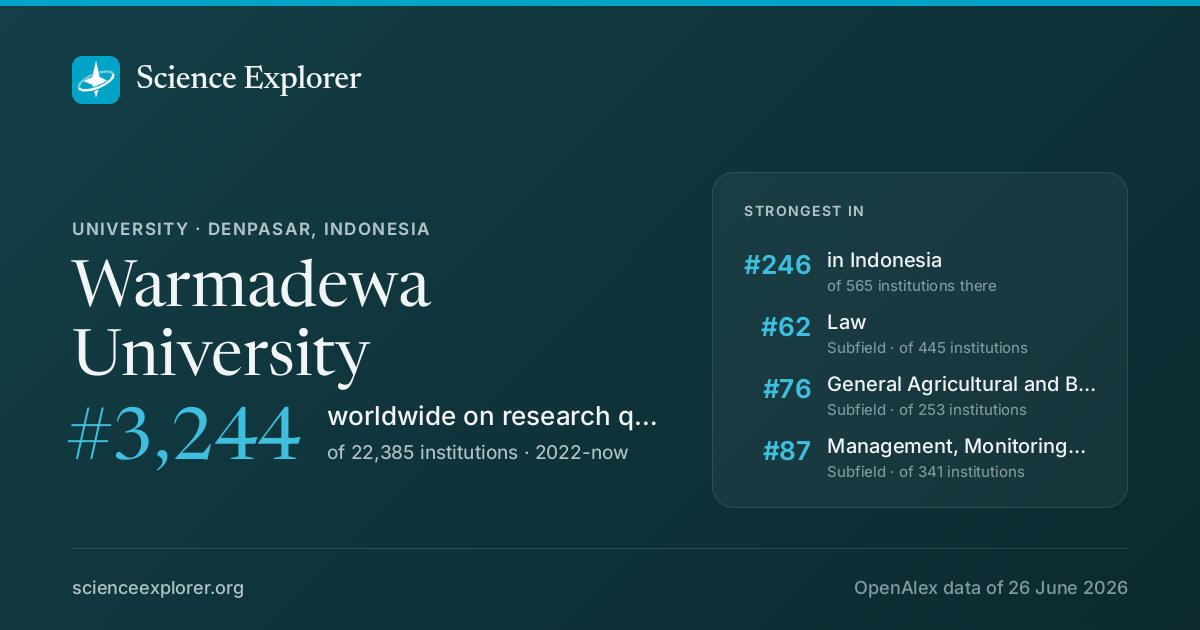
Warmadewa University
In research, Warmadewa University stands highest in Social Sciences (#845 of 9,585 worldwide), Social Sciences (#700 of 5,988 worldwide) and Law (#62 of 445 worldwide), 2022-now. Relative to its size it is most specialised in Law, Conservation and Human Factors and Ergonomics (Law is 20.6× its share of world research).
- World rank, 2022-now
- #3,244 of 22,385 · #5,474 all time
- Rank in Indonesia
- #246 of 565
- Research works
- 6.3k ▲ 45% vs 2018-21
- Citations
- 12k 1.9 per fractional work
- Top-10% rate
- 6.1% all institutions 10.0%
- vs its own fields
- 0.45× 1.00× is exactly expected
- Open access
- 91% world 40%
- International
- 3% world 18%
What is Warmadewa University known for in research?
The fields where it stands highest, 2022-now, ranked among every institution above the floor in each field.
| Field | World rank | Where that sits | Top-10% rate | Works | All time |
|---|---|---|---|---|---|
| Social SciencesDomain | #845 of 9,585 | 6.5% | 2,191 | #1119 | |
| Social SciencesField | #700 of 5,988 | 6.2% | 1,488 | #835 | |
| LawSubfield | #62 of 445 | 6.5% | 411 | #95 | |
| Business, Management and AccountingField | #596 of 2,581 | 7.9% | 397 | #904 | |
| Management, Monitoring, Policy and LawSubfield | #87 of 341 | 7.0% | 93 | #381 | |
| Sociology and Political ScienceSubfield | #707 of 2,526 | 6.5% | 353 | #931 | |
| General Agricultural and Biological SciencesSubfield | #76 of 253 | 7.0% | 123 | #222 | |
| Organizational Behavior and Human Resource ManagementSubfield | #91 of 253 | 12.3% | 68 | #423 | |
| Agricultural and Biological SciencesField | #1,277 of 3,157 | 5.9% | 388 | #2091 | |
| DemographySubfield | #177 of 434 | 7.3% | 244 | #263 |
Each strip is that field's whole ranked pool, with the notch where Warmadewa University sits in it, in the colour of the band that rank falls in. The track under the rate is the rate itself: it carries no average mark, because the average differs by field (from about 6% in Dentistry to 21% in Economics).
Which of those standings moved
The same fields on both windows: where it stood over the whole record, and where it stands in 2022-now. The distance is the story, and it is the one thing the two rank columns above cannot show.
- Social Sciences#1,119 #845
- Social Sciences#835 #700
- Law#95 #62
- Business, Management and Accounting#904 #596
- Management, Monitoring, Policy and Law#381 #87
- Sociology and Political Science#931 #707
- General Agricultural and Biological Sciences#222 #76
- Organizational Behavior and Human Resource Management#423 #91
- Agricultural and Biological Sciences#2,091 #1,277
- Demography#263 #177
A dot further right is a better standing. Fields it was not ranked in over the whole record are left out.
Which fields of science does Warmadewa University work in?
In 2022-now, 63% of research at Warmadewa University is in Social Sciences, 13% in Physical Sciences. Its largest fields are Social Sciences (43%), Business, Management and Accounting (11%), Agricultural and Biological Sciences (11%). It does 2.5× the world's share of Social Sciences.
Each ring splits the one inside it: the four domains of science, their fields, their subfields. Size is fractional works in 2022-now. Every slice is a page; the interactive view zooms down to single topics and colours each by how much more of it this institution does than the world.
Its 4 domains and 24 fields, with their numbers
- Social Sciences2,33963.2%
- Social Sciences1,58242.8%
- Business, Management and Accounting42311.4%
- Arts and Humanities1654.5%
- Economics, Econometrics and Finance982.6%
- Psychology571.5%
- Decision Sciences150.4%
- Physical Sciences48613.1%
- Environmental Science1814.9%
- Computer Science1594.3%
- Engineering1193.2%
- Earth and Planetary Sciences100.3%
- Chemistry70.2%
- Materials Science60.2%
- Mathematics40.1%
- Energy10.0%
- Life Sciences45512.3%
- Health Sciences41911.3%
- Medicine2627.1%
- Health Professions1453.9%
- Nursing90.2%
- Dentistry20.0%
- Veterinary10.0%
What does Warmadewa University specialise in?
Where its research is concentrated relative to its size: Law takes 20.6× the share of its output that it takes of world research.
- LawSubfield · 442.8 works21×
- ConservationSubfield · 52.5 works15×
- Human Factors and ErgonomicsSubfield · 42.3 works10×
- DemographySubfield · 247.9 works9.8×
- Geography, Planning and DevelopmentSubfield · 65.4 works8.6×
- General Agricultural and Biological SciencesSubfield · 126.8 works7.8×
- AccountingSubfield · 129.9 works5.8×
- Occupational TherapySubfield · 30.7 works4.9×
Location quotient, a volume reading rather than an impact one. It surfaces small, lopsided specialities.
Field profile
Location quotient across every field it publishes in: outside the ring is more than an institution of this size would be expected to publish, inside it is less.
Rings at 0.5×, 1× and 2×. Widest outward: Business, Management and Accounting, 3.5×. Every wedge is a field page.
All 24 fields, with their numbers
- Business, Management and Accounting3.54×422 works
- Social Sciences3.38×1,582 works
- Agricultural and Biological Sciences2.30×404 works
- Arts and Humanities1.54×165 works
- Health Professions1.48×145 works
- Economics, Econometrics and Finance1.23×98 works
- Environmental Science0.99×181 works
- Computer Science0.55×159 works
- Nursing0.51×9 works
- Psychology0.51×57 works
- Decision Sciences0.43×15 works
- Medicine0.37×262 works
- Immunology and Microbiology0.22×8 works
- Engineering0.21×119 works
- Biochemistry, Genetics and Molecular Biology0.18×35 works
- Earth and Planetary Sciences0.16×10 works
- Pharmacology, Toxicology and Pharmaceutics0.15×2 works
- Veterinary0.14×1 works
- Chemistry0.12×7 works
- Neuroscience0.11×7 works
- Dentistry0.10×2 works
- Mathematics0.09×4 works
- Materials Science0.04×6 works
- Energy0.02×1 works
- Business, Management and Accounting 3.5×
- Social Sciences 3.4×
- Agricultural and Biological Sciences 2.3×
- Arts and Humanities 1.5×
- Health Professions 1.5×
- Economics, Econometrics and Finance 1.2×
- Environmental Science 1.0×
- Computer Science 0.6×
- Nursing 0.5×
- Psychology 0.5×
- Decision Sciences 0.4×
- Medicine 0.4×
- Immunology and Microbiology 0.2×
- Engineering 0.2×
- Biochemistry, Genetics and Molecular Biology 0.2×
- Earth and Planetary Sciences 0.2×
- Pharmacology, Toxicology and Pharmaceutics 0.1×
- Veterinary 0.1×
- Chemistry 0.1×
- Neuroscience 0.1×
- Dentistry 0.1×
- Mathematics 0.1×
- Materials Science 0.0×
- Energy 0.0×
Who are the top researchers at Warmadewa University?
Ranked on the quality score, Komang Adi Kurniawan Saputra, Made Setini and I Dewa Gede Atmadja lead among researchers whose main affiliation is Warmadewa University.
- 1
Komang Adi Kurniawan Saputra
 Indonesia · #939,461 worldwide
1.3k citations · 134 works
- 2
Made Setini
Indonesia · #966,726 worldwide
1.2k citations · 87 works
- 3
I Dewa Gede Atmadja
Indonesia · #1,284,141 worldwide
153 citations · 21 works
- 4
Sri Masyeni
Indonesia · #1,322,103 worldwide
395 citations · 15 works
- 5
Putu Budi Anggiriawan
Indonesia · #1,688,712 worldwide
194 citations · 18 works
- 6
I Made Sara
Indonesia · #1,716,107 worldwide
360 citations · 47 works
- 7
Dewi Ratih Megawati
Indonesia · #1,941,737 worldwide
2k citations · 41 works
- 8
I Made Suniastha Amerta
Indonesia · #1,965,513 worldwide
272 citations · 40 works
- 9
I Gede Surya Pratama
Indonesia · #2,064,218 worldwide
251 citations · 18 works
- 10
Sri Masyeni
Indonesia · #2,653,302 worldwide
886 citations · 61 works
Which keywords describe research at Warmadewa University?
By fractional works in 2022-now, weighted toward what it does more of than the world: Community Empowerment, Human Rights, Islamic Banking, Social Media, Financial Performance, Indonesia, Community Participation and Pandemic.
- Maternal Health
- Non-Communicable Diseases
- Community-based Tourism
- Juvenile Justice
- Data Privacy
- Legal System
- Intellectual Property
- Health Education
- Normative Methodology
- Leadership Styles
- UMKM
- SMEs
- Criminal Justice
- Local Wisdom
- E-commerce
- COVID-19
- Community Participation
- Financial Performance
- Sustainable Development
- Social Media
- Community Empowerment
- Human Rights
- Islamic Banking
- Indonesia
- Pandemic
- Corporate Governance
- Economic Impact
- Environmental Law
- Restorative Justice
- Digital Marketing
- Legal Research
- Criminal Law
- Pandemic Response
- Legal Framework
- Legal Education
- Omnibus Law
- Child Protection
- Community Resilience
- Cultural Ecotourism
- Breastfeeding
Size is fractional works in 2022-now in the topics tagged with each word; colour is the word's share of this institution's work against its share of the world's. The 40 words are chosen for being large and distinctive. Each links to the topic it comes from most.
All 40 words, with their numbers
- Community Empowerment327▲ 12×11 topics
- Social Media322▲ 6.3×18 topics
- Human Rights312▲ 8.2×25 topics
- Sustainable Development296▲ 5.1×38 topics
- Islamic Banking291▲ 21×3 topics
- Financial Performance285▲ 14×9 topics
- Indonesia279▲ 17×5 topics
- Community Participation275▲ 21×7 topics
- Pandemic275▲ 7.5×11 topics
- COVID-19273▲ 5.7×18 topics
- Corporate Governance266▲ 9.8×19 topics
- E-commerce265▲ 13×9 topics
- Economic Impact264▲ 13×6 topics
- Local Wisdom259▲ 15×9 topics
- Environmental Law239▲ 31×6 topics
- Criminal Justice235▲ 28×6 topics
- Restorative Justice230▲ 45×2 topics
- SMEs227▲ 19×3 topics
- Digital Marketing224▲ 16×4 topics
- UMKM223▲ 22×1 topic
- Legal Research205▲ 46×2 topics
- Leadership Styles204▲ 35×3 topics
- Criminal Law203▲ 35×1 topic
- Normative Methodology203▲ 51×1 topic
- Pandemic Response187▲ 22×2 topics
- Health Education157▲ 9.8×7 topics
- Legal Framework152▲ 39×2 topics
- Intellectual Property137▲ 32×3 topics
- Legal Education136▲ 43×3 topics
- Legal System135▲ 39×1 topic
- Omnibus Law135▲ 58×1 topic
- Data Privacy134▲ 33×2 topics
- Child Protection133▲ 55×1 topic
- Juvenile Justice133▲ 55×1 topic
- Community Resilience131▲ 20×3 topics
- Community-based Tourism118▲ 54×1 topic
- Cultural Ecotourism118▲ 54×1 topic
- Non-Communicable Diseases109▲ 11×2 topics
- Breastfeeding109▲ 13×2 topics
- Maternal Health109▲ 11×2 topics
Which research topics does Warmadewa University publish most on?
By volume in 2022-now: SMEs Development and Digital Marketing, Legal Studies and Policies, Indonesian Legal and Regulatory Studies and Legal and Social Justice Studies.
Area is fractional works; colour is the subfield each topic belongs to.
- 1 SMEs Development and Digital Marketing Demography 223 works
- 2 Legal Studies and Policies Law 203 works
- 3 Indonesian Legal and Regulatory Studies Political Science and International Relations 135 works
- 4 Legal and Social Justice Studies Law 133 works
- 5 Community-based Tourism Development and Sustainability Sociology and Political Science 118 works
- 6 Public Health and Nutrition Pediatrics, Perinatology and Child Health 108 works
- 7 Legal and Policy Analysis in Indonesia Law 97 works
- 8 Coastal Management and Development Management, Monitoring, Policy and Law 77 works
- 9 Food and Agricultural Sciences Food Science 77 works
- 10 Islamic Finance and Communication Sociology and Political Science 68 works
How open and international is its research?
Against the world's own shares: the tick on each track. Both are shares of its output, so they sit on one scale and can be read against each other as well as against the world.
World: 40% of research is openly available.
World: 18% is written across borders.
How has Warmadewa University's research output changed?
Output in 2022-2025 was 45% higher than in 2018-2021.
The same series as a ribbon: one cell per year, darker for more. The line above answers how much; this answers when.
Its share of all research
Growing output can still be a shrinking share: all of science grows. This is Warmadewa University as a percentage of every work published that year, 0.015% in 2024.
Fractional works of Warmadewa University over all fractional works that year. How the balance of science has shifted.
How much of it reaches the world top 10%
Year by year, against all institutions in the same year.
Of each year's output, the share that reached the world's 10% most cited for its field and year. Peak 14.7% in 2016.
Other research institutions in Denpasar
- Udayana University
- Universitas Mahasaraswati Denpasar
- University of National Education
- Universitas Hindu Indonesia
- Institut Seni Indonesia Denpasar
- Universitas Teknologi Indonesia
- Universitas Ngurah Rai
- Universitas Dwijendra

Share Warmadewa University's ranking



Research measures only: rankings here say nothing about teaching, admissions or student experience. Comparable institutions and collaboration partners have tabs of their own, above.
Discussion
Ask a question or share a note about Warmadewa University. Posts are plain text and can be reported.