Science Explorer Back to mapMap
Discussion
University · Wilberforce · United States

Wilberforce University

World rank, all time
#20,676
of 34,923
Rank in United States
#4,290
of 7,310
Research works
195
▲ 13% vs 2018-21
Citations
6.1k
31.0 per fractional work
Top-10% rate
6.7%
all institutions 10.0%
vs its own fields
1.06×
1.00× is exactly expected
Open access
39%
world 40%
International
23%
world 18%

Which fields of science does Wilberforce University work in?

In 2022-now, 53% of research at Wilberforce University is in Physical Sciences, 39% in Social Sciences. Its largest fields are Physics and Astronomy (28%), Social Sciences (18%), Engineering (8%). It does 1.4× the world's share of Social Sciences.

Physical Sciences: 12 fractional works · 52.9% of its workPhysics and Astronomy: 6 fractional works · 27.6% of its workAstronomy and Astrophysics: 3 fractional works · 12.2% of its workNuclear and High Energy Physics: 2 fractional works · 10.4% of its workCondensed Matter Physics: 0 fractional works · 1.9% of its workAtomic and Molecular Physics, and Optics: 0 fractional works · 1.4% of its workStatistical and Nonlinear Physics: 0 fractional works · 1.0% of its workInstrumentation: 0 fractional works · 0.7% of its workEngineering: 2 fractional works · 8.4% of its workBiomedical Engineering: 1 fractional works · 2.9% of its workElectrical and Electronic Engineering: 1 fractional works · 2.6% of its workBuilding and Construction: 0 fractional works · 1.4% of its workControl and Systems Engineering: 0 fractional works · 0.7% of its workMechanical Engineering: 0 fractional works · 0.5% of its workAerospace Engineering: 0 fractional works · 0.2% of its workComputer Science: 1 fractional works · 5.8% of its workComputer Networks and Communications: 1 fractional works · 3.6% of its workComputational Theory and Mathematics: 0 fractional works · 1.0% of its workArtificial Intelligence: 0 fractional works · 0.8% of its workComputer Science Applications: 0 fractional works · 0.3% of its workSmaller subfields together: 0 fractional works · 0.0% of its workMaterials Science: 1 fractional works · 4.5% of its workMaterials Chemistry: 1 fractional works · 4.0% of its workElectronic, Optical and Magnetic Materials: 0 fractional works · 0.3% of its workSmaller subfields together: 0 fractional works · 0.2% of its workMathematics: 1 fractional works · 3.4% of its workGeometry and Topology: 0 fractional works · 1.2% of its workMathematical Physics: 0 fractional works · 1.2% of its workDiscrete Mathematics and Combinatorics: 0 fractional works · 0.7% of its workAlgebra and Number Theory: 0 fractional works · 0.3% of its workEarth and Planetary Sciences: 1 fractional works · 2.3% of its workAtmospheric Science: 1 fractional works · 2.3% of its workSmaller subfields together: 0 fractional works · 0.0% of its workChemistry: 0 fractional works · 0.5% of its workSpectroscopy: 0 fractional works · 0.5% of its workEnvironmental Science: 0 fractional works · 0.3% of its workManagement, Monitoring, Policy and Law: 0 fractional works · 0.3% of its workSocial Sciences: 9 fractional works · 39.1% of its workSocial Sciences: 4 fractional works · 18.4% of its workSociology and Political Science: 1 fractional works · 6.4% of its workEducation: 1 fractional works · 6.2% of its workAnthropology: 1 fractional works · 2.7% of its workGender Studies: 0 fractional works · 1.7% of its workPolitical Science and International Relations: 0 fractional works · 0.9% of its workSafety Research: 0 fractional works · 0.3% of its workDemography: 0 fractional works · 0.2% of its workArts and Humanities: 2 fractional works · 7.9% of its workHistory and Philosophy of Science: 0 fractional works · 2.2% of its workClassics: 0 fractional works · 1.4% of its workHistory: 0 fractional works · 1.4% of its workMuseology: 0 fractional works · 1.4% of its workMusic: 0 fractional works · 1.4% of its workSmaller subfields together: 0 fractional works · 0.0% of its workEconomics, Econometrics and Finance: 1 fractional works · 6.4% of its workEconomics and Econometrics: 1 fractional works · 4.9% of its workGeneral Economics, Econometrics and Finance: 0 fractional works · 1.4% of its workPsychology: 1 fractional works · 3.6% of its workExperimental and Cognitive Psychology: 0 fractional works · 1.7% of its workSocial Psychology: 0 fractional works · 1.4% of its workClinical Psychology: 0 fractional works · 0.3% of its workSmaller subfields together: 0 fractional works · 0.0% of its workBusiness, Management and Accounting: 1 fractional works · 2.5% of its workOrganizational Behavior and Human Resource Management: 0 fractional works · 1.4% of its workMarketing: 0 fractional works · 0.7% of its workManagement Information Systems: 0 fractional works · 0.3% of its workDecision Sciences: 0 fractional works · 0.3% of its workManagement Science and Operations Research: 0 fractional works · 0.3% of its workHealth Sciences: 2 fractional works · 6.9% of its workHealth Professions: 1 fractional works · 3.6% of its workHealth Information Management: 0 fractional works · 2.2% of its workPhysical Therapy, Sports Therapy and Rehabilitation: 0 fractional works · 0.7% of its workEmergency Medical Services: 0 fractional works · 0.3% of its workGeneral Health Professions: 0 fractional works · 0.3% of its workMedicine: 1 fractional works · 3.3% of its workPulmonary and Respiratory Medicine: 0 fractional works · 0.8% of its workNeurology: 0 fractional works · 0.7% of its workOncology: 0 fractional works · 0.5% of its workPediatrics, Perinatology and Child Health: 0 fractional works · 0.5% of its workPsychiatry and Mental health: 0 fractional works · 0.3% of its workPhysiology: 0 fractional works · 0.3% of its workSmaller subfields together: 0 fractional works · 0.1% of its workLife Sciences: 0 fractional works · 1.2% of its workNeuroscience: 0 fractional works · 0.8% of its workNeurology: 0 fractional works · 0.7% of its workSmaller subfields together: 0 fractional works · 0.0% of its workAgricultural and Biological Sciences: 0 fractional works · 0.1% of its workBiochemistry, Genetics and Molecular Biology: 0 fractional works · 0.1% of its workImmunology and Microbiology: 0 fractional works · 0.1% of its workALL ITS WORKWilberforceUniversity23fractional works, 2022-now
Life Sciences1%Physical Sciences53%Health Sciences7%Social Sciences39%

Each ring splits the one inside it: the four domains of science, their fields, their subfields. Size is fractional works in 2022-now. Every slice is a page; the interactive view zooms down to single topics and colours each by how much more of it this institution does than the world.

Its 4 domains and 20 fields, with their numbers
    1. Physics and Astronomy627.6%
    2. Engineering28.4%
    3. Computer Science15.8%
    4. Materials Science14.5%
    5. Mathematics13.4%
    6. Earth and Planetary Sciences12.3%
    7. Chemistry00.5%
    8. Environmental Science00.3%
    1. Social Sciences418.4%
    2. Arts and Humanities27.9%
    3. Economics, Econometrics and Finance16.4%
    4. Psychology13.6%
    5. Business, Management and Accounting12.5%
    6. Decision Sciences00.3%
    1. Health Professions13.6%
    2. Medicine13.3%
    1. Neuroscience00.8%
    2. Agricultural and Biological Sciences00.1%
    3. Biochemistry, Genetics and Molecular Biology00.1%
    4. Immunology and Microbiology00.1%
All of science, and how each field's share has moved since 1950: the Science domain explorer

Field profile

Location quotient across every field it publishes in: outside the ring is more than an institution of this size would be expected to publish, inside it is less.

Agricultural and Biological Sciences: 0.03× its world share, 0 worksAgricultural and Bio…Biochemistry, Genetics and Molecular Biology: 0.02× its world share, 0 worksBiochemistry, Geneti…Immunology and Microbiology: 0.14× its world share, 0 worksImmunology and Micro…Neuroscience: 0.47× its world share, 0 worksNeuroscienceChemistry: 0.31× its world share, 0 worksChemistryComputer Science: 0.75× its world share, 1 worksComputer ScienceEarth and Planetary Sciences: 1.48× its world share, 0 worksEarth and Planetary …Engineering: 0.56× its world share, 2 worksEngineeringEnvironmental Science: 0.07× its world share, 0 worksEnvironmental ScienceMaterials Science: 1.29× its world share, 1 worksMaterials ScienceMathematics: 2.87× its world share, 1 worksMathematicsPhysics and Astronomy: 12.42× its world share, 6 worksPhysics and AstronomyHealth Professions: 1.37× its world share, 1 worksHealth ProfessionsMedicine: 0.17× its world share, 1 worksMedicineArts and Humanities: 2.75× its world share, 2 worksArts and HumanitiesBusiness, Management and Accounting: 0.78× its world share, 1 worksBusiness, Management…Decision Sciences: 0.37× its world share, 0 worksDecision SciencesEconomics, Econometrics and Finance: 2.99× its world share, 2 worksEconomics, Econometr…Psychology: 1.16× its world share, 1 worksPsychologySocial Sciences: 1.45× its world share, 4 worksSocial Sciences1×world share
more than its size predictsabout as predictedless

Rings at 0.5×, 1× and 2×. Widest outward: Physics and Astronomy, 12.4×. Every wedge is a field page.

All 20 fields, with their numbers
  1. Physics and Astronomy12.42×6 works
  2. Economics, Econometrics and Finance2.99×2 works
  3. Mathematics2.87×1 works
  4. Arts and Humanities2.75×2 works
  5. Earth and Planetary Sciences1.48×0 works
  6. Social Sciences1.45×4 works
  7. Health Professions1.37×1 works
  8. Materials Science1.29×1 works
  9. Psychology1.16×1 works
  10. Business, Management and Accounting0.78×1 works
  11. Computer Science0.75×1 works
  12. Engineering0.56×2 works
  13. Neuroscience0.47×0 works
  14. Decision Sciences0.37×0 works
  15. Chemistry0.31×0 works
  16. Medicine0.17×1 works
  17. Immunology and Microbiology0.14×0 works
  18. Environmental Science0.07×0 works
  19. Agricultural and Biological Sciences0.03×0 works
  20. Biochemistry, Genetics and Molecular Biology0.02×0 works

Who are the top researchers at Wilberforce University?

Ranked on the quality score, Michael Ashdown, David Pollard and Deok Hee Nam lead among researchers whose main affiliation is Wilberforce University.

  1. 1 Michael Ashdown United States · #3,128,289 worldwide 7 citations · 25 works
  2. 2 David Pollard United States · #3,630,756 worldwide 129 citations · 35 works
  3. 3 Deok Hee Nam United States · #4,157,448 worldwide 36 citations · 20 works
  4. 4 Gene Reeves United States · #4,447,333 worldwide 81 citations · 32 works
All ranked researchers at Wilberforce University

What are the most cited papers from Wilberforce University?

The most cited paper from Wilberforce University is "Morphological distinctions between the mandibular teeth of young sheep, Ovis, and goats, Capra" (Sebastian Payne, 1985), with 313 citations. Next come "Quantitative analysis of narrowings of intramyocardial small arteries in normal hearts, hypertensive hearts, and hearts with hypertrophic cardiomyopathy." (309) and "Reference codes for wear states in the mandibular cheek teeth of sheep and goats" (241).

Most cited papers
#PaperReleasedCitations
1 Morphological distinctions between the mandibular teeth of young sheep, Ovis, and goats, Capra Sebastian Payne · Journal of Archaeological Science Mar 1985 313
2 Quantitative analysis of narrowings of intramyocardial small arteries in normal hearts, hypertensive hearts, and hearts with hypertrophic cardiomyopathy. Masaru Tanaka, Hisayoshi Fujiwara, Tomoya Onodera et al. · Circulation Jun 1987 309
3 Reference codes for wear states in the mandibular cheek teeth of sheep and goats Sebastian Payne · Journal of Archaeological Science Nov 1987 241
4 Duality and higher derivative terms in M theory Michael Green, Pierre Vanhove · Journal of High Energy Physics Open access 17 Jan 2006 213
5 Phonemic awareness training: What to teach and how to teach it. Nancy K. Lewkowicz · Journal of Educational Psychology Oct 1980 208
All 59 most cited papers, with filters and sorting

Which keywords describe research at Wilberforce University?

By fractional works in 2022-now, weighted toward what it does more of than the world: Dark Matter, Cosmology, Galactic Center, Particle Physics, Quantum Gravity, Black Holes, Cosmic Rays and Neutrinos.

▲ more of its work than of the world's◆ about the world's share▼ less than the world's

Size is fractional works in 2022-now in the topics tagged with each word; colour is the word's share of this institution's work against its share of the world's. The 14 words are chosen for being large and distinctive. Each links to the topic it comes from most.

All 14 words, with their numbers
  1. Dark Matter2▲ 59×3 topics
  2. Cosmology1▲ 90×2 topics
  3. Galactic Center1▲ 128×2 topics
  4. Particle Physics1▲ 80×2 topics
  5. Black Holes1▲ 57×3 topics
  6. Cosmic Rays1▲ 111×2 topics
  7. Neutrinos1▲ 111×2 topics
  8. Quantum Gravity1▲ 69×3 topics
  9. Axions1▲ 223×1 topic
  10. Colonialism1▲ 11×4 topics
  11. Globalization1▲ 2.6×3 topics
  12. WIMPs1▲ 223×1 topic
  13. Healthcare1▲ 3.8×2 topics
  14. History1▲ 6.2×4 topics

Which research topics does Wilberforce University publish most on?

By volume in 2022-now: Dark Matter and Cosmic Phenomena, Black Holes and Theoretical Physics, Historical Economic and Social Studies and Critical Race Theory in Education.

  1. 1 Dark Matter and Cosmic Phenomena Nuclear and High Energy Physics 1 works
  2. 2 Black Holes and Theoretical Physics Nuclear and High Energy Physics 1 works
  3. 3 Historical Economic and Social Studies Economics and Econometrics 1 works
  4. 4 Critical Race Theory in Education Sociology and Political Science 1 works
  5. 5 Cosmology and Gravitation Theories Astronomy and Astrophysics 1 works
  6. 6 Innovation in Digital Healthcare Systems Health Information Management 0 works
  7. 7 Astrophysics and Star Formation Studies Astronomy and Astrophysics 0 works
  8. 8 Solar and Space Plasma Dynamics Astronomy and Astrophysics 0 works
  9. 9 IoT and Edge/Fog Computing Computer Networks and Communications 0 works
  10. 10 Micro and Nano Robotics Condensed Matter Physics 0 works

How open and international is its research?

Against the world's own shares: the tick on each track. Both are shares of its output, so they sit on one scale and can be read against each other as well as against the world.

openly available38.8%not open61.2%

World: 40% of research is openly available.

with international co-authors23.3%domestic only76.7%

World: 18% is written across borders.

How has Wilberforce University's research output changed?

Output in 2022-2025 was 13% higher than in 2018-2021.

still counting1990200020102020
grewheldshrank

The same series as a ribbon: one cell per year, darker for more. The line above answers how much; this answers when.

Its share of all research

Growing output can still be a shrinking share: all of science grows. This is Wilberforce University as a percentage of every work published that year, 0.000087% in 2024.

still counting0.00050%0.0010%Wilberforce University0.000096% in 202519801990200020102020

Fractional works of Wilberforce University over all fractional works that year. How the balance of science has shifted.

Other research institutions in Wilberforce

All research institutions in Wilberforce

Share Wilberforce University's ranking
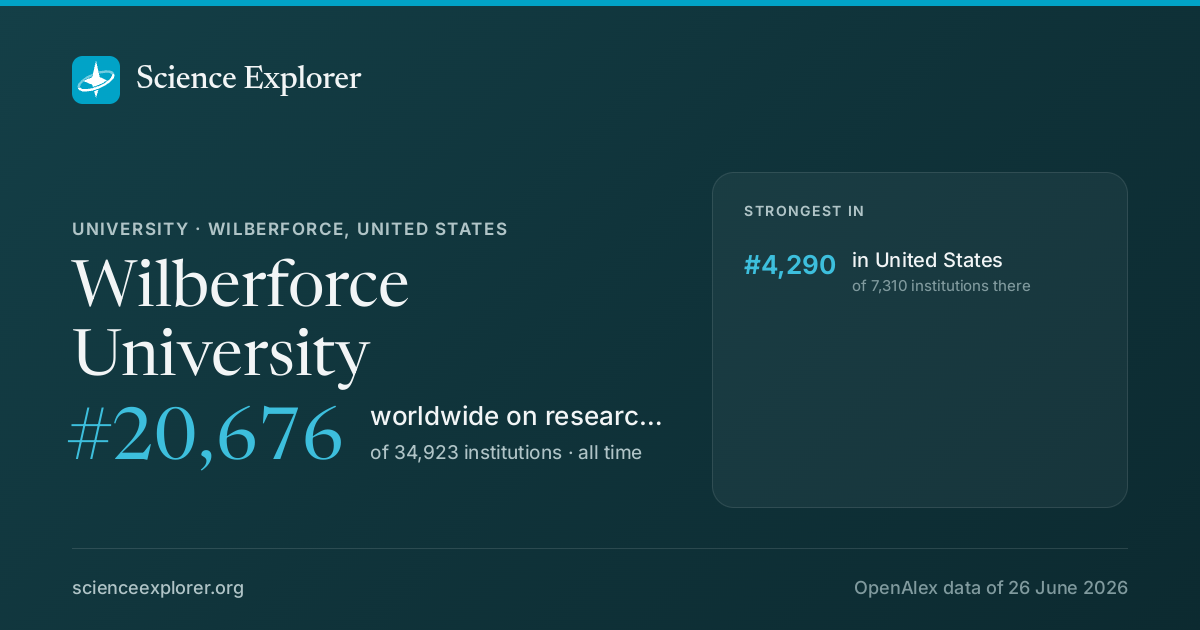
Wilberforce University on Science Explorer

A card with Wilberforce University's standing and the fields it leads in, for a post or a slide. A link to this page previews as the same card.

Download the card

1200 × 630 PNG, sized for social posts, drawn from the latest snapshot.

Badges for a website1Each links back here and updates with every snapshot

Research measures only: rankings here say nothing about teaching, admissions or student experience. Comparable institutions and collaboration partners have tabs of their own, above.

Discussion

Ask a question or share a note about Wilberforce University. Keep it to the research: no personal attacks, advertising or links. Any reader can report a post, which collapses it for everyone until it is opened.
