Science Explorer Back to mapMap
Discussion
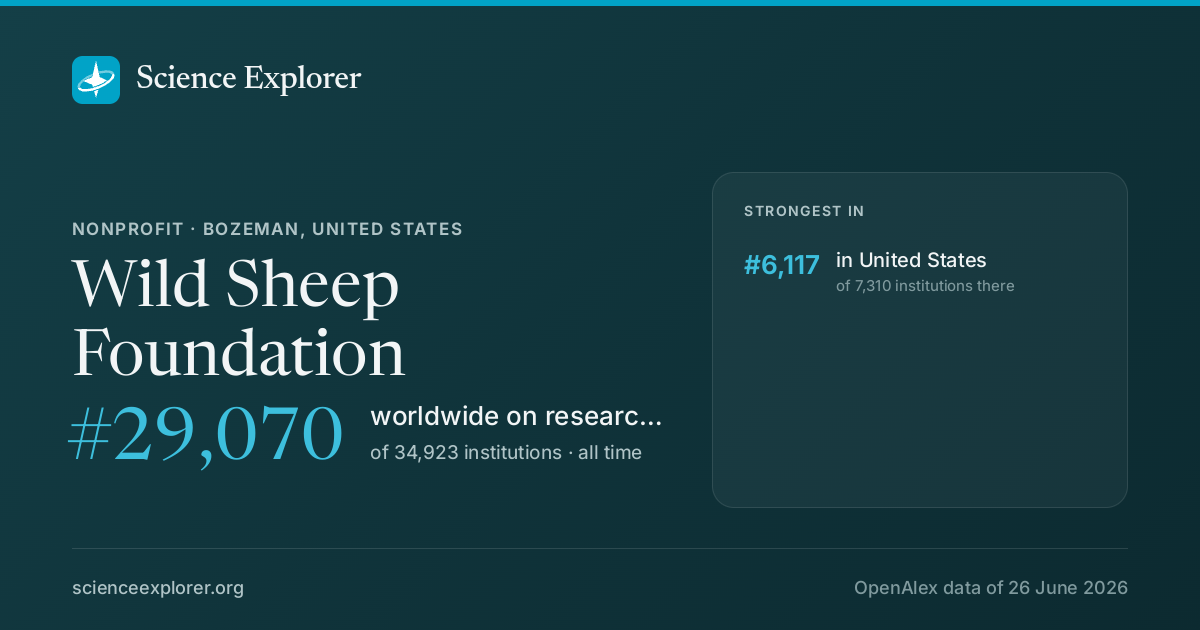
Nonprofit · Bozeman · United States

Wild Sheep Foundation

World rank, all time
#29,070
of 34,923
Rank in United States
#6,117
of 7,310
Research works
121
▲ 106% vs 2018-21
Citations
5.5k
45.7 per fractional work
Top-10% rate
10.5%
all institutions 10.0%
vs its own fields
1.09×
1.00× is exactly expected
Open access
22%
world 40%
International
16%
world 18%

Which fields of science does Wild Sheep Foundation work in?

In 2022-now, 35% of research at Wild Sheep Foundation is in Health Sciences, 31% in Life Sciences. Its largest fields are Medicine (31%), Biochemistry, Genetics and Molecular Biology (13%), Neuroscience (10%). It does 1.9× the world's share of Life Sciences.

Health Sciences: 16 fractional works · 34.8% of its workMedicine: 14 fractional works · 31.1% of its workReproductive Medicine: 3 fractional works · 6.2% of its workPublic Health, Environmental and Occupational Health: 3 fractional works · 5.6% of its workInfectious Diseases: 2 fractional works · 4.4% of its workPharmacology: 1 fractional works · 2.9% of its workEpidemiology: 1 fractional works · 2.2% of its workRadiology, Nuclear Medicine and Imaging: 1 fractional works · 2.2% of its workPhysiology: 1 fractional works · 1.8% of its workSurgery: 1 fractional works · 1.8% of its workOncology: 1 fractional works · 1.5% of its workPediatrics, Perinatology and Child Health: 0 fractional works · 0.8% of its workEndocrinology, Diabetes and Metabolism: 0 fractional works · 0.7% of its workNeurology: 0 fractional works · 0.7% of its workSmaller subfields together: 0 fractional works · 0.2% of its workHealth Professions: 1 fractional works · 2.6% of its workGeneral Health Professions: 1 fractional works · 2.4% of its workSmaller subfields together: 0 fractional works · 0.2% of its workVeterinary: 1 fractional works · 1.1% of its workSmall Animals: 1 fractional works · 1.1% of its workLife Sciences: 14 fractional works · 31.4% of its workBiochemistry, Genetics and Molecular Biology: 6 fractional works · 13.2% of its workMolecular Biology: 3 fractional works · 6.7% of its workBiophysics: 2 fractional works · 3.7% of its workGenetics: 1 fractional works · 1.9% of its workCancer Research: 0 fractional works · 0.7% of its workSmaller subfields together: 0 fractional works · 0.2% of its workNeuroscience: 5 fractional works · 10.3% of its workCognitive Neuroscience: 2 fractional works · 5.1% of its workCellular and Molecular Neuroscience: 1 fractional works · 2.2% of its workBehavioral Neuroscience: 0 fractional works · 0.7% of its workBiological Psychiatry: 0 fractional works · 0.7% of its workDevelopmental Neuroscience: 0 fractional works · 0.7% of its workNeurology: 0 fractional works · 0.7% of its workSmaller subfields together: 0 fractional works · 0.1% of its workAgricultural and Biological Sciences: 3 fractional works · 5.9% of its workEcology, Evolution, Behavior and Systematics: 2 fractional works · 4.8% of its workPlant Science: 0 fractional works · 0.9% of its workSmaller subfields together: 0 fractional works · 0.2% of its workImmunology and Microbiology: 1 fractional works · 1.8% of its workImmunology: 0 fractional works · 0.9% of its workVirology: 0 fractional works · 0.7% of its workSmaller subfields together: 0 fractional works · 0.2% of its workPharmacology, Toxicology and Pharmaceutics: 0 fractional works · 0.2% of its workPharmacology: 0 fractional works · 0.2% of its workSocial Sciences: 9 fractional works · 19.3% of its workPsychology: 3 fractional works · 6.6% of its workSocial Psychology: 2 fractional works · 3.8% of its workClinical Psychology: 1 fractional works · 2.3% of its workApplied Psychology: 0 fractional works · 0.3% of its workSmaller subfields together: 0 fractional works · 0.2% of its workSocial Sciences: 3 fractional works · 6.0% of its workGender Studies: 1 fractional works · 2.9% of its workHealth: 0 fractional works · 0.7% of its workSociology and Political Science: 0 fractional works · 0.7% of its workSafety Research: 0 fractional works · 0.5% of its workCommunication: 0 fractional works · 0.4% of its workDemography: 0 fractional works · 0.2% of its workGeography, Planning and Development: 0 fractional works · 0.2% of its workLaw: 0 fractional works · 0.2% of its workDecision Sciences: 2 fractional works · 3.9% of its workStatistics, Probability and Uncertainty: 2 fractional works · 3.5% of its workManagement Science and Operations Research: 0 fractional works · 0.4% of its workEconomics, Econometrics and Finance: 1 fractional works · 1.8% of its workEconomics and Econometrics: 1 fractional works · 1.7% of its workSmaller subfields together: 0 fractional works · 0.2% of its workArts and Humanities: 0 fractional works · 1.1% of its workHistory and Philosophy of Science: 0 fractional works · 0.4% of its workLanguage and Linguistics: 0 fractional works · 0.4% of its workVisual Arts and Performing Arts: 0 fractional works · 0.2% of its workPhysical Sciences: 7 fractional works · 14.5% of its workEnvironmental Science: 3 fractional works · 5.9% of its workEcology: 1 fractional works · 2.0% of its workNature and Landscape Conservation: 1 fractional works · 1.1% of its workHealth, Toxicology and Mutagenesis: 0 fractional works · 1.1% of its workEnvironmental Engineering: 0 fractional works · 0.9% of its workGlobal and Planetary Change: 0 fractional works · 0.5% of its workSmaller subfields together: 0 fractional works · 0.3% of its workEngineering: 1 fractional works · 2.3% of its workBiomedical Engineering: 1 fractional works · 1.5% of its workIndustrial and Manufacturing Engineering: 0 fractional works · 0.4% of its workArchitecture: 0 fractional works · 0.2% of its workSmaller subfields together: 0 fractional works · 0.1% of its workMathematics: 1 fractional works · 2.1% of its workModeling and Simulation: 1 fractional works · 1.5% of its workStatistics and Probability: 0 fractional works · 0.6% of its workComputer Science: 1 fractional works · 1.7% of its workArtificial Intelligence: 0 fractional works · 1.1% of its workInformation Systems: 0 fractional works · 0.4% of its workSmaller subfields together: 0 fractional works · 0.2% of its workPhysics and Astronomy: 1 fractional works · 1.5% of its workAstronomy and Astrophysics: 0 fractional works · 0.7% of its workCondensed Matter Physics: 0 fractional works · 0.7% of its workSmaller subfields together: 0 fractional works · 0.0% of its workChemistry: 0 fractional works · 0.7% of its workOrganic Chemistry: 0 fractional works · 0.7% of its workEnergy: 0 fractional works · 0.3% of its workRenewable Energy, Sustainability and the Environment: 0 fractional works · 0.3% of its workEarth and Planetary Sciences: 0 fractional works · 0.2% of its workALL ITS WORKWild SheepFoundation45fractional works, 2022-now
Life Sciences31%Physical Sciences14%Health Sciences35%Social Sciences19%

Each ring splits the one inside it: the four domains of science, their fields, their subfields. Size is fractional works in 2022-now. Every slice is a page; the interactive view zooms down to single topics and colours each by how much more of it this institution does than the world.

Its 4 domains and 21 fields, with their numbers
    1. Medicine1431.1%
    2. Health Professions12.6%
    3. Veterinary11.1%
    1. Biochemistry, Genetics and Molecular Biology613.2%
    2. Neuroscience510.3%
    3. Agricultural and Biological Sciences35.9%
    4. Immunology and Microbiology11.8%
    5. Pharmacology, Toxicology and Pharmaceutics00.2%
    1. Psychology36.6%
    2. Social Sciences36.0%
    3. Decision Sciences23.9%
    4. Economics, Econometrics and Finance11.8%
    5. Arts and Humanities01.1%
    1. Environmental Science35.9%
    2. Engineering12.3%
    3. Mathematics12.1%
    4. Computer Science11.7%
    5. Physics and Astronomy11.5%
    6. Chemistry00.7%
    7. Energy00.3%
    8. Earth and Planetary Sciences00.2%
All of science, and how each field's share has moved since 1950: the Science domain explorer

Field profile

Location quotient across every field it publishes in: outside the ring is more than an institution of this size would be expected to publish, inside it is less.

Agricultural and Biological Sciences: 1.24× its world share, 3 worksAgricultural and Bio…Biochemistry, Genetics and Molecular Biology: 2.47× its world share, 6 worksBiochemistry, Geneti…Immunology and Microbiology: 1.75× its world share, 1 worksImmunology and Micro…Neuroscience: 6.36× its world share, 5 worksNeurosciencePharmacology, Toxicology and Pharmaceutics: 0.69× its world share, 0 worksPharmacology, Toxico…Chemistry: 0.47× its world share, 0 worksChemistryComputer Science: 0.21× its world share, 1 worksComputer ScienceEarth and Planetary Sciences: 0.09× its world share, 0 worksEarth and Planetary …Energy: 0.32× its world share, 0 worksEnergyEngineering: 0.15× its world share, 1 worksEngineeringEnvironmental Science: 1.18× its world share, 3 worksEnvironmental ScienceMathematics: 1.76× its world share, 1 worksMathematicsPhysics and Astronomy: 0.66× its world share, 1 worksPhysics and AstronomyHealth Professions: 0.97× its world share, 1 worksHealth ProfessionsMedicine: 1.62× its world share, 14 worksMedicineVeterinary: 8.48× its world share, 0 worksVeterinaryArts and Humanities: 0.36× its world share, 0 worksArts and HumanitiesDecision Sciences: 3.98× its world share, 2 worksDecision SciencesEconomics, Econometrics and Finance: 0.86× its world share, 1 worksEconomics, Econometr…Psychology: 2.16× its world share, 3 worksPsychologySocial Sciences: 0.47× its world share, 3 worksSocial Sciences1×world share
more than its size predictsabout as predictedless

Rings at 0.5×, 1× and 2×. Widest outward: Veterinary, 8.5×. Every wedge is a field page.

All 21 fields, with their numbers
  1. Veterinary8.48×0 works
  2. Neuroscience6.36×5 works
  3. Decision Sciences3.98×2 works
  4. Biochemistry, Genetics and Molecular Biology2.47×6 works
  5. Psychology2.16×3 works
  6. Mathematics1.76×1 works
  7. Immunology and Microbiology1.75×1 works
  8. Medicine1.62×14 works
  9. Agricultural and Biological Sciences1.24×3 works
  10. Environmental Science1.18×3 works
  11. Health Professions0.97×1 works
  12. Economics, Econometrics and Finance0.86×1 works
  13. Pharmacology, Toxicology and Pharmaceutics0.69×0 works
  14. Physics and Astronomy0.66×1 works
  15. Chemistry0.47×0 works
  16. Social Sciences0.47×3 works
  17. Arts and Humanities0.36×0 works
  18. Energy0.32×0 works
  19. Computer Science0.21×1 works
  20. Engineering0.15×1 works
  21. Earth and Planetary Sciences0.09×0 works

Who are the top researchers at Wild Sheep Foundation?

Ranked on the quality score, Stephen Budiansky lead among researchers whose main affiliation is Wild Sheep Foundation.

  1. 1 Stephen Budiansky United States · #7,671,917 worldwide 624 citations · 420 works
All ranked researchers at Wild Sheep Foundation

What are the most cited papers from Wild Sheep Foundation?

The most cited paper from Wild Sheep Foundation is "Unhealthy Landscapes: Policy Recommendations on Land Use Change and Infectious Disease Emergence" (Jonathan A. Patz, Peter Daszak, Gary Tabor et al., 2004), with 971 citations. Next come "Ten Years of Talking About Machines" (109) and "Modeling an aspirational connected network of protected areas across North America" (61).

Most cited papers
#PaperReleasedCitations
1 Unhealthy Landscapes: Policy Recommendations on Land Use Change and Infectious Disease Emergence Jonathan A. Patz, Peter Daszak, Gary Tabor et al. · Environmental Health Perspectives Open access 22 Apr 2004 971
2 Ten Years of Talking About Machines Julian E. Orr · Organization Studies Dec 2006 109
3 Modeling an aspirational connected network of protected areas across North America Kevin Barnett, R. Travis Belote · Ecological Applications Open access 16 Jun 2021 61
4 Identification and analysis of uncertainty in disaster risk reduction and climate change adaptation in South and Southeast Asia Peter van der Keur, Caroline van Bers, Hans Jørgen Henriksen et al. · International Journal of Disaster Risk Reduction Open access 8 Mar 2016 59
5 Whitebark pine mortality related to white pine blister rust, mountain pine beetle outbreak, and water availability Erin K. Shanahan, Kathryn M. Irvine, David P. Thoma et al. · Ecosphere Open access Dec 2016 51
All 51 most cited papers, with filters and sorting

Which keywords describe research at Wild Sheep Foundation?

By fractional works in 2022-now, weighted toward what it does more of than the world: Ethical Considerations, Public Health, Drug Development, Biomedical Science, Health Research, Neurobiology, Pandemic and Neuroscience.

▲ more of its work than of the world's◆ about the world's share▼ less than the world's

Size is fractional works in 2022-now in the topics tagged with each word; colour is the word's share of this institution's work against its share of the world's. The 40 words are chosen for being large and distinctive. Each links to the topic it comes from most.

All 40 words, with their numbers
  1. Ethical Considerations4▲ 29×5 topics
  2. Public Health4▲ 6.2×5 topics
  3. Drug Development3▲ 81×2 topics
  4. Epidemiology3▲ 1.68×7 topics
  5. Biomedical Science3▲ 285×1 topic
  6. Health Research3▲ 56×1 topic
  7. Neurobiology3▲ 24×5 topics
  8. Pandemic3▲ 5.9×3 topics
  9. Neuroscience2▲ 17×3 topics
  10. Depression2▲ 5.3×6 topics
  11. Genomics2▲ 14×3 topics
  12. ACE2 Receptor2▲ 16×2 topics
  13. Academic Medicine2▲ 47×2 topics
  14. SARS-CoV-22▲ 12×2 topics
  15. Serotonin2▲ 90×2 topics
  16. Anxiety1▲ 6.3×3 topics
  17. Bibliometric Analysis1▲ 53×1 topic
  18. Bioimage Analysis1▲ 76×1 topic
  19. High-Content Screening1▲ 76×1 topic
  20. Influenza1▲ 71×2 topics
  21. Medical Research1▲ 106×1 topic
  22. Molecular Phylogeny1▲ 17×4 topics
  23. Pathogenesis1▲ 5.8×2 topics
  24. Physician-Scientist1▲ 106×1 topic
  25. Research Evaluation1▲ 120×1 topic
  26. Viral Transmission1▲ 21×2 topics
  27. Biological Soil Crusts1▲ 128×1 topic
  28. Bystander Education1▲ 133×1 topic
  29. Cognitive Neuroscience1▲ 65×1 topic
  30. Coronavirus1▲ 11×1 topic
  31. Cyanobacteria1▲ 45×1 topic
  32. Genetic Variation1▲ 10.0×2 topics
  33. Glycosylation1▲ 20×2 topics
  34. H1N11▲ 72×1 topic
  35. Near-Death Experiences1▲ 238×1 topic
  36. Neuromyths1▲ 110×1 topic
  37. Paranormal Beliefs1▲ 238×1 topic
  38. Psilocybin1▲ 135×1 topic
  39. Psychedelics1▲ 135×1 topic
  40. Sexual Violence Prevention1▲ 133×1 topic

Which research topics does Wild Sheep Foundation publish most on?

By volume in 2022-now: Science, Research, and Medicine, scientometrics and bibliometrics research, Health and Medical Research Impacts and Cell Image Analysis Techniques.

  1. 1 Science, Research, and Medicine Reproductive Medicine 3 works
  2. 2 scientometrics and bibliometrics research Statistics, Probability and Uncertainty 1 works
  3. 3 Health and Medical Research Impacts Public Health, Environmental and Occupational Health 1 works
  4. 4 Cell Image Analysis Techniques Biophysics 1 works
  5. 5 Paranormal Experiences and Beliefs Social Psychology 1 works
  6. 6 Sexual Assault and Victimization Studies Gender Studies 1 works
  7. 7 Psychedelics and Drug Studies Clinical Psychology 1 works
  8. 8 Biocrusts and Microbial Ecology Ecology, Evolution, Behavior and Systematics 1 works
  9. 9 SARS-CoV-2 and COVID-19 Research Infectious Diseases 1 works
  10. 10 Neuroscience, Education and Cognitive Function Cognitive Neuroscience 1 works

How open and international is its research?

Against the world's own shares: the tick on each track. Both are shares of its output, so they sit on one scale and can be read against each other as well as against the world.

openly available22.0%not open78.0%

World: 40% of research is openly available.

with international co-authors15.7%domestic only84.3%

World: 18% is written across borders.

How has Wild Sheep Foundation's research output changed?

Output in 2022-2025 was 106% higher than in 2018-2021.

still counting1990200020102020
grewheldshrank

The same series as a ribbon: one cell per year, darker for more. The line above answers how much; this answers when.

Its share of all research

Growing output can still be a shrinking share: all of science grows. This is Wild Sheep Foundation as a percentage of every work published that year, 0.00034% in 2024.

still counting0.00020%0.00040%0.00060%Wild Sheep Foundation0.000080% in 202519801990200020102020

Fractional works of Wild Sheep Foundation over all fractional works that year. How the balance of science has shifted.

Other research institutions in Bozeman

All research institutions in Bozeman

Share Wild Sheep Foundation's ranking

Wild Sheep Foundation on Science Explorer

A card with Wild Sheep Foundation's standing and the fields it leads in, for a post or a slide. A link to this page previews as the same card.

Download the card

1200 × 630 PNG, sized for social posts, drawn from the latest snapshot.

Badges for a website1Each links back here and updates with every snapshot

Research measures only: rankings here say nothing about teaching, admissions or student experience. Comparable institutions and collaboration partners have tabs of their own, above.

Discussion

Ask a question or share a note about Wild Sheep Foundation. Posts are plain text and can be reported.