Yokkaichi University
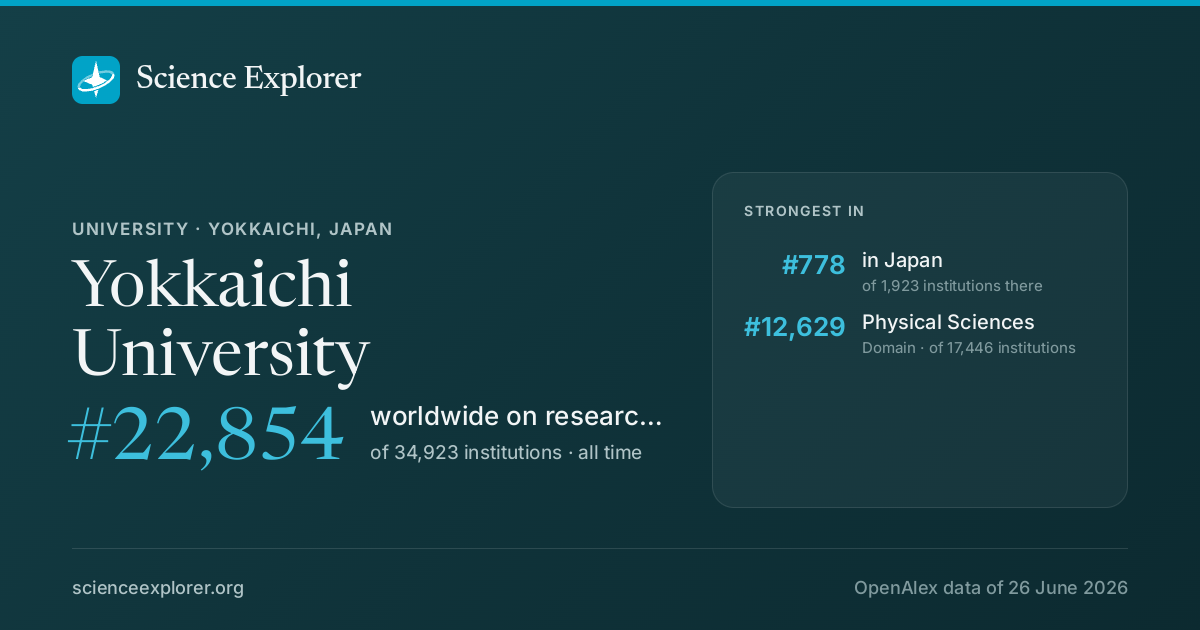
In research, Yokkaichi University stands highest in Physical Sciences (#12,629 of 17,446 worldwide), over all time.
- World rank, all time
- #22,854 of 34,923
- Rank in Japan
- #778 of 1,923
- Research works
- 416 ▼ 3% vs 2018-21
- Citations
- 4.5k 10.8 per fractional work
- Top-10% rate
- 4.1% all institutions 10.0%
- vs its own fields
- 0.79× 1.00× is exactly expected
- Open access
- 42% world 40%
- International
- 11% world 18%
What is Yokkaichi University known for in research?
The fields where it stands highest, over all time, ranked among every institution above the floor in each field.
| Field | World rank | Where that sits | Top-10% rate | Works |
|---|---|---|---|---|
| Physical SciencesDomain | #12,629 of 17,446 | 4.6% | 308 |
Each strip is that field's whole ranked pool, with the notch where Yokkaichi University sits in it, in the colour of the band that rank falls in. The track under the rate is the rate itself: it carries no average mark, because the average differs by field (from about 6% in Dentistry to 21% in Economics).
Which fields of science does Yokkaichi University work in?
In 2022-now, 74% of research at Yokkaichi University is in Physical Sciences, 10% in Health Sciences. Its largest fields are Engineering (30%), Materials Science (14%), Medicine (9%). It does 1.8× the world's share of Physical Sciences.
Each ring splits the one inside it: the four domains of science, their fields, their subfields. Size is fractional works in 2022-now. Every slice is a page; the interactive view zooms down to single topics and colours each by how much more of it this institution does than the world.
Its 4 domains and 24 fields, with their numbers
- Physical Sciences4474.0%
- Engineering1830.5%
- Materials Science813.8%
- Computer Science58.1%
- Mathematics46.2%
- Chemistry46.0%
- Environmental Science35.2%
- Physics and Astronomy22.6%
- Chemical Engineering10.9%
- Earth and Planetary Sciences00.7%
- Health Sciences610.1%
- Medicine58.8%
- Nursing00.8%
- Dentistry00.2%
- Health Professions00.2%
- Veterinary00.1%
- Life Sciences69.6%
- Social Sciences46.3%
Field profile
Location quotient across every field it publishes in: outside the ring is more than an institution of this size would be expected to publish, inside it is less.
Rings at 0.5×, 1× and 2×. Widest outward: Mathematics, 5.2×. Every wedge is a field page.
All 24 fields, with their numbers
- Mathematics5.23×4 works
- Materials Science3.96×8 works
- Chemistry3.82×4 works
- Pharmacology, Toxicology and Pharmaceutics3.55×1 works
- Chemical Engineering2.67×1 works
- Engineering2.03×18 works
- Nursing1.71×0 works
- Physics and Astronomy1.18×2 works
- Computer Science1.05×5 works
- Environmental Science1.05×3 works
- Biochemistry, Genetics and Molecular Biology1.02×3 works
- Agricultural and Biological Sciences0.58×2 works
- Dentistry0.46×0 works
- Medicine0.46×5 works
- Earth and Planetary Sciences0.42×0 works
- Veterinary0.41×0 works
- Arts and Humanities0.39×1 works
- Social Sciences0.35×3 works
- Decision Sciences0.12×0 works
- Psychology0.11×0 works
- Neuroscience0.09×0 works
- Health Professions0.07×0 works
- Business, Management and Accounting0.04×0 works
- Economics, Econometrics and Finance0.04×0 works
- Mathematics 5.2×
- Materials Science 4.0×
- Chemistry 3.8×
- Pharmacology, Toxicology and Pharmaceutics 3.5×
- Chemical Engineering 2.7×
- Engineering 2.0×
- Nursing 1.7×
- Physics and Astronomy 1.2×
- Computer Science 1.1×
- Environmental Science 1.1×
- Biochemistry, Genetics and Molecular Biology 1.0×
- Agricultural and Biological Sciences 0.6×
- Dentistry 0.5×
- Medicine 0.5×
- Earth and Planetary Sciences 0.4×
- Veterinary 0.4×
- Arts and Humanities 0.4×
- Social Sciences 0.3×
- Decision Sciences 0.1×
- Psychology 0.1×
- Neuroscience 0.1×
- Health Professions 0.1×
- Business, Management and Accounting 0.0×
- Economics, Econometrics and Finance 0.0×
Who are the top researchers at Yokkaichi University?
Ranked on the quality score, Nobuo Kawahashi, Takao Usami and Takaaki Uno lead among researchers whose main affiliation is Yokkaichi University.
- 1
Nobuo Kawahashi
 Japan · #1,212,885 worldwide
887 citations · 15 works
- 2
Takao Usami
Japan · #1,882,401 worldwide
810 citations · 20 works
- 3
Takaaki Uno
Japan · #2,416,977 worldwide
668 citations · 16 works
- 4
Yūkichi Ōsaka
Japan · #3,572,741 worldwide
15 citations · 15 works
- 5
Katsunori Miyachi
Japan · #4,394,749 worldwide
9 citations · 16 works
- 6
Yutaka Makita
Japan · #4,409,005 worldwide
284 citations · 24 works
- 7
Masaaki Takahashi
Japan · #4,463,053 worldwide
192 citations · 18 works
- 8
Takuo Sone
Japan · #4,808,164 worldwide
275 citations · 22 works
- 9
Shoei Komatsu
Japan · #4,997,095 worldwide
54 citations · 16 works
- 10
Yoshiaki Nakamura
Japan · #4,997,439 worldwide
0 citations · 25 works
Which keywords describe research at Yokkaichi University?
By fractional works in 2022-now, weighted toward what it does more of than the world: High-Resolution Patterning, Nanoscale Patterning, Historical Sources, Mathematics Education, Biological Applications, Nanolithography, Soft Lithography and Solar Cells.
- Superhydrophobic Surfaces
- Spectroscopy
- Photonic Crystals
- Network Coding
- Low-k Dielectrics
- Distributed Storage
- Surface Roughness
- Nanofabrication
- Kinetics
- Polymerization
- Polyimides
- Elemental Sulfur
- High-k Dielectrics
- Robotics Programming
- Phosphorus
- Wastewater
- Solar Cells
- Nanolithography
- Mathematics Education
- Nanoscale Patterning
- High-Resolution Patterning
- Historical Sources
- Biological Applications
- Soft Lithography
- Recovery
- Fertilizer
- Nanoelectronics
- Atomic Layer Deposition
- Thin Films
- Parallel Computing
- Flexible Electronics
- Electromigration
- Interconnect
- Nanostructures
- Through-Silicon Via
- Environmental Management
- Microelectronics
- Photoinitiation
- Visible Light
- Bioinspired Design
Size is fractional works in 2022-now in the topics tagged with each word; colour is the word's share of this institution's work against its share of the world's. The 40 words are chosen for being large and distinctive. Each links to the topic it comes from most.
All 40 words, with their numbers
- High-Resolution Patterning3▲ 223×2 topics
- Nanoscale Patterning3▲ 180×2 topics
- Historical Sources3▲ 262×1 topic
- Mathematics Education3▲ 97×1 topic
- Biological Applications2▲ 58×2 topics
- Nanolithography2▲ 332×1 topic
- Soft Lithography2▲ 332×1 topic
- Solar Cells2▲ 19×4 topics
- Recovery2▲ 32×2 topics
- Wastewater2▲ 44×2 topics
- Fertilizer2▲ 111×1 topic
- Phosphorus2▲ 36×1 topic
- Nanoelectronics2▲ 38×2 topics
- Robotics Programming2▲ 323×1 topic
- Atomic Layer Deposition2▲ 46×1 topic
- High-k Dielectrics2▲ 46×1 topic
- Thin Films2▲ 15×3 topics
- Elemental Sulfur2▲ 128×1 topic
- Parallel Computing2▲ 24×2 topics
- Polyimides2▲ 143×1 topic
- Flexible Electronics2▲ 16×3 topics
- Polymerization2▲ 28×3 topics
- Electromigration2▲ 89×2 topics
- Kinetics2▲ 82×2 topics
- Interconnect1▲ 141×1 topic
- Nanofabrication1▲ 39×2 topics
- Nanostructures1▲ 6.0×2 topics
- Surface Roughness1▲ 18×2 topics
- Through-Silicon Via1▲ 141×1 topic
- Distributed Storage1▲ 83×1 topic
- Environmental Management1▲ 5.5×3 topics
- Low-k Dielectrics1▲ 226×1 topic
- Microelectronics1▲ 184×1 topic
- Network Coding1▲ 50×1 topic
- Photoinitiation1▲ 187×1 topic
- Photonic Crystals1▲ 18×2 topics
- Visible Light1▲ 9.6×1 topic
- Spectroscopy1▲ 12×3 topics
- Bioinspired Design1▲ 40×1 topic
- Superhydrophobic Surfaces1▲ 40×1 topic
Which research topics does Yokkaichi University publish most on?
By volume in 2022-now: History and Theory of Mathematics, Nanofabrication and Lithography Techniques, Phosphorus and nutrient management and Educational Robotics and Engineering.
Area is fractional works; colour is the subfield each topic belongs to.
- 1 History and Theory of Mathematics Theoretical Computer Science 3 works
- 2 Nanofabrication and Lithography Techniques Biomedical Engineering 2 works
- 3 Phosphorus and nutrient management Industrial and Manufacturing Engineering 2 works
- 4 Educational Robotics and Engineering Artificial Intelligence 2 works
- 5 Semiconductor materials and devices Electrical and Electronic Engineering 2 works
- 6 Synthesis and properties of polymers Polymers and Plastics 2 works
- 7 3D IC and TSV technologies Electrical and Electronic Engineering 1 works
- 8 Photopolymerization techniques and applications Organic Chemistry 1 works
- 9 Copper Interconnects and Reliability Electronic, Optical and Magnetic Materials 1 works
- 10 Advanced Data Storage Technologies Computer Networks and Communications 1 works
How open and international is its research?
Against the world's own shares: the tick on each track. Both are shares of its output, so they sit on one scale and can be read against each other as well as against the world.
World: 40% of research is openly available.
World: 18% is written across borders.
How has Yokkaichi University's research output changed?
Output in 2022-2025 was 3% lower than in 2018-2021.
The same series as a ribbon: one cell per year, darker for more. The line above answers how much; this answers when.
Its share of all research
Growing output can still be a shrinking share: all of science grows. This is Yokkaichi University as a percentage of every work published that year, 0.00024% in 2024.
Fractional works of Yokkaichi University over all fractional works that year. How the balance of science has shifted.
Other research institutions in Yokkaichi
- Yokkaichi Municipal Hospital
- Yokkaichi Social Insurance Hospital
- Tomitahama Hospital
- Yokkaichi Nursing and Medical Care University
- AutoNetworks Technologies (Japan)
- Mie Prefectural Yokkaichi Nishi High School
- Yokkaichi University Junior College
- Mie Prefectural Yokkaichi Technical High School
Share Yokkaichi University's ranking
Badges for a website1Each links back here and updates with every snapshot

Research measures only: rankings here say nothing about teaching, admissions or student experience. Comparable institutions and collaboration partners have tabs of their own, above.
Discussion
Ask a question or share a note about Yokkaichi University. Keep it to the research: no personal attacks, advertising or links. Any reader can report a post, which collapses it for everyone until it is opened.