Science Explorer Back to mapMap
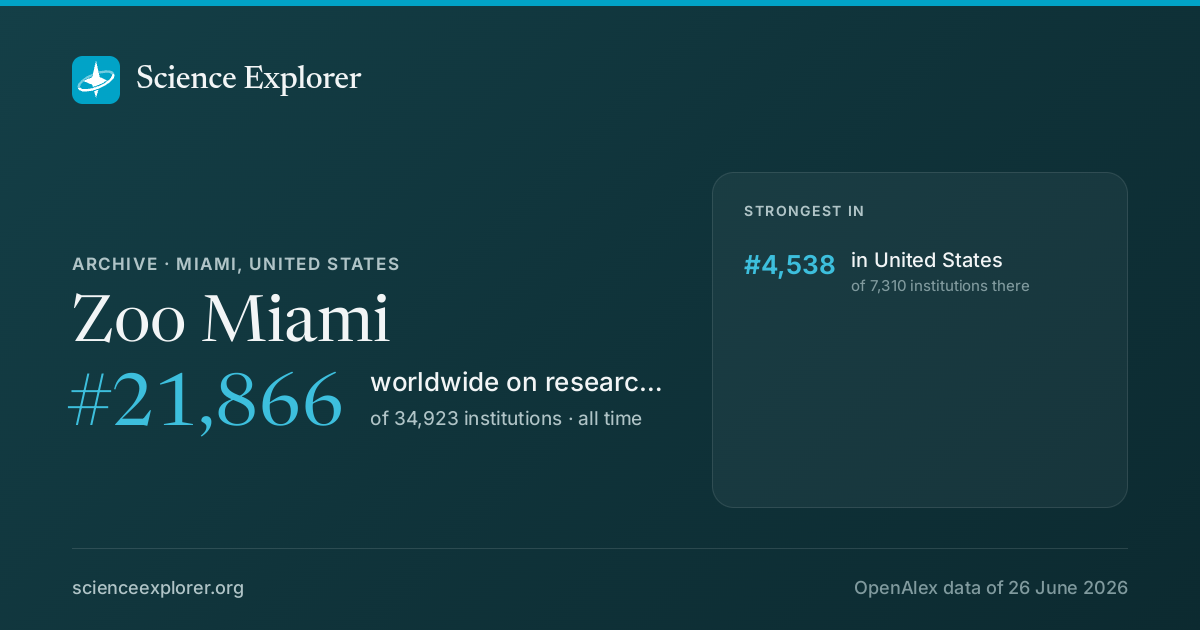
Archive · Miami · United States

Zoo Miami

World rank, all time
#21,866
of 34,923
Rank in United States
#4,538
of 7,310
Research works
268
◆ 0% vs 2018-21
Citations
5.1k
19.0 per fractional work
Top-10% rate
7.6%
all institutions 10.0%
vs its own fields
0.91×
1.00× is exactly expected
Open access
29%
world 40%
International
22%
world 18%

Which fields of science does Zoo Miami work in?

In 2022-now, 41% of research at Zoo Miami is in Physical Sciences, 29% in Life Sciences. Its largest fields are Environmental Science (27%), Agricultural and Biological Sciences (11%), Medicine (10%). It does 1.8× the world's share of Life Sciences.

Physical Sciences: 23 fractional works · 40.8% of its workEnvironmental Science: 15 fractional works · 27.1% of its workEcology: 6 fractional works · 10.0% of its workNature and Landscape Conservation: 4 fractional works · 6.9% of its workGlobal and Planetary Change: 3 fractional works · 4.5% of its workManagement, Monitoring, Policy and Law: 2 fractional works · 2.8% of its workHealth, Toxicology and Mutagenesis: 1 fractional works · 1.4% of its workEcological Modeling: 1 fractional works · 1.2% of its workWater Science and Technology: 0 fractional works · 0.2% of its workComputer Science: 4 fractional works · 6.3% of its workSignal Processing: 2 fractional works · 2.8% of its workComputer Networks and Communications: 1 fractional works · 2.0% of its workComputer Vision and Pattern Recognition: 0 fractional works · 0.6% of its workArtificial Intelligence: 0 fractional works · 0.4% of its workComputer Science Applications: 0 fractional works · 0.3% of its workInformation Systems: 0 fractional works · 0.2% of its workEngineering: 2 fractional works · 3.9% of its workAutomotive Engineering: 1 fractional works · 1.6% of its workAerospace Engineering: 0 fractional works · 0.4% of its workBiomedical Engineering: 0 fractional works · 0.4% of its workBuilding and Construction: 0 fractional works · 0.3% of its workMechanical Engineering: 0 fractional works · 0.3% of its workMechanics of Materials: 0 fractional works · 0.3% of its workMedia Technology: 0 fractional works · 0.3% of its workSmaller subfields together: 0 fractional works · 0.3% of its workEarth and Planetary Sciences: 2 fractional works · 3.2% of its workAtmospheric Science: 1 fractional works · 1.1% of its workPaleontology: 1 fractional works · 1.1% of its workOceanography: 0 fractional works · 0.7% of its workSmaller subfields together: 0 fractional works · 0.3% of its workMaterials Science: 0 fractional works · 0.2% of its workPhysics and Astronomy: 0 fractional works · 0.0% of its workLife Sciences: 16 fractional works · 28.9% of its workAgricultural and Biological Sciences: 6 fractional works · 10.8% of its workEcology, Evolution, Behavior and Systematics: 2 fractional works · 3.6% of its workAgronomy and Crop Science: 1 fractional works · 1.8% of its workFood Science: 1 fractional works · 1.6% of its workAnimal Science and Zoology: 1 fractional works · 1.3% of its workPlant Science: 0 fractional works · 0.9% of its workAquatic Science: 0 fractional works · 0.8% of its workInsect Science: 0 fractional works · 0.8% of its workBiochemistry, Genetics and Molecular Biology: 5 fractional works · 8.9% of its workGenetics: 3 fractional works · 4.6% of its workPhysiology: 1 fractional works · 1.3% of its workMolecular Biology: 1 fractional works · 1.1% of its workDevelopmental Biology: 0 fractional works · 0.8% of its workBiophysics: 0 fractional works · 0.6% of its workClinical Biochemistry: 0 fractional works · 0.3% of its workSmaller subfields together: 0 fractional works · 0.2% of its workImmunology and Microbiology: 5 fractional works · 8.5% of its workParasitology: 3 fractional works · 5.1% of its workVirology: 1 fractional works · 2.0% of its workImmunology: 1 fractional works · 1.2% of its workSmaller subfields together: 0 fractional works · 0.1% of its workNeuroscience: 0 fractional works · 0.7% of its workCognitive Neuroscience: 0 fractional works · 0.4% of its workSensory Systems: 0 fractional works · 0.3% of its workHealth Sciences: 10 fractional works · 17.3% of its workMedicine: 6 fractional works · 10.4% of its workRadiology, Nuclear Medicine and Imaging: 1 fractional works · 1.3% of its workSurgery: 1 fractional works · 1.0% of its workInfectious Diseases: 1 fractional works · 1.0% of its workPulmonary and Respiratory Medicine: 1 fractional works · 1.0% of its workPublic Health, Environmental and Occupational Health: 1 fractional works · 0.9% of its workUrology: 0 fractional works · 0.9% of its workEpidemiology: 0 fractional works · 0.9% of its workEndocrinology, Diabetes and Metabolism: 0 fractional works · 0.8% of its workNephrology: 0 fractional works · 0.6% of its workReproductive Medicine: 0 fractional works · 0.5% of its workPhysiology: 0 fractional works · 0.3% of its workOphthalmology: 0 fractional works · 0.3% of its workPathology and Forensic Medicine: 0 fractional works · 0.2% of its workSmaller subfields together: 0 fractional works · 0.8% of its workVeterinary: 3 fractional works · 4.8% of its workSmall Animals: 3 fractional works · 4.8% of its workHealth Professions: 1 fractional works · 1.7% of its workGeneral Health Professions: 1 fractional works · 1.0% of its workSpeech and Hearing: 0 fractional works · 0.7% of its workNursing: 0 fractional works · 0.3% of its workNutrition and Dietetics: 0 fractional works · 0.3% of its workDentistry: 0 fractional works · 0.1% of its workSocial Sciences: 7 fractional works · 13.1% of its workPsychology: 3 fractional works · 5.1% of its workSocial Psychology: 3 fractional works · 4.8% of its workDevelopmental and Educational Psychology: 0 fractional works · 0.3% of its workSocial Sciences: 2 fractional works · 3.8% of its workSociology and Political Science: 1 fractional works · 1.5% of its workCultural Studies: 0 fractional works · 0.9% of its workDemography: 0 fractional works · 0.6% of its workUrban Studies: 0 fractional works · 0.3% of its workSmaller subfields together: 0 fractional works · 0.6% of its workEconomics, Econometrics and Finance: 1 fractional works · 1.9% of its workFinance: 1 fractional works · 1.8% of its workSmaller subfields together: 0 fractional works · 0.1% of its workDecision Sciences: 1 fractional works · 0.9% of its workInformation Systems and Management: 0 fractional works · 0.6% of its workManagement Science and Operations Research: 0 fractional works · 0.3% of its workArts and Humanities: 0 fractional works · 0.8% of its workLiterature and Literary Theory: 0 fractional works · 0.6% of its workSmaller subfields together: 0 fractional works · 0.2% of its workBusiness, Management and Accounting: 0 fractional works · 0.5% of its workMarketing: 0 fractional works · 0.3% of its workSmaller subfields together: 0 fractional works · 0.2% of its workALL ITS WORKZoo Miami56fractional works, 2022-now
Life Sciences29%Physical Sciences41%Health Sciences17%Social Sciences13%

Each ring splits the one inside it: the four domains of science, their fields, their subfields. Size is fractional works in 2022-now. Every slice is a page; the interactive view zooms down to single topics and colours each by how much more of it this institution does than the world.

Its 4 domains and 21 fields, with their numbers
    1. Environmental Science1527.1%
    2. Computer Science46.3%
    3. Engineering23.9%
    4. Earth and Planetary Sciences23.2%
    5. Materials Science00.2%
    6. Physics and Astronomy00.0%
    1. Agricultural and Biological Sciences610.8%
    2. Biochemistry, Genetics and Molecular Biology58.9%
    3. Immunology and Microbiology58.5%
    4. Neuroscience00.7%
    1. Medicine610.4%
    2. Veterinary34.8%
    3. Health Professions11.7%
    4. Nursing00.3%
    5. Dentistry00.1%
    1. Psychology35.1%
    2. Social Sciences23.8%
    3. Economics, Econometrics and Finance11.9%
    4. Decision Sciences10.9%
    5. Arts and Humanities00.8%
    6. Business, Management and Accounting00.5%
All of science, and how each field's share has moved since 1950: the Science domain explorer

Field profile

Location quotient across every field it publishes in: outside the ring is more than an institution of this size would be expected to publish, inside it is less.

Agricultural and Biological Sciences: 2.27× its world share, 6 worksAgricultural and Bio…Biochemistry, Genetics and Molecular Biology: 1.66× its world share, 5 worksBiochemistry, Geneti…Immunology and Microbiology: 8.41× its world share, 5 worksImmunology and Micro…Neuroscience: 0.44× its world share, 0 worksNeuroscienceComputer Science: 0.81× its world share, 4 worksComputer ScienceEarth and Planetary Sciences: 2.04× its world share, 2 worksEarth and Planetary …Engineering: 0.26× its world share, 2 worksEngineeringEnvironmental Science: 5.46× its world share, 15 worksEnvironmental ScienceMaterials Science: 0.06× its world share, 0 worksMaterials SciencePhysics and Astronomy: 0.01× its world share, 0 worksPhysics and AstronomyDentistry: 0.24× its world share, 0 worksDentistryHealth Professions: 0.65× its world share, 1 worksHealth ProfessionsMedicine: 0.54× its world share, 6 worksMedicineNursing: 0.66× its world share, 0 worksNursingVeterinary: 35.05× its world share, 3 worksVeterinaryArts and Humanities: 0.27× its world share, 0 worksArts and HumanitiesBusiness, Management and Accounting: 0.16× its world share, 0 worksBusiness, Management…Decision Sciences: 0.96× its world share, 0 worksDecision SciencesEconomics, Econometrics and Finance: 0.89× its world share, 1 worksEconomics, Econometr…Psychology: 1.67× its world share, 3 worksPsychologySocial Sciences: 0.30× its world share, 2 worksSocial Sciences1×world share
more than its size predictsabout as predictedless

Rings at 0.5×, 1× and 2×. Widest outward: Veterinary, 35.0×. Every wedge is a field page.

All 21 fields, with their numbers
  1. Veterinary35.05×3 works
  2. Immunology and Microbiology8.41×5 works
  3. Environmental Science5.46×15 works
  4. Agricultural and Biological Sciences2.27×6 works
  5. Earth and Planetary Sciences2.04×2 works
  6. Psychology1.67×3 works
  7. Biochemistry, Genetics and Molecular Biology1.66×5 works
  8. Decision Sciences0.96×0 works
  9. Economics, Econometrics and Finance0.89×1 works
  10. Computer Science0.81×4 works
  11. Nursing0.66×0 works
  12. Health Professions0.65×1 works
  13. Medicine0.54×6 works
  14. Neuroscience0.44×0 works
  15. Social Sciences0.30×2 works
  16. Arts and Humanities0.27×0 works
  17. Engineering0.26×2 works
  18. Dentistry0.24×0 works
  19. Business, Management and Accounting0.16×0 works
  20. Materials Science0.06×0 works
  21. Physics and Astronomy0.01×0 works

Who are the top researchers at Zoo Miami?

Ranked on the quality score, Ray L. Ball, Alexandra K. Mason and Ray L. Ball lead among researchers whose main affiliation is Zoo Miami.

  1. 1 Ray L. Ball United States · #2,787,069 worldwide 544 citations · 20 works
  2. 2 Alexandra K. Mason United States · #4,807,249 worldwide 41 citations · 16 works
  3. 3 Ray L. Ball United States · #5,395,339 worldwide 268 citations · 32 works
  4. 4 Frank N. Ridgley United States · #5,930,780 worldwide 162 citations · 31 works
  5. 5 James E. Bogan United States · #6,100,957 worldwide 242 citations · 63 works
All ranked researchers at Zoo Miami

What are the most cited papers from Zoo Miami?

The most cited paper from Zoo Miami is "Amphibian fungal panzootic causes catastrophic and ongoing loss of biodiversity" (Ben C. Scheele et al., 2019), with 1,411 citations. Next come "Mutation rate variation in multicellular eukaryotes: causes and consequences" (502) and "The Indian cobra reference genome and transcriptome enables comprehensive identification of venom toxins" (242).

Most cited papers
#PaperReleasedCitations
1 Amphibian fungal panzootic causes catastrophic and ongoing loss of biodiversity Ben C. Scheele et al. · Science Open access 28 Mar 2019 1,411
2 Mutation rate variation in multicellular eukaryotes: causes and consequences Charles F. Baer, Michael M. Miyamoto, Dee R. Denver · Nature Reviews Genetics Review 18 Jul 2007 502
3 The Indian cobra reference genome and transcriptome enables comprehensive identification of venom toxins Kushal Suryamohan et al. · Nature Genetics Open access 2020 242
4 Evidence for henipavirus spillover into human populations in Africa Olivier Pernet, Bradley S. Schneider, Shannon M. Beaty et al. · Nature Communications Open access 18 Nov 2014 208
5 Habitat selection in a large orb‐weaving spider: vegetational complexity determines site selection and distribution Bonnie Jean Mcnett, Ann Lundie Rypstra · Ecological Entomology Nov 2000 173
All 61 most cited papers, with filters and sorting

Which keywords describe research at Zoo Miami?

By fractional works in 2022-now, weighted toward what it does more of than the world: Climate Change, Population Dynamics, Conservation, Evolution, Biodiversity, Habitat Fragmentation, Genetic Structure and Conservation Biology.

▲ more of its work than of the world's◆ about the world's share▼ less than the world's

Size is fractional works in 2022-now in the topics tagged with each word; colour is the word's share of this institution's work against its share of the world's. The 40 words are chosen for being large and distinctive. Each links to the topic it comes from most.

All 40 words, with their numbers
  1. Climate Change9▲ 6.2×23 topics
  2. Population Dynamics8▲ 52×7 topics
  3. Conservation6▲ 23×10 topics
  4. Epidemiology4▲ 1.91×21 topics
  5. Biodiversity4▲ 8.6×14 topics
  6. Evolution4▲ 25×9 topics
  7. Habitat Fragmentation3▲ 25×4 topics
  8. Conservation Biology3▲ 45×4 topics
  9. Genetic Structure3▲ 65×3 topics
  10. Molecular Phylogeny3▲ 29×6 topics
  11. Trophic Cascades3▲ 49×2 topics
  12. Habitat Selection2▲ 59×2 topics
  13. Phylogenetic Analysis2▲ 14×6 topics
  14. Animal Movement2▲ 75×1 topic
  15. Invasive Species2▲ 9.4×9 topics
  16. Occupancy Rates2▲ 75×1 topic
  17. Social Behavior2▲ 67×2 topics
  18. Public Health2▲ 2.5×7 topics
  19. Animal Welfare2▲ 36×3 topics
  20. Bats2▲ 97×2 topics
  21. Biodiversity Loss2▲ 56×2 topics
  22. Bycatch2▲ 287×1 topic
  23. Marine Turtles2▲ 287×1 topic
  24. Pathogenesis2▲ 6.3×8 topics
  25. Amphibian Declines2▲ 119×1 topic
  26. Chytridiomycosis2▲ 119×1 topic
  27. Emotional State2▲ 85×1 topic
  28. Stress Indicators2▲ 85×1 topic
  29. Intelligence1▲ 61×1 topic
  30. Oxytocin1▲ 55×2 topics
  31. Phylogeny1▲ 15×4 topics
  32. Primates1▲ 131×1 topic
  33. Zoonotic Transmission1▲ 34×3 topics
  34. Cryptosporidium1▲ 126×1 topic
  35. Ecology1▲ 13×4 topics
  36. Genomic Characterization1▲ 19×2 topics
  37. Giardia1▲ 126×1 topic
  38. Global Change1▲ 8.8×4 topics
  39. Marine Ecosystems1▲ 38×2 topics
  40. Metabolic Rate1▲ 35×3 topics

Which research topics does Zoo Miami publish most on?

By volume in 2022-now: Wildlife Ecology and Conservation, Turtle Biology and Conservation, Amphibian and Reptile Biology and Animal Behavior and Welfare Studies.

  1. 1 Wildlife Ecology and Conservation Ecology 2 works
  2. 2 Turtle Biology and Conservation Nature and Landscape Conservation 2 works
  3. 3 Amphibian and Reptile Biology Global and Planetary Change 2 works
  4. 4 Animal Behavior and Welfare Studies Small Animals 2 works
  5. 5 Primate Behavior and Ecology Social Psychology 1 works
  6. 6 Parasitic Infections and Diagnostics Parasitology 1 works
  7. 7 Bird parasitology and diseases Parasitology 1 works
  8. 8 Advanced Malware Detection Techniques Signal Processing 1 works
  9. 9 Housing, Finance, and Neoliberalism Finance 1 works
  10. 10 Urban Arborization and Environmental Studies Management, Monitoring, Policy and Law 1 works

How open and international is its research?

Against the world's own shares: the tick on each track. Both are shares of its output, so they sit on one scale and can be read against each other as well as against the world.

openly available29.2%not open70.8%

World: 40% of research is openly available.

with international co-authors22.5%domestic only77.5%

World: 18% is written across borders.

How has Zoo Miami's research output changed?

Output in 2022-2025 was 0% lower than in 2018-2021.

still counting1990200020102020
grewheldshrank

The same series as a ribbon: one cell per year, darker for more. The line above answers how much; this answers when.

Its share of all research

Growing output can still be a shrinking share: all of science grows. This is Zoo Miami as a percentage of every work published that year, 0.00019% in 2024.

still counting0.0010%0.0020%0.0030%Zoo Miami0.00020% in 202519801990200020102020

Fractional works of Zoo Miami over all fractional works that year. How the balance of science has shifted.

Other research institutions in Miami

All research institutions in Miami

Share Zoo Miami's ranking

Zoo Miami on Science Explorer

A card with Zoo Miami's standing and the fields it leads in, for a post or a slide. A link to this page previews as the same card.

Download the card

1200 × 630 PNG, sized for social posts, drawn from the latest snapshot.

Badges for a website1Each links back here and updates with every snapshot

Research measures only: rankings here say nothing about teaching, admissions or student experience. Comparable institutions and collaboration partners have tabs of their own, above.

Discussion

Ask a question or share a note about Zoo Miami. Posts are plain text and can be reported.