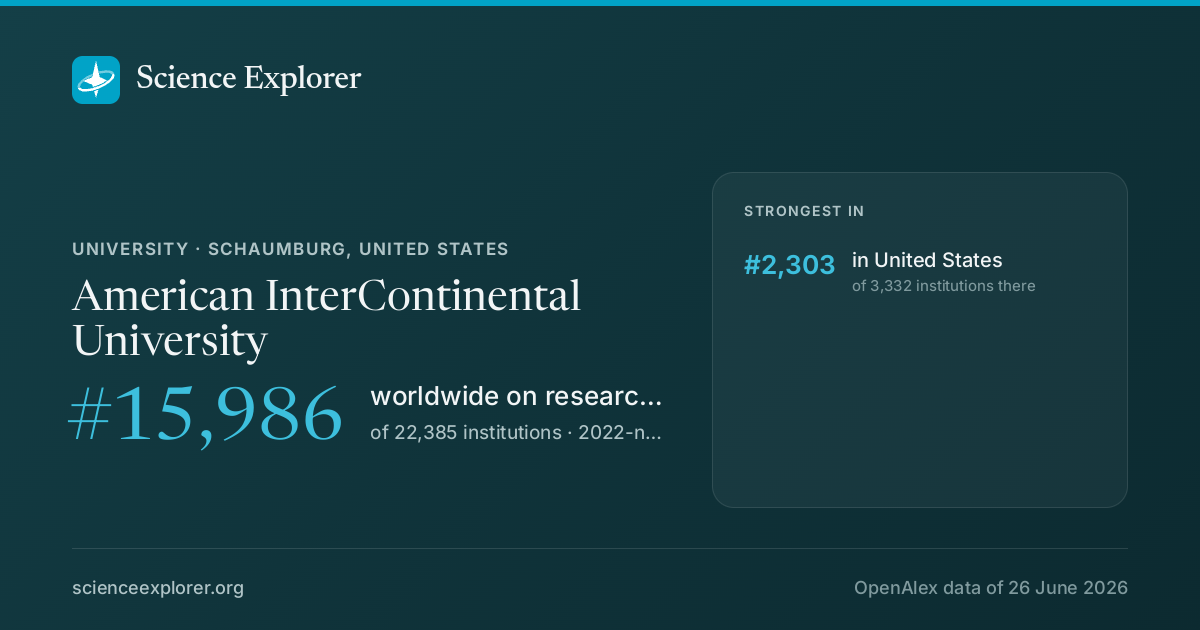
- World rank, 2022-now
- #15,986 of 22,385 · #27,638 all time
- Rank in United States
- #2,303 of 3,332
- Research works
- 166 ▲ 289% vs 2018-21
- Citations
- 808 4.9 per fractional work
- Top-10% rate
- 16.8% all institutions 10.0%
- vs its own fields
- 1.04× 1.00× is exactly expected
- Open access
- 62% world 40%
- International
- 33% world 18%
Which fields of science does American InterContinental University work in?
In 2022-now, 62% of research at American InterContinental University is in Social Sciences, 28% in Physical Sciences. Its largest fields are Social Sciences (22%), Business, Management and Accounting (22%), Computer Science (19%). It does 2.3× the world's share of Social Sciences.
Each ring splits the one inside it: the four domains of science, their fields, their subfields. Size is fractional works in 2022-now. Every slice is a page; the interactive view zooms down to single topics and colours each by how much more of it this institution does than the world.
Its 4 domains and 19 fields, with their numbers
- Social Sciences5861.7%
- Social Sciences2122.4%
- Business, Management and Accounting2122.0%
- Decision Sciences55.1%
- Arts and Humanities44.4%
- Economics, Econometrics and Finance44.2%
- Psychology33.5%
- Physical Sciences2728.5%
- Computer Science1818.7%
- Engineering77.5%
- Environmental Science11.4%
- Materials Science00.3%
- Chemistry00.2%
- Energy00.2%
- Mathematics00.2%
- Health Sciences55.4%
- Medicine33.2%
- Health Professions22.2%
- Life Sciences44.5%
What does American InterContinental University specialise in?
Where its research is concentrated relative to its size: Business, Management and Accounting takes 6.8× the share of its output that it takes of world research.
- Business, Management and AccountingField · 20.7 works6.8×
Location quotient, a volume reading rather than an impact one. It surfaces small, lopsided specialities.
Field profile
Location quotient across every field it publishes in: outside the ring is more than an institution of this size would be expected to publish, inside it is less.
Rings at 0.5×, 1× and 2×. Widest outward: Business, Management and Accounting, 6.8×. Every wedge is a field page.
All 19 fields, with their numbers
- Business, Management and Accounting6.83×21 works
- Decision Sciences5.24×5 works
- Computer Science2.40×18 works
- Economics, Econometrics and Finance1.96×4 works
- Social Sciences1.77×21 works
- Arts and Humanities1.54×4 works
- Psychology1.16×3 works
- Health Professions0.85×2 works
- Agricultural and Biological Sciences0.73×3 works
- Engineering0.50×7 works
- Environmental Science0.28×1 works
- Energy0.21×0 works
- Medicine0.17×3 works
- Chemistry0.16×0 works
- Mathematics0.15×0 works
- Biochemistry, Genetics and Molecular Biology0.14×1 works
- Neuroscience0.11×0 works
- Materials Science0.10×0 works
- Immunology and Microbiology0.07×0 works
- Business, Management and Accounting 6.8×
- Decision Sciences 5.2×
- Computer Science 2.4×
- Economics, Econometrics and Finance 2.0×
- Social Sciences 1.8×
- Arts and Humanities 1.5×
- Psychology 1.2×
- Health Professions 0.8×
- Agricultural and Biological Sciences 0.7×
- Engineering 0.5×
- Environmental Science 0.3×
- Energy 0.2×
- Medicine 0.2×
- Chemistry 0.2×
- Mathematics 0.1×
- Biochemistry, Genetics and Molecular Biology 0.1×
- Neuroscience 0.1×
- Materials Science 0.1×
- Immunology and Microbiology 0.1×
Who are the top researchers at American InterContinental University?
Ranked on the quality score, Abdallah Adway, Francisco de Cossío and Stephen Basdeo lead among researchers whose main affiliation is American InterContinental University.
- 1
Abdallah Adway
 United States · #2,128,836 worldwide
15 citations · 18 works
- 2
Francisco de Cossío
United States · #3,736,734 worldwide
26 citations · 20 works
- 3
Stephen Basdeo
United States · #4,069,122 worldwide
10 citations · 27 works
- 4
Temitope Oluwatosin Fatunmbi
United States · #4,774,293 worldwide
32 citations · 21 works
- 5
Errol Craig Sull
United States · #5,836,270 worldwide
1 citations · 36 works
- 6
Lori Schwartz
United States · #7,298,099 worldwide
190 citations · 144 works
Which keywords describe research at American InterContinental University?
By fractional works in 2022-now, weighted toward what it does more of than the world: Supply Chain Management, Big Data, Machine Learning, Sustainability, Predictive Analytics, Analytics, Business Intelligence and Internet of Things.
- Pandemic Impact
- Workforce Planning
- Decentralization
- Knowledge Sharing
- Blockchain
- Plant Disease Detection
- Pedagogy
- Cyber-Physical Systems
- Technology Integration
- Organizational Performance
- Wireless Sensor Networks
- Identity
- Risk Management
- Healthcare
- Education
- Security
- Business Intelligence
- Deep Learning
- Sustainability
- Machine Learning
- Supply Chain Management
- Big Data
- Predictive Analytics
- Analytics
- Internet of Things
- Neural Networks
- Globalization
- Privacy
- Social Media
- Data Mining
- Educational Technology
- Environmental Monitoring
- Quality Assurance
- Image Processing
- Cybersecurity
- Smart Farming
- Digital Twin
- Big Data Analytics
- Smart Contracts
- Cloud Computing
Size is fractional works in 2022-now in the topics tagged with each word; colour is the word's share of this institution's work against its share of the world's. The 40 words are chosen for being large and distinctive. Each links to the topic it comes from most.
All 40 words, with their numbers
- Supply Chain Management14▲ 17×8 topics
- Machine Learning13▲ 4.2×37 topics
- Big Data12▲ 14×12 topics
- Sustainability11▲ 4.9×17 topics
- Predictive Analytics9▲ 85×2 topics
- Deep Learning8▲ 2.5×27 topics
- Analytics7▲ 84×1 topic
- Business Intelligence7▲ 84×1 topic
- Internet of Things6▲ 7.1×7 topics
- Security5▲ 8.7×12 topics
- Neural Networks5▲ 3.6×14 topics
- Education5▲ 3.2×13 topics
- Globalization5▲ 2.8×9 topics
- Healthcare5▲ 4.5×8 topics
- Privacy4▲ 15×6 topics
- Risk Management4▲ 9.1×7 topics
- Social Media4▲ 3.0×12 topics
- Identity4▲ 5.1×8 topics
- Data Mining3▲ 4.9×5 topics
- Wireless Sensor Networks3▲ 7.8×3 topics
- Educational Technology3▲ 2.9×10 topics
- Organizational Performance3▲ 12×3 topics
- Environmental Monitoring3▲ 7.9×3 topics
- Technology Integration3▲ 9.5×5 topics
- Quality Assurance3▲ 17×4 topics
- Cyber-Physical Systems3▲ 10×4 topics
- Image Processing3▲ 6.5×4 topics
- Pedagogy3▲ 5.5×3 topics
- Cybersecurity2▲ 11×3 topics
- Plant Disease Detection2▲ 23×1 topic
- Smart Farming2▲ 21×1 topic
- Blockchain2▲ 11×2 topics
- Digital Twin2▲ 17×2 topics
- Knowledge Sharing2▲ 15×3 topics
- Big Data Analytics2▲ 10×4 topics
- Decentralization2▲ 11×1 topic
- Smart Contracts2▲ 15×1 topic
- Workforce Planning2▲ 56×2 topics
- Cloud Computing2▲ 7.2×4 topics
- Pandemic Impact2▲ 25×3 topics
Which research topics does American InterContinental University publish most on?
By volume in 2022-now: Big Data and Business Intelligence, Smart Agriculture and AI, Blockchain Technology Applications and Security and AI and HR Technologies.
Area is fractional works; colour is the subfield each topic belongs to.
- 1 Big Data and Business Intelligence Management Information Systems 7 works
- 2 Smart Agriculture and AI Plant Science 2 works
- 3 Blockchain Technology Applications and Security Information Systems 2 works
- 4 AI and HR Technologies Organizational Behavior and Human Resource Management 2 works
- 5 Digital Transformation in Industry Industrial and Manufacturing Engineering 2 works
- 6 Supply Chain Resilience and Risk Management Strategy and Management 1 works
- 7 Quality and Supply Management Management Information Systems 1 works
- 8 Education and Islamic Studies Education 1 works
- 9 Online and Blended Learning Education 1 works
- 10 Technology Adoption and User Behaviour Information Systems and Management 1 works
How open and international is its research?
Against the world's own shares: the tick on each track. Both are shares of its output, so they sit on one scale and can be read against each other as well as against the world.
World: 40% of research is openly available.
World: 18% is written across borders.
How has American InterContinental University's research output changed?
Output in 2022-2025 was 289% higher than in 2018-2021.
The same series as a ribbon: one cell per year, darker for more. The line above answers how much; this answers when.
Its share of all research
Growing output can still be a shrinking share: all of science grows. This is American InterContinental University as a percentage of every work published that year, 0.00056% in 2024.
Fractional works of American InterContinental University over all fractional works that year. How the balance of science has shifted.
Other research institutions in Schaumburg
- Motorola (United States)
- American Society of Anesthesiologists
- ISCO International (United States)
- American Academy of Dermatology
- Society of Actuaries
- Anesthesia Quality Institute
- American Veterinary Medical Association
- American Foundry Society
Share American InterContinental University's ranking
Badges for a website1Each links back here and updates with every snapshot

Research measures only: rankings here say nothing about teaching, admissions or student experience. Comparable institutions and collaboration partners have tabs of their own, above.
Discussion
Ask a question or share a note about American InterContinental University. Keep it to the research: no personal attacks, advertising or links. Any reader can report a post, which collapses it for everyone until it is opened.