Science Explorer Back to mapMap
Discussion
Institution · Schaumburg · United States

Anesthesia Quality Institute

World rank, all time
#25,021
of 34,923
Rank in United States
#5,214
of 7,310
Research works
195
▲ 182% vs 2018-21
Citations
1.5k
7.8 per fractional work
Top-10% rate
7.6%
all institutions 10.0%
vs its own fields
0.86×
1.00× is exactly expected
Open access
28%
world 40%
International
10%
world 18%

Which fields of science does Anesthesia Quality Institute work in?

In 2022-now, 38% of research at Anesthesia Quality Institute is in Social Sciences, 25% in Life Sciences. Its largest fields are Agricultural and Biological Sciences (20%), Social Sciences (20%), Economics, Econometrics and Finance (10%). It does 1.6× the world's share of Life Sciences.

Social Sciences: 18 fractional works · 38.1% of its workSocial Sciences: 9 fractional works · 19.8% of its workEducation: 8 fractional works · 16.4% of its workCultural Studies: 1 fractional works · 1.4% of its workSociology and Political Science: 1 fractional works · 1.2% of its workPolitical Science and International Relations: 0 fractional works · 0.7% of its workEconomics, Econometrics and Finance: 5 fractional works · 10.3% of its workEconomics and Econometrics: 5 fractional works · 10.3% of its workDecision Sciences: 1 fractional works · 2.8% of its workManagement Science and Operations Research: 1 fractional works · 2.3% of its workStatistics, Probability and Uncertainty: 0 fractional works · 0.5% of its workArts and Humanities: 1 fractional works · 2.1% of its workHistory: 0 fractional works · 0.7% of its workLanguage and Linguistics: 0 fractional works · 0.7% of its workMusic: 0 fractional works · 0.7% of its workSmaller subfields together: 0 fractional works · 0.0% of its workPsychology: 1 fractional works · 2.0% of its workSocial Psychology: 0 fractional works · 0.7% of its workExperimental and Cognitive Psychology: 0 fractional works · 0.7% of its workClinical Psychology: 0 fractional works · 0.6% of its workBusiness, Management and Accounting: 1 fractional works · 1.1% of its workManagement Information Systems: 0 fractional works · 0.5% of its workStrategy and Management: 0 fractional works · 0.5% of its workSmaller subfields together: 0 fractional works · 0.1% of its workLife Sciences: 12 fractional works · 25.1% of its workAgricultural and Biological Sciences: 10 fractional works · 20.2% of its workAquatic Science: 6 fractional works · 13.7% of its workAgronomy and Crop Science: 1 fractional works · 2.9% of its workPlant Science: 1 fractional works · 2.5% of its workEcology, Evolution, Behavior and Systematics: 0 fractional works · 0.5% of its workGeneral Agricultural and Biological Sciences: 0 fractional works · 0.4% of its workFood Science: 0 fractional works · 0.3% of its workImmunology and Microbiology: 1 fractional works · 1.9% of its workParasitology: 1 fractional works · 1.4% of its workMicrobiology: 0 fractional works · 0.4% of its workSmaller subfields together: 0 fractional works · 0.1% of its workBiochemistry, Genetics and Molecular Biology: 1 fractional works · 1.2% of its workMolecular Biology: 0 fractional works · 1.1% of its workSmaller subfields together: 0 fractional works · 0.1% of its workNeuroscience: 0 fractional works · 0.9% of its workNeurology: 0 fractional works · 0.7% of its workDevelopmental Neuroscience: 0 fractional works · 0.2% of its workPharmacology, Toxicology and Pharmaceutics: 0 fractional works · 0.9% of its workPharmacology: 0 fractional works · 0.9% of its workPhysical Sciences: 10 fractional works · 20.7% of its workComputer Science: 4 fractional works · 8.9% of its workArtificial Intelligence: 3 fractional works · 7.3% of its workComputational Theory and Mathematics: 1 fractional works · 1.4% of its workInformation Systems: 0 fractional works · 0.2% of its workEngineering: 3 fractional works · 6.0% of its workIndustrial and Manufacturing Engineering: 1 fractional works · 1.6% of its workMechanical Engineering: 1 fractional works · 1.5% of its workBiomedical Engineering: 0 fractional works · 1.0% of its workAutomotive Engineering: 0 fractional works · 0.7% of its workElectrical and Electronic Engineering: 0 fractional works · 0.6% of its workOcean Engineering: 0 fractional works · 0.3% of its workSmaller subfields together: 0 fractional works · 0.2% of its workPhysics and Astronomy: 1 fractional works · 3.0% of its workAtomic and Molecular Physics, and Optics: 1 fractional works · 3.0% of its workMaterials Science: 1 fractional works · 2.6% of its workMaterials Chemistry: 1 fractional works · 1.9% of its workBiomaterials: 0 fractional works · 0.4% of its workPolymers and Plastics: 0 fractional works · 0.4% of its workChemistry: 0 fractional works · 0.2% of its workOrganic Chemistry: 0 fractional works · 0.2% of its workHealth Sciences: 8 fractional works · 16.1% of its workMedicine: 5 fractional works · 9.5% of its workPublic Health, Environmental and Occupational Health: 1 fractional works · 2.4% of its workSurgery: 1 fractional works · 1.8% of its workEpidemiology: 1 fractional works · 1.5% of its workOncology: 0 fractional works · 0.7% of its workPulmonary and Respiratory Medicine: 0 fractional works · 0.5% of its workPhysiology: 0 fractional works · 0.4% of its workInfectious Diseases: 0 fractional works · 0.4% of its workEndocrinology, Diabetes and Metabolism: 0 fractional works · 0.2% of its workPathology and Forensic Medicine: 0 fractional works · 0.2% of its workSmaller subfields together: 1 fractional works · 1.5% of its workHealth Professions: 1 fractional works · 2.5% of its workEmergency Medical Services: 1 fractional works · 1.3% of its workGeneral Health Professions: 0 fractional works · 0.9% of its workPharmacy: 0 fractional works · 0.4% of its workDentistry: 1 fractional works · 2.1% of its workOral Surgery: 1 fractional works · 1.4% of its workOrthodontics: 0 fractional works · 0.7% of its workVeterinary: 1 fractional works · 1.2% of its workSmall Animals: 1 fractional works · 1.2% of its workNursing: 0 fractional works · 0.7% of its workNutrition and Dietetics: 0 fractional works · 0.7% of its workALL ITS WORKAnesthesiaQuality Institute47fractional works, 2022-now
Life Sciences25%Physical Sciences21%Health Sciences16%Social Sciences38%

Each ring splits the one inside it: the four domains of science, their fields, their subfields. Size is fractional works in 2022-now. Every slice is a page; the interactive view zooms down to single topics and colours each by how much more of it this institution does than the world.

Its 4 domains and 21 fields, with their numbers
    1. Social Sciences919.8%
    2. Economics, Econometrics and Finance510.3%
    3. Decision Sciences12.8%
    4. Arts and Humanities12.1%
    5. Psychology12.0%
    6. Business, Management and Accounting11.1%
    1. Agricultural and Biological Sciences1020.2%
    2. Immunology and Microbiology11.9%
    3. Biochemistry, Genetics and Molecular Biology11.2%
    4. Neuroscience00.9%
    5. Pharmacology, Toxicology and Pharmaceutics00.9%
    1. Computer Science48.9%
    2. Engineering36.0%
    3. Physics and Astronomy13.0%
    4. Materials Science12.6%
    5. Chemistry00.2%
    1. Medicine59.5%
    2. Health Professions12.5%
    3. Dentistry12.1%
    4. Veterinary11.2%
    5. Nursing00.7%
All of science, and how each field's share has moved since 1950: the Science domain explorer

Field profile

Location quotient across every field it publishes in: outside the ring is more than an institution of this size would be expected to publish, inside it is less.

Agricultural and Biological Sciences: 4.26× its world share, 10 worksAgricultural and Bio…Biochemistry, Genetics and Molecular Biology: 0.22× its world share, 1 worksBiochemistry, Geneti…Immunology and Microbiology: 1.89× its world share, 1 worksImmunology and Micro…Neuroscience: 0.58× its world share, 0 worksNeurosciencePharmacology, Toxicology and Pharmaceutics: 2.50× its world share, 0 worksPharmacology, Toxico…Chemistry: 0.15× its world share, 0 worksChemistryComputer Science: 1.15× its world share, 4 worksComputer ScienceEngineering: 0.40× its world share, 3 worksEngineeringMaterials Science: 0.74× its world share, 1 worksMaterials SciencePhysics and Astronomy: 1.37× its world share, 1 worksPhysics and AstronomyDentistry: 4.35× its world share, 1 worksDentistryHealth Professions: 0.95× its world share, 1 worksHealth ProfessionsMedicine: 0.50× its world share, 4 worksMedicineNursing: 1.44× its world share, 0 worksNursingVeterinary: 8.64× its world share, 1 worksVeterinaryArts and Humanities: 0.73× its world share, 1 worksArts and HumanitiesBusiness, Management and Accounting: 0.33× its world share, 0 worksBusiness, Management…Decision Sciences: 2.91× its world share, 1 worksDecision SciencesEconomics, Econometrics and Finance: 4.82× its world share, 5 worksEconomics, Econometr…Psychology: 0.66× its world share, 1 worksPsychologySocial Sciences: 1.56× its world share, 9 worksSocial Sciences1×world share
more than its size predictsabout as predictedless

Rings at 0.5×, 1× and 2×. Widest outward: Veterinary, 8.6×. Every wedge is a field page.

All 21 fields, with their numbers
  1. Veterinary8.64×1 works
  2. Economics, Econometrics and Finance4.82×5 works
  3. Dentistry4.35×1 works
  4. Agricultural and Biological Sciences4.26×10 works
  5. Decision Sciences2.91×1 works
  6. Pharmacology, Toxicology and Pharmaceutics2.50×0 works
  7. Immunology and Microbiology1.89×1 works
  8. Social Sciences1.56×9 works
  9. Nursing1.44×0 works
  10. Physics and Astronomy1.37×1 works
  11. Computer Science1.15×4 works
  12. Health Professions0.95×1 works
  13. Materials Science0.74×1 works
  14. Arts and Humanities0.73×1 works
  15. Psychology0.66×1 works
  16. Neuroscience0.58×0 works
  17. Medicine0.50×4 works
  18. Engineering0.40×3 works
  19. Business, Management and Accounting0.33×0 works
  20. Biochemistry, Genetics and Molecular Biology0.22×1 works
  21. Chemistry0.15×0 works

Who are the top researchers at Anesthesia Quality Institute?

Ranked on the quality score, Jean Gayton Carroll and Rowan Brad Quni-Gudzinas lead among researchers whose main affiliation is Anesthesia Quality Institute.

  1. 1 Jean Gayton Carroll United States · #2,828,581 worldwide 693 citations · 117 works
  2. 2 Rowan Brad Quni-Gudzinas United States · #7,538,504 worldwide 8 citations · 983 works
All ranked researchers at Anesthesia Quality Institute

What are the most cited papers from Anesthesia Quality Institute?

The most cited paper from Anesthesia Quality Institute is "Crossing the Quality Chasm" (Jean Gayton Carroll, 2002), with 368 citations. Next come "Haemostatic resuscitation" (175) and "Patterns of Surgical Care and Complications in Elderly Adults" (168).

Most cited papers
#PaperReleasedCitations
1 Crossing the Quality Chasm Jean Gayton Carroll · Quality Management in Health Care 2002 368
2 Haemostatic resuscitation Richard P. Dutton · British Journal of Anaesthesia Open access Dec 2012 175
3 Patterns of Surgical Care and Complications in Elderly Adults Stacie G. Deiner, Benjamin Westlake, Richard P. Dutton · Journal of the American Geriatrics Society Open access 14 Apr 2014 168
4 The Incidence and Risk Factors for Perioperative Cardiac Arrest Observed in the National Anesthesia Clinical Outcomes Registry Mark Nunnally, Michael F. O’Connor, Hubert A. Kordylewski et al. · Anesthesia & Analgesia 12 Nov 2014 149
5 Effect of video laryngoscopy on trauma patient survival Dale J. Yeatts, Richard P. Dutton, Peter Fu-Ming Hu et al. · The Journal of Trauma: Injury, Infection, and Critical Care 3 Jul 2013 124
All 59 most cited papers, with filters and sorting

Which keywords describe research at Anesthesia Quality Institute?

By fractional works in 2022-now, weighted toward what it does more of than the world: Teaching Methods, Pedagogy, Student Competencies, Irrigation, Water Efficiency, Economic Development, Innovation Economics and Sustainability.

▲ more of its work than of the world's◆ about the world's share▼ less than the world's

Size is fractional works in 2022-now in the topics tagged with each word; colour is the word's share of this institution's work against its share of the world's. The 21 words are chosen for being large and distinctive. Each links to the topic it comes from most.

All 21 words, with their numbers
  1. Teaching Methods8▲ 105×2 topics
  2. Pedagogy8▲ 32×1 topic
  3. Student Competencies8▲ 248×1 topic
  4. Irrigation6▲ 710×1 topic
  5. Water Efficiency6▲ 710×1 topic
  6. Sustainability6▲ 5.0×4 topics
  7. Globalization5▲ 5.5×2 topics
  8. Economic Development5▲ 13×1 topic
  9. Innovation Economics5▲ 300×1 topic
  10. Epidemiology2◆ 1.07×7 topics
  11. Drought Tolerance2▲ 28×3 topics
  12. Climate Change1◆ 1.08×2 topics
  13. Quantum Computing1▲ 28×2 topics
  14. Soil Fertility1▲ 13×2 topics
  15. Sustainable Agriculture1▲ 9.1×2 topics
  16. Classification1▲ 5.7×3 topics
  17. Crop Adaptation1▲ 179×1 topic
  18. Forage Production1▲ 102×1 topic
  19. Deep Neural Networks1▲ 17×2 topics
  20. Simulation Optimization1▲ 136×1 topic
  21. Verification and Validation1▲ 136×1 topic

Which research topics does Anesthesia Quality Institute publish most on?

By volume in 2022-now: Education, Innovation and Language Studies, Engineering and Agricultural Innovations, Economic and Industrial Development and Agricultural Productivity and Crop Improvement.

  1. 1 Education, Innovation and Language Studies Education 8 works
  2. 2 Engineering and Agricultural Innovations Aquatic Science 6 works
  3. 3 Economic and Industrial Development Economics and Econometrics 5 works
  4. 4 Agricultural Productivity and Crop Improvement Agronomy and Crop Science 1 works
  5. 5 Simulation Techniques and Applications Management Science and Operations Research 1 works
  6. 6 Quantum Computing Algorithms and Architecture Artificial Intelligence 1 works
  7. 7 Quantum Information and Cryptography Artificial Intelligence 1 works
  8. 8 Machine Learning and Data Classification Artificial Intelligence 1 works
  9. 9 Quantum-Dot Cellular Automata Computational Theory and Mathematics 1 works
  10. 10 Diamond and Carbon-based Materials Research Materials Chemistry 1 works

How open and international is its research?

Against the world's own shares: the tick on each track. Both are shares of its output, so they sit on one scale and can be read against each other as well as against the world.

openly available28.0%not open72.0%

World: 40% of research is openly available.

with international co-authors10.3%domestic only89.7%

World: 18% is written across borders.

How has Anesthesia Quality Institute's research output changed?

Output in 2022-2025 was 182% higher than in 2018-2021.

still counting1990200020102020
grewheldshrank

The same series as a ribbon: one cell per year, darker for more. The line above answers how much; this answers when.

Its share of all research

Growing output can still be a shrinking share: all of science grows. This is Anesthesia Quality Institute as a percentage of every work published that year, 0.00014% in 2024.

still counting0.00025%0.00050%0.00075%Anesthesia Quality Institute0.00025% in 202519801990200020102020

Fractional works of Anesthesia Quality Institute over all fractional works that year. How the balance of science has shifted.

Other research institutions in Schaumburg

All research institutions in Schaumburg

Share Anesthesia Quality Institute's ranking
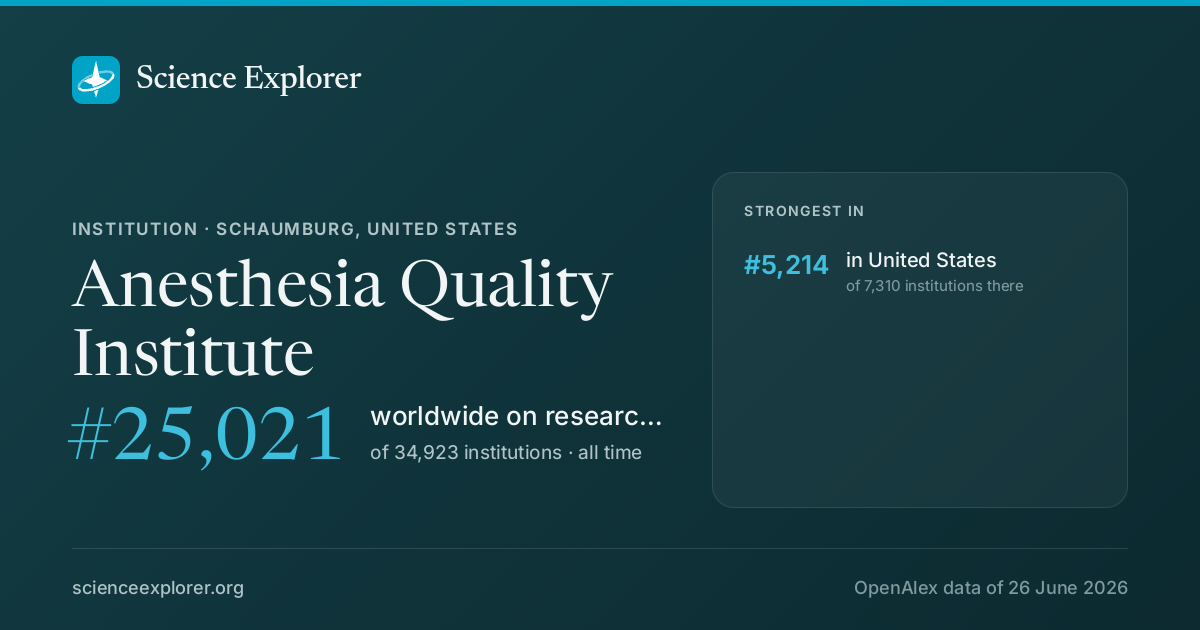
Anesthesia Quality Institute on Science Explorer

A card with Anesthesia Quality Institute's standing and the fields it leads in, for a post or a slide. A link to this page previews as the same card.

Download the card

1200 × 630 PNG, sized for social posts, drawn from the latest snapshot.

Badges for a website1Each links back here and updates with every snapshot

Research measures only: rankings here say nothing about teaching, admissions or student experience. Comparable institutions and collaboration partners have tabs of their own, above.

Discussion

Ask a question or share a note about Anesthesia Quality Institute. Keep it to the research: no personal attacks, advertising or links. Any reader can report a post, which collapses it for everyone until it is opened.
