Science Explorer Back to mapMap
Discussion

Applied Science Associates (United States)

In research, Applied Science Associates (United States) stands highest in Physical Sciences (#11,077 of 17,446 worldwide), over all time.

World rank, all time
#21,337
of 34,923
Rank in United States
#4,417
of 7,310
Research works
345
▼ 23% vs 2018-21
Citations
6.1k
17.7 per fractional work
Top-10% rate
11.6%
all institutions 10.0%
vs its own fields
0.91×
1.00× is exactly expected
Open access
32%
world 40%
International
11%
world 18%
Applied Science Associates (United States)

What is Applied Science Associates (United States) known for in research?

The fields where it stands highest, over all time, ranked among every institution above the floor in each field.

FieldWorld rankWhere that sitsTop-10% rateWorks
Physical SciencesDomain #11,077 of 17,446 9.6%268

Each strip is that field's whole ranked pool, with the notch where Applied Science Associates (United States) sits in it, in the colour of the band that rank falls in. The track under the rate is the rate itself: it carries no average mark, because the average differs by field (from about 6% in Dentistry to 21% in Economics).

Which fields of science does Applied Science Associates (United States) work in?

In all years, 78% of research at Applied Science Associates (United States) is in Physical Sciences, 12% in Social Sciences. Its largest fields are Environmental Science (32%), Engineering (21%), Earth and Planetary Sciences (19%). It does 1.9× the world's share of Physical Sciences.

Physical Sciences: 268 fractional works · 77.7% of its workEnvironmental Science: 109 fractional works · 31.6% of its workPollution: 40 fractional works · 11.6% of its workGlobal and Planetary Change: 22 fractional works · 6.3% of its workHealth, Toxicology and Mutagenesis: 14 fractional works · 4.2% of its workEcology: 7 fractional works · 2.1% of its workWater Science and Technology: 6 fractional works · 1.8% of its workEnvironmental Engineering: 6 fractional works · 1.6% of its workEnvironmental Chemistry: 5 fractional works · 1.6% of its workNature and Landscape Conservation: 5 fractional works · 1.4% of its workManagement, Monitoring, Policy and Law: 2 fractional works · 0.6% of its workIndustrial and Manufacturing Engineering: 1 fractional works · 0.3% of its workEngineering: 71 fractional works · 20.6% of its workAerospace Engineering: 16 fractional works · 4.6% of its workOcean Engineering: 9 fractional works · 2.6% of its workControl and Systems Engineering: 8 fractional works · 2.4% of its workComputational Mechanics: 7 fractional works · 2.0% of its workMechanical Engineering: 6 fractional works · 1.8% of its workElectrical and Electronic Engineering: 5 fractional works · 1.6% of its workCivil and Structural Engineering: 5 fractional works · 1.4% of its workSafety, Risk, Reliability and Quality: 4 fractional works · 1.1% of its workBiomedical Engineering: 3 fractional works · 0.8% of its workMechanics of Materials: 2 fractional works · 0.6% of its workMedia Technology: 2 fractional works · 0.5% of its workBuilding and Construction: 2 fractional works · 0.4% of its workAutomotive Engineering: 1 fractional works · 0.4% of its workArchitecture: 1 fractional works · 0.3% of its workSmaller subfields together: 0 fractional works · 0.1% of its workEarth and Planetary Sciences: 64 fractional works · 18.6% of its workOceanography: 40 fractional works · 11.5% of its workAtmospheric Science: 13 fractional works · 3.9% of its workEarth-Surface Processes: 8 fractional works · 2.4% of its workGeophysics: 2 fractional works · 0.5% of its workGeology: 1 fractional works · 0.3% of its workSmaller subfields together: 0 fractional works · 0.1% of its workComputer Science: 12 fractional works · 3.4% of its workArtificial Intelligence: 3 fractional works · 0.8% of its workInformation Systems: 3 fractional works · 0.8% of its workComputer Vision and Pattern Recognition: 2 fractional works · 0.5% of its workComputational Theory and Mathematics: 1 fractional works · 0.4% of its workComputer Graphics and Computer-Aided Design: 1 fractional works · 0.3% of its workComputer Science Applications: 1 fractional works · 0.2% of its workSmaller subfields together: 1 fractional works · 0.4% of its workPhysics and Astronomy: 7 fractional works · 1.9% of its workAtomic and Molecular Physics, and Optics: 3 fractional works · 0.9% of its workAstronomy and Astrophysics: 1 fractional works · 0.4% of its workStatistical and Nonlinear Physics: 1 fractional works · 0.3% of its workSmaller subfields together: 1 fractional works · 0.3% of its workMathematics: 3 fractional works · 0.8% of its workApplied Mathematics: 1 fractional works · 0.3% of its workSmaller subfields together: 2 fractional works · 0.4% of its workMaterials Science: 1 fractional works · 0.4% of its workEnergy: 1 fractional works · 0.3% of its workRenewable Energy, Sustainability and the Environment: 1 fractional works · 0.3% of its workChemistry: 1 fractional works · 0.2% of its workChemical Engineering: 0 fractional works · 0.0% of its workSocial Sciences: 41 fractional works · 11.9% of its workSocial Sciences: 15 fractional works · 4.3% of its workSociology and Political Science: 6 fractional works · 1.7% of its workEducation: 4 fractional works · 1.2% of its workDemography: 1 fractional works · 0.4% of its workGender Studies: 1 fractional works · 0.3% of its workSafety Research: 1 fractional works · 0.3% of its workSmaller subfields together: 2 fractional works · 0.5% of its workDecision Sciences: 9 fractional works · 2.6% of its workStatistics, Probability and Uncertainty: 5 fractional works · 1.3% of its workManagement Science and Operations Research: 4 fractional works · 1.1% of its workInformation Systems and Management: 1 fractional works · 0.2% of its workPsychology: 5 fractional works · 1.4% of its workSocial Psychology: 2 fractional works · 0.4% of its workDevelopmental and Educational Psychology: 1 fractional works · 0.4% of its workApplied Psychology: 1 fractional works · 0.2% of its workExperimental and Cognitive Psychology: 1 fractional works · 0.2% of its workSmaller subfields together: 0 fractional works · 0.1% of its workArts and Humanities: 5 fractional works · 1.4% of its workArcheology: 1 fractional works · 0.4% of its workHistory: 1 fractional works · 0.3% of its workHistory and Philosophy of Science: 1 fractional works · 0.3% of its workSmaller subfields together: 1 fractional works · 0.4% of its workBusiness, Management and Accounting: 5 fractional works · 1.3% of its workOrganizational Behavior and Human Resource Management: 2 fractional works · 0.5% of its workManagement Information Systems: 1 fractional works · 0.3% of its workStrategy and Management: 1 fractional works · 0.3% of its workSmaller subfields together: 1 fractional works · 0.2% of its workEconomics, Econometrics and Finance: 3 fractional works · 0.8% of its workEconomics and Econometrics: 2 fractional works · 0.5% of its workGeneral Economics, Econometrics and Finance: 1 fractional works · 0.3% of its workHealth Sciences: 29 fractional works · 8.3% of its workMedicine: 17 fractional works · 4.9% of its workPublic Health, Environmental and Occupational Health: 3 fractional works · 0.7% of its workSurgery: 2 fractional works · 0.5% of its workPsychiatry and Mental health: 1 fractional works · 0.4% of its workRadiology, Nuclear Medicine and Imaging: 1 fractional works · 0.4% of its workPulmonary and Respiratory Medicine: 1 fractional works · 0.4% of its workOphthalmology: 1 fractional works · 0.3% of its workPharmacology: 1 fractional works · 0.3% of its workEndocrinology, Diabetes and Metabolism: 1 fractional works · 0.3% of its workEpidemiology: 1 fractional works · 0.2% of its workGastroenterology: 1 fractional works · 0.2% of its workSmaller subfields together: 4 fractional works · 1.2% of its workHealth Professions: 9 fractional works · 2.7% of its workGeneral Health Professions: 4 fractional works · 1.1% of its workEmergency Medical Services: 2 fractional works · 0.6% of its workRadiological and Ultrasound Technology: 1 fractional works · 0.3% of its workMedical Laboratory Technology: 1 fractional works · 0.3% of its workSmaller subfields together: 2 fractional works · 0.5% of its workDentistry: 1 fractional works · 0.3% of its workOral Surgery: 1 fractional works · 0.3% of its workSmaller subfields together: 0 fractional works · 0.0% of its workNursing: 1 fractional works · 0.2% of its workNutrition and Dietetics: 1 fractional works · 0.2% of its workSmaller subfields together: 0 fractional works · 0.0% of its workVeterinary: 0 fractional works · 0.1% of its workLife Sciences: 7 fractional works · 2.0% of its workBiochemistry, Genetics and Molecular Biology: 3 fractional works · 0.7% of its workMolecular Biology: 1 fractional works · 0.4% of its workCancer Research: 1 fractional works · 0.2% of its workSmaller subfields together: 0 fractional works · 0.1% of its workAgricultural and Biological Sciences: 3 fractional works · 0.7% of its workNeuroscience: 1 fractional works · 0.3% of its workImmunology and Microbiology: 1 fractional works · 0.2% of its workPharmacology, Toxicology and Pharmaceutics: 0 fractional works · 0.0% of its workALL ITS WORKApplied ScienceAssociates…345fractional works, all years
Life Sciences2%Physical Sciences78%Health Sciences8%Social Sciences12%

Each ring splits the one inside it: the four domains of science, their fields, their subfields. Size is fractional works in all years. Every slice is a page; the interactive view zooms down to single topics and colours each by how much more of it this institution does than the world.

Its 4 domains and 26 fields, with their numbers
    1. Environmental Science10931.6%
    2. Engineering7120.6%
    3. Earth and Planetary Sciences6418.6%
    4. Computer Science123.4%
    5. Physics and Astronomy71.9%
    6. Mathematics30.8%
    7. Materials Science10.4%
    8. Energy10.3%
    9. Chemistry10.2%
    10. Chemical Engineering00.0%
    1. Social Sciences154.3%
    2. Decision Sciences92.6%
    3. Psychology51.4%
    4. Arts and Humanities51.4%
    5. Business, Management and Accounting51.3%
    6. Economics, Econometrics and Finance30.8%
    1. Medicine174.9%
    2. Health Professions92.7%
    3. Dentistry10.3%
    4. Nursing10.2%
    5. Veterinary00.1%
    1. Biochemistry, Genetics and Molecular Biology30.7%
    2. Agricultural and Biological Sciences30.7%
    3. Neuroscience10.3%
    4. Immunology and Microbiology10.2%
    5. Pharmacology, Toxicology and Pharmaceutics00.0%
All of science, and how each field's share has moved since 1950: the Science domain explorer

Field profile

Location quotient across every field it publishes in: outside the ring is more than an institution of this size would be expected to publish, inside it is less.

Agricultural and Biological Sciences: 0.14× its world share, 0 worksAgricultural and Bio…Biochemistry, Genetics and Molecular Biology: 0.45× its world share, 0 worksBiochemistry, Geneti…Immunology and Microbiology: 0.87× its world share, 0 worksImmunology and Micro…Neuroscience: 1.33× its world share, 0 worksNeuroscienceComputer Science: 0.46× its world share, 1 worksComputer ScienceEarth and Planetary Sciences: 3.14× its world share, 1 worksEarth and Planetary …Engineering: 1.10× its world share, 3 worksEngineeringEnvironmental Science: 6.26× its world share, 6 worksEnvironmental ScienceMaterials Science: 0.25× its world share, 0 worksMaterials ScienceMathematics: 0.99× its world share, 0 worksMathematicsPhysics and Astronomy: 0.58× its world share, 0 worksPhysics and AstronomyHealth Professions: 2.57× its world share, 1 worksHealth ProfessionsMedicine: 0.70× its world share, 3 worksMedicineNursing: 1.19× its world share, 0 worksNursingArts and Humanities: 0.09× its world share, 0 worksArts and HumanitiesBusiness, Management and Accounting: 0.19× its world share, 0 worksBusiness, Management…Economics, Econometrics and Finance: 1.15× its world share, 0 worksEconomics, Econometr…Psychology: 0.98× its world share, 1 worksPsychologySocial Sciences: 0.57× its world share, 1 worksSocial Sciences1×world share
more than its size predictsabout as predictedless

Rings at 0.5×, 1× and 2×. Widest outward: Environmental Science, 6.3×. Every wedge is a field page.

All 19 fields, with their numbers
  1. Environmental Science6.26×6 works
  2. Earth and Planetary Sciences3.14×1 works
  3. Health Professions2.57×1 works
  4. Neuroscience1.33×0 works
  5. Nursing1.19×0 works
  6. Economics, Econometrics and Finance1.15×0 works
  7. Engineering1.10×3 works
  8. Mathematics0.99×0 works
  9. Psychology0.98×1 works
  10. Immunology and Microbiology0.87×0 works
  11. Medicine0.70×3 works
  12. Physics and Astronomy0.58×0 works
  13. Social Sciences0.57×1 works
  14. Computer Science0.46×1 works
  15. Biochemistry, Genetics and Molecular Biology0.45×0 works
  16. Materials Science0.25×0 works
  17. Business, Management and Accounting0.19×0 works
  18. Agricultural and Biological Sciences0.14×0 works
  19. Arts and Humanities0.09×0 works

Who are the top researchers at Applied Science Associates (United States)?

Ranked on the quality score, Deborah French-McCay, John K. Hawley and Subbayya Sankaranarayanan lead among researchers whose main affiliation is Applied Science Associates (United States).

  1. 1 Deborah French-McCay United States · #1,557,076 worldwide 1.6k citations · 51 works
  2. 2 John K. Hawley United States · #3,194,496 worldwide 468 citations · 49 works
  3. 3 Subbayya Sankaranarayanan United States · #3,365,495 worldwide 710 citations · 30 works
  4. 4 Eric Comerma United States · #3,569,283 worldwide 251 citations · 16 works
  5. 5 Kelly Knee United States · #3,660,624 worldwide 223 citations · 19 works
  6. 6 Deborah French McCay United States · #3,718,766 worldwide 478 citations · 22 works
  7. 7 J. Craig Swanson United States · #3,915,073 worldwide 187 citations · 31 works
  8. 8 H. C. Strasel United States · #4,019,762 worldwide 13 citations · 17 works
  9. 9 Dagmar Schmidt Etkin United States · #4,093,336 worldwide 643 citations · 44 works
  10. 10 Lee S. Miller United States · #4,272,996 worldwide 464 citations · 47 works
All ranked researchers at Applied Science Associates (United States)

What are the most cited papers from Applied Science Associates (United States)?

The most cited paper from Applied Science Associates (United States) is "The average impulse response of a rough surface and its applications" (Gerald R. Brown, 1977), with 752 citations. Next come "Ecosystem services related to oyster restoration" (691) and "Backscattering from a Gaussian-distributed perfectly conducting rough surface" (296).

Most cited papers
#PaperReleasedCitations
1 The average impulse response of a rough surface and its applications Gerald R. Brown · IRE Transactions on Antennas and Propagation 1977 752
2 Ecosystem services related to oyster restoration L. D. Coen, R. Dan Brumbaugh, David Bushek et al. · Marine Ecology Progress Series Open access 2007 691
3 Backscattering from a Gaussian-distributed perfectly conducting rough surface Gerald R. Brown · IRE Transactions on Antennas and Propagation May 1978 296
4 Relationships between the surface concentration of particulate organic carbon and optical properties in the eastern South Pacific and eastern Atlantic Oceans Dariusz Stramski, Rick Allen Reynolds, Marcel Babin et al. PreprintOpen access 2 Oct 2007 276
5 Natural and unnatural oil slicks in the G ulf of M exico Ian R. MacDonald, Oscar Garcia‐Pineda, Andrew Beet et al. · Journal of Geophysical Research Oceans Open access Dec 2015 253
All 60 most cited papers, with filters and sorting

Which keywords describe research at Applied Science Associates (United States)?

By fractional works in all years, weighted toward what it does more of than the world: Remote Sensing, Environmental Impact, Climate Change, Marine Pollution, Health Effects, Biodegradation, Deepwater Horizon and Oil Spill Detection.

▲ more of its work than of the world's◆ about the world's share▼ less than the world's

Size is fractional works in all years in the topics tagged with each word; colour is the word's share of this institution's work against its share of the world's. The 40 words are chosen for being large and distinctive. Each links to the topic it comes from most.

All 40 words, with their numbers
  1. Remote Sensing51▲ 13×16 topics
  2. Environmental Impact50▲ 11×18 topics
  3. Climate Change49▲ 5.3×40 topics
  4. Marine Pollution41▲ 555×2 topics
  5. Health Effects40▲ 19×8 topics
  6. Biodegradation40▲ 106×3 topics
  7. Deepwater Horizon38▲ 1028×1 topic
  8. Oil Spill Detection38▲ 1028×1 topic
  9. Water Quality17▲ 12×9 topics
  10. Data Assimilation17▲ 26×4 topics
  11. Ocean Circulation16▲ 33×3 topics
  12. Climate Change Impact15▲ 23×4 topics
  13. Global Warming15▲ 12×7 topics
  14. Fisheries Sustainability13▲ 31×2 topics
  15. Oceanic Modeling13▲ 88×1 topic
  16. Tidal Analysis13▲ 88×1 topic
  17. Tropical Cyclones13▲ 63×2 topics
  18. Wave Modeling13▲ 61×2 topics
  19. Bioaccumulation13▲ 31×3 topics
  20. Toxicity11▲ 7.4×6 topics
  21. Ecosystem Management11▲ 38×2 topics
  22. Eutrophication10▲ 20×4 topics
  23. Fish Population Dynamics10▲ 50×1 topic
  24. Marine Fisheries10▲ 50×1 topic
  25. Global Distribution9▲ 37×3 topics
  26. Environmental Exposure9▲ 26×2 topics
  27. Sea Level Rise9▲ 21×3 topics
  28. Harmful Algal Blooms9▲ 24×2 topics
  29. Polycyclic Aromatic Hydrocarbons9▲ 38×2 topics
  30. Aryl Hydrocarbon Receptor8▲ 54×1 topic
  31. Brominated Flame Retardants8▲ 54×1 topic
  32. Sediment Transport8▲ 15×5 topics
  33. Dissolved Organic Matter8▲ 43×1 topic
  34. Oceanic Carbon Cycle8▲ 43×1 topic
  35. Sea-Level Rise8▲ 23×5 topics
  36. Hydraulic Fracturing8▲ 19×2 topics
  37. Ocean Waves8▲ 80×1 topic
  38. Satellite Observations8▲ 19×3 topics
  39. Wind Stress8▲ 80×1 topic
  40. Shale Gas8▲ 16×2 topics

Which research topics does Applied Science Associates (United States) publish most on?

By volume in 2022-now: Technology Use by Older Adults, Toxic Organic Pollutants Impact, Oil Spill Detection and Mitigation and Environmental Toxicology and Ecotoxicology.

  1. 1 Technology Use by Older Adults Demography 1 works
  2. 2 Toxic Organic Pollutants Impact Health, Toxicology and Mutagenesis 1 works
  3. 3 Oil Spill Detection and Mitigation Pollution 0 works
  4. 4 Environmental Toxicology and Ecotoxicology Health, Toxicology and Mutagenesis 0 works
  5. 5 Marine and fisheries research Global and Planetary Change 0 works
  6. 6 Underwater Vehicles and Communication Systems Ocean Engineering 0 works
  7. 7 Urban Stormwater Management Solutions Environmental Engineering 0 works
  8. 8 Flood Risk Assessment and Management Global and Planetary Change 0 works
  9. 9 Urban Green Space and Health Health, Toxicology and Mutagenesis 0 works
  10. 10 Neuroscience of respiration and sleep Endocrine and Autonomic Systems 0 works

How open and international is its research?

Against the world's own shares: the tick on each track. Both are shares of its output, so they sit on one scale and can be read against each other as well as against the world.

openly available31.7%not open68.3%

World: 40% of research is openly available.

with international co-authors11.3%domestic only88.7%

World: 18% is written across borders.

How has Applied Science Associates (United States)'s research output changed?

Output in 2022-2025 was 23% lower than in 2018-2021.

still counting1990200020102020
grewheldshrank

The same series as a ribbon: one cell per year, darker for more. The line above answers how much; this answers when.

Its share of all research

Growing output can still be a shrinking share: all of science grows. This is Applied Science Associates (United States) as a percentage of every work published that year, 0.000055% in 2024.

still counting0.0020%0.0040%Applied Science Associates (United States)0.00010% in 202519801990200020102020

Fractional works of Applied Science Associates (United States) over all fractional works that year. How the balance of science has shifted.

Share Applied Science Associates (United States)'s ranking
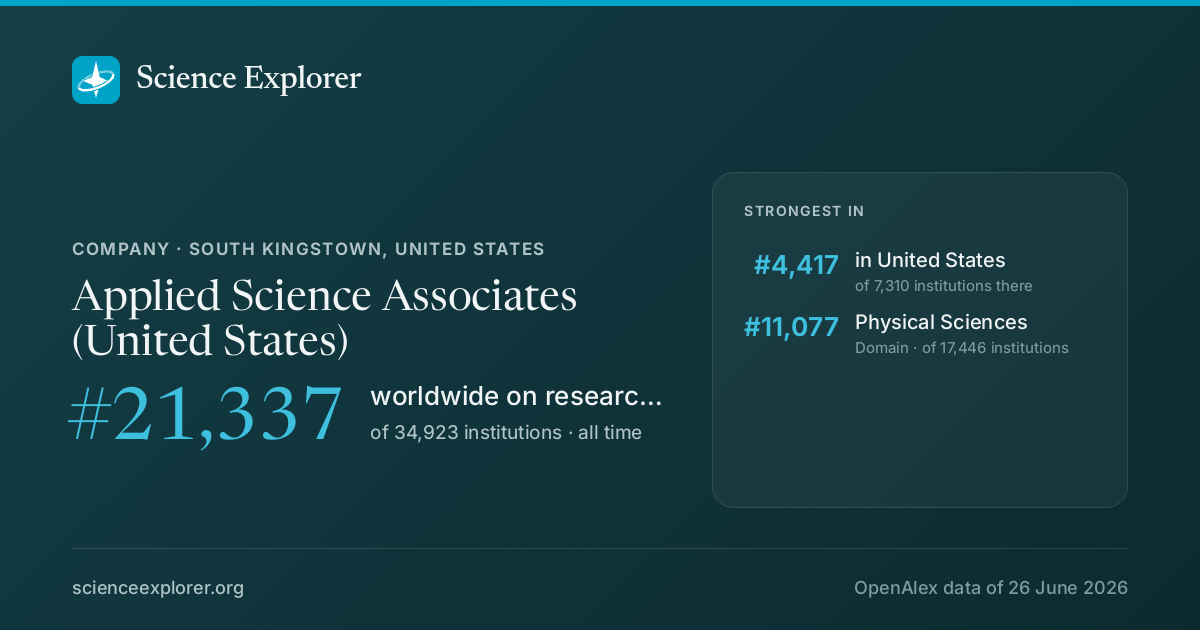
Applied Science Associates (United States) on Science Explorer

A card with Applied Science Associates (United States)'s standing and the fields it leads in, for a post or a slide. A link to this page previews as the same card.

Download the card

1200 × 630 PNG, sized for social posts, drawn from the latest snapshot.

Badges for a website1Each links back here and updates with every snapshot

Research measures only: rankings here say nothing about teaching, admissions or student experience. Comparable institutions and collaboration partners have tabs of their own, above.

Discussion

Ask a question or share a note about Applied Science Associates (United States). Keep it to the research: no personal attacks, advertising or links. Any reader can report a post, which collapses it for everyone until it is opened.
