Science Explorer Back to mapMap
Discussion
University · Passo Fundo · Brazil

Atitus Educação

In research, Atitus Educação stands highest in Social Sciences (#5,901 of 9,585 worldwide) and Social Sciences (#4,229 of 5,988 worldwide), 2022-now.

World rank, 2022-now
#10,598
of 22,385 · #3,444 all time
Rank in Brazil
#407
of 684
Research works
1.9k
▼ 78% vs 2018-21
Citations
8.5k
4.5 per fractional work
Top-10% rate
5.6%
all institutions 10.0%
vs its own fields
0.99×
1.00× is exactly expected
Open access
60%
world 40%
International
9%
world 18%

What is Atitus Educação known for in research?

The fields where it stands highest, 2022-now, ranked among every institution above the floor in each field.

FieldWorld rankWhere that sitsTop-10% rateWorksAll time
Social SciencesDomain #5,901 of 9,585 5.3%96 #2371
Social SciencesField #4,229 of 5,988 6.7%69 #1810

Each strip is that field's whole ranked pool, with the notch where Atitus Educação sits in it, in the colour of the band that rank falls in. The track under the rate is the rate itself: it carries no average mark, because the average differs by field (from about 6% in Dentistry to 21% in Economics).

Which fields of science does Atitus Educação work in?

In 2022-now, 58% of research at Atitus Educação is in Social Sciences, 26% in Health Sciences. Its largest fields are Social Sciences (42%), Medicine (14%), Health Professions (7%). It does 2.2× the world's share of Social Sciences.

Social Sciences: 98 fractional works · 57.8% of its workSocial Sciences: 71 fractional works · 41.8% of its workLaw: 17 fractional works · 10.3% of its workSociology and Political Science: 17 fractional works · 10.0% of its workEducation: 7 fractional works · 4.2% of its workDemography: 7 fractional works · 4.1% of its workPolitical Science and International Relations: 6 fractional works · 3.8% of its workUrban Studies: 6 fractional works · 3.5% of its workGender Studies: 4 fractional works · 2.4% of its workHealth: 3 fractional works · 1.7% of its workPublic Administration: 1 fractional works · 0.6% of its workGeneral Social Sciences: 0 fractional works · 0.3% of its workTransportation: 0 fractional works · 0.3% of its workSafety Research: 0 fractional works · 0.2% of its workSmaller subfields together: 1 fractional works · 0.4% of its workBusiness, Management and Accounting: 8 fractional works · 5.0% of its workStrategy and Management: 4 fractional works · 2.5% of its workOrganizational Behavior and Human Resource Management: 2 fractional works · 0.9% of its workManagement of Technology and Innovation: 1 fractional works · 0.7% of its workMarketing: 1 fractional works · 0.3% of its workManagement Information Systems: 0 fractional works · 0.2% of its workBusiness and International Management: 0 fractional works · 0.2% of its workSmaller subfields together: 0 fractional works · 0.1% of its workPsychology: 8 fractional works · 4.4% of its workSocial Psychology: 4 fractional works · 2.5% of its workClinical Psychology: 3 fractional works · 1.7% of its workSmaller subfields together: 0 fractional works · 0.3% of its workDecision Sciences: 5 fractional works · 3.1% of its workInformation Systems and Management: 4 fractional works · 2.5% of its workStatistics, Probability and Uncertainty: 1 fractional works · 0.3% of its workManagement Science and Operations Research: 0 fractional works · 0.3% of its workArts and Humanities: 5 fractional works · 2.8% of its workPhilosophy: 2 fractional works · 0.9% of its workLiterature and Literary Theory: 1 fractional works · 0.8% of its workHistory: 1 fractional works · 0.3% of its workSmaller subfields together: 1 fractional works · 0.7% of its workEconomics, Econometrics and Finance: 1 fractional works · 0.7% of its workEconomics and Econometrics: 1 fractional works · 0.6% of its workSmaller subfields together: 0 fractional works · 0.1% of its workHealth Sciences: 44 fractional works · 25.8% of its workMedicine: 23 fractional works · 13.7% of its workSurgery: 4 fractional works · 2.3% of its workPublic Health, Environmental and Occupational Health: 3 fractional works · 1.8% of its workEpidemiology: 2 fractional works · 1.1% of its workInfectious Diseases: 2 fractional works · 0.9% of its workPhysiology: 1 fractional works · 0.8% of its workPulmonary and Respiratory Medicine: 1 fractional works · 0.8% of its workNephrology: 1 fractional works · 0.5% of its workPediatrics, Perinatology and Child Health: 1 fractional works · 0.5% of its workPathology and Forensic Medicine: 1 fractional works · 0.5% of its workRheumatology: 1 fractional works · 0.5% of its workPsychiatry and Mental health: 1 fractional works · 0.4% of its workCritical Care and Intensive Care Medicine: 1 fractional works · 0.3% of its workCardiology and Cardiovascular Medicine: 0 fractional works · 0.3% of its workGenetics: 0 fractional works · 0.3% of its workOrthopedics and Sports Medicine: 0 fractional works · 0.3% of its workNeurology: 0 fractional works · 0.3% of its workUrology: 0 fractional works · 0.3% of its workPharmacology: 0 fractional works · 0.2% of its workAnesthesiology and Pain Medicine: 0 fractional works · 0.2% of its workEndocrinology, Diabetes and Metabolism: 0 fractional works · 0.2% of its workSmaller subfields together: 2 fractional works · 1.1% of its workHealth Professions: 12 fractional works · 7.1% of its workGeneral Health Professions: 5 fractional works · 3.0% of its workOccupational Therapy: 2 fractional works · 1.2% of its workRadiological and Ultrasound Technology: 2 fractional works · 0.9% of its workEmergency Medical Services: 1 fractional works · 0.6% of its workHealth Information Management: 1 fractional works · 0.6% of its workPharmacy: 0 fractional works · 0.2% of its workComplementary and Manual Therapy: 0 fractional works · 0.2% of its workSpeech and Hearing: 0 fractional works · 0.2% of its workSmaller subfields together: 0 fractional works · 0.2% of its workDentistry: 8 fractional works · 4.8% of its workOral Surgery: 3 fractional works · 2.0% of its workOrthodontics: 2 fractional works · 1.4% of its workPeriodontics: 2 fractional works · 1.1% of its workGeneral Dentistry: 0 fractional works · 0.2% of its workVeterinary: 0 fractional works · 0.2% of its workSmall Animals: 0 fractional works · 0.2% of its workNursing: 0 fractional works · 0.0% of its workPhysical Sciences: 23 fractional works · 13.4% of its workEnvironmental Science: 11 fractional works · 6.7% of its workManagement, Monitoring, Policy and Law: 7 fractional works · 4.3% of its workWater Science and Technology: 2 fractional works · 1.0% of its workNature and Landscape Conservation: 1 fractional works · 0.6% of its workEcology: 0 fractional works · 0.2% of its workSmaller subfields together: 1 fractional works · 0.5% of its workEngineering: 6 fractional works · 3.6% of its workBuilding and Construction: 3 fractional works · 2.1% of its workCivil and Structural Engineering: 1 fractional works · 0.7% of its workIndustrial and Manufacturing Engineering: 1 fractional works · 0.3% of its workMedia Technology: 0 fractional works · 0.3% of its workSmaller subfields together: 0 fractional works · 0.2% of its workComputer Science: 4 fractional works · 2.6% of its workInformation Systems: 2 fractional works · 1.2% of its workArtificial Intelligence: 1 fractional works · 0.8% of its workSignal Processing: 1 fractional works · 0.6% of its workEarth and Planetary Sciences: 0 fractional works · 0.3% of its workMaterials Science: 0 fractional works · 0.2% of its workPhysics and Astronomy: 0 fractional works · 0.1% of its workLife Sciences: 5 fractional works · 3.0% of its workBiochemistry, Genetics and Molecular Biology: 2 fractional works · 1.2% of its workGenetics: 1 fractional works · 0.7% of its workMolecular Biology: 1 fractional works · 0.5% of its workSmaller subfields together: 0 fractional works · 0.1% of its workAgricultural and Biological Sciences: 2 fractional works · 1.0% of its workForestry: 1 fractional works · 0.5% of its workPlant Science: 1 fractional works · 0.3% of its workSmaller subfields together: 0 fractional works · 0.2% of its workNeuroscience: 1 fractional works · 0.4% of its workCognitive Neuroscience: 1 fractional works · 0.4% of its workSmaller subfields together: 0 fractional works · 0.0% of its workImmunology and Microbiology: 1 fractional works · 0.3% of its workImmunology: 0 fractional works · 0.3% of its workSmaller subfields together: 0 fractional works · 0.1% of its workALL ITS WORKAtitus Educação170fractional works, 2022-now
Life Sciences3%Physical Sciences13%Health Sciences26%Social Sciences58%

Each ring splits the one inside it: the four domains of science, their fields, their subfields. Size is fractional works in 2022-now. Every slice is a page; the interactive view zooms down to single topics and colours each by how much more of it this institution does than the world.

Its 4 domains and 21 fields, with their numbers
    1. Social Sciences7141.8%
    2. Business, Management and Accounting85.0%
    3. Psychology84.4%
    4. Decision Sciences53.1%
    5. Arts and Humanities52.8%
    6. Economics, Econometrics and Finance10.7%
    1. Medicine2313.7%
    2. Health Professions127.1%
    3. Dentistry84.8%
    4. Veterinary00.2%
    5. Nursing00.0%
    1. Environmental Science116.7%
    2. Engineering63.6%
    3. Computer Science42.6%
    4. Earth and Planetary Sciences00.3%
    5. Materials Science00.2%
    6. Physics and Astronomy00.1%
    1. Biochemistry, Genetics and Molecular Biology21.2%
    2. Agricultural and Biological Sciences21.0%
    3. Neuroscience10.4%
    4. Immunology and Microbiology10.3%
All of science, and how each field's share has moved since 1950: the Science domain explorer

Field profile

Location quotient across every field it publishes in: outside the ring is more than an institution of this size would be expected to publish, inside it is less.

Agricultural and Biological Sciences: 0.21× its world share, 2 worksAgricultural and Bio…Biochemistry, Genetics and Molecular Biology: 0.23× its world share, 2 worksBiochemistry, Geneti…Immunology and Microbiology: 0.35× its world share, 1 worksImmunology and Micro…Neuroscience: 0.26× its world share, 1 worksNeuroscienceComputer Science: 0.33× its world share, 4 worksComputer ScienceEarth and Planetary Sciences: 0.18× its world share, 0 worksEarth and Planetary …Engineering: 0.24× its world share, 6 worksEngineeringEnvironmental Science: 1.34× its world share, 11 worksEnvironmental ScienceMaterials Science: 0.07× its world share, 0 worksMaterials SciencePhysics and Astronomy: 0.04× its world share, 0 worksPhysics and AstronomyDentistry: 9.82× its world share, 8 worksDentistryHealth Professions: 2.68× its world share, 12 worksHealth ProfessionsMedicine: 0.71× its world share, 23 worksMedicineNursing: 0.09× its world share, 0 worksNursingVeterinary: 1.81× its world share, 0 worksVeterinaryArts and Humanities: 0.96× its world share, 5 worksArts and HumanitiesBusiness, Management and Accounting: 1.54× its world share, 8 worksBusiness, Management…Decision Sciences: 3.21× its world share, 5 worksDecision SciencesEconomics, Econometrics and Finance: 0.31× its world share, 1 worksEconomics, Econometr…Psychology: 1.46× its world share, 8 worksPsychologySocial Sciences: 3.30× its world share, 71 worksSocial Sciences1×world share
more than its size predictsabout as predictedless

Rings at 0.5×, 1× and 2×. Widest outward: Dentistry, 9.8×. Every wedge is a field page.

All 21 fields, with their numbers
  1. Dentistry9.82×8 works
  2. Social Sciences3.30×71 works
  3. Decision Sciences3.21×5 works
  4. Health Professions2.68×12 works
  5. Veterinary1.81×0 works
  6. Business, Management and Accounting1.54×8 works
  7. Psychology1.46×8 works
  8. Environmental Science1.34×11 works
  9. Arts and Humanities0.96×5 works
  10. Medicine0.71×23 works
  11. Immunology and Microbiology0.35×1 works
  12. Computer Science0.33×4 works
  13. Economics, Econometrics and Finance0.31×1 works
  14. Neuroscience0.26×1 works
  15. Engineering0.24×6 works
  16. Biochemistry, Genetics and Molecular Biology0.23×2 works
  17. Agricultural and Biological Sciences0.21×2 works
  18. Earth and Planetary Sciences0.18×0 works
  19. Nursing0.09×0 works
  20. Materials Science0.07×0 works
  21. Physics and Astronomy0.04×0 works

Who are the top researchers at Atitus Educação?

Ranked on the quality score, Bernardo Antônio Agostini, Eliane Thaines Bodah and Ataís Bacchi lead among researchers whose main affiliation is Atitus Educação.

  1. 1 Bernardo Antônio Agostini Brazil · #1,424,255 worldwide 856 citations · 54 works
  2. 2 Eliane Thaines Bodah Brazil · #2,001,741 worldwide 551 citations · 34 works
  3. 3 Ataís Bacchi Brazil · #2,224,211 worldwide 1.6k citations · 125 works
  4. 4 Carlos Costa Brazil · #2,331,973 worldwide 1.8k citations · 96 works
  5. 5 André Karam Trindade Brazil · #2,403,001 worldwide 101 citations · 23 works
  6. 6 Júlio César Ferro de Guimarães Brazil · #2,503,755 worldwide 3k citations · 248 works
  7. 7 Eduardo Rech Brazil · #2,574,704 worldwide 137 citations · 23 works
  8. 8 Lara Dotto Brazil · #2,604,726 worldwide 341 citations · 42 works
  9. 9 Rodrigo Alessandretti Brazil · #2,608,763 worldwide 886 citations · 38 works
  10. 10 Mateus Luan Dellarmelin Brazil · #2,723,849 worldwide 671 citations · 26 works
All ranked researchers at Atitus Educação

What are the most cited papers from Atitus Educação?

The most cited paper from Atitus Educação is "How to properly use the PRISMA Statement" (Rafael Sarkis‐Onofre, Ferrán Catalá-López, Edoardo Aromataris et al., 2021), with 1,072 citations. Next come "36th International Symposium on Intensive Care and Emergency Medicine" (531) and "Adsorption of congo red and methylene blue dyes on an ashitaba waste and a walnut shell-based activated carbon from aqueous solutions: Experiments, characterization and physical interpretations" (522).

Most cited papers
#PaperReleasedCitations
1 How to properly use the PRISMA Statement Rafael Sarkis‐Onofre, Ferrán Catalá-López, Edoardo Aromataris et al. · Systematic Reviews Open access 19 Apr 2021 1,072
2 36th International Symposium on Intensive Care and Emergency Medicine R. M. Bateman et al. · Critical Care Open access2,440 authors Apr 2016 531
3 Adsorption of congo red and methylene blue dyes on an ashitaba waste and a walnut shell-based activated carbon from aqueous solutions: Experiments, characterization and physical interpretations Zichao Li, Hassan Hanafy, Lei Zhang et al. · Chemical Engineering Journal Open access 28 Jan 2020 522
4 Sampling: how to select participants in my research study? Jeovany Martínez-Mesa, David Alejandro González‐Chica, Rodrigo Pereira Duquia et al. · Anais Brasileiros de Dermatologia Open access Jun 2016 402
5 Scientific development of smart farming technologies and their application in Brazil Dieisson Pivoto, Paulo Dabdab Waquil, Edson Talamini et al. · Information Processing in Agriculture Open access 14 Dec 2017 383
All 60 most cited papers, with filters and sorting

Which keywords describe research at Atitus Educação?

By fractional works in 2022-now, weighted toward what it does more of than the world: Human Rights, Legal Philosophy, Legal Theory, Public Policy, Environmental Law, Civil Rights, Constitutional Law and Globalization.

▲ more of its work than of the world's◆ about the world's share▼ less than the world's

Size is fractional works in 2022-now in the topics tagged with each word; colour is the word's share of this institution's work against its share of the world's. The 40 words are chosen for being large and distinctive. Each links to the topic it comes from most.

All 40 words, with their numbers
  1. Human Rights18▲ 10×9 topics
  2. Legal Philosophy15▲ 146×2 topics
  3. Legal Theory15▲ 134×2 topics
  4. Environmental Law15▲ 42×2 topics
  5. Public Policy15▲ 19×8 topics
  6. Civil Rights15▲ 129×1 topic
  7. Constitutional Law15▲ 66×1 topic
  8. Globalization14▲ 4.1×19 topics
  9. Sustainability13▲ 3.2×18 topics
  10. Public Health10▲ 4.0×11 topics
  11. Brazil10▲ 61×5 topics
  12. Risk Factors8▲ 4.6×9 topics
  13. Mental Health8▲ 3.3×15 topics
  14. Qualitative Research7▲ 4.9×5 topics
  15. Health7▲ 10×4 topics
  16. Prevalence7▲ 10.0×4 topics
  17. Adolescents7▲ 11×4 topics
  18. Treatment6▲ 3.1×12 topics
  19. Identity6▲ 5.1×8 topics
  20. Urbanization6▲ 8.6×4 topics
  21. Segregation6▲ 44×2 topics
  22. Environmental Justice6▲ 24×2 topics
  23. Social Movements6▲ 11×5 topics
  24. Family5▲ 44×2 topics
  25. Cocaine5▲ 110×1 topic
  26. Crack5▲ 110×1 topic
  27. Democracy5▲ 8.8×4 topics
  28. Healthcare Access5▲ 11×4 topics
  29. Social Work5▲ 46×2 topics
  30. Inequality5▲ 13×3 topics
  31. Neoliberalism5▲ 8.1×3 topics
  32. Poverty5▲ 31×2 topics
  33. Political Economy5▲ 11×1 topic
  34. Social Welfare5▲ 29×1 topic
  35. Social Inequality4▲ 10×6 topics
  36. Rural Development4▲ 7.3×1 topic
  37. Territoriality4▲ 53×1 topic
  38. Agroecology4▲ 17×2 topics
  39. Marketing Strategies4▲ 26×2 topics
  40. Social Development4▲ 29×2 topics

Which research topics does Atitus Educação publish most on?

By volume in 2022-now: Brazilian Legal Issues, Youth, Drugs, and Violence, Social and Political Issues and Urban Development and Societal Issues.

  1. 1 Brazilian Legal Issues Law 15 works
  2. 2 Youth, Drugs, and Violence Demography 5 works
  3. 3 Social and Political Issues Sociology and Political Science 5 works
  4. 4 Urban Development and Societal Issues Urban Studies 4 works
  5. 5 Rural Development and Agriculture Management, Monitoring, Policy and Law 4 works
  6. 6 Business and Management Studies Information Systems and Management 4 works
  7. 7 Gender, Sexuality, and Education Gender Studies 3 works
  8. 8 Academic Research in Diverse Fields Education 3 works
  9. 9 Education and Public Policy Political Science and International Relations 3 works
  10. 10 Public Health in Brazil Sociology and Political Science 2 works

How open and international is its research?

Against the world's own shares: the tick on each track. Both are shares of its output, so they sit on one scale and can be read against each other as well as against the world.

openly available59.7%not open40.3%

World: 40% of research is openly available.

with international co-authors8.6%domestic only91.4%

World: 18% is written across borders.

How has Atitus Educação's research output changed?

Output in 2022-2025 was 78% lower than in 2018-2021.

still counting1990200020102020
grewheldshrank

The same series as a ribbon: one cell per year, darker for more. The line above answers how much; this answers when.

Its share of all research

Growing output can still be a shrinking share: all of science grows. This is Atitus Educação as a percentage of every work published that year, 0.00043% in 2024.

still counting0.0050%0.010%Atitus Educação0.000093% in 202519801990200020102020

Fractional works of Atitus Educação over all fractional works that year. How the balance of science has shifted.

How much of it reaches the world top 10%

Year by year, against all institutions in the same year.

5%10%all institutions10.0% in 2024Atitus Educação9.0% in 20242020

Of each year's output, the share that reached the world's 10% most cited for its field and year. Peak 9.9% in 2019.

Other research institutions in Passo Fundo

All research institutions in Passo Fundo

Share Atitus Educação's ranking
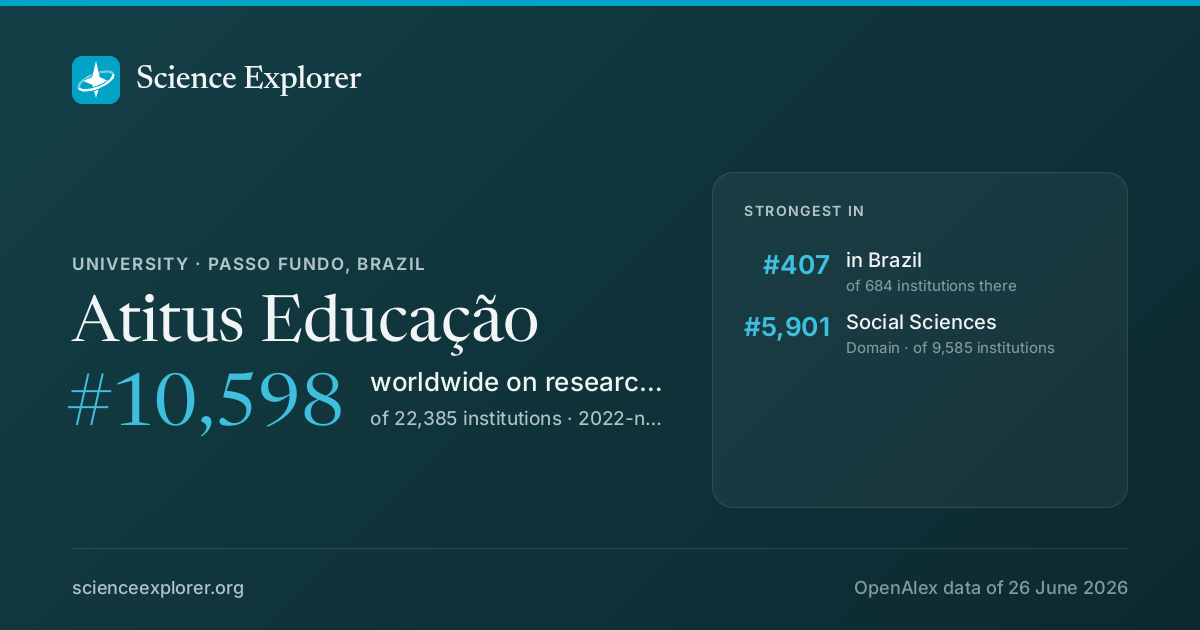
Atitus Educação on Science Explorer

A card with Atitus Educação's standing and the fields it leads in, for a post or a slide. A link to this page previews as the same card.

Download the card

1200 × 630 PNG, sized for social posts, drawn from the latest snapshot.

Badges for a website1Each links back here and updates with every snapshot

Research measures only: rankings here say nothing about teaching, admissions or student experience. Comparable institutions and collaboration partners have tabs of their own, above.

Discussion

Ask a question or share a note about Atitus Educação. Keep it to the research: no personal attacks, advertising or links. Any reader can report a post, which collapses it for everyone until it is opened.
