Atomic Energy (Canada)
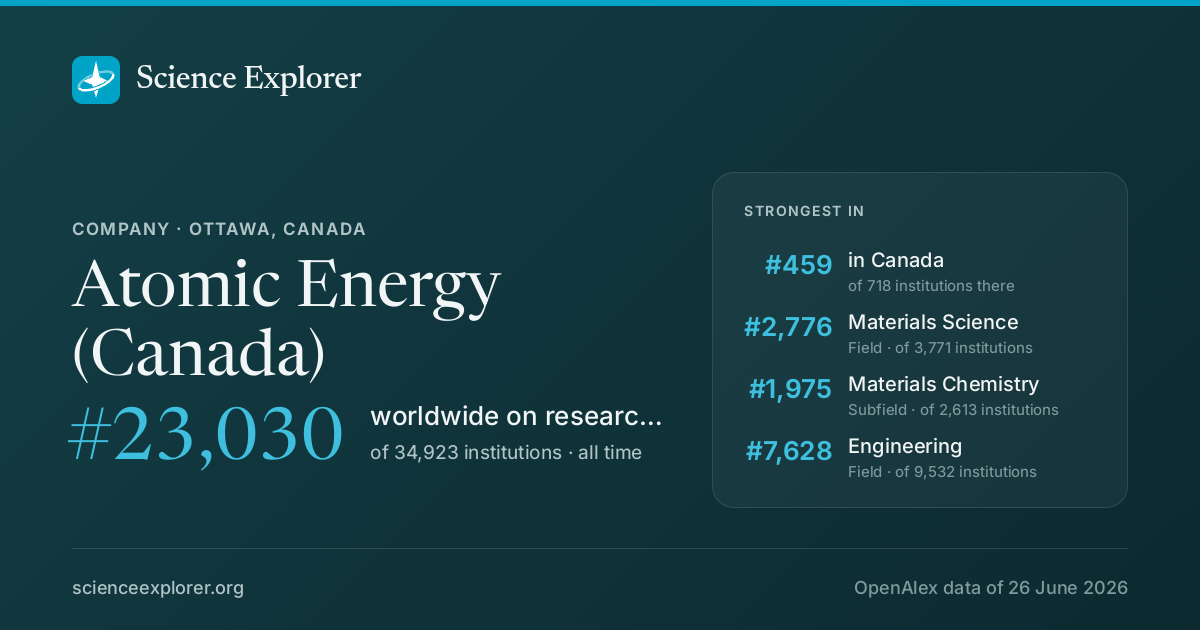
In research, Atomic Energy (Canada) stands highest in Materials Science (#2,776 of 3,771 worldwide), Materials Chemistry (#1,975 of 2,613 worldwide) and Engineering (#7,628 of 9,532 worldwide), over all time.
- World rank, all time
- #23,030 of 34,923
- Rank in Canada
- #459 of 718
- Research works
- 8.4k ▼ 32% vs 2018-21
- Citations
- 234k 27.9 per fractional work
- Top-10% rate
- 1.0% all institutions 10.0%
- vs its own fields
- 1.21× 1.00× is exactly expected
- Open access
- 8% world 40%
- International
- 14% world 18%
What is Atomic Energy (Canada) known for in research?
The fields where it stands highest, over all time, ranked among every institution above the floor in each field.
| Field | World rank | Where that sits | Top-10% rate | Works |
|---|---|---|---|---|
| Materials ScienceField | #2,776 of 3,771 | 15.4% | 1,534 | |
| Materials ChemistrySubfield | #1,975 of 2,613 | 15.8% | 1,240 | |
| EngineeringField | #7,628 of 9,532 | 12.3% | 2,423 | |
| ChemistryField | #2,630 of 2,902 | 12.4% | 555 | |
| Mechanical EngineeringSubfield | #2,303 of 2,525 | 12.6% | 405 | |
| Electrical and Electronic EngineeringSubfield | #3,509 of 3,725 | 11.3% | 289 | |
| Physics and AstronomyField | #2,749 of 2,917 | 13.0% | 1,784 | |
| Mechanics of MaterialsSubfield | #1,406 of 1,474 | 10.1% | 227 | |
| Earth and Planetary SciencesField | #2,129 of 2,224 | 10.3% | 234 | |
| Computational MechanicsSubfield | #1,173 of 1,225 | 12.6% | 227 |
Each strip is that field's whole ranked pool, with the notch where Atomic Energy (Canada) sits in it, in the colour of the band that rank falls in. The track under the rate is the rate itself: it carries no average mark, because the average differs by field (from about 6% in Dentistry to 21% in Economics).
Which fields of science does Atomic Energy (Canada) work in?
In all years, 87% of research at Atomic Energy (Canada) is in Physical Sciences, 6% in Life Sciences. Its largest fields are Engineering (29%), Physics and Astronomy (21%), Materials Science (18%). It does 2.1× the world's share of Physical Sciences.
Each ring splits the one inside it: the four domains of science, their fields, their subfields. Size is fractional works in all years. Every slice is a page; the interactive view zooms down to single topics and colours each by how much more of it this institution does than the world.
Its 4 domains and 26 fields, with their numbers
- Physical Sciences7,30587.2%
- Engineering2,42328.9%
- Physics and Astronomy1,78421.3%
- Materials Science1,53418.3%
- Chemistry5556.6%
- Environmental Science4725.6%
- Earth and Planetary Sciences2342.8%
- Computer Science1091.3%
- Chemical Engineering851.0%
- Mathematics650.8%
- Energy440.5%
- Life Sciences5056.0%
- Health Sciences4004.8%
- Medicine2833.4%
- Health Professions941.1%
- Nursing200.2%
- Veterinary20.0%
- Dentistry00.0%
- Social Sciences1642.0%
- Decision Sciences720.9%
- Social Sciences470.6%
- Arts and Humanities200.2%
- Psychology100.1%
- Business, Management and Accounting80.1%
- Economics, Econometrics and Finance60.1%
Field profile
Location quotient across every field it publishes in: outside the ring is more than an institution of this size would be expected to publish, inside it is less.
Rings at 0.5×, 1× and 2×. Widest outward: Physics and Astronomy, 6.4×. Every wedge is a field page.
All 16 fields, with their numbers
- Physics and Astronomy6.38×2 works
- Decision Sciences5.40×1 works
- Chemical Engineering2.71×0 works
- Energy2.68×0 works
- Mathematics2.42×0 works
- Materials Science2.40×2 works
- Earth and Planetary Sciences2.36×1 works
- Environmental Science1.74×2 works
- Engineering1.68×4 works
- Health Professions1.47×1 works
- Chemistry1.41×0 works
- Medicine0.92×3 works
- Biochemistry, Genetics and Molecular Biology0.27×0 works
- Computer Science0.25×0 works
- Agricultural and Biological Sciences0.13×0 works
- Social Sciences0.04×0 works
- Physics and Astronomy 6.4×
- Decision Sciences 5.4×
- Chemical Engineering 2.7×
- Energy 2.7×
- Mathematics 2.4×
- Materials Science 2.4×
- Earth and Planetary Sciences 2.4×
- Environmental Science 1.7×
- Engineering 1.7×
- Health Professions 1.5×
- Chemistry 1.4×
- Medicine 0.9×
- Biochemistry, Genetics and Molecular Biology 0.3×
- Computer Science 0.2×
- Agricultural and Biological Sciences 0.1×
- Social Sciences 0.0×
Who are the top researchers at Atomic Energy (Canada)?
Ranked on the quality score, E. C. Svensson, D.G. Martin and D. Ward lead among researchers whose main affiliation is Atomic Energy (Canada).
- 1
E. C. Svensson
 Canada · #476,147 worldwide
7.3k citations · 178 works
- 2
D.G. Martin
Canada · #688,999 worldwide
2k citations · 159 works
- 3
D. Ward
Canada · #707,636 worldwide
21k citations · 339 works
- 4
J. D. Chapman
Canada · #1,056,774 worldwide
3.1k citations · 61 works
- 5
Robert Leslie James Graham
Canada · #1,317,956 worldwide
10k citations · 236 works
- 6
B. Sur
Canada · #1,324,297 worldwide
8.1k citations · 125 works
- 7 Z. Yamani #1,742,929 worldwide 2.9k citations · 157 works
- 8 Hua‐Hong Zou #2,029,442 worldwide 617 citations · 83 works
- 9 Roxana Flacau #2,299,578 worldwide 1.1k citations · 83 works
- 10 Ajit Singh #2,359,737 worldwide 2.3k citations · 120 works
Which keywords describe research at Atomic Energy (Canada)?
By fractional works in all years, weighted toward what it does more of than the world: Density Functional Theory, Hydrogen Embrittlement, Oxidation Resistance, Tomography, High Temperature Behavior, Accident Tolerant Fuels, Fuel Cladding and Data Analysis.
- Soil Contamination
- Thermal Properties
- Superconductivity
- Nuclear Forces
- Radiation Protection
- radiation damage
- Nucleosynthesis
- Uranium
- Sorption
- Lanthanides
- Finite Element Analysis
- Radionuclides
- Health Effects
- Nuclear Reactor
- Neutron Imaging
- Radiography
- Data Analysis
- Accident Tolerant Fuels
- Tomography
- Hydrogen Embrittlement
- Density Functional Theory
- Oxidation Resistance
- High Temperature Behavior
- Fuel Cladding
- Small-Angle Scattering
- Neutron Activation Analysis
- Molten Salt
- Actinides
- Adsorption
- Extraction
- Bioremediation
- Coordination Chemistry
- Complexation
- Molecular Dynamics Simulations
- fusion materials
- Nuclear Fuel
- Raman Spectroscopy
- Nuclear Structure
- Environmental Impacts
- Oxidation Behavior
Size is fractional works in all years in the topics tagged with each word; colour is the word's share of this institution's work against its share of the world's. The 40 words are chosen for being large and distinctive. Each links to the topic it comes from most.
All 40 words, with their numbers
- Density Functional Theory521▲ 23×6 topics
- Hydrogen Embrittlement480▲ 56×3 topics
- Oxidation Resistance480▲ 40×3 topics
- Tomography474▲ 21×5 topics
- High Temperature Behavior465▲ 57×2 topics
- Accident Tolerant Fuels429▲ 104×1 topic
- Fuel Cladding429▲ 104×1 topic
- Data Analysis407▲ 15×9 topics
- Small-Angle Scattering398▲ 37×2 topics
- Radiography396▲ 57×2 topics
- Neutron Activation Analysis396▲ 59×1 topic
- Neutron Imaging396▲ 59×1 topic
- Molten Salt347▲ 90×1 topic
- Nuclear Reactor347▲ 90×1 topic
- Actinides264▲ 40×2 topics
- Health Effects248▲ 4.9×16 topics
- Adsorption236▲ 12×7 topics
- Radionuclides224▲ 50×2 topics
- Extraction220▲ 14×4 topics
- Finite Element Analysis207▲ 11×9 topics
- Bioremediation206▲ 16×7 topics
- Lanthanides204▲ 30×2 topics
- Coordination Chemistry197▲ 21×2 topics
- Sorption196▲ 33×2 topics
- Complexation196▲ 41×1 topic
- Uranium196▲ 41×1 topic
- Molecular Dynamics Simulations189▲ 41×2 topics
- Nucleosynthesis189▲ 22×3 topics
- fusion materials186▲ 78×1 topic
- radiation damage186▲ 78×1 topic
- Nuclear Fuel180▲ 74×1 topic
- Radiation Protection180▲ 74×1 topic
- Raman Spectroscopy176▲ 8.9×7 topics
- Nuclear Forces169▲ 36×1 topic
- Nuclear Structure169▲ 36×1 topic
- Superconductivity166▲ 6.4×9 topics
- Environmental Impacts163▲ 9.0×6 topics
- Thermal Properties162▲ 13×7 topics
- Oxidation Behavior162▲ 32×2 topics
- Soil Contamination152▲ 47×3 topics
Which research topics does Atomic Energy (Canada) publish most on?
By volume in 2022-now: Chemical Synthesis and Characterization, Risk and Safety Analysis, Radioactivity and Radon Measurements and Graphite, nuclear technology, radiation studies.
Area is fractional works; colour is the subfield each topic belongs to.
- 1 Chemical Synthesis and Characterization Industrial and Manufacturing Engineering 1 works
- 2 Risk and Safety Analysis Statistics, Probability and Uncertainty 1 works
- 3 Radioactivity and Radon Measurements Radiological and Ultrasound Technology 1 works
- 4 Graphite, nuclear technology, radiation studies Materials Chemistry 0 works
- 5 Fusion materials and technologies Materials Chemistry 0 works
- 6 Radiation Therapy and Dosimetry Pulmonary and Respiratory Medicine 0 works
- 7 Nuclear reactor physics and engineering Aerospace Engineering 0 works
- 8 Nuclear Physics and Applications Radiation 0 works
- 9 Advanced NMR Techniques and Applications Spectroscopy 0 works
- 10 Seismic Performance and Analysis Civil and Structural Engineering 0 works
How open and international is its research?
Against the world's own shares: the tick on each track. Both are shares of its output, so they sit on one scale and can be read against each other as well as against the world.
World: 40% of research is openly available.
World: 18% is written across borders.
How has Atomic Energy (Canada)'s research output changed?
Output in 2022-2025 was 32% lower than in 2018-2021.
The same series as a ribbon: one cell per year, darker for more. The line above answers how much; this answers when.
Its share of all research
Growing output can still be a shrinking share: all of science grows. This is Atomic Energy (Canada) as a percentage of every work published that year, 0.000072% in 2024.
Fractional works of Atomic Energy (Canada) over all fractional works that year. How the balance of science has shifted.
How much of it reaches the world top 10%
Year by year, against all institutions in the same year.
Of each year's output, the share that reached the world's 10% most cited for its field and year. Peak 13.4% in 1992.
Other research institutions in Ottawa
- University of Ottawa
- Carleton University
- National Research Council Canada
- Agriculture and Agri-Food Canada
- Natural Resources Canada
- Environment and Climate Change Canada
- Fisheries and Oceans Canada
- Health Canada
Share Atomic Energy (Canada)'s ranking
Badges for a website1Each links back here and updates with every snapshot

Research measures only: rankings here say nothing about teaching, admissions or student experience. Comparable institutions and collaboration partners have tabs of their own, above.
Discussion
Ask a question or share a note about Atomic Energy (Canada). Posts are plain text and can be reported.