Science Explorer Back to mapMap
Discussion
Government institution · Vienna · Austria

Austrian Federal Railways

In research, Austrian Federal Railways stands highest in Physical Sciences (#13,949 of 17,446 worldwide), over all time.

World rank, all time
#22,327
of 34,923
Rank in Austria
#173
of 255
Research works
239
▲ 2% vs 2018-21
Citations
1.6k
6.8 per fractional work
Top-10% rate
5.0%
all institutions 10.0%
vs its own fields
0.89×
1.00× is exactly expected
Open access
26%
world 40%
International
17%
world 18%

What is Austrian Federal Railways known for in research?

The fields where it stands highest, over all time, ranked among every institution above the floor in each field.

FieldWorld rankWhere that sitsTop-10% rateWorks
Physical SciencesDomain #13,949 of 17,446 5.1%142

Each strip is that field's whole ranked pool, with the notch where Austrian Federal Railways sits in it, in the colour of the band that rank falls in. The track under the rate is the rate itself: it carries no average mark, because the average differs by field (from about 6% in Dentistry to 21% in Economics).

Which fields of science does Austrian Federal Railways work in?

In 2022-now, 55% of research at Austrian Federal Railways is in Physical Sciences, 25% in Social Sciences. Its largest fields are Engineering (39%), Medicine (13%), Social Sciences (10%). It does 1.4× the world's share of Physical Sciences.

Physical Sciences: 27 fractional works · 55.1% of its workEngineering: 19 fractional works · 38.9% of its workCivil and Structural Engineering: 8 fractional works · 15.5% of its workIndustrial and Manufacturing Engineering: 2 fractional works · 3.9% of its workMechanical Engineering: 2 fractional works · 3.8% of its workMechanics of Materials: 2 fractional works · 3.5% of its workSafety, Risk, Reliability and Quality: 2 fractional works · 3.3% of its workAutomotive Engineering: 1 fractional works · 2.4% of its workOcean Engineering: 1 fractional works · 2.0% of its workBuilding and Construction: 0 fractional works · 1.0% of its workElectrical and Electronic Engineering: 0 fractional works · 1.0% of its workGeneral Engineering: 0 fractional works · 0.9% of its workAerospace Engineering: 0 fractional works · 0.8% of its workComputational Mechanics: 0 fractional works · 0.4% of its workControl and Systems Engineering: 0 fractional works · 0.3% of its workEnvironmental Science: 3 fractional works · 6.5% of its workEcology: 1 fractional works · 1.3% of its workManagement, Monitoring, Policy and Law: 1 fractional works · 1.2% of its workNature and Landscape Conservation: 1 fractional works · 1.1% of its workGlobal and Planetary Change: 0 fractional works · 1.0% of its workHealth, Toxicology and Mutagenesis: 0 fractional works · 0.7% of its workEnvironmental Engineering: 0 fractional works · 0.4% of its workWater Science and Technology: 0 fractional works · 0.3% of its workEnvironmental Chemistry: 0 fractional works · 0.2% of its workSmaller subfields together: 0 fractional works · 0.4% of its workEarth and Planetary Sciences: 3 fractional works · 5.6% of its workAtmospheric Science: 1 fractional works · 2.0% of its workEarth-Surface Processes: 1 fractional works · 1.4% of its workGeology: 0 fractional works · 0.8% of its workOceanography: 0 fractional works · 0.8% of its workGeochemistry and Petrology: 0 fractional works · 0.7% of its workComputer Science: 1 fractional works · 2.6% of its workComputer Graphics and Computer-Aided Design: 0 fractional works · 1.0% of its workInformation Systems: 0 fractional works · 0.8% of its workArtificial Intelligence: 0 fractional works · 0.4% of its workSoftware: 0 fractional works · 0.2% of its workSmaller subfields together: 0 fractional works · 0.2% of its workMaterials Science: 0 fractional works · 0.9% of its workMaterials Chemistry: 0 fractional works · 0.5% of its workElectronic, Optical and Magnetic Materials: 0 fractional works · 0.3% of its workEnergy: 0 fractional works · 0.3% of its workEnergy Engineering and Power Technology: 0 fractional works · 0.3% of its workChemistry: 0 fractional works · 0.2% of its workPhysics and Astronomy: 0 fractional works · 0.1% of its workSocial Sciences: 12 fractional works · 25.2% of its workSocial Sciences: 5 fractional works · 10.3% of its workPolitical Science and International Relations: 2 fractional works · 4.4% of its workSociology and Political Science: 1 fractional works · 1.7% of its workDemography: 0 fractional works · 1.0% of its workLaw: 0 fractional works · 1.0% of its workCommunication: 0 fractional works · 0.7% of its workCultural Studies: 0 fractional works · 0.7% of its workTransportation: 0 fractional works · 0.7% of its workSmaller subfields together: 0 fractional works · 0.2% of its workPsychology: 3 fractional works · 6.9% of its workDevelopmental and Educational Psychology: 1 fractional works · 2.4% of its workClinical Psychology: 1 fractional works · 2.1% of its workSocial Psychology: 1 fractional works · 1.8% of its workApplied Psychology: 0 fractional works · 0.7% of its workBusiness, Management and Accounting: 2 fractional works · 3.2% of its workStrategy and Management: 1 fractional works · 1.7% of its workManagement of Technology and Innovation: 0 fractional works · 1.0% of its workAccounting: 0 fractional works · 0.3% of its workManagement Information Systems: 0 fractional works · 0.2% of its workArts and Humanities: 1 fractional works · 2.3% of its workHistory and Philosophy of Science: 0 fractional works · 0.7% of its workPhilosophy: 0 fractional works · 0.7% of its workVisual Arts and Performing Arts: 0 fractional works · 0.7% of its workArcheology: 0 fractional works · 0.2% of its workSmaller subfields together: 0 fractional works · 0.0% of its workEconomics, Econometrics and Finance: 1 fractional works · 1.9% of its workEconomics and Econometrics: 0 fractional works · 0.9% of its workFinance: 0 fractional works · 0.7% of its workGeneral Economics, Econometrics and Finance: 0 fractional works · 0.3% of its workDecision Sciences: 0 fractional works · 0.6% of its workStatistics, Probability and Uncertainty: 0 fractional works · 0.4% of its workManagement Science and Operations Research: 0 fractional works · 0.2% of its workHealth Sciences: 8 fractional works · 15.8% of its workMedicine: 7 fractional works · 13.2% of its workSurgery: 1 fractional works · 2.4% of its workPublic Health, Environmental and Occupational Health: 1 fractional works · 1.9% of its workPharmacology: 1 fractional works · 1.7% of its workRheumatology: 0 fractional works · 1.0% of its workPulmonary and Respiratory Medicine: 0 fractional works · 0.8% of its workPhysiology: 0 fractional works · 0.8% of its workOrthopedics and Sports Medicine: 0 fractional works · 0.7% of its workPediatrics, Perinatology and Child Health: 0 fractional works · 0.7% of its workCritical Care and Intensive Care Medicine: 0 fractional works · 0.4% of its workPathology and Forensic Medicine: 0 fractional works · 0.4% of its workEpidemiology: 0 fractional works · 0.3% of its workCardiology and Cardiovascular Medicine: 0 fractional works · 0.2% of its workAnatomy: 0 fractional works · 0.2% of its workEmergency Medicine: 0 fractional works · 0.2% of its workRehabilitation: 0 fractional works · 0.2% of its workSmaller subfields together: 1 fractional works · 1.3% of its workHealth Professions: 1 fractional works · 1.5% of its workComplementary and Manual Therapy: 0 fractional works · 0.7% of its workGeneral Health Professions: 0 fractional works · 0.2% of its workEmergency Medical Services: 0 fractional works · 0.2% of its workRadiological and Ultrasound Technology: 0 fractional works · 0.2% of its workSmaller subfields together: 0 fractional works · 0.2% of its workDentistry: 0 fractional works · 1.0% of its workOral Surgery: 0 fractional works · 0.5% of its workOrthodontics: 0 fractional works · 0.3% of its workSmaller subfields together: 0 fractional works · 0.2% of its workLife Sciences: 2 fractional works · 4.0% of its workBiochemistry, Genetics and Molecular Biology: 2 fractional works · 3.4% of its workGenetics: 1 fractional works · 1.2% of its workMolecular Biology: 0 fractional works · 1.0% of its workBiochemistry: 0 fractional works · 0.7% of its workCell Biology: 0 fractional works · 0.4% of its workSmaller subfields together: 0 fractional works · 0.0% of its workAgricultural and Biological Sciences: 0 fractional works · 0.5% of its workEcology, Evolution, Behavior and Systematics: 0 fractional works · 0.3% of its workSmaller subfields together: 0 fractional works · 0.2% of its workImmunology and Microbiology: 0 fractional works · 0.1% of its workALL ITS WORKAustrian FederalRailways49fractional works, 2022-now
Life Sciences4%Physical Sciences55%Health Sciences16%Social Sciences25%

Each ring splits the one inside it: the four domains of science, their fields, their subfields. Size is fractional works in 2022-now. Every slice is a page; the interactive view zooms down to single topics and colours each by how much more of it this institution does than the world.

Its 4 domains and 20 fields, with their numbers
    1. Engineering1938.9%
    2. Environmental Science36.5%
    3. Earth and Planetary Sciences35.6%
    4. Computer Science12.6%
    5. Materials Science00.9%
    6. Energy00.3%
    7. Chemistry00.2%
    8. Physics and Astronomy00.1%
    1. Social Sciences510.3%
    2. Psychology36.9%
    3. Business, Management and Accounting23.2%
    4. Arts and Humanities12.3%
    5. Economics, Econometrics and Finance11.9%
    6. Decision Sciences00.6%
    1. Medicine713.2%
    2. Health Professions11.5%
    3. Dentistry01.0%
    1. Biochemistry, Genetics and Molecular Biology23.4%
    2. Agricultural and Biological Sciences00.5%
    3. Immunology and Microbiology00.1%
All of science, and how each field's share has moved since 1950: the Science domain explorer

Field profile

Location quotient across every field it publishes in: outside the ring is more than an institution of this size would be expected to publish, inside it is less.

Agricultural and Biological Sciences: 0.11× its world share, 0 worksAgricultural and Bio…Biochemistry, Genetics and Molecular Biology: 0.63× its world share, 2 worksBiochemistry, Geneti…Immunology and Microbiology: 0.07× its world share, 0 worksImmunology and Micro…Chemistry: 0.11× its world share, 0 worksChemistryComputer Science: 0.34× its world share, 1 worksComputer ScienceEarth and Planetary Sciences: 3.56× its world share, 3 worksEarth and Planetary …Energy: 0.37× its world share, 0 worksEnergyEngineering: 2.60× its world share, 19 worksEngineeringEnvironmental Science: 1.31× its world share, 3 worksEnvironmental ScienceMaterials Science: 0.24× its world share, 0 worksMaterials SciencePhysics and Astronomy: 0.04× its world share, 0 worksPhysics and AstronomyDentistry: 2.09× its world share, 0 worksDentistryHealth Professions: 0.58× its world share, 1 worksHealth ProfessionsMedicine: 0.69× its world share, 6 worksMedicineArts and Humanities: 0.78× its world share, 1 worksArts and HumanitiesBusiness, Management and Accounting: 1.00× its world share, 2 worksBusiness, Management…Decision Sciences: 0.68× its world share, 0 worksDecision SciencesEconomics, Econometrics and Finance: 0.87× its world share, 1 worksEconomics, Econometr…Psychology: 2.27× its world share, 3 worksPsychologySocial Sciences: 0.81× its world share, 5 worksSocial Sciences1×world share
more than its size predictsabout as predictedless

Rings at 0.5×, 1× and 2×. Widest outward: Earth and Planetary Sciences, 3.6×. Every wedge is a field page.

All 20 fields, with their numbers
  1. Earth and Planetary Sciences3.56×3 works
  2. Engineering2.60×19 works
  3. Psychology2.27×3 works
  4. Dentistry2.09×0 works
  5. Environmental Science1.31×3 works
  6. Business, Management and Accounting1.00×2 works
  7. Economics, Econometrics and Finance0.87×1 works
  8. Social Sciences0.81×5 works
  9. Arts and Humanities0.78×1 works
  10. Medicine0.69×6 works
  11. Decision Sciences0.68×0 works
  12. Biochemistry, Genetics and Molecular Biology0.63×2 works
  13. Health Professions0.58×1 works
  14. Energy0.37×0 works
  15. Computer Science0.34×1 works
  16. Materials Science0.24×0 works
  17. Agricultural and Biological Sciences0.11×0 works
  18. Chemistry0.11×0 works
  19. Immunology and Microbiology0.07×0 works
  20. Physics and Astronomy0.04×0 works

Who are the top researchers at Austrian Federal Railways?

Ranked on the quality score, Moritz Menge, Hans Jörg Laimer and Rudolf Kern lead among researchers whose main affiliation is Austrian Federal Railways.

  1. 1 Moritz Menge Austria · #3,165,937 worldwide 6 citations · 38 works
  2. 2 Hans Jörg Laimer Austria · #3,625,565 worldwide 106 citations · 17 works
  3. 3 Rudolf Kern Austria · #3,709,261 worldwide 126 citations · 44 works
  4. 4 Hugo Gasteiger Austria · #3,918,358 worldwide 13 citations · 55 works
  5. 5 Pınar Yılmazer Austria · #4,287,466 worldwide 85 citations · 16 works
  6. 6 Roman Heissenberger Austria · #4,476,261 worldwide 41 citations · 15 works
  7. 7 Gerhard Gobiet Austria · #4,687,219 worldwide 45 citations · 17 works
  8. 8 Robert Genser Austria · #4,720,914 worldwide 68 citations · 33 works
  9. 9 Hannes Kari Austria · #4,789,871 worldwide 40 citations · 21 works
  10. 10 Marijan Kotar Austria · #5,105,105 worldwide 40 citations · 39 works
All ranked researchers at Austrian Federal Railways

What are the most cited papers from Austrian Federal Railways?

The most cited paper from Austrian Federal Railways is "Agricultural abandonment in mountain areas of Europe: Environmental consequences and policy response" (David Whyte Macdonald, Jason Crabtree, Georg Wiesinger et al., 2000), with 2,039 citations. Next come "Spatial decoupling of agricultural production and consumption: quantifying dependences of countries on food imports due to domestic land and water constraints" (341) and "The climate change mitigation effects of daily active travel in cities" (296).

Most cited papers
#PaperReleasedCitations
1 Agricultural abandonment in mountain areas of Europe: Environmental consequences and policy response David Whyte Macdonald, Jason Crabtree, Georg Wiesinger et al. · Journal of Environmental Management May 2000 2,039
2 Spatial decoupling of agricultural production and consumption: quantifying dependences of countries on food imports due to domestic land and water constraints Marianela Fader, Dieter Gerten, Michael M. Krause et al. · Environmental Research Letters Open access Mar 2013 341
3 The climate change mitigation effects of daily active travel in cities Christian Brand et al. · Transportation Research Part D Transport and Environment Open access 27 Feb 2021 296
4 Resistance exercise and breast cancer–related lymphedema—a systematic review update and meta-analysis Timothy Hasenoehrl, Stefano Palma, Dariga Ramazanova et al. · Supportive Care in Cancer ReviewOpen access 15 May 2020 136
5 Design and construction of the tunnel geothermal system in Jenbach / Stephan Frodl, Jan Niklas Franzius, Thomas Bartl · Geomechanics and Tunnelling Oct 2010 97
All 61 most cited papers, with filters and sorting

Which keywords describe research at Austrian Federal Railways?

By fractional works in 2022-now, weighted toward what it does more of than the world: Risk Assessment, Numerical Simulation, Performance Prediction, TBM, Sustainable Development, Civil Engineering, Dynamic Interaction and Structural Health Monitoring.

▲ more of its work than of the world's◆ about the world's share▼ less than the world's

Size is fractional works in 2022-now in the topics tagged with each word; colour is the word's share of this institution's work against its share of the world's. The 37 words are chosen for being large and distinctive. Each links to the topic it comes from most.

All 37 words, with their numbers
  1. Risk Assessment4▲ 11×3 topics
  2. Machine Learning4▲ 2.1×5 topics
  3. Numerical Simulation4▲ 24×2 topics
  4. Performance Prediction3▲ 89×1 topic
  5. Sustainable Development3▲ 3.9×6 topics
  6. TBM3▲ 238×1 topic
  7. Energy Efficiency2▲ 5.0×4 topics
  8. Civil Engineering2▲ 85×2 topics
  9. Dynamic Interaction2▲ 62×2 topics
  10. Structural Health Monitoring2▲ 51×4 topics
  11. Climate Change2▲ 1.37×15 topics
  12. Epidemiology2◆ 0.92×17 topics
  13. Construction2▲ 25×2 topics
  14. Finite Element Analysis2▲ 15×2 topics
  15. Governance2▲ 10×3 topics
  16. Material Properties2▲ 35×2 topics
  17. Ground Vibration2▲ 113×1 topic
  18. Railway Dynamics2▲ 113×1 topic
  19. Reliability Analysis2▲ 33×2 topics
  20. Slope Stability Analysis2▲ 81×1 topic
  21. Spatial Variability2▲ 49×1 topic
  22. Bridge Engineering2▲ 293×1 topic
  23. Digitalization2▲ 15×3 topics
  24. Geotechnical Design2▲ 293×1 topic
  25. Railway Timetabling2▲ 170×1 topic
  26. Remote Sensing2▲ 2.5×5 topics
  27. Train Scheduling2▲ 170×1 topic
  28. Physical Activity1▲ 6.0×3 topics
  29. Risk Factors1▲ 2.2×8 topics
  30. Artificial Intelligence1▲ 1.54×5 topics
  31. Big Data1▲ 2.1×3 topics
  32. Corrosion1▲ 17×2 topics
  33. Developmental Coordination Disorder1▲ 56×1 topic
  34. Leadership1▲ 4.2×1 topic
  35. Motor Skill Competence1▲ 56×1 topic
  36. Participation1▲ 21×1 topic
  37. Public Health1▲ 1.44×4 topics

Which research topics does Austrian Federal Railways publish most on?

By volume in 2022-now: Tunneling and Rock Mechanics, Railway Engineering and Dynamics, Geotechnical Engineering and Analysis and Civil and Structural Engineering Research.

  1. 1 Tunneling and Rock Mechanics Civil and Structural Engineering 3 works
  2. 2 Railway Engineering and Dynamics Mechanical Engineering 2 works
  3. 3 Geotechnical Engineering and Analysis Safety, Risk, Reliability and Quality 2 works
  4. 4 Civil and Structural Engineering Research Civil and Structural Engineering 2 works
  5. 5 Railway Systems and Energy Efficiency Industrial and Manufacturing Engineering 2 works
  6. 6 Children's Physical and Motor Development Developmental and Educational Psychology 1 works
  7. 7 Public Administration and Political Analysis Political Science and International Relations 1 works
  8. 8 Concrete Corrosion and Durability Civil and Structural Engineering 1 works
  9. 9 Rock Mechanics and Modeling Mechanics of Materials 1 works
  10. 10 Psychology, Coaching, and Therapy Social Psychology 1 works

How open and international is its research?

Against the world's own shares: the tick on each track. Both are shares of its output, so they sit on one scale and can be read against each other as well as against the world.

openly available25.8%not open74.2%

World: 40% of research is openly available.

with international co-authors17.4%domestic only82.6%

World: 18% is written across borders.

How has Austrian Federal Railways's research output changed?

Output in 2022-2025 was 2% higher than in 2018-2021.

still counting1990200020102020
grewheldshrank

The same series as a ribbon: one cell per year, darker for more. The line above answers how much; this answers when.

Its share of all research

Growing output can still be a shrinking share: all of science grows. This is Austrian Federal Railways as a percentage of every work published that year, 0.00017% in 2024.

still counting0.0010%0.0020%Austrian Federal Railways0.00026% in 202519801990200020102020

Fractional works of Austrian Federal Railways over all fractional works that year. How the balance of science has shifted.

Other research institutions in Vienna

All research institutions in Vienna

Share Austrian Federal Railways's ranking
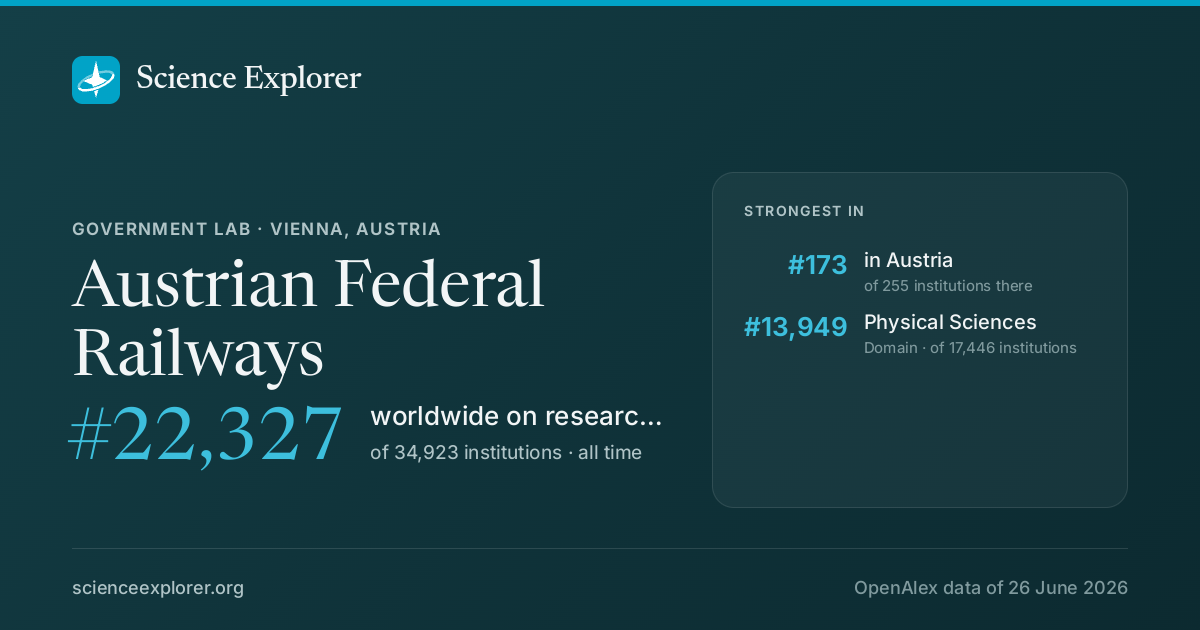
Austrian Federal Railways on Science Explorer

A card with Austrian Federal Railways's standing and the fields it leads in, for a post or a slide. A link to this page previews as the same card.

Download the card

1200 × 630 PNG, sized for social posts, drawn from the latest snapshot.

Badges for a website1Each links back here and updates with every snapshot

Research measures only: rankings here say nothing about teaching, admissions or student experience. Comparable institutions and collaboration partners have tabs of their own, above.

Discussion

Ask a question or share a note about Austrian Federal Railways. Keep it to the research: no personal attacks, advertising or links. Any reader can report a post, which collapses it for everyone until it is opened.