TU Wien
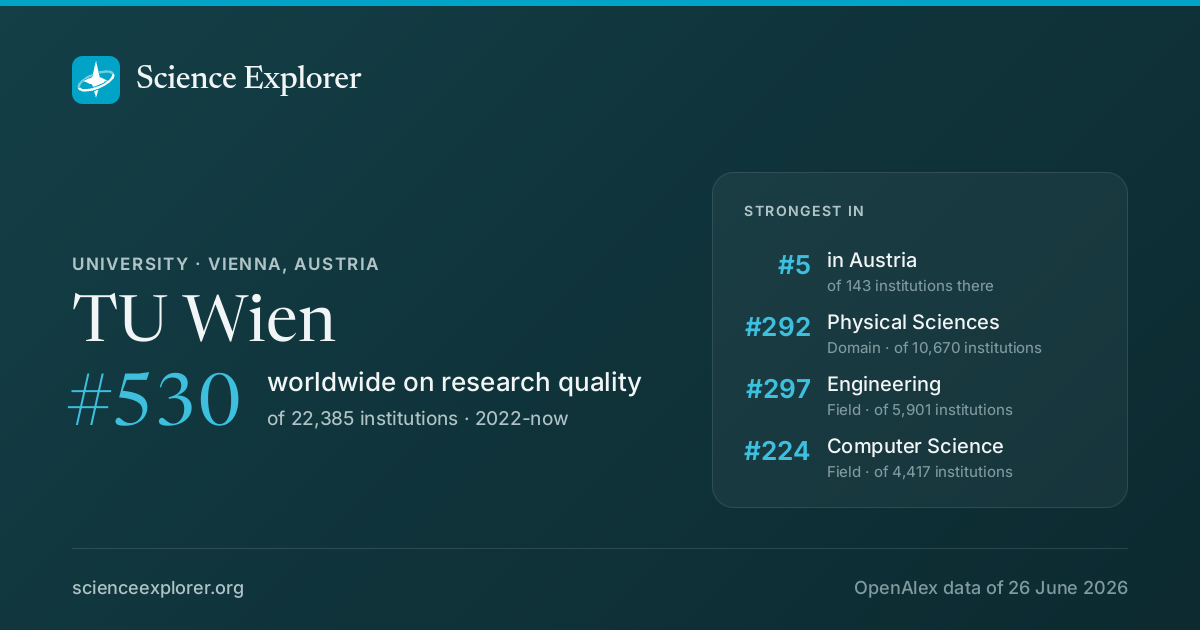
In research, TU Wien stands highest in Physical Sciences (#292 of 10,670 worldwide), Engineering (#297 of 5,901 worldwide) and Computer Science (#224 of 4,417 worldwide), 2022-now. Relative to its size it is most specialised in Architecture, Software and Hardware and Architecture (Architecture is 11.9× its share of world research).
- World rank, 2022-now
- #530 of 22,385 · #408 all time
- Rank in Austria
- #5 of 143
- Research works
- 46k ▲ 6% vs 2018-21
- Citations
- 1.1M 24.5 per fractional work
- Top-10% rate
- 8.2% all institutions 10.0%
- vs its own fields
- 1.03× 1.00× is exactly expected
- Open access
- 34% world 40%
- International
- 28% world 18%
What is TU Wien known for in research?
The fields where it stands highest, 2022-now, ranked among every institution above the floor in each field.
| Field | World rank | Where that sits | Top-10% rate | Works | All time |
|---|---|---|---|---|---|
| Physical SciencesDomain | #292 of 10,670 | 8.5% | 5,130 | #185 | |
| EngineeringField | #297 of 5,901 | 7.8% | 2,058 | #159 | |
| Computer ScienceField | #224 of 4,417 | 8.9% | 1,267 | #85 | |
| Social SciencesDomain | #726 of 9,585 | 8.8% | 788 | #628 | |
| Social SciencesField | #822 of 5,988 | 9.4% | 311 | #740 | |
| Physics and AstronomyField | #196 of 1,417 | 10.6% | 460 | #134 | |
| Health SciencesDomain | #1,433 of 9,902 | 11.3% | 193 | #1449 | |
| Materials ScienceField | #332 of 2,276 | 7.4% | 387 | #225 | |
| Artificial IntelligenceSubfield | #280 of 1,862 | 8.0% | 414 | #139 | |
| Electrical and Electronic EngineeringSubfield | #343 of 2,176 | 7.1% | 494 | #180 |
Each strip is that field's whole ranked pool, with the notch where TU Wien sits in it, in the colour of the band that rank falls in. The track under the rate is the rate itself: it carries no average mark, because the average differs by field (from about 6% in Dentistry to 21% in Economics).
Which of those standings moved
The same fields on both windows: where it stood over the whole record, and where it stands in 2022-now. The distance is the story, and it is the one thing the two rank columns above cannot show.
- Physical Sciences#185 #292
- Engineering#159 #297
- Computer Science#85 #224
- Social Sciences#628 #726
- Social Sciences#740 #822
- Physics and Astronomy#134 #196
- Health Sciences#1,449 #1,433
- Materials Science#225 #332
- Artificial Intelligence#139 #280
- Electrical and Electronic Engineering#180 #343
A dot further right is a better standing. Fields it was not ranked in over the whole record are left out.
Which fields of science does TU Wien work in?
In 2022-now, 79% of research at TU Wien is in Physical Sciences, 13% in Social Sciences. Its largest fields are Engineering (31%), Computer Science (19%), Physics and Astronomy (7%). It does 2.0× the world's share of Physical Sciences.
Each ring splits the one inside it: the four domains of science, their fields, their subfields. Size is fractional works in 2022-now. Every slice is a page; the interactive view zooms down to single topics and colours each by how much more of it this institution does than the world.
Its 4 domains and 26 fields, with their numbers
- Physical Sciences6,16479.2%
- Engineering2,45231.5%
- Computer Science1,50819.4%
- Physics and Astronomy5447.0%
- Materials Science4646.0%
- Environmental Science4175.4%
- Mathematics2343.0%
- Chemistry2192.8%
- Earth and Planetary Sciences1381.8%
- Energy1161.5%
- Chemical Engineering720.9%
- Social Sciences1,01713.1%
- Social Sciences4085.2%
- Business, Management and Accounting1622.1%
- Arts and Humanities1542.0%
- Decision Sciences1221.6%
- Psychology901.2%
- Economics, Econometrics and Finance811.0%
- Life Sciences3604.6%
- Health Sciences2433.1%
- Medicine1882.4%
- Health Professions430.5%
- Dentistry60.1%
- Nursing50.1%
- Veterinary20.0%
What does TU Wien specialise in?
Where its research is concentrated relative to its size: Architecture takes 11.9× the share of its output that it takes of world research.
- ArchitectureSubfield · 36.2 works12×
- SoftwareSubfield · 41.9 works8.4×
- Hardware and ArchitectureSubfield · 55.2 works6.3×
- Computational Theory and MathematicsSubfield · 197.4 works5.9×
- Atomic and Molecular Physics, and OpticsSubfield · 263.0 works4.7×
- Computer Graphics and Computer-Aided DesignSubfield · 29.7 works4.6×
Location quotient, a volume reading rather than an impact one. It surfaces small, lopsided specialities.
Field profile
Location quotient across every field it publishes in: outside the ring is more than an institution of this size would be expected to publish, inside it is less.
Rings at 0.5×, 1× and 2×. Widest outward: Physics and Astronomy, 3.1×. Every wedge is a field page.
All 26 fields, with their numbers
- Physics and Astronomy3.14×544 works
- Chemical Engineering2.64×72 works
- Mathematics2.56×234 works
- Computer Science2.49×1,508 works
- Engineering2.10×2,452 works
- Chemistry1.79×219 works
- Materials Science1.71×464 works
- Energy1.62×116 works
- Decision Sciences1.62×122 works
- Earth and Planetary Sciences1.13×138 works
- Environmental Science1.08×417 works
- Arts and Humanities0.68×154 works
- Business, Management and Accounting0.64×162 works
- Neuroscience0.58×74 works
- Biochemistry, Genetics and Molecular Biology0.50×207 works
- Economics, Econometrics and Finance0.49×81 works
- Social Sciences0.41×408 works
- Psychology0.38×90 works
- Health Professions0.21×43 works
- Agricultural and Biological Sciences0.18×68 works
- Veterinary0.17×2 works
- Pharmacology, Toxicology and Pharmaceutics0.16×4 works
- Dentistry0.16×6 works
- Medicine0.13×188 works
- Nursing0.13×5 works
- Immunology and Microbiology0.10×8 works
- Physics and Astronomy 3.1×
- Chemical Engineering 2.6×
- Mathematics 2.6×
- Computer Science 2.5×
- Engineering 2.1×
- Chemistry 1.8×
- Materials Science 1.7×
- Energy 1.6×
- Decision Sciences 1.6×
- Earth and Planetary Sciences 1.1×
- Environmental Science 1.1×
- Arts and Humanities 0.7×
- Business, Management and Accounting 0.6×
- Neuroscience 0.6×
- Biochemistry, Genetics and Molecular Biology 0.5×
- Economics, Econometrics and Finance 0.5×
- Social Sciences 0.4×
- Psychology 0.4×
- Health Professions 0.2×
- Agricultural and Biological Sciences 0.2×
- Veterinary 0.2×
- Pharmacology, Toxicology and Pharmaceutics 0.2×
- Dentistry 0.2×
- Medicine 0.1×
- Nursing 0.1×
- Immunology and Microbiology 0.1×
Who are the top researchers at TU Wien?
Ranked on the quality score, Peter Rabl, J. Ulrich and Günter Blöschl lead among researchers whose main affiliation is TU Wien.
- 1
Peter Rabl
 Austria · #19,829 worldwide
12k citations · 179 works
- 2
J. Ulrich
Austria · #26,042 worldwide
7.7k citations · 61 works
- 3
Günter Blöschl
Austria · #30,372 worldwide
52k citations · 806 works
- 4
Chet Ruszczyk
Austria · #30,581 worldwide
16k citations · 38 works
- 5
Jörg Schmiedmayer
Austria · #37,696 worldwide
23k citations · 430 works
- 6
A. Toschi
Austria · #54,827 worldwide
7.4k citations · 204 works
- 7
Praveen Kumar Donta
Austria · #57,359 worldwide
2.2k citations · 150 works
- 8
Irina S. Druzhinina
Austria · #61,374 worldwide
16k citations · 254 works
- 9
Katta Spiel
Austria · #66,354 worldwide
4.3k citations · 127 works
- 10
Christian Peter Kubicek
Austria · #69,943 worldwide
34k citations · 399 works
Which keywords describe research at TU Wien?
By fractional works in 2022-now, weighted toward what it does more of than the world: Deep Learning, Sustainability, Machine Learning, Renewable Energy, Model Checking, Mechanical Properties, Energy Efficiency and Sustainable Development.
- Urban Planning
- Software Engineering
- Answer Set Programming
- Modal Logic
- Semantic Web
- Biosphere Reserves
- Thin Films
- Construction
- Additive Manufacturing
- Model Predictive Control
- Distributed Systems
- Temporal Logic
- Catalysis
- Data Mining
- Model Checking
- Environmental Impact
- Energy Efficiency
- Neural Networks
- Renewable Energy
- Machine Learning
- Deep Learning
- Sustainability
- Sustainable Development
- Mechanical Properties
- Big Data
- Remote Sensing
- Virtual Reality
- Internet of Things
- Microstructure
- Knowledge Representation
- Description Logics
- Renewable Resources
- Entanglement
- Simulation
- Landscape Management
- Participatory Governance
- Molecular Dynamics
- Approximation Algorithms
- Belief Revision
- Automata
Size is fractional works in 2022-now in the topics tagged with each word; colour is the word's share of this institution's work against its share of the world's. The 40 words are chosen for being large and distinctive. Each links to the topic it comes from most.
All 40 words, with their numbers
- Deep Learning406▲ 1.51×76 topics
- Machine Learning330▲ 1.27×80 topics
- Sustainability322▲ 1.69×79 topics
- Renewable Energy236▲ 2.1×47 topics
- Sustainable Development201▲ 1.65×49 topics
- Neural Networks189▲ 1.58×36 topics
- Mechanical Properties186▲ 2.4×36 topics
- Energy Efficiency177▲ 2.5×38 topics
- Big Data166▲ 2.2×25 topics
- Environmental Impact162▲ 1.22×50 topics
- Remote Sensing129▲ 1.36×33 topics
- Model Checking120▲ 33×3 topics
- Virtual Reality113▲ 3.0×15 topics
- Data Mining108▲ 1.90×16 topics
- Internet of Things108▲ 1.62×19 topics
- Catalysis103▲ 1.99×26 topics
- Microstructure90▲ 2.2×19 topics
- Temporal Logic88▲ 34×2 topics
- Knowledge Representation84▲ 13×5 topics
- Distributed Systems84▲ 6.3×6 topics
- Description Logics82▲ 23×2 topics
- Model Predictive Control79▲ 4.0×6 topics
- Renewable Resources78▲ 5.7×6 topics
- Additive Manufacturing74▲ 3.1×8 topics
- Entanglement73▲ 6.2×4 topics
- Construction71▲ 6.8×3 topics
- Simulation71▲ 3.5×14 topics
- Thin Films70▲ 4.7×10 topics
- Landscape Management64▲ 46×2 topics
- Biosphere Reserves64▲ 67×1 topic
- Participatory Governance64▲ 67×1 topic
- Semantic Web62▲ 8.4×5 topics
- Molecular Dynamics58▲ 4.3×6 topics
- Modal Logic52▲ 23×2 topics
- Approximation Algorithms52▲ 9.1×5 topics
- Answer Set Programming50▲ 43×1 topic
- Belief Revision50▲ 43×1 topic
- Software Engineering50▲ 7.3×2 topics
- Automata48▲ 22×2 topics
- Urban Planning47▲ 7.1×10 topics
Which research topics does TU Wien publish most on?
By volume in 2022-now: Ecology, Conservation, and Geographical Studies, Logic, Reasoning, and Knowledge, Formal Methods in Verification and Semiconductor materials and devices.
Area is fractional works; colour is the subfield each topic belongs to.
- 1 Ecology, Conservation, and Geographical Studies Nature and Landscape Conservation 64 works
- 2 Logic, Reasoning, and Knowledge Artificial Intelligence 50 works
- 3 Formal Methods in Verification Computational Theory and Mathematics 38 works
- 4 Semiconductor materials and devices Electrical and Electronic Engineering 36 works
- 5 Digital Transformation in Industry Industrial and Manufacturing Engineering 35 works
- 6 Building Energy and Comfort Optimization Building and Construction 33 works
- 7 Semantic Web and Ontologies Artificial Intelligence 32 works
- 8 Civil and Structural Engineering Research Civil and Structural Engineering 32 works
- 9 Logic, programming, and type systems Artificial Intelligence 32 works
- 10 IoT and Edge/Fog Computing Computer Networks and Communications 32 works
How open and international is its research?
Against the world's own shares: the tick on each track. Both are shares of its output, so they sit on one scale and can be read against each other as well as against the world.
World: 40% of research is openly available.
World: 18% is written across borders.
How has TU Wien's research output changed?
Output in 2022-2025 was 6% higher than in 2018-2021.
The same series as a ribbon: one cell per year, darker for more. The line above answers how much; this answers when.
Its share of all research
Growing output can still be a shrinking share: all of science grows. This is TU Wien as a percentage of every work published that year, 0.027% in 2024.
Fractional works of TU Wien over all fractional works that year. How the balance of science has shifted.
How much of it reaches the world top 10%
Year by year, against all institutions in the same year.
Of each year's output, the share that reached the world's 10% most cited for its field and year. Peak 13.3% in 2007.
Other research institutions in Vienna
- University of Vienna
- Medical University of Vienna
- Austrian Academy of Sciences
- BOKU University
- Vienna University of Economics and Business
- University of Veterinary Medicine Vienna
- Austrian Institute of Technology
- International Atomic Energy Agency



Compare TU Wien with
- vs
 Beijing National Laboratory for Molecular Sciences
- vs Zhejiang Normal University
- vs Nanjing University of Information Science and Technology
- vs
 The University of Texas Health Science Center at Houston
- vs
 Universidad de Murcia
- vs
 National Cheng Kung University
Share TU Wien's ranking



Research measures only: rankings here say nothing about teaching, admissions or student experience. Comparable institutions and collaboration partners have tabs of their own, above.
Discussion
Ask a question or share a note about TU Wien. Posts are plain text and can be reported.