Baogang Group (China)
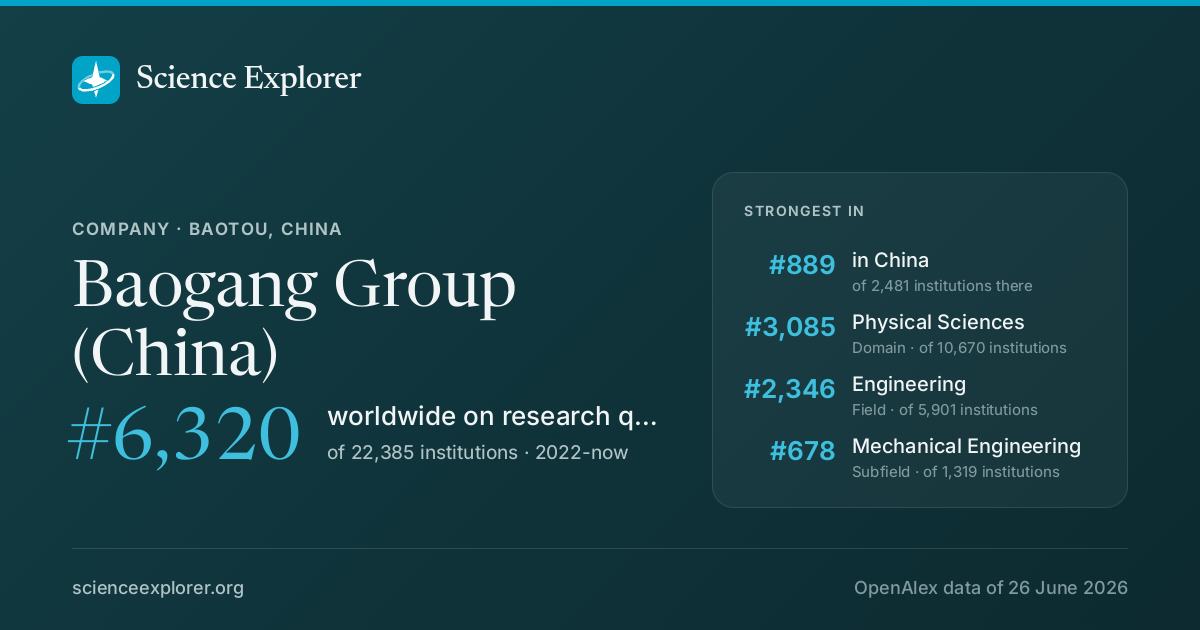
In research, Baogang Group (China) stands highest in Physical Sciences (#3,085 of 10,670 worldwide), Engineering (#2,346 of 5,901 worldwide) and Mechanical Engineering (#678 of 1,319 worldwide), 2022-now. Relative to its size it is most specialised in Mechanical Engineering, Mechanics of Materials and Materials Chemistry (Mechanical Engineering is 11.4× its share of world research).
- World rank, 2022-now
- #6,320 of 22,385 · #10,569 all time
- Rank in China
- #889 of 2,481
- Research works
- 3k ▲ 105% vs 2018-21
- Citations
- 13k 4.2 per fractional work
- Top-10% rate
- 9.0% all institutions 10.0%
- vs its own fields
- 0.91× 1.00× is exactly expected
- Open access
- 17% world 40%
- International
- 8% world 18%
What is Baogang Group (China) known for in research?
The fields where it stands highest, 2022-now, ranked among every institution above the floor in each field.
| Field | World rank | Where that sits | Top-10% rate | Works | All time |
|---|---|---|---|---|---|
| Physical SciencesDomain | #3,085 of 10,670 | 9.4% | 285 | #6126 | |
| EngineeringField | #2,346 of 5,901 | 8.5% | 177 | #4775 | |
| Mechanical EngineeringSubfield | #678 of 1,319 | 9.2% | 82 | #1153 |
Each strip is that field's whole ranked pool, with the notch where Baogang Group (China) sits in it, in the colour of the band that rank falls in. The track under the rate is the rate itself: it carries no average mark, because the average differs by field (from about 6% in Dentistry to 21% in Economics).
Which of those standings moved
The same fields on both windows: where it stood over the whole record, and where it stands in 2022-now. The distance is the story, and it is the one thing the two rank columns above cannot show.
- Physical Sciences#6,126 #3,085
- Engineering#4,775 #2,346
- Mechanical Engineering#1,153 #678
A dot further right is a better standing. Fields it was not ranked in over the whole record are left out.
Which fields of science does Baogang Group (China) work in?
In 2022-now, 75% of research at Baogang Group (China) is in Physical Sciences, 14% in Health Sciences. Its largest fields are Engineering (45%), Materials Science (13%), Medicine (12%). It does 1.9× the world's share of Physical Sciences.
Each ring splits the one inside it: the four domains of science, their fields, their subfields. Size is fractional works in 2022-now. Every slice is a page; the interactive view zooms down to single topics and colours each by how much more of it this institution does than the world.
Its 4 domains and 26 fields, with their numbers
- Physical Sciences37174.5%
- Engineering22645.4%
- Materials Science6713.5%
- Computer Science295.9%
- Environmental Science224.4%
- Earth and Planetary Sciences101.9%
- Chemistry61.2%
- Energy51.0%
- Chemical Engineering30.6%
- Physics and Astronomy20.4%
- Mathematics10.1%
- Health Sciences6813.6%
- Medicine5911.9%
- Health Professions61.1%
- Nursing20.3%
- Dentistry10.3%
- Veterinary00.0%
- Life Sciences316.3%
- Social Sciences285.6%
What does Baogang Group (China) specialise in?
Where its research is concentrated relative to its size: Mechanical Engineering takes 11.4× the share of its output that it takes of world research.
- Mechanical EngineeringSubfield · 104.0 works11×
- Mechanics of MaterialsSubfield · 23.4 works6.6×
- Materials ChemistrySubfield · 44.8 works4.6×
- Materials ScienceField · 67.2 works3.9×
Location quotient, a volume reading rather than an impact one. It surfaces small, lopsided specialities.
Field profile
Location quotient across every field it publishes in: outside the ring is more than an institution of this size would be expected to publish, inside it is less.
Rings at 0.5×, 1× and 2×. Widest outward: Materials Science, 3.9×. Every wedge is a field page.
All 26 fields, with their numbers
- Materials Science3.87×67 works
- Engineering3.03×226 works
- Chemical Engineering1.77×3 works
- Earth and Planetary Sciences1.24×10 works
- Energy1.12×5 works
- Environmental Science0.89×22 works
- Computer Science0.76×29 works
- Chemistry0.75×6 works
- Nursing0.69×2 works
- Neuroscience0.62×5 works
- Medicine0.62×59 works
- Biochemistry, Genetics and Molecular Biology0.53×14 works
- Dentistry0.53×1 works
- Pharmacology, Toxicology and Pharmaceutics0.51×1 works
- Health Professions0.42×6 works
- Immunology and Microbiology0.41×2 works
- Agricultural and Biological Sciences0.39×9 works
- Arts and Humanities0.31×4 works
- Decision Sciences0.27×1 works
- Psychology0.27×4 works
- Social Sciences0.23×14 works
- Physics and Astronomy0.20×2 works
- Veterinary0.17×0 works
- Economics, Econometrics and Finance0.15×2 works
- Business, Management and Accounting0.13×2 works
- Mathematics0.11×1 works
- Materials Science 3.9×
- Engineering 3.0×
- Chemical Engineering 1.8×
- Earth and Planetary Sciences 1.2×
- Energy 1.1×
- Environmental Science 0.9×
- Computer Science 0.8×
- Chemistry 0.8×
- Nursing 0.7×
- Neuroscience 0.6×
- Medicine 0.6×
- Biochemistry, Genetics and Molecular Biology 0.5×
- Dentistry 0.5×
- Pharmacology, Toxicology and Pharmaceutics 0.5×
- Health Professions 0.4×
- Immunology and Microbiology 0.4×
- Agricultural and Biological Sciences 0.4×
- Arts and Humanities 0.3×
- Decision Sciences 0.3×
- Psychology 0.3×
- Social Sciences 0.2×
- Physics and Astronomy 0.2×
- Veterinary 0.2×
- Economics, Econometrics and Finance 0.1×
- Business, Management and Accounting 0.1×
- Mathematics 0.1×
Who are the top researchers at Baogang Group (China)?
Ranked on the quality score, Shanqing Li, Laizhu Jiang and Zhenxiang Cui lead among researchers whose main affiliation is Baogang Group (China).
- 1
Shanqing Li
 China · #1,026,785 worldwide
2.2k citations · 61 works
- 2
Laizhu Jiang
China · #1,466,433 worldwide
2.1k citations · 73 works
- 3
Zhenxiang Cui
China · #1,653,349 worldwide
349 citations · 18 works
- 4
Jianzhong He
China · #2,185,498 worldwide
298 citations · 30 works
- 5
Zhongshuai Jia
China · #2,662,334 worldwide
54 citations · 21 works
- 6
Yonggang Zhao
China · #2,723,282 worldwide
95 citations · 16 works
- 7
Yongli Xiao
China · #3,396,865 worldwide
381 citations · 20 works
- 8
Hui Ren
China · #3,675,166 worldwide
129 citations · 29 works
- 9
Jianguo Zhi
China · #3,922,474 worldwide
671 citations · 44 works
- 10
Jinming Zhu
China · #3,987,922 worldwide
687 citations · 57 works
Which keywords describe research at Baogang Group (China)?
By fractional works in 2022-now, weighted toward what it does more of than the world: Microstructure, Mechanical Properties, Grain Refinement, Metallurgy, High-Strength Steels, Martensite Transformation, Microstructural Evolution and Databases.
- Oxidation Resistance
- Metal Corrosion
- Rare Earth Elements
- Sulfate-Reducing Bacteria
- Passive Films
- IoT
- Pitting Corrosion
- Iron Oxides
- Hydrogen
- Hot Deformation
- Grain Boundary Engineering
- Constitutive Modeling
- Corrosion Behavior
- Cryogenic Treatment
- Energy Efficiency
- Databases
- Martensite Transformation
- Deep Learning
- Machine Learning
- Mechanical Properties
- Microstructure
- Grain Refinement
- Metallurgy
- High-Strength Steels
- Microstructural Evolution
- Thermochemical
- Wear Resistance
- Tool Steels
- Artificial Neural Networks
- Hydrogen Embrittlement
- Dynamic Recrystallization
- Metal Recovery
- Metallurgical Processes
- Reduction Kinetics
- Aerospace Applications
- Molecular Dynamics Simulation
- Stainless Steels
- Numerical Simulation
- Corrosion Inhibitors
- Sintering
Size is fractional works in 2022-now in the topics tagged with each word; colour is the word's share of this institution's work against its share of the world's. The 40 words are chosen for being large and distinctive. Each links to the topic it comes from most.
All 40 words, with their numbers
- Microstructure54▲ 21×17 topics
- Mechanical Properties51▲ 10×28 topics
- Grain Refinement32▲ 55×4 topics
- Machine Learning26▲ 1.59×49 topics
- Metallurgy25▲ 84×2 topics
- Deep Learning22▲ 1.31×45 topics
- High-Strength Steels22▲ 137×1 topic
- Martensite Transformation22▲ 137×1 topic
- Microstructural Evolution20▲ 28×4 topics
- Databases20▲ 141×1 topic
- Thermochemical20▲ 141×1 topic
- Energy Efficiency15▲ 3.3×16 topics
- Wear Resistance13▲ 67×2 topics
- Cryogenic Treatment13▲ 92×1 topic
- Tool Steels13▲ 92×1 topic
- Corrosion Behavior13▲ 31×2 topics
- Artificial Neural Networks12▲ 5.4×5 topics
- Constitutive Modeling12▲ 36×2 topics
- Hydrogen Embrittlement11▲ 28×3 topics
- Grain Boundary Engineering11▲ 33×2 topics
- Dynamic Recrystallization11▲ 56×1 topic
- Hot Deformation11▲ 56×1 topic
- Metal Recovery10▲ 10×3 topics
- Hydrogen10▲ 24×2 topics
- Metallurgical Processes9▲ 77×2 topics
- Iron Oxides9▲ 100×1 topic
- Reduction Kinetics9▲ 100×1 topic
- Pitting Corrosion8▲ 30×2 topics
- Aerospace Applications8▲ 16×3 topics
- IoT8▲ 4.0×10 topics
- Molecular Dynamics Simulation8▲ 14×3 topics
- Passive Films7▲ 43×1 topic
- Stainless Steels7▲ 43×1 topic
- Sulfate-Reducing Bacteria7▲ 23×2 topics
- Numerical Simulation7▲ 4.9×6 topics
- Rare Earth Elements7▲ 9.2×4 topics
- Corrosion Inhibitors7▲ 27×1 topic
- Metal Corrosion7▲ 27×1 topic
- Sintering6▲ 10×4 topics
- Oxidation Resistance6▲ 11×3 topics
Which research topics does Baogang Group (China) publish most on?
By volume in 2022-now: Microstructure and Mechanical Properties of Steels, Metallurgical Processes and Thermodynamics, Metal Alloys Wear and Properties and Metallurgy and Material Forming.
Area is fractional works; colour is the subfield each topic belongs to.
- 1 Microstructure and Mechanical Properties of Steels Mechanical Engineering 22 works
- 2 Metallurgical Processes and Thermodynamics Mechanical Engineering 20 works
- 3 Metal Alloys Wear and Properties Materials Chemistry 13 works
- 4 Metallurgy and Material Forming Mechanics of Materials 11 works
- 5 Iron and Steelmaking Processes Mechanical Engineering 9 works
- 6 Hydrogen embrittlement and corrosion behaviors in metals Metals and Alloys 7 works
- 7 Corrosion Behavior and Inhibition Materials Chemistry 7 works
- 8 Metal Forming Simulation Techniques Mechanical Engineering 5 works
- 9 Aluminum Alloy Microstructure Properties Aerospace Engineering 5 works
- 10 Metal Extraction and Bioleaching Biomedical Engineering 5 works
How open and international is its research?
Against the world's own shares: the tick on each track. Both are shares of its output, so they sit on one scale and can be read against each other as well as against the world.
World: 40% of research is openly available.
World: 18% is written across borders.
How has Baogang Group (China)'s research output changed?
Output in 2022-2025 was 105% higher than in 2018-2021.
The same series as a ribbon: one cell per year, darker for more. The line above answers how much; this answers when.
Its share of all research
Growing output can still be a shrinking share: all of science grows. This is Baogang Group (China) as a percentage of every work published that year, 0.0017% in 2024.
Fractional works of Baogang Group (China) over all fractional works that year. How the balance of science has shifted.
How much of it reaches the world top 10%
Year by year, against all institutions in the same year.
Of each year's output, the share that reached the world's 10% most cited for its field and year. Peak 12.3% in 2021.
Other research institutions in Baotou
- Inner Mongolia University of Science and Technology
- Baotou Medical College
- Baotou Teachers College
- Baotou Research Institute of Rare Earths
- Third Affiliated Hospital of Inner Mongolia Medical College
Share Baogang Group (China)'s ranking
Badges for a website1Each links back here and updates with every snapshot

Research measures only: rankings here say nothing about teaching, admissions or student experience. Comparable institutions and collaboration partners have tabs of their own, above.
Discussion
Ask a question or share a note about Baogang Group (China). Keep it to the research: no personal attacks, advertising or links. Any reader can report a post, which collapses it for everyone until it is opened.