Baylor University

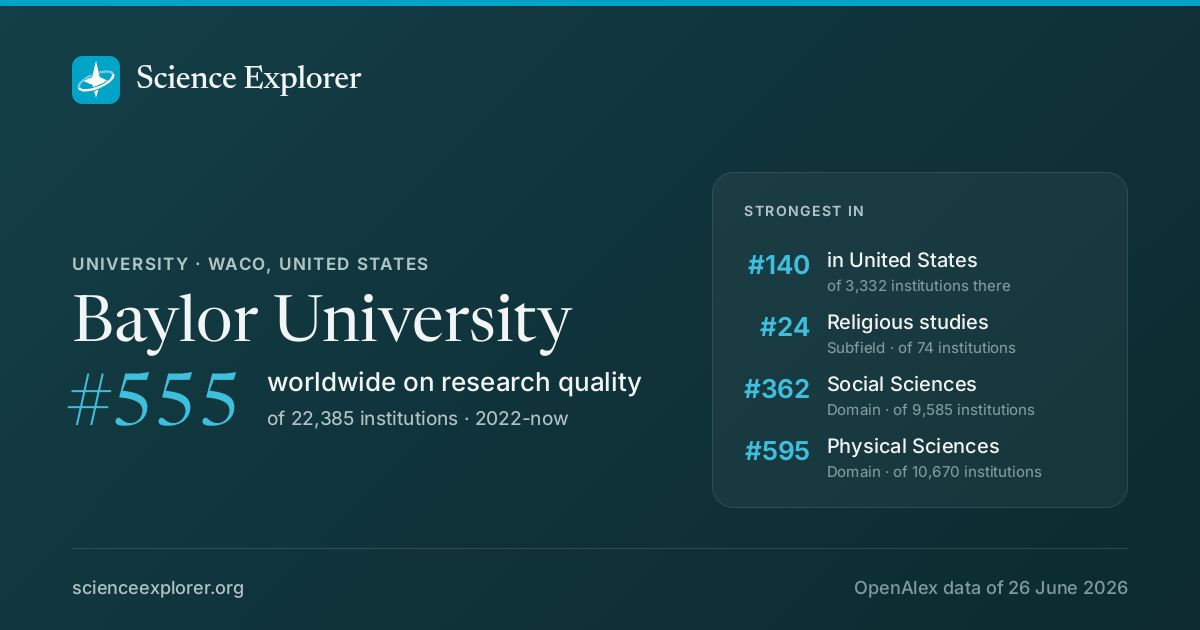
In research, Baylor University stands highest in Social Sciences (#362 of 9,585 worldwide), Physical Sciences (#595 of 10,670 worldwide) and Social Sciences (#383 of 5,988 worldwide), 2022-now. Relative to its size it is most specialised in Religious studies, Health and Philosophy (Religious studies is 12.1× its share of world research).
- World rank, 2022-now
- #555 of 22,385 · #453 all time
- Rank in United States
- #140 of 3,332
- Research works
- 20k ▲ 19% vs 2018-21
- Citations
- 412k 20.6 per fractional work
- Top-10% rate
- 9.6% all institutions 10.0%
- vs its own fields
- 0.91× 1.00× is exactly expected
- Open access
- 28% world 40%
- International
- 10% world 18%
What is Baylor University known for in research?
The fields where it stands highest, 2022-now, ranked among every institution above the floor in each field.
| Field | World rank | Where that sits | Top-10% rate | Works | All time |
|---|---|---|---|---|---|
| Social SciencesDomain | #362 of 9,585 | 10.6% | 1,612 | #274 | |
| Physical SciencesDomain | #595 of 10,670 | 9.1% | 1,160 | #580 | |
| Social SciencesField | #383 of 5,988 | 11.5% | 706 | #219 | |
| Health SciencesDomain | #740 of 9,902 | 8.4% | 577 | #624 | |
| EngineeringField | #441 of 5,901 | 9.1% | 374 | #483 | |
| MedicineField | #797 of 8,541 | 8.8% | 446 | #609 | |
| PsychologyField | #209 of 2,121 | 9.1% | 344 | #211 | |
| Environmental ScienceField | #417 of 3,334 | 8.9% | 159 | #377 | |
| Life SciencesDomain | #861 of 6,403 | 7.6% | 305 | #760 | |
| Arts and HumanitiesField | #263 of 1,896 | 10.1% | 341 | #205 |
Each strip is that field's whole ranked pool, with the notch where Baylor University sits in it, in the colour of the band that rank falls in. The track under the rate is the rate itself: it carries no average mark, because the average differs by field (from about 6% in Dentistry to 21% in Economics).
Which of those standings moved
The same fields on both windows: where it stood over the whole record, and where it stands in 2022-now. The distance is the story, and it is the one thing the two rank columns above cannot show.
- Social Sciences#274 #362
- Physical Sciences#580 #595
- Social Sciences#219 #383
- Health Sciences#624 #740
- Engineering#483 #441
- Medicine#609 #797
- Psychology#211 #209
- Environmental Science#377 #417
- Life Sciences#760 #861
- Arts and Humanities#205 #263
A dot further right is a better standing. Fields it was not ranked in over the whole record are left out.
Which fields of science does Baylor University work in?
In 2022-now, 43% of research at Baylor University is in Social Sciences, 32% in Physical Sciences. Its largest fields are Social Sciences (19%), Medicine (12%), Engineering (10%). It does 1.7× the world's share of Social Sciences.
Each ring splits the one inside it: the four domains of science, their fields, their subfields. Size is fractional works in 2022-now. Every slice is a page; the interactive view zooms down to single topics and colours each by how much more of it this institution does than the world.
Its 4 domains and 26 fields, with their numbers
- Social Sciences1,78543.2%
- Social Sciences77718.8%
- Psychology3939.5%
- Arts and Humanities3759.1%
- Business, Management and Accounting1243.0%
- Economics, Econometrics and Finance771.9%
- Decision Sciences390.9%
- Physical Sciences1,34332.5%
- Engineering42410.2%
- Computer Science2516.1%
- Environmental Science1794.3%
- Mathematics1283.1%
- Physics and Astronomy1102.7%
- Chemistry812.0%
- Earth and Planetary Sciences791.9%
- Materials Science661.6%
- Energy150.4%
- Chemical Engineering100.2%
- Health Sciences65515.8%
- Medicine50912.3%
- Health Professions1303.1%
- Nursing130.3%
- Veterinary20.0%
- Dentistry10.0%
- Life Sciences3548.6%
What does Baylor University specialise in?
Where its research is concentrated relative to its size: Religious studies takes 12.1× the share of its output that it takes of world research.
- Religious studiesSubfield · 83.3 works12×
- HealthSubfield · 75.9 works6.2×
- PhilosophySubfield · 96.8 works5.5×
Location quotient, a volume reading rather than an impact one. It surfaces small, lopsided specialities.
Field profile
Location quotient across every field it publishes in: outside the ring is more than an institution of this size would be expected to publish, inside it is less.
Rings at 0.5×, 1× and 2×. Widest outward: Arts and Humanities, 3.1×. Every wedge is a field page.
All 26 fields, with their numbers
- Arts and Humanities3.14×375 works
- Psychology3.12×393 works
- Mathematics2.63×128 works
- Neuroscience1.64×110 works
- Social Sciences1.48×777 works
- Chemistry1.25×81 works
- Earth and Planetary Sciences1.21×79 works
- Physics and Astronomy1.20×110 works
- Health Professions1.19×130 works
- Decision Sciences0.97×39 works
- Business, Management and Accounting0.93×124 works
- Environmental Science0.87×179 works
- Economics, Econometrics and Finance0.87×77 works
- Computer Science0.78×251 works
- Biochemistry, Genetics and Molecular Biology0.71×158 works
- Chemical Engineering0.68×10 works
- Engineering0.68×424 works
- Pharmacology, Toxicology and Pharmaceutics0.64×9 works
- Medicine0.64×509 works
- Nursing0.63×13 works
- Materials Science0.46×66 works
- Immunology and Microbiology0.43×18 works
- Energy0.39×15 works
- Veterinary0.35×2 works
- Agricultural and Biological Sciences0.30×59 works
- Dentistry0.05×1 works
- Arts and Humanities 3.1×
- Psychology 3.1×
- Mathematics 2.6×
- Neuroscience 1.6×
- Social Sciences 1.5×
- Chemistry 1.2×
- Earth and Planetary Sciences 1.2×
- Physics and Astronomy 1.2×
- Health Professions 1.2×
- Decision Sciences 1.0×
- Business, Management and Accounting 0.9×
- Environmental Science 0.9×
- Economics, Econometrics and Finance 0.9×
- Computer Science 0.8×
- Biochemistry, Genetics and Molecular Biology 0.7×
- Chemical Engineering 0.7×
- Engineering 0.7×
- Pharmacology, Toxicology and Pharmaceutics 0.6×
- Medicine 0.6×
- Nursing 0.6×
- Materials Science 0.5×
- Immunology and Microbiology 0.4×
- Energy 0.4×
- Veterinary 0.3×
- Agricultural and Biological Sciences 0.3×
- Dentistry 0.1×
Who are the top researchers at Baylor University?
Ranked on the quality score, Jacques Banchereau, Virginia Pascual and Dawn S. Carlson lead among researchers whose main affiliation is Baylor University.
- 1
Jacques Banchereau
 United States · #9,182 worldwide
109k citations · 707 works
- 2
Virginia Pascual
United States · #11,286 worldwide
24k citations · 168 works
- 3
Dawn S. Carlson
United States · #16,653 worldwide
19k citations · 174 works
- 4
Boris Nikolaev
United States · #36,229 worldwide
4.2k citations · 78 works
- 5
Damien Chaussabel
United States · #38,187 worldwide
22k citations · 279 works
- 6
Anna Karolina Palucka
United States · #46,338 worldwide
14k citations · 85 works
- 7
Byron R. Johnson
United States · #51,676 worldwide
6.4k citations · 380 works
- 8
Kirk L. Wakefield
United States · #73,020 worldwide
8.7k citations · 70 works
- 9
John D. Childs
United States · #84,958 worldwide
14k citations · 161 works
- 10
Virginia Pascual
United States · #94,144 worldwide
14k citations · 127 works
Which keywords describe research at Baylor University?
By fractional works in 2022-now, weighted toward what it does more of than the world: Religion, Mental Health, Well-being, Social Support, Psychological Adjustment, Spirituality, Theology and Resilience.
- Political Philosophy
- International Aid
- Positive Psychology
- Civil Religion
- NGOs
- Public Opinion
- Jewish Society
- Public Sphere
- Politics
- End-of-Life Care
- Emotion Regulation
- Ethics
- Identity
- Spirituality
- Psychological Adjustment
- Health
- Resilience
- Quality of Life
- Globalization
- Religion
- Mental Health
- Epidemiology
- Social Support
- Well-being
- Nationalism
- Depression
- Gender
- Theology
- Social Justice
- Coping
- Democracy
- Secularism
- Community Development
- Biblical Monotheism
- Church History
- Pluralism
- Atheism
- Evidence-Based Practice
- Humanitarianism
- Civil Society
Size is fractional works in 2022-now in the topics tagged with each word; colour is the word's share of this institution's work against its share of the world's. The 40 words are chosen for being large and distinctive. Each links to the topic it comes from most.
All 40 words, with their numbers
- Mental Health212▲ 3.6×40 topics
- Religion174▲ 9.1×32 topics
- Epidemiology161◆ 0.98×10³ topics
- Globalization136▲ 1.68×76 topics
- Social Support123▲ 5.5×16 topics
- Quality of Life115▲ 1.93×42 topics
- Well-being115▲ 7.1×14 topics
- Resilience86▲ 4.2×15 topics
- Nationalism82▲ 4.4×21 topics
- Health80▲ 4.8×18 topics
- Depression75▲ 2.1×22 topics
- Psychological Adjustment71▲ 12×4 topics
- Gender69▲ 3.1×38 topics
- Spirituality69▲ 17×6 topics
- Theology67▲ 18×5 topics
- Identity66▲ 2.2×44 topics
- Social Justice64▲ 2.6×27 topics
- Ethics64▲ 3.0×34 topics
- Coping62▲ 30×2 topics
- Emotion Regulation59▲ 4.5×9 topics
- Democracy55▲ 3.8×18 topics
- End-of-Life Care52▲ 11×2 topics
- Secularism50▲ 12×5 topics
- Politics49▲ 4.5×12 topics
- Community Development40▲ 5.3×4 topics
- Public Sphere39▲ 17×4 topics
- Biblical Monotheism37▲ 36×1 topic
- Jewish Society37▲ 36×1 topic
- Church History37▲ 21×3 topics
- Public Opinion37▲ 7.4×5 topics
- Pluralism37▲ 22×2 topics
- NGOs36▲ 9.5×4 topics
- Atheism36▲ 35×1 topic
- Civil Religion36▲ 35×1 topic
- Evidence-Based Practice35▲ 6.4×7 topics
- Positive Psychology35▲ 11×3 topics
- Humanitarianism34▲ 14×3 topics
- International Aid34▲ 18×2 topics
- Civil Society34▲ 7.4×5 topics
- Political Philosophy32▲ 14×4 topics
Which research topics does Baylor University publish most on?
By volume in 2022-now: Religion, Spirituality, and Psychology, Biblical Studies and Interpretation, Religion and Society Interactions and Religion, Society, and Development.
Area is fractional works; colour is the subfield each topic belongs to.
- 1 Religion, Spirituality, and Psychology Health 51 works
- 2 Biblical Studies and Interpretation Religious studies 37 works
- 3 Religion and Society Interactions Sociology and Political Science 36 works
- 4 Religion, Society, and Development Sociology and Political Science 31 works
- 5 American Constitutional Law and Politics Political Science and International Relations 29 works
- 6 Behavioral and Psychological Studies Developmental and Educational Psychology 23 works
- 7 Sleep and related disorders Experimental and Cognitive Psychology 22 works
- 8 Reformation and Early Modern Christianity History 20 works
- 9 Autism Spectrum Disorder Research Cognitive Neuroscience 20 works
- 10 Psychological Well-being and Life Satisfaction Social Psychology 20 works
How open and international is its research?
Against the world's own shares: the tick on each track. Both are shares of its output, so they sit on one scale and can be read against each other as well as against the world.
World: 40% of research is openly available.
World: 18% is written across borders.
How has Baylor University's research output changed?
Output in 2022-2025 was 19% higher than in 2018-2021.
The same series as a ribbon: one cell per year, darker for more. The line above answers how much; this answers when.
Its share of all research
Growing output can still be a shrinking share: all of science grows. This is Baylor University as a percentage of every work published that year, 0.016% in 2024.
Fractional works of Baylor University over all fractional works that year. How the balance of science has shifted.
How much of it reaches the world top 10%
Year by year, against all institutions in the same year.
Of each year's output, the share that reached the world's 10% most cited for its field and year. Peak 12.5% in 2006.
Other research institutions in Waco
- Center for Occupational Research and Development
- Association for the Sciences of Limnology and Oceanography
- Allergy Asthma Research Institute
- Baylor Scott and White Hillcrest Medical Center
- Hillcrest Clinics
- Texas State Technical College Waco
- Council of Scientific Society Presidents
Compare Baylor University with
- vs
 Samsung (South Korea)
- vs
 University of Jinan
- vs
 Indian Institute of Technology Bombay
- vs
 Tokyo Institute of Technology
- vs University of Montana
- vs
 Università Cattolica del Sacro Cuore
Share Baylor University's ranking



Research measures only: rankings here say nothing about teaching, admissions or student experience. Comparable institutions and collaboration partners have tabs of their own, above.
Discussion
Ask a question or share a note about Baylor University. Posts are plain text and can be reported.