Science Explorer Back to mapMap
Discussion
Company · Pune · India

Bharat Forge (India)

World rank, all time
#30,864
of 34,923
Rank in India
#1,475
of 1,754
Research works
136
◆ 1% vs 2018-21
Citations
1.7k
12.4 per fractional work
Top-10% rate
9.3%
all institutions 10.0%
vs its own fields
0.91×
1.00× is exactly expected
Open access
54%
world 40%
International
12%
world 18%

Which fields of science does Bharat Forge (India) work in?

In 2022-now, 54% of research at Bharat Forge (India) is in Physical Sciences, 25% in Health Sciences. Its largest fields are Engineering (25%), Medicine (19%), Computer Science (18%). It does 1.3× the world's share of Physical Sciences.

Physical Sciences: 32 fractional works · 54.3% of its workEngineering: 15 fractional works · 25.2% of its workMechanical Engineering: 3 fractional works · 5.8% of its workElectrical and Electronic Engineering: 2 fractional works · 3.9% of its workAerospace Engineering: 2 fractional works · 2.7% of its workBiomedical Engineering: 2 fractional works · 2.6% of its workOcean Engineering: 1 fractional works · 2.2% of its workMechanics of Materials: 1 fractional works · 2.2% of its workAutomotive Engineering: 1 fractional works · 1.5% of its workIndustrial and Manufacturing Engineering: 1 fractional works · 1.5% of its workMedia Technology: 1 fractional works · 1.1% of its workCivil and Structural Engineering: 0 fractional works · 0.7% of its workBuilding and Construction: 0 fractional works · 0.6% of its workComputational Mechanics: 0 fractional works · 0.3% of its workComputer Science: 11 fractional works · 17.6% of its workInformation Systems: 4 fractional works · 6.8% of its workComputer Networks and Communications: 3 fractional works · 4.4% of its workArtificial Intelligence: 2 fractional works · 3.7% of its workComputer Vision and Pattern Recognition: 1 fractional works · 1.1% of its workSignal Processing: 1 fractional works · 1.1% of its workComputational Theory and Mathematics: 0 fractional works · 0.4% of its workSmaller subfields together: 0 fractional works · 0.2% of its workMaterials Science: 3 fractional works · 5.5% of its workMaterials Chemistry: 2 fractional works · 3.8% of its workMetals and Alloys: 0 fractional works · 0.6% of its workElectronic, Optical and Magnetic Materials: 0 fractional works · 0.5% of its workPolymers and Plastics: 0 fractional works · 0.3% of its workCeramics and Composites: 0 fractional works · 0.2% of its workSmaller subfields together: 0 fractional works · 0.2% of its workEnvironmental Science: 2 fractional works · 2.7% of its workIndustrial and Manufacturing Engineering: 1 fractional works · 1.2% of its workWater Science and Technology: 0 fractional works · 0.6% of its workPollution: 0 fractional works · 0.4% of its workSmaller subfields together: 0 fractional works · 0.5% of its workEarth and Planetary Sciences: 1 fractional works · 2.0% of its workAtmospheric Science: 1 fractional works · 1.7% of its workOceanography: 0 fractional works · 0.3% of its workChemical Engineering: 0 fractional works · 0.6% of its workBioengineering: 0 fractional works · 0.3% of its workCatalysis: 0 fractional works · 0.3% of its workChemistry: 0 fractional works · 0.5% of its workAnalytical Chemistry: 0 fractional works · 0.3% of its workSmaller subfields together: 0 fractional works · 0.2% of its workMathematics: 0 fractional works · 0.2% of its workHealth Sciences: 15 fractional works · 25.2% of its workMedicine: 12 fractional works · 19.4% of its workPulmonary and Respiratory Medicine: 2 fractional works · 3.7% of its workEpidemiology: 2 fractional works · 2.9% of its workSurgery: 2 fractional works · 2.5% of its workComplementary and alternative medicine: 1 fractional works · 1.4% of its workNeurology: 1 fractional works · 1.1% of its workPublic Health, Environmental and Occupational Health: 1 fractional works · 1.1% of its workInfectious Diseases: 1 fractional works · 1.0% of its workObstetrics and Gynecology: 0 fractional works · 0.7% of its workOncology: 0 fractional works · 0.6% of its workOphthalmology: 0 fractional works · 0.6% of its workOtorhinolaryngology: 0 fractional works · 0.6% of its workRadiology, Nuclear Medicine and Imaging: 0 fractional works · 0.5% of its workUrology: 0 fractional works · 0.5% of its workPediatrics, Perinatology and Child Health: 0 fractional works · 0.4% of its workGastroenterology: 0 fractional works · 0.3% of its workGeriatrics and Gerontology: 0 fractional works · 0.3% of its workRehabilitation: 0 fractional works · 0.3% of its workRheumatology: 0 fractional works · 0.3% of its workEndocrinology, Diabetes and Metabolism: 0 fractional works · 0.2% of its workSmaller subfields together: 0 fractional works · 0.4% of its workHealth Professions: 3 fractional works · 4.4% of its workGeneral Health Professions: 1 fractional works · 1.9% of its workHealth Information Management: 1 fractional works · 1.5% of its workEmergency Medical Services: 0 fractional works · 0.3% of its workOccupational Therapy: 0 fractional works · 0.3% of its workPharmacy: 0 fractional works · 0.3% of its workSmaller subfields together: 0 fractional works · 0.2% of its workNursing: 1 fractional works · 1.2% of its workNutrition and Dietetics: 1 fractional works · 1.2% of its workDentistry: 0 fractional works · 0.2% of its workSocial Sciences: 7 fractional works · 12.4% of its workSocial Sciences: 2 fractional works · 3.4% of its workEducation: 1 fractional works · 1.1% of its workSociology and Political Science: 1 fractional works · 1.1% of its workDevelopment: 0 fractional works · 0.6% of its workHealth: 0 fractional works · 0.6% of its workPsychology: 2 fractional works · 3.1% of its workExperimental and Cognitive Psychology: 1 fractional works · 1.1% of its workSocial Psychology: 1 fractional works · 1.1% of its workApplied Psychology: 0 fractional works · 0.3% of its workClinical Psychology: 0 fractional works · 0.3% of its workDevelopmental and Educational Psychology: 0 fractional works · 0.3% of its workBusiness, Management and Accounting: 1 fractional works · 1.8% of its workBusiness and International Management: 0 fractional works · 0.6% of its workManagement Information Systems: 0 fractional works · 0.6% of its workOrganizational Behavior and Human Resource Management: 0 fractional works · 0.5% of its workSmaller subfields together: 0 fractional works · 0.3% of its workDecision Sciences: 1 fractional works · 1.8% of its workManagement Science and Operations Research: 1 fractional works · 1.8% of its workEconomics, Econometrics and Finance: 1 fractional works · 1.5% of its workEconomics and Econometrics: 0 fractional works · 0.8% of its workFinance: 0 fractional works · 0.7% of its workArts and Humanities: 0 fractional works · 0.8% of its workPhilosophy: 0 fractional works · 0.8% of its workLife Sciences: 5 fractional works · 8.2% of its workPharmacology, Toxicology and Pharmaceutics: 2 fractional works · 3.6% of its workPharmaceutical Science: 1 fractional works · 2.2% of its workDrug Discovery: 1 fractional works · 1.1% of its workToxicology: 0 fractional works · 0.3% of its workNeuroscience: 1 fractional works · 2.1% of its workCellular and Molecular Neuroscience: 0 fractional works · 0.8% of its workNeurology: 0 fractional works · 0.6% of its workCognitive Neuroscience: 0 fractional works · 0.5% of its workSensory Systems: 0 fractional works · 0.3% of its workAgricultural and Biological Sciences: 1 fractional works · 1.7% of its workPlant Science: 0 fractional works · 0.6% of its workSoil Science: 0 fractional works · 0.6% of its workFood Science: 0 fractional works · 0.6% of its workBiochemistry, Genetics and Molecular Biology: 0 fractional works · 0.4% of its workGenetics: 0 fractional works · 0.2% of its workSmaller subfields together: 0 fractional works · 0.2% of its workImmunology and Microbiology: 0 fractional works · 0.3% of its workImmunology: 0 fractional works · 0.3% of its workALL ITS WORKBharat Forge(India)60fractional works, 2022-now
Life Sciences8%Physical Sciences54%Health Sciences25%Social Sciences12%

Each ring splits the one inside it: the four domains of science, their fields, their subfields. Size is fractional works in 2022-now. Every slice is a page; the interactive view zooms down to single topics and colours each by how much more of it this institution does than the world.

Its 4 domains and 23 fields, with their numbers
    1. Engineering1525.2%
    2. Computer Science1117.6%
    3. Materials Science35.5%
    4. Environmental Science22.7%
    5. Earth and Planetary Sciences12.0%
    6. Chemical Engineering00.6%
    7. Chemistry00.5%
    8. Mathematics00.2%
    1. Medicine1219.4%
    2. Health Professions34.4%
    3. Nursing11.2%
    4. Dentistry00.2%
    1. Social Sciences23.4%
    2. Psychology23.1%
    3. Business, Management and Accounting11.8%
    4. Decision Sciences11.8%
    5. Economics, Econometrics and Finance11.5%
    6. Arts and Humanities00.8%
    1. Pharmacology, Toxicology and Pharmaceutics23.6%
    2. Neuroscience12.1%
    3. Agricultural and Biological Sciences11.7%
    4. Biochemistry, Genetics and Molecular Biology00.4%
    5. Immunology and Microbiology00.3%
All of science, and how each field's share has moved since 1950: the Science domain explorer

Field profile

Location quotient across every field it publishes in: outside the ring is more than an institution of this size would be expected to publish, inside it is less.

Agricultural and Biological Sciences: 0.36× its world share, 1 worksAgricultural and Bio…Biochemistry, Genetics and Molecular Biology: 0.08× its world share, 0 worksBiochemistry, Geneti…Immunology and Microbiology: 0.28× its world share, 0 worksImmunology and Micro…Neuroscience: 1.32× its world share, 1 worksNeurosciencePharmacology, Toxicology and Pharmaceutics: 10.30× its world share, 2 worksPharmacology, Toxico…Chemical Engineering: 1.60× its world share, 0 worksChemical EngineeringChemistry: 0.33× its world share, 0 worksChemistryComputer Science: 2.26× its world share, 10 worksComputer ScienceEarth and Planetary Sciences: 1.25× its world share, 1 worksEarth and Planetary …Engineering: 1.68× its world share, 15 worksEngineeringEnvironmental Science: 0.55× its world share, 2 worksEnvironmental ScienceMaterials Science: 1.58× its world share, 3 worksMaterials ScienceMathematics: 0.16× its world share, 0 worksMathematicsDentistry: 0.38× its world share, 0 worksDentistryHealth Professions: 1.67× its world share, 3 worksHealth ProfessionsMedicine: 1.01× its world share, 12 worksMedicineNursing: 2.44× its world share, 1 worksNursingArts and Humanities: 0.29× its world share, 0 worksArts and HumanitiesBusiness, Management and Accounting: 0.57× its world share, 1 worksBusiness, Management…Decision Sciences: 1.83× its world share, 1 worksDecision SciencesEconomics, Econometrics and Finance: 0.70× its world share, 1 worksEconomics, Econometr…Psychology: 1.01× its world share, 2 worksPsychologySocial Sciences: 0.26× its world share, 2 worksSocial Sciences1×world share
more than its size predictsabout as predictedless

Rings at 0.5×, 1× and 2×. Widest outward: Pharmacology, Toxicology and Pharmaceutics, 10.3×. Every wedge is a field page.

All 23 fields, with their numbers
  1. Pharmacology, Toxicology and Pharmaceutics10.30×2 works
  2. Nursing2.44×1 works
  3. Computer Science2.26×10 works
  4. Decision Sciences1.83×1 works
  5. Engineering1.68×15 works
  6. Health Professions1.67×3 works
  7. Chemical Engineering1.60×0 works
  8. Materials Science1.58×3 works
  9. Neuroscience1.32×1 works
  10. Earth and Planetary Sciences1.25×1 works
  11. Medicine1.01×12 works
  12. Psychology1.01×2 works
  13. Economics, Econometrics and Finance0.70×1 works
  14. Business, Management and Accounting0.57×1 works
  15. Environmental Science0.55×2 works
  16. Dentistry0.38×0 works
  17. Agricultural and Biological Sciences0.36×1 works
  18. Chemistry0.33×0 works
  19. Arts and Humanities0.29×0 works
  20. Immunology and Microbiology0.28×0 works
  21. Social Sciences0.26×2 works
  22. Mathematics0.16×0 works
  23. Biochemistry, Genetics and Molecular Biology0.08×0 works

Who are the top researchers at Bharat Forge (India)?

Ranked on the quality score, Rajkumar Prasad Singh, R. K. P. Singh and Rajkumar Singh lead among researchers whose main affiliation is Bharat Forge (India).

  1. 1 Rajkumar Prasad Singh India · #4,008,076 worldwide 766 citations · 53 works
  2. 2 R. K. P. Singh India · #5,089,262 worldwide 108 citations · 20 works
  3. 3 Rajkumar Singh India · #5,149,460 worldwide 581 citations · 30 works
All ranked researchers at Bharat Forge (India)

What are the most cited papers from Bharat Forge (India)?

The most cited paper from Bharat Forge (India) is "Magnetic Iron Oxide Nanoparticle (IONP) Synthesis to Applications: Present and Future" (Ajinkya Nene, Xue‐Feng Yu, Poonam Kaithal et al., 2020), with 361 citations. Next come "Understanding the Design of Cathode Materials for Na-Ion Batteries" (216) and "A Review on Functionally Gradient Materials (FGMs) and Their Applications" (213).

Most cited papers
#PaperReleasedCitations
1 Magnetic Iron Oxide Nanoparticle (IONP) Synthesis to Applications: Present and Future Ajinkya Nene, Xue‐Feng Yu, Poonam Kaithal et al. · Materials Open access 18 Oct 2020 361
2 Understanding the Design of Cathode Materials for Na-Ion Batteries Priyanka Gupta, Sujatha Pushpakanth, Mohammad Ali Haider et al. · ACS Omega Open access 11 Feb 2022 216
3 A Review on Functionally Gradient Materials (FGMs) and Their Applications Valmik Bhavar, Prakash Kattire, Sandeep Thakare et al. · IOP Conference Series Materials Science and Engineering Conference paperOpen access Sep 2017 213
4 Recent advances and future technologies in nano-microplastics detection Ajinkya Nene, Sorour Sadeghzade, Stefano Viaroli et al. · Environmental Sciences Europe Open access 8 Jan 2025 163
5 Cutting Force and Surface Finish Analysis of Machining Additive Manufactured Titanium Alloy Ti-6Al-4V Ashwin Polishetty, Manikanda Shunmugavel, Moshe Goldberg et al. · Procedia Manufacturing Open access 26 Dec 2016 108
All 61 most cited papers, with filters and sorting

Which keywords describe research at Bharat Forge (India)?

By fractional works in 2022-now, weighted toward what it does more of than the world: Machine Learning, Deep Learning, Microstructure, Healthcare, Security, Internet of Things, Cloud Computing and Big Data Analytics.

▲ more of its work than of the world's◆ about the world's share▼ less than the world's

Size is fractional works in 2022-now in the topics tagged with each word; colour is the word's share of this institution's work against its share of the world's. The 40 words are chosen for being large and distinctive. Each links to the topic it comes from most.

All 40 words, with their numbers
  1. Machine Learning5▲ 2.5×17 topics
  2. Deep Learning5▲ 2.5×18 topics
  3. Epidemiology3▲ 1.44×14 topics
  4. Healthcare3▲ 4.3×5 topics
  5. Internet of Things3▲ 5.1×4 topics
  6. Microstructure3▲ 8.5×6 topics
  7. Security2▲ 6.1×6 topics
  8. Sustainability2▲ 1.52×7 topics
  9. Cloud Computing2▲ 12×4 topics
  10. Data Mining2▲ 4.5×5 topics
  11. Treatment2▲ 2.8×4 topics
  12. Artificial Intelligence2▲ 2.2×5 topics
  13. Big Data Analytics2▲ 15×2 topics
  14. Risk Factors2▲ 3.0×6 topics
  15. 5G Networks2▲ 15×2 topics
  16. Grain Refinement2▲ 26×3 topics
  17. Smart Cities2▲ 11×2 topics
  18. Wireless Sensor Networks2▲ 6.9×4 topics
  19. Big Data2▲ 3.0×5 topics
  20. Mechanical Properties2▲ 3.0×8 topics
  21. Metabolic Syndrome2▲ 3.5×3 topics
  22. Cybersecurity2▲ 11×3 topics
  23. Antioxidant2▲ 3.7×3 topics
  24. IoT Security1▲ 7.9×3 topics
  25. Numerical Simulation1▲ 7.8×3 topics
  26. Herbal Medicine1▲ 7.9×2 topics
  27. Higher Education1▲ 4.2×2 topics
  28. Prevalence1▲ 5.5×2 topics
  29. Anomaly Detection1▲ 6.2×3 topics
  30. Calcium Oxalate1▲ 68×1 topic
  31. Data Assimilation1▲ 10×1 topic
  32. Distributed Systems1▲ 9.8×2 topics
  33. Ensemble Kalman Filter1▲ 16×1 topic
  34. High-Strength Steels1▲ 52×1 topic
  35. Martensite Transformation1▲ 52×1 topic
  36. Microneedles1▲ 57×1 topic
  37. Network Virtualization1▲ 45×1 topic
  38. Software-Defined Networking1▲ 45×1 topic
  39. Solid Lipid Nanoparticles1▲ 57×1 topic
  40. Urolithiasis1▲ 68×1 topic

Which research topics does Bharat Forge (India) publish most on?

By volume in 2022-now: Advancements in Transdermal Drug Delivery, Meteorological Phenomena and Simulations, Kidney Stones and Urolithiasis Treatments and Software-Defined Networks and 5G.

  1. 1 Advancements in Transdermal Drug Delivery Pharmaceutical Science 1 works
  2. 2 Meteorological Phenomena and Simulations Atmospheric Science 1 works
  3. 3 Kidney Stones and Urolithiasis Treatments Pulmonary and Respiratory Medicine 1 works
  4. 4 Software-Defined Networks and 5G Computer Networks and Communications 1 works
  5. 5 Microstructure and Mechanical Properties of Steels Mechanical Engineering 1 works
  6. 6 Internet of Things and AI Information Systems 1 works
  7. 7 High Temperature Alloys and Creep Mechanical Engineering 1 works
  8. 8 Artificial Intelligence in Healthcare Health Information Management 1 works
  9. 9 ICT in Developing Communities Information Systems 1 works
  10. 10 IoT and Edge/Fog Computing Computer Networks and Communications 1 works

How open and international is its research?

Against the world's own shares: the tick on each track. Both are shares of its output, so they sit on one scale and can be read against each other as well as against the world.

openly available53.8%not open46.2%

World: 40% of research is openly available.

with international co-authors11.5%domestic only88.5%

World: 18% is written across borders.

How has Bharat Forge (India)'s research output changed?

Output in 2022-2025 was 1% higher than in 2018-2021.

still counting20052010201520202025
grewheldshrank

The same series as a ribbon: one cell per year, darker for more. The line above answers how much; this answers when.

Its share of all research

Growing output can still be a shrinking share: all of science grows. This is Bharat Forge (India) as a percentage of every work published that year, 0.00021% in 2024.

still counting0.00020%0.00040%Bharat Forge (India)0.00018% in 202520102020

Fractional works of Bharat Forge (India) over all fractional works that year. How the balance of science has shifted.

Other research institutions in Pune

All research institutions in Pune

Share Bharat Forge (India)'s ranking
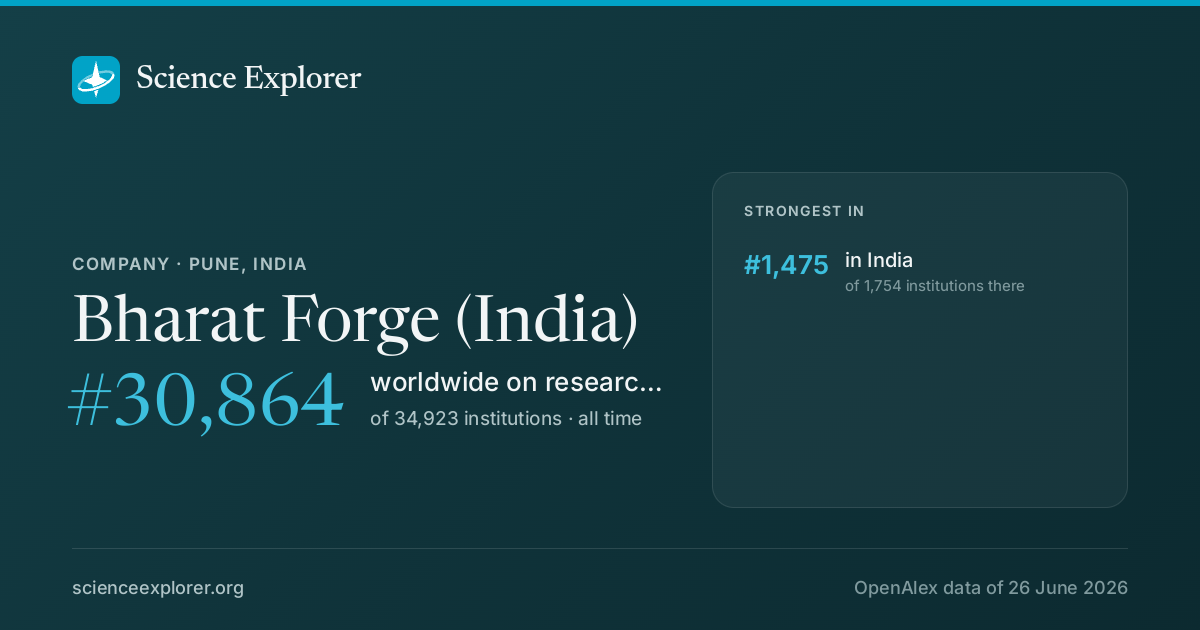
Bharat Forge (India) on Science Explorer

A card with Bharat Forge (India)'s standing and the fields it leads in, for a post or a slide. A link to this page previews as the same card.

Download the card

1200 × 630 PNG, sized for social posts, drawn from the latest snapshot.

Badges for a website1Each links back here and updates with every snapshot

Research measures only: rankings here say nothing about teaching, admissions or student experience. Comparable institutions and collaboration partners have tabs of their own, above.

Discussion

Ask a question or share a note about Bharat Forge (India). Keep it to the research: no personal attacks, advertising or links. Any reader can report a post, which collapses it for everyone until it is opened.