Science Explorer Back to mapMap
Discussion
Company · Baar · Switzerland

Biotronik (Switzerland)

World rank, all time
#21,394
of 34,923
Rank in Switzerland
#262
of 378
Research works
182
▲ 32% vs 2018-21
Citations
1.9k
10.2 per fractional work
Top-10% rate
6.1%
all institutions 10.0%
vs its own fields
0.98×
1.00× is exactly expected
Open access
41%
world 40%
International
58%
world 18%

Which fields of science does Biotronik (Switzerland) work in?

In 2022-now, 45% of research at Biotronik (Switzerland) is in Health Sciences, 34% in Physical Sciences. Its largest fields are Medicine (44%), Engineering (17%), Social Sciences (8%). It does 1.7× the world's share of Health Sciences.

Health Sciences: 16 fractional works · 45.2% of its workMedicine: 15 fractional works · 43.6% of its workCardiology and Cardiovascular Medicine: 8 fractional works · 23.8% of its workSurgery: 2 fractional works · 5.4% of its workRadiology, Nuclear Medicine and Imaging: 1 fractional works · 3.0% of its workNeurology: 1 fractional works · 2.4% of its workEpidemiology: 1 fractional works · 1.5% of its workOncology: 0 fractional works · 1.1% of its workHematology: 0 fractional works · 0.9% of its workPulmonary and Respiratory Medicine: 0 fractional works · 0.9% of its workInfectious Diseases: 0 fractional works · 0.7% of its workPathology and Forensic Medicine: 0 fractional works · 0.7% of its workPediatrics, Perinatology and Child Health: 0 fractional works · 0.6% of its workOphthalmology: 0 fractional works · 0.6% of its workComplementary and alternative medicine: 0 fractional works · 0.5% of its workPhysiology: 0 fractional works · 0.5% of its workAnesthesiology and Pain Medicine: 0 fractional works · 0.4% of its workSmaller subfields together: 0 fractional works · 0.6% of its workHealth Professions: 0 fractional works · 1.4% of its workGeneral Health Professions: 0 fractional works · 1.2% of its workSmaller subfields together: 0 fractional works · 0.2% of its workNursing: 0 fractional works · 0.2% of its workPhysical Sciences: 12 fractional works · 33.9% of its workEngineering: 6 fractional works · 16.6% of its workBiomedical Engineering: 2 fractional works · 5.9% of its workMechanical Engineering: 1 fractional works · 3.1% of its workElectrical and Electronic Engineering: 1 fractional works · 2.2% of its workAerospace Engineering: 0 fractional works · 1.4% of its workControl and Systems Engineering: 0 fractional works · 1.4% of its workIndustrial and Manufacturing Engineering: 0 fractional works · 0.9% of its workMechanics of Materials: 0 fractional works · 0.9% of its workMedia Technology: 0 fractional works · 0.6% of its workComputer Science: 2 fractional works · 6.0% of its workComputer Networks and Communications: 1 fractional works · 3.0% of its workInformation Systems: 0 fractional works · 1.0% of its workArtificial Intelligence: 0 fractional works · 0.9% of its workComputer Science Applications: 0 fractional works · 0.5% of its workComputational Theory and Mathematics: 0 fractional works · 0.3% of its workComputer Vision and Pattern Recognition: 0 fractional works · 0.2% of its workMathematics: 1 fractional works · 3.3% of its workTheoretical Computer Science: 1 fractional works · 1.6% of its workModeling and Simulation: 0 fractional works · 0.9% of its workStatistics and Probability: 0 fractional works · 0.7% of its workSmaller subfields together: 0 fractional works · 0.0% of its workMaterials Science: 1 fractional works · 2.3% of its workBiomaterials: 1 fractional works · 1.6% of its workMaterials Chemistry: 0 fractional works · 0.8% of its workEarth and Planetary Sciences: 1 fractional works · 2.2% of its workOceanography: 0 fractional works · 0.9% of its workAtmospheric Science: 0 fractional works · 0.6% of its workEarth-Surface Processes: 0 fractional works · 0.3% of its workPaleontology: 0 fractional works · 0.3% of its workSmaller subfields together: 0 fractional works · 0.0% of its workEnvironmental Science: 0 fractional works · 1.2% of its workHealth, Toxicology and Mutagenesis: 0 fractional works · 1.0% of its workSmaller subfields together: 0 fractional works · 0.2% of its workEnergy: 0 fractional works · 0.9% of its workEnergy Engineering and Power Technology: 0 fractional works · 0.9% of its workPhysics and Astronomy: 0 fractional works · 0.9% of its workStatistical and Nonlinear Physics: 0 fractional works · 0.9% of its workChemical Engineering: 0 fractional works · 0.3% of its workCatalysis: 0 fractional works · 0.3% of its workChemistry: 0 fractional works · 0.1% of its workSocial Sciences: 4 fractional works · 11.5% of its workSocial Sciences: 3 fractional works · 8.4% of its workEducation: 2 fractional works · 6.8% of its workSociology and Political Science: 0 fractional works · 1.1% of its workPublic Administration: 0 fractional works · 0.5% of its workPsychology: 1 fractional works · 2.8% of its workSocial Psychology: 1 fractional works · 2.6% of its workSmaller subfields together: 0 fractional works · 0.2% of its workDecision Sciences: 0 fractional works · 0.2% of its workBusiness, Management and Accounting: 0 fractional works · 0.1% of its workLife Sciences: 3 fractional works · 9.5% of its workBiochemistry, Genetics and Molecular Biology: 2 fractional works · 5.8% of its workMolecular Biology: 1 fractional works · 3.8% of its workBiophysics: 0 fractional works · 0.9% of its workCancer Research: 0 fractional works · 0.5% of its workGenetics: 0 fractional works · 0.5% of its workSmaller subfields together: 0 fractional works · 0.1% of its workAgricultural and Biological Sciences: 1 fractional works · 2.0% of its workFood Science: 0 fractional works · 0.9% of its workPlant Science: 0 fractional works · 0.6% of its workAquatic Science: 0 fractional works · 0.3% of its workSmaller subfields together: 0 fractional works · 0.1% of its workImmunology and Microbiology: 0 fractional works · 1.4% of its workVirology: 0 fractional works · 0.9% of its workImmunology: 0 fractional works · 0.4% of its workNeuroscience: 0 fractional works · 0.4% of its workNeurology: 0 fractional works · 0.4% of its workALL ITS WORKBiotronik(Switzerland)35fractional works, 2022-now
Life Sciences9%Physical Sciences34%Health Sciences45%Social Sciences12%

Each ring splits the one inside it: the four domains of science, their fields, their subfields. Size is fractional works in 2022-now. Every slice is a page; the interactive view zooms down to single topics and colours each by how much more of it this institution does than the world.

Its 4 domains and 21 fields, with their numbers
    1. Medicine1543.6%
    2. Health Professions01.4%
    3. Nursing00.2%
    1. Engineering616.6%
    2. Computer Science26.0%
    3. Mathematics13.3%
    4. Materials Science12.3%
    5. Earth and Planetary Sciences12.2%
    6. Environmental Science01.2%
    7. Energy00.9%
    8. Physics and Astronomy00.9%
    9. Chemical Engineering00.3%
    10. Chemistry00.1%
    1. Social Sciences38.4%
    2. Psychology12.8%
    3. Decision Sciences00.2%
    4. Business, Management and Accounting00.1%
    1. Biochemistry, Genetics and Molecular Biology25.8%
    2. Agricultural and Biological Sciences12.0%
    3. Immunology and Microbiology01.4%
    4. Neuroscience00.4%
All of science, and how each field's share has moved since 1950: the Science domain explorer

Field profile

Location quotient across every field it publishes in: outside the ring is more than an institution of this size would be expected to publish, inside it is less.

Agricultural and Biological Sciences: 0.42× its world share, 1 worksAgricultural and Bio…Biochemistry, Genetics and Molecular Biology: 1.08× its world share, 2 worksBiochemistry, Geneti…Immunology and Microbiology: 1.36× its world share, 0 worksImmunology and Micro…Neuroscience: 0.23× its world share, 0 worksNeuroscienceChemical Engineering: 0.90× its world share, 0 worksChemical EngineeringChemistry: 0.06× its world share, 0 worksChemistryComputer Science: 0.77× its world share, 2 worksComputer ScienceEarth and Planetary Sciences: 1.40× its world share, 1 worksEarth and Planetary …Energy: 1.03× its world share, 0 worksEnergyEngineering: 1.11× its world share, 6 worksEngineeringEnvironmental Science: 0.24× its world share, 0 worksEnvironmental ScienceMaterials Science: 0.67× its world share, 1 worksMaterials ScienceMathematics: 2.80× its world share, 1 worksMathematicsPhysics and Astronomy: 0.39× its world share, 0 worksPhysics and AstronomyHealth Professions: 0.51× its world share, 0 worksHealth ProfessionsMedicine: 2.27× its world share, 15 worksMedicineNursing: 0.32× its world share, 0 worksNursingBusiness, Management and Accounting: 0.02× its world share, 0 worksBusiness, Management…Decision Sciences: 0.20× its world share, 0 worksDecision SciencesPsychology: 0.93× its world share, 1 worksPsychologySocial Sciences: 0.66× its world share, 3 worksSocial Sciences1×world share
more than its size predictsabout as predictedless

Rings at 0.5×, 1× and 2×. Widest outward: Mathematics, 2.8×. Every wedge is a field page.

All 21 fields, with their numbers
  1. Mathematics2.80×1 works
  2. Medicine2.27×15 works
  3. Earth and Planetary Sciences1.40×1 works
  4. Immunology and Microbiology1.36×0 works
  5. Engineering1.11×6 works
  6. Biochemistry, Genetics and Molecular Biology1.08×2 works
  7. Energy1.03×0 works
  8. Psychology0.93×1 works
  9. Chemical Engineering0.90×0 works
  10. Computer Science0.77×2 works
  11. Materials Science0.67×1 works
  12. Social Sciences0.66×3 works
  13. Health Professions0.51×0 works
  14. Agricultural and Biological Sciences0.42×1 works
  15. Physics and Astronomy0.39×0 works
  16. Nursing0.32×0 works
  17. Environmental Science0.24×0 works
  18. Neuroscience0.23×0 works
  19. Decision Sciences0.20×0 works
  20. Chemistry0.06×0 works
  21. Business, Management and Accounting0.02×0 works

Who are the top researchers at Biotronik (Switzerland)?

Ranked on the quality score, Roberto Audoglio and Steven Mullane lead among researchers whose main affiliation is Biotronik (Switzerland).

  1. 1 Roberto Audoglio Switzerland · #2,804,391 worldwide 189 citations · 30 works
  2. 2 Steven Mullane Switzerland · #4,144,028 worldwide 66 citations · 20 works
All ranked researchers at Biotronik (Switzerland)

What are the most cited papers from Biotronik (Switzerland)?

The most cited paper from Biotronik (Switzerland) is "Catheter Ablation for Atrial Fibrillation with Heart Failure" (NASSIR F. MARROUCHE, Johannes Brachmann, Dietrich Andresen et al., 2018), with 2,511 citations. Next come "Complication Rates Associated With Pacemaker or Implantable Cardioverter-Defibrillator Generator Replacements and Upgrade Procedures" (790) and "Intramyocardial Bone Marrow Cell Injection for Chronic Myocardial Ischemia" (300).

Most cited papers
#PaperReleasedCitations
1 Catheter Ablation for Atrial Fibrillation with Heart Failure NASSIR F. MARROUCHE, Johannes Brachmann, Dietrich Andresen et al. · New England Journal of Medicine 31 Jan 2018 2,511
2 Complication Rates Associated With Pacemaker or Implantable Cardioverter-Defibrillator Generator Replacements and Upgrade Procedures Jeanne E. Poole, Marye J. Gleva, Theofanie Mela et al. · Circulation 5 Oct 2010 790
3 Intramyocardial Bone Marrow Cell Injection for Chronic Myocardial Ischemia Jan van Ramshorst, Jeroen Joost Bax, Saskia L.M.A. Beeres et al. · JAMA 19 May 2009 300
4 The Road to Bioabsorbable Stents: Reaching Clinical Reality? Paul Erné, Matthias Schier, Thérèse J. Resink · CardioVascular and Interventional Radiology 29 Sep 2005 252
5 His Corrective Pacing or Biventricular Pacing for Cardiac Resynchronization in Heart Failure Gaurav A. Upadhyay, Pugazhendhi Vijayaraman, Hemal M. Nayak et al. · Journal of the American College of Cardiology Open access 9 May 2019 249
All 61 most cited papers, with filters and sorting

Which keywords describe research at Biotronik (Switzerland)?

By fractional works in 2022-now, weighted toward what it does more of than the world: Sudden Cardiac Death, Heart Failure, Echocardiography, Arrhythmias, Remote Monitoring, Cardiac Resynchronization Therapy, Implantable Cardioverter-Defibrillator and Deep Learning.

▲ more of its work than of the world's◆ about the world's share▼ less than the world's

Size is fractional works in 2022-now in the topics tagged with each word; colour is the word's share of this institution's work against its share of the world's. The 24 words are chosen for being large and distinctive. Each links to the topic it comes from most.

All 24 words, with their numbers
  1. Sudden Cardiac Death4▲ 138×2 topics
  2. Deep Learning4▲ 3.2×9 topics
  3. Heart Failure4▲ 25×8 topics
  4. Echocardiography3▲ 33×2 topics
  5. Arrhythmias3▲ 90×2 topics
  6. Remote Monitoring3▲ 76×2 topics
  7. Cardiac Resynchronization Therapy3▲ 197×1 topic
  8. Implantable Cardioverter-Defibrillator3▲ 197×1 topic
  9. Catheter Ablation2▲ 55×2 topics
  10. Radiofrequency Ablation2▲ 44×1 topic
  11. Ventricular Tachycardia2▲ 95×1 topic
  12. Mathematics Education2▲ 96×2 topics
  13. Internet of Things1▲ 4.2×3 topics
  14. Ion Channels1▲ 33×1 topic
  15. Long-QT Syndrome1▲ 84×1 topic
  16. Teacher Professional Development1▲ 23×2 topics
  17. Artificial Intelligence1▲ 2.5×3 topics
  18. Medical Image Analysis1▲ 19×2 topics
  19. Smart Cities1▲ 12×2 topics
  20. Educational Technology1▲ 2.8×2 topics
  21. Edge Computing1▲ 22×1 topic
  22. Fog Computing1▲ 25×1 topic
  23. Spine Segmentation1▲ 84×1 topic
  24. Vertebrae Detection1▲ 84×1 topic

Which research topics does Biotronik (Switzerland) publish most on?

By volume in 2022-now: Cardiac pacing and defibrillation studies, Cardiac Arrhythmias and Treatments, Cardiac electrophysiology and arrhythmias and Mathematics Education and Teaching Techniques.

  1. 1 Cardiac pacing and defibrillation studies Cardiology and Cardiovascular Medicine 3 works
  2. 2 Cardiac Arrhythmias and Treatments Cardiology and Cardiovascular Medicine 2 works
  3. 3 Cardiac electrophysiology and arrhythmias Cardiology and Cardiovascular Medicine 1 works
  4. 4 Mathematics Education and Teaching Techniques Education 1 works
  5. 5 Medical Imaging and Analysis Biomedical Engineering 1 works
  6. 6 IoT and Edge/Fog Computing Computer Networks and Communications 1 works
  7. 7 Single-cell and spatial transcriptomics Molecular Biology 1 works
  8. 8 Atrial Fibrillation Management and Outcomes Cardiology and Cardiovascular Medicine 1 works
  9. 9 History and Theory of Mathematics Theoretical Computer Science 1 works
  10. 10 ECG Monitoring and Analysis Cardiology and Cardiovascular Medicine 1 works

How open and international is its research?

Against the world's own shares: the tick on each track. Both are shares of its output, so they sit on one scale and can be read against each other as well as against the world.

openly available40.7%not open59.3%

World: 40% of research is openly available.

with international co-authors58.4%domestic only41.6%

World: 18% is written across borders.

How has Biotronik (Switzerland)'s research output changed?

Output in 2022-2025 was 32% higher than in 2018-2021.

still counting1990200020102020
grewheldshrank

The same series as a ribbon: one cell per year, darker for more. The line above answers how much; this answers when.

Its share of all research

Growing output can still be a shrinking share: all of science grows. This is Biotronik (Switzerland) as a percentage of every work published that year, 0.00018% in 2024.

still counting0.00025%0.00050%0.00075%Biotronik (Switzerland)0.00019% in 202519801990200020102020

Fractional works of Biotronik (Switzerland) over all fractional works that year. How the balance of science has shifted.

Other research institutions in Baar

All research institutions in Baar

Share Biotronik (Switzerland)'s ranking
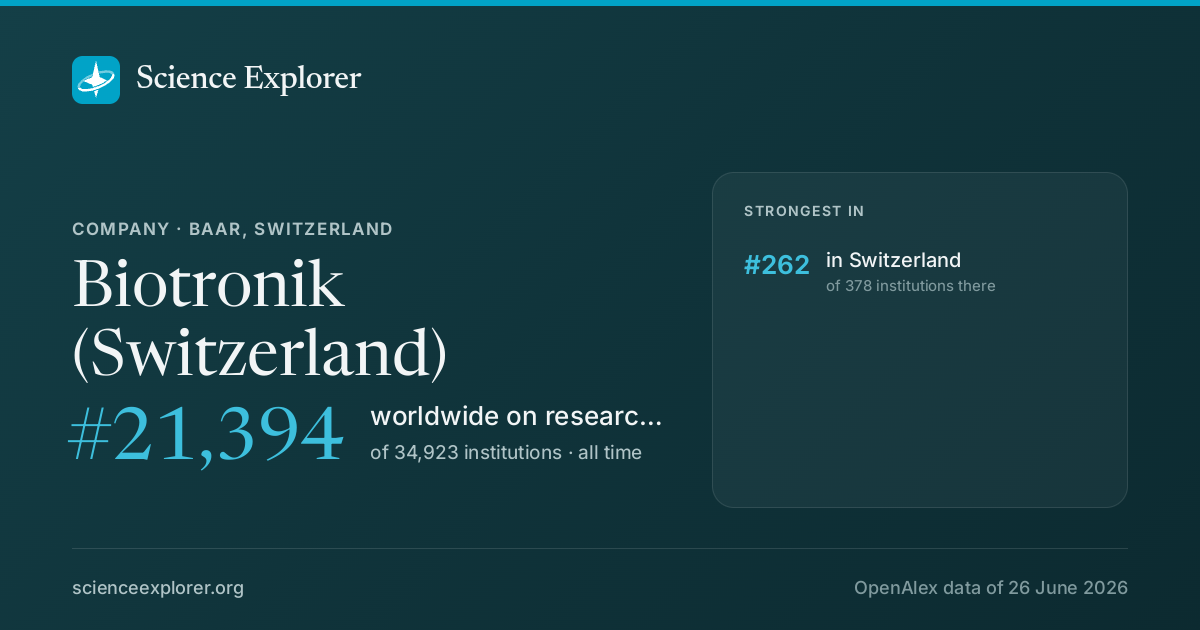
Biotronik (Switzerland) on Science Explorer

A card with Biotronik (Switzerland)'s standing and the fields it leads in, for a post or a slide. A link to this page previews as the same card.

Download the card

1200 × 630 PNG, sized for social posts, drawn from the latest snapshot.

Badges for a website1Each links back here and updates with every snapshot

Research measures only: rankings here say nothing about teaching, admissions or student experience. Comparable institutions and collaboration partners have tabs of their own, above.

Discussion

Ask a question or share a note about Biotronik (Switzerland). Keep it to the research: no personal attacks, advertising or links. Any reader can report a post, which collapses it for everyone until it is opened.
