Bosmal (Poland)
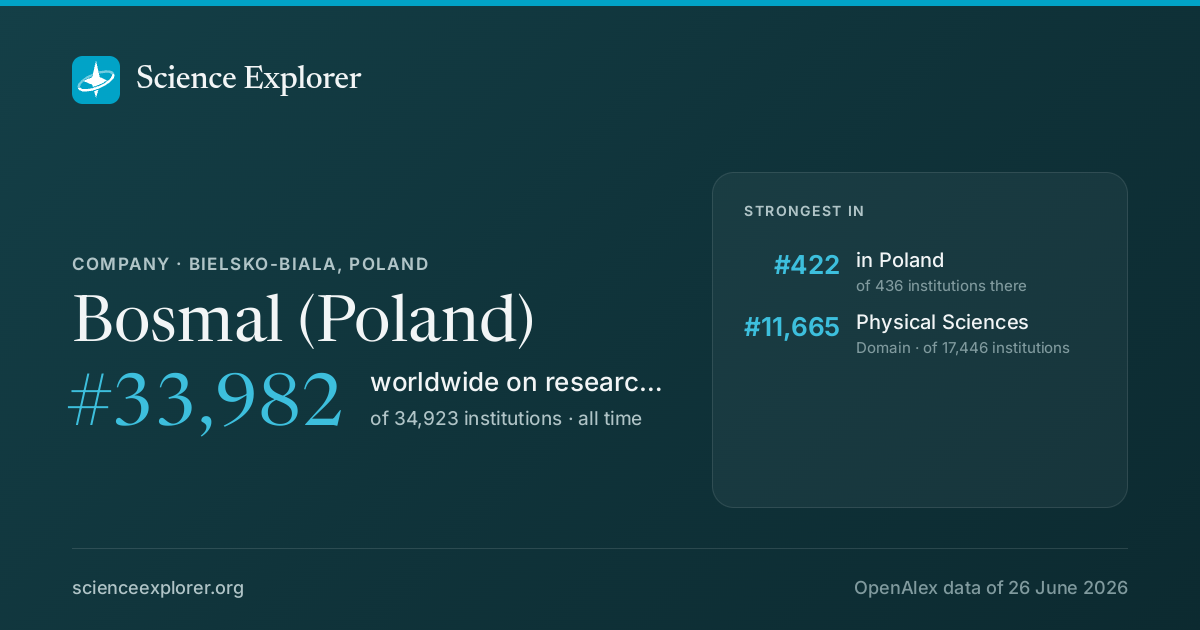
In research, Bosmal (Poland) stands highest in Physical Sciences (#11,665 of 17,446 worldwide), over all time.
- World rank, all time
- #33,982 of 34,923
- Rank in Poland
- #422 of 436
- Research works
- 155 ▼ 80% vs 2018-21
- Citations
- 1.9k 12.2 per fractional work
- Top-10% rate
- 5.9% all institutions 10.0%
- vs its own fields
- 0.99× 1.00× is exactly expected
- Open access
- 33% world 40%
- International
- 14% world 18%
What is Bosmal (Poland) known for in research?
The fields where it stands highest, over all time, ranked among every institution above the floor in each field.
| Field | World rank | Where that sits | Top-10% rate | Works |
|---|---|---|---|---|
| Physical SciencesDomain | #11,665 of 17,446 | 9.1% | 149 |
Each strip is that field's whole ranked pool, with the notch where Bosmal (Poland) sits in it, in the colour of the band that rank falls in. The track under the rate is the rate itself: it carries no average mark, because the average differs by field (from about 6% in Dentistry to 21% in Economics).
Which fields of science does Bosmal (Poland) work in?
In all years, 96% of research at Bosmal (Poland) is in Physical Sciences, 2% in Health Sciences. Its largest fields are Engineering (57%), Chemical Engineering (13%), Environmental Science (12%). It does 2.3× the world's share of Physical Sciences.
Each ring splits the one inside it: the four domains of science, their fields, their subfields. Size is fractional works in all years. Every slice is a page; the interactive view zooms down to single topics and colours each by how much more of it this institution does than the world.
Its 4 domains and 19 fields, with their numbers
- Physical Sciences14996.4%
- Engineering8856.9%
- Chemical Engineering2013.0%
- Environmental Science1912.2%
- Materials Science149.1%
- Energy32.1%
- Computer Science21.5%
- Earth and Planetary Sciences10.7%
- Chemistry10.4%
- Physics and Astronomy10.4%
- Mathematics00.2%
- Health Sciences31.8%
- Medicine21.2%
- Dentistry10.4%
- Health Professions00.2%
- Social Sciences21.2%
- Life Sciences10.6%
Field profile
Location quotient across every field it publishes in: outside the ring is more than an institution of this size would be expected to publish, inside it is less.
Rings at 0.5×, 1× and 2×. Widest outward: Chemical Engineering, 18.0×. Every wedge is a field page.
All 8 fields, with their numbers
- Chemical Engineering17.96×0 works
- Materials Science3.90×1 works
- Engineering3.38×4 works
- Environmental Science3.08×1 works
- Earth and Planetary Sciences2.05×0 works
- Energy1.52×0 works
- Medicine0.33×0 works
- Social Sciences0.25×0 works
Who are the top researchers at Bosmal (Poland)?
Ranked on the quality score, Joseph Woodburn, Andrzej Szczotka and Krzysztof ADAMASZEK lead among researchers whose main affiliation is Bosmal (Poland).
- 1
Joseph Woodburn
 Poland · #4,311,988 worldwide
1.4k citations · 79 works
- 2
Andrzej Szczotka
Poland · #4,451,659 worldwide
1.1k citations · 74 works
- 3
Krzysztof ADAMASZEK
Poland · #4,904,678 worldwide
112 citations · 21 works
- 4
Joanna Faber
Poland · #5,181,038 worldwide
449 citations · 50 works
- 5
Rafał Sala
Poland · #5,253,249 worldwide
83 citations · 18 works
- 6
Krzysztof Brodzik
Poland · #5,368,621 worldwide
340 citations · 29 works
- 7
Zbigniew Jurasz
Poland · #5,420,370 worldwide
105 citations · 29 works
- 8
Piotr Bielaczyc
Poland · #6,193,297 worldwide
2k citations · 142 works
Which keywords describe research at Bosmal (Poland)?
By fractional works in all years, weighted toward what it does more of than the world: Eco-Driving, Fuel Consumption, Emissions, Environmental Impact, Energy Efficiency, Combustion, Oxidation Mechanism and Chemical Kinetics.
- Indoor Air Quality
- Thermal Analysis
- Air Quality Monitoring
- Hybrid Vehicles
- Energy Storage Systems
- Biodiesel
- Vehicle Technical Condition
- Intelligent Transport Systems
- Electric Vehicles
- Ceria
- Global Burden of Disease
- Oxidative Stress
- Health Effects
- Fuel Emissions
- Vehicle Diagnostics
- Renewable Energy
- Chemical Kinetics
- Combustion
- Environmental Impact
- Fuel Consumption
- Eco-Driving
- Emissions
- Energy Efficiency
- Oxidation Mechanism
- Soot Formation
- Control Systems
- Common Rail Injectors
- Particulate Matter
- Nanoparticles
- Air Pollution
- Catalysis
- Oxidation
- Mechanical Properties
- Condition Based Maintenance
- Model Predictive Control
- Transesterification
- Environmental Monitoring
- IoT
- Low-Cost Sensors
- Airborne Microorganisms
Size is fractional works in all years in the topics tagged with each word; colour is the word's share of this institution's work against its share of the world's. The 40 words are chosen for being large and distinctive. Each links to the topic it comes from most.
All 40 words, with their numbers
- Eco-Driving31▲ 439×1 topic
- Fuel Consumption31▲ 339×1 topic
- Emissions24▲ 79×3 topics
- Environmental Impact24▲ 12×10 topics
- Energy Efficiency20▲ 16×9 topics
- Combustion20▲ 189×2 topics
- Oxidation Mechanism20▲ 164×2 topics
- Chemical Kinetics20▲ 114×1 topic
- Soot Formation20▲ 267×1 topic
- Renewable Energy18▲ 12×4 topics
- Control Systems16▲ 38×4 topics
- Vehicle Diagnostics14▲ 575×2 topics
- Common Rail Injectors14▲ 960×1 topic
- Fuel Emissions14▲ 960×1 topic
- Particulate Matter13▲ 74×2 topics
- Health Effects13▲ 13×3 topics
- Nanoparticles10▲ 4.9×6 topics
- Oxidative Stress10▲ 3.5×2 topics
- Air Pollution10▲ 57×1 topic
- Global Burden of Disease10▲ 31×1 topic
- Catalysis8▲ 6.4×3 topics
- Ceria8▲ 43×1 topic
- Oxidation8▲ 24×1 topic
- Electric Vehicles7▲ 27×4 topics
- Mechanical Properties6▲ 4.5×14 topics
- Intelligent Transport Systems6▲ 227×2 topics
- Condition Based Maintenance6▲ 645×1 topic
- Vehicle Technical Condition6▲ 645×1 topic
- Model Predictive Control5▲ 14×2 topics
- Biodiesel4▲ 30×1 topic
- Transesterification4▲ 73×1 topic
- Energy Storage Systems4▲ 26×1 topic
- Environmental Monitoring4▲ 7.6×2 topics
- Hybrid Vehicles4▲ 97×1 topic
- IoT4▲ 11×2 topics
- Air Quality Monitoring3▲ 52×1 topic
- Low-Cost Sensors3▲ 52×1 topic
- Thermal Analysis3▲ 12×2 topics
- Airborne Microorganisms3▲ 76×1 topic
- Indoor Air Quality3▲ 45×1 topic
Which research topics does Bosmal (Poland) publish most on?
By volume in 2022-now: Vehicle emissions and performance, Air Quality and Health Impacts, Catalytic Processes in Materials Science and Advanced Combustion Engine Technologies.
Area is fractional works; colour is the subfield each topic belongs to.
- 1 Vehicle emissions and performance Automotive Engineering 1 works
- 2 Air Quality and Health Impacts Health, Toxicology and Mutagenesis 1 works
- 3 Catalytic Processes in Materials Science Materials Chemistry 1 works
- 4 Advanced Combustion Engine Technologies Fluid Flow and Transfer Processes 0 works
- 5 Atmospheric chemistry and aerosols Atmospheric Science 0 works
- 6 Advanced Battery Technologies Research Automotive Engineering 0 works
- 7 Polish Legal and Social Issues Law 0 works
- 8 Vascular Malformations and Hemangiomas Surgery 0 works
- 9 Electric and Hybrid Vehicle Technologies Automotive Engineering 0 works
- 10 Electric Vehicles and Infrastructure Electrical and Electronic Engineering 0 works
How open and international is its research?
Against the world's own shares: the tick on each track. Both are shares of its output, so they sit on one scale and can be read against each other as well as against the world.
World: 40% of research is openly available.
World: 18% is written across borders.
How has Bosmal (Poland)'s research output changed?
Output in 2022-2025 was 80% lower than in 2018-2021.
The same series as a ribbon: one cell per year, darker for more. The line above answers how much; this answers when.
Its share of all research
Growing output can still be a shrinking share: all of science grows. This is Bosmal (Poland) as a percentage of every work published that year, 0.000010% in 2024.
Fractional works of Bosmal (Poland) over all fractional works that year. How the balance of science has shifted.
Other research institutions in Bielsko-Biala
- University of Bielsko-Biała
- Bielsko-Biala University of Applied Sciences
- School of Administration in Bielsko-Biala
- Sempre (Poland)
- Beskidzkie Centrum Onkologii Szpital Miejski im. Jana Pawla II w Bielsku-Bialej
- ANGA Mechanical Seals (Poland)
- FAS (Poland)
Share Bosmal (Poland)'s ranking
Badges for a website1Each links back here and updates with every snapshot

Research measures only: rankings here say nothing about teaching, admissions or student experience. Comparable institutions and collaboration partners have tabs of their own, above.
Discussion
Ask a question or share a note about Bosmal (Poland). Posts are plain text and can be reported.