Science Explorer Back to mapMap
Discussion
Company · London · United Kingdom

Brook Lyndhurst (United Kingdom)

World rank, all time
#27,277
of 34,923
Rank in United Kingdom
#1,466
of 1,844
Research works
128
▼ 39% vs 2018-21
Citations
2.4k
18.9 per fractional work
Top-10% rate
4.8%
all institutions 10.0%
vs its own fields
0.99×
1.00× is exactly expected
Open access
23%
world 40%
International
16%
world 18%

Which fields of science does Brook Lyndhurst (United Kingdom) work in?

In all years, 34% of research at Brook Lyndhurst (United Kingdom) is in Physical Sciences, 31% in Health Sciences. Its largest fields are Medicine (22%), Physics and Astronomy (14%), Psychology (10%). It does 1.3× the world's share of Social Sciences.

Physical Sciences: 44 fractional works · 34.4% of its workPhysics and Astronomy: 17 fractional works · 13.5% of its workAstronomy and Astrophysics: 15 fractional works · 12.0% of its workInstrumentation: 1 fractional works · 0.8% of its workAtomic and Molecular Physics, and Optics: 1 fractional works · 0.5% of its workStatistical and Nonlinear Physics: 0 fractional works · 0.3% of its workEngineering: 9 fractional works · 7.4% of its workComputational Mechanics: 2 fractional works · 2.0% of its workBiomedical Engineering: 2 fractional works · 1.6% of its workIndustrial and Manufacturing Engineering: 1 fractional works · 1.0% of its workMechanical Engineering: 1 fractional works · 0.8% of its workAerospace Engineering: 1 fractional works · 0.8% of its workOcean Engineering: 1 fractional works · 0.5% of its workBuilding and Construction: 0 fractional works · 0.4% of its workCivil and Structural Engineering: 0 fractional works · 0.3% of its workSmaller subfields together: 0 fractional works · 0.1% of its workComputer Science: 6 fractional works · 4.8% of its workInformation Systems: 3 fractional works · 2.2% of its workComputational Theory and Mathematics: 1 fractional works · 0.8% of its workComputer Vision and Pattern Recognition: 1 fractional works · 0.5% of its workComputer Science Applications: 0 fractional works · 0.4% of its workArtificial Intelligence: 0 fractional works · 0.3% of its workComputer Graphics and Computer-Aided Design: 0 fractional works · 0.3% of its workComputer Networks and Communications: 0 fractional works · 0.3% of its workSignal Processing: 0 fractional works · 0.3% of its workEnvironmental Science: 6 fractional works · 4.6% of its workEcology: 2 fractional works · 1.8% of its workManagement, Monitoring, Policy and Law: 2 fractional works · 1.3% of its workNature and Landscape Conservation: 1 fractional works · 0.5% of its workGlobal and Planetary Change: 1 fractional works · 0.5% of its workHealth, Toxicology and Mutagenesis: 0 fractional works · 0.4% of its workSmaller subfields together: 0 fractional works · 0.1% of its workMaterials Science: 3 fractional works · 2.1% of its workPolymers and Plastics: 2 fractional works · 2.0% of its workSmaller subfields together: 0 fractional works · 0.2% of its workEarth and Planetary Sciences: 1 fractional works · 0.9% of its workPaleontology: 0 fractional works · 0.4% of its workAtmospheric Science: 0 fractional works · 0.3% of its workEarth-Surface Processes: 0 fractional works · 0.3% of its workMathematics: 1 fractional works · 0.9% of its workApplied Mathematics: 1 fractional works · 0.5% of its workSmaller subfields together: 0 fractional works · 0.4% of its workChemical Engineering: 0 fractional works · 0.2% of its workHealth Sciences: 39 fractional works · 30.7% of its workMedicine: 29 fractional works · 22.4% of its workSurgery: 4 fractional works · 3.2% of its workOphthalmology: 4 fractional works · 3.1% of its workEpidemiology: 3 fractional works · 2.6% of its workPublic Health, Environmental and Occupational Health: 2 fractional works · 1.4% of its workPathology and Forensic Medicine: 2 fractional works · 1.4% of its workReproductive Medicine: 1 fractional works · 1.1% of its workRadiology, Nuclear Medicine and Imaging: 1 fractional works · 1.0% of its workCardiology and Cardiovascular Medicine: 1 fractional works · 0.9% of its workDermatology: 1 fractional works · 0.7% of its workPsychiatry and Mental health: 1 fractional works · 0.7% of its workEndocrinology, Diabetes and Metabolism: 1 fractional works · 0.7% of its workPediatrics, Perinatology and Child Health: 1 fractional works · 0.6% of its workUrology: 1 fractional works · 0.5% of its workRehabilitation: 1 fractional works · 0.5% of its workPhysiology: 1 fractional works · 0.4% of its workPulmonary and Respiratory Medicine: 1 fractional works · 0.4% of its workHematology: 1 fractional works · 0.4% of its workGenetics: 0 fractional works · 0.3% of its workObstetrics and Gynecology: 0 fractional works · 0.3% of its workOncology: 0 fractional works · 0.3% of its workAnesthesiology and Pain Medicine: 0 fractional works · 0.3% of its workOtorhinolaryngology: 0 fractional works · 0.3% of its workPharmacology: 0 fractional works · 0.3% of its workSmaller subfields together: 1 fractional works · 1.0% of its workHealth Professions: 5 fractional works · 3.9% of its workGeneral Health Professions: 3 fractional works · 2.5% of its workOccupational Therapy: 0 fractional works · 0.3% of its workSpeech and Hearing: 0 fractional works · 0.3% of its workEmergency Medical Services: 0 fractional works · 0.3% of its workPharmacy: 0 fractional works · 0.3% of its workSmaller subfields together: 0 fractional works · 0.3% of its workDentistry: 4 fractional works · 3.3% of its workOral Surgery: 3 fractional works · 2.6% of its workOrthodontics: 1 fractional works · 0.7% of its workNursing: 1 fractional works · 0.9% of its workIssues, ethics and legal aspects: 1 fractional works · 0.8% of its workSmaller subfields together: 0 fractional works · 0.1% of its workVeterinary: 0 fractional works · 0.1% of its workSocial Sciences: 37 fractional works · 28.9% of its workPsychology: 12 fractional works · 9.7% of its workClinical Psychology: 7 fractional works · 5.5% of its workSocial Psychology: 4 fractional works · 2.9% of its workDevelopmental and Educational Psychology: 1 fractional works · 0.8% of its workApplied Psychology: 1 fractional works · 0.5% of its workSocial Sciences: 10 fractional works · 7.9% of its workEducation: 3 fractional works · 2.0% of its workPolitical Science and International Relations: 1 fractional works · 1.1% of its workSafety Research: 1 fractional works · 1.0% of its workUrban Studies: 1 fractional works · 0.9% of its workSociology and Political Science: 1 fractional works · 0.9% of its workGeography, Planning and Development: 1 fractional works · 0.5% of its workDemography: 0 fractional works · 0.3% of its workAnthropology: 0 fractional works · 0.3% of its workDevelopment: 0 fractional works · 0.3% of its workGender Studies: 0 fractional works · 0.3% of its workLaw: 0 fractional works · 0.3% of its workSmaller subfields together: 0 fractional works · 0.1% of its workArts and Humanities: 7 fractional works · 5.6% of its workHistory and Philosophy of Science: 1 fractional works · 1.0% of its workVisual Arts and Performing Arts: 1 fractional works · 1.0% of its workHistory: 1 fractional works · 0.9% of its workArcheology: 1 fractional works · 0.9% of its workClassics: 0 fractional works · 0.4% of its workMuseology: 0 fractional works · 0.4% of its workLanguage and Linguistics: 0 fractional works · 0.3% of its workLiterature and Literary Theory: 0 fractional works · 0.3% of its workReligious studies: 0 fractional works · 0.3% of its workSmaller subfields together: 0 fractional works · 0.1% of its workEconomics, Econometrics and Finance: 4 fractional works · 2.7% of its workEconomics and Econometrics: 4 fractional works · 2.7% of its workBusiness, Management and Accounting: 3 fractional works · 2.0% of its workMarketing: 1 fractional works · 1.1% of its workStrategy and Management: 1 fractional works · 0.9% of its workDecision Sciences: 1 fractional works · 1.0% of its workManagement Science and Operations Research: 1 fractional works · 1.0% of its workLife Sciences: 8 fractional works · 5.9% of its workBiochemistry, Genetics and Molecular Biology: 4 fractional works · 2.8% of its workGenetics: 2 fractional works · 1.2% of its workMolecular Biology: 1 fractional works · 1.0% of its workCell Biology: 1 fractional works · 0.5% of its workSmaller subfields together: 0 fractional works · 0.2% of its workAgricultural and Biological Sciences: 2 fractional works · 1.9% of its workEcology, Evolution, Behavior and Systematics: 1 fractional works · 0.6% of its workAnimal Science and Zoology: 0 fractional works · 0.3% of its workAgronomy and Crop Science: 0 fractional works · 0.3% of its workFood Science: 0 fractional works · 0.3% of its workPlant Science: 0 fractional works · 0.3% of its workSmaller subfields together: 0 fractional works · 0.2% of its workImmunology and Microbiology: 1 fractional works · 0.8% of its workImmunology: 1 fractional works · 0.7% of its workSmaller subfields together: 0 fractional works · 0.1% of its workNeuroscience: 0 fractional works · 0.4% of its workALL ITS WORKBrook Lyndhurst(United Kingdom)128fractional works, all years
Life Sciences6%Physical Sciences34%Health Sciences31%Social Sciences29%

Each ring splits the one inside it: the four domains of science, their fields, their subfields. Size is fractional works in all years. Every slice is a page; the interactive view zooms down to single topics and colours each by how much more of it this institution does than the world.

Its 4 domains and 23 fields, with their numbers
    1. Physics and Astronomy1713.5%
    2. Engineering97.4%
    3. Computer Science64.8%
    4. Environmental Science64.6%
    5. Materials Science32.1%
    6. Earth and Planetary Sciences10.9%
    7. Mathematics10.9%
    8. Chemical Engineering00.2%
    1. Medicine2922.4%
    2. Health Professions53.9%
    3. Dentistry43.3%
    4. Nursing10.9%
    5. Veterinary00.1%
    1. Psychology129.7%
    2. Social Sciences107.9%
    3. Arts and Humanities75.6%
    4. Economics, Econometrics and Finance42.7%
    5. Business, Management and Accounting32.0%
    6. Decision Sciences11.0%
    1. Biochemistry, Genetics and Molecular Biology42.8%
    2. Agricultural and Biological Sciences21.9%
    3. Immunology and Microbiology10.8%
    4. Neuroscience00.4%
All of science, and how each field's share has moved since 1950: the Science domain explorer

Field profile

Location quotient across every field it publishes in: outside the ring is more than an institution of this size would be expected to publish, inside it is less.

Agricultural and Biological Sciences: 0.16× its world share, 0 worksAgricultural and Bio…Biochemistry, Genetics and Molecular Biology: 0.52× its world share, 0 worksBiochemistry, Geneti…Engineering: 0.76× its world share, 1 worksEngineeringEnvironmental Science: 1.07× its world share, 0 worksEnvironmental ScienceDentistry: 32.73× its world share, 1 worksDentistryHealth Professions: 0.72× its world share, 0 worksHealth ProfessionsMedicine: 2.87× its world share, 5 worksMedicineNursing: 2.59× its world share, 0 worksNursingPsychology: 1.02× its world share, 0 worksPsychologySocial Sciences: 0.19× its world share, 0 worksSocial Sciences1×world share
more than its size predictsabout as predictedless

Rings at 0.5×, 1× and 2×. Widest outward: Dentistry, 32.7×. Every wedge is a field page.

All 10 fields, with their numbers
  1. Dentistry32.73×1 works
  2. Medicine2.87×5 works
  3. Nursing2.59×0 works
  4. Environmental Science1.07×0 works
  5. Psychology1.02×0 works
  6. Engineering0.76×1 works
  7. Health Professions0.72×0 works
  8. Biochemistry, Genetics and Molecular Biology0.52×0 works
  9. Social Sciences0.19×0 works
  10. Agricultural and Biological Sciences0.16×0 works

Who are the top researchers at Brook Lyndhurst (United Kingdom)?

Ranked on the quality score, Jayne Cox, Andreas Alzner and Owen Brazell lead among researchers whose main affiliation is Brook Lyndhurst (United Kingdom).

  1. 1 Jayne Cox United Kingdom · #2,452,050 worldwide 511 citations · 17 works
  2. 2 Andreas Alzner United Kingdom · #3,243,944 worldwide 259 citations · 24 works
  3. 3 Owen Brazell United Kingdom · #4,395,403 worldwide 18 citations · 32 works
  4. 4 H. Saunders United Kingdom · #5,086,028 worldwide 736 citations · 55 works
  5. 5 Ernő Berkó United Kingdom · #5,322,134 worldwide 3 citations · 33 works
All ranked researchers at Brook Lyndhurst (United Kingdom)

What are the most cited papers from Brook Lyndhurst (United Kingdom)?

The most cited paper from Brook Lyndhurst (United Kingdom) is "Consumer understanding of product lifetimes" (Jayne Cox, Sarah Griffith, Sara Giorgi et al., 2013), with 221 citations. Next come "Survival in traumatic spinal cord injury" (216) and "Simple Techniques of Measurement" (198).

Most cited papers
#PaperReleasedCitations
1 Consumer understanding of product lifetimes Jayne Cox, Sarah Griffith, Sara Giorgi et al. · Resources Conservation and Recycling 3 Jul 2013 221
2 Survival in traumatic spinal cord injury W O Geisler, A T Jousse, Megan Wynne-Jones et al. · Spinal Cord Dec 1983 216
3 Simple Techniques of Measurement E. T. H. Teague, R. W. Argyle · Patrick Moore's practical astronomy series/˜The œPatrick Moore practical astronomy series Book chapter 2012 198
4 Ferric carboxymaltose injection in the treatment of postpartum iron deficiency anemia: a randomized controlled clinical trial Melvin H. Seid, Richard J. Derman, Jeffrey B. Baker et al. · American Journal of Obstetrics and Gynecology Oct 2008 192
5 Soda consumption and the risk of stroke in men and women Adam Bernstein, Lawrence de Koning, Alan John Flint et al. · American Journal of Clinical Nutrition Open access 6 Apr 2012 191
All 59 most cited papers, with filters and sorting

Which keywords describe research at Brook Lyndhurst (United Kingdom)?

By fractional works in all years, weighted toward what it does more of than the world: Spectroscopy, Radio Astronomy, Transits of Venus, Historical Astronomy, Antikythera Mechanism, Astronomical Calculator, Epidemiology and Urban Development.

▲ more of its work than of the world's◆ about the world's share▼ less than the world's

Size is fractional works in all years in the topics tagged with each word; colour is the word's share of this institution's work against its share of the world's. The 40 words are chosen for being large and distinctive. Each links to the topic it comes from most.

All 40 words, with their numbers
  1. Epidemiology9▲ 1.76×24 topics
  2. Spectroscopy7▲ 17×2 topics
  3. Radio Astronomy7▲ 146×1 topic
  4. Transits of Venus7▲ 272×1 topic
  5. Quality of Life5▲ 3.0×15 topics
  6. Historical Astronomy5▲ 183×2 topics
  7. Antikythera Mechanism4▲ 360×1 topic
  8. Astronomical Calculator4▲ 360×1 topic
  9. Climate Change4▲ 1.26×15 topics
  10. Urban Development4▲ 9.8×3 topics
  11. Laser Eye Injuries4▲ 140×1 topic
  12. Mental Health4▲ 2.4×6 topics
  13. Public Health4▲ 2.0×10 topics
  14. Retinal Damage4▲ 140×1 topic
  15. Clinical Trials3▲ 3.7×6 topics
  16. Structural Health Monitoring3▲ 21×2 topics
  17. Educational Technology3▲ 3.1×4 topics
  18. Housing Supply3▲ 48×1 topic
  19. Mortgage Credit Expansion3▲ 48×1 topic
  20. Meta-Analysis3▲ 3.7×6 topics
  21. Optical 3D Laser Measurement2▲ 99×1 topic
  22. Position-Sensitive Detector2▲ 99×1 topic
  23. Dental Implants2▲ 37×1 topic
  24. Peri-implant Diseases2▲ 37×1 topic
  25. Social Support2▲ 3.7×3 topics
  26. Professional Development2▲ 9.8×2 topics
  27. Neuromodulation2▲ 21×2 topics
  28. Renewable Resources2▲ 11×2 topics
  29. Solar System Abundances2▲ 17×1 topic
  30. Terrestrial Planets2▲ 17×1 topic
  31. Functional Recovery2▲ 10×2 topics
  32. Narrative Analysis2▲ 20×3 topics
  33. Recovery2▲ 14×2 topics
  34. Neurological Classification2▲ 55×1 topic
  35. Spinal Cord Injury2▲ 23×1 topic
  36. Exoplanets2▲ 16×1 topic
  37. Self-Healing2▲ 44×1 topic
  38. Stellar Astrophysics2▲ 16×1 topic
  39. Cosmetic Surgery1▲ 33×2 topics
  40. Human Papillomavirus1▲ 8.9×2 topics

Which research topics does Brook Lyndhurst (United Kingdom) publish most on?

By volume in 2022-now: Advanced Sensor Technologies Research, Cervical Cancer and HPV Research, Facial Rejuvenation and Surgery Techniques and Endodontics and Root Canal Treatments.

  1. 1 Advanced Sensor Technologies Research Biomedical Engineering 1 works
  2. 2 Cervical Cancer and HPV Research Epidemiology 1 works
  3. 3 Facial Rejuvenation and Surgery Techniques Dermatology 1 works
  4. 4 Endodontics and Root Canal Treatments Oral Surgery 0 works
  5. 5 Cardiovascular Health and Risk Factors Cardiology and Cardiovascular Medicine 0 works
  6. 6 Dental Erosion and Treatment Orthodontics 0 works
  7. 7 Ovarian cancer diagnosis and treatment Reproductive Medicine 0 works
  8. 8 Breast Implant and Reconstruction Surgery 0 works
  9. 9 Dementia and Cognitive Impairment Research Psychiatry and Mental health 0 works
  10. 10 Health, Environment, Cognitive Aging Health, Toxicology and Mutagenesis 0 works

How open and international is its research?

Against the world's own shares: the tick on each track. Both are shares of its output, so they sit on one scale and can be read against each other as well as against the world.

openly available22.6%not open77.4%

World: 40% of research is openly available.

with international co-authors15.7%domestic only84.3%

World: 18% is written across borders.

How has Brook Lyndhurst (United Kingdom)'s research output changed?

Output in 2022-2025 was 39% lower than in 2018-2021.

still counting1990200020102020
grewheldshrank

The same series as a ribbon: one cell per year, darker for more. The line above answers how much; this answers when.

Its share of all research

Growing output can still be a shrinking share: all of science grows. This is Brook Lyndhurst (United Kingdom) as a percentage of every work published that year, 0.000067% in 2024.

still counting0.0010%0.0020%Brook Lyndhurst (United Kingdom)0.000018% in 202519801990200020102020

Fractional works of Brook Lyndhurst (United Kingdom) over all fractional works that year. How the balance of science has shifted.

Other research institutions in London

All research institutions in London

Share Brook Lyndhurst (United Kingdom)'s ranking
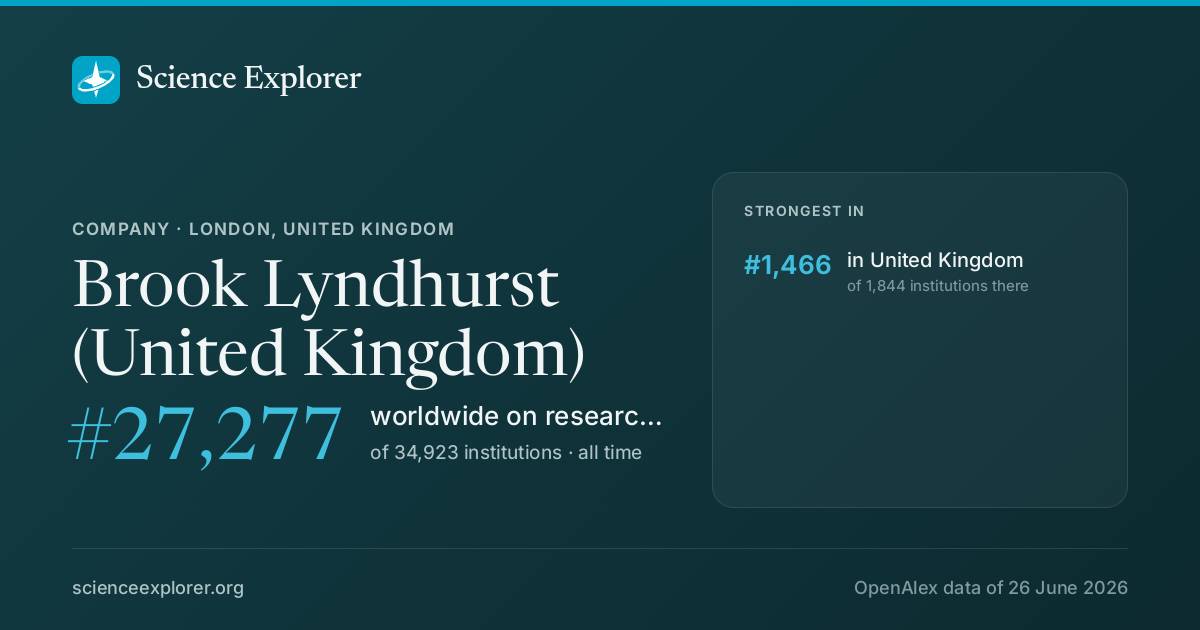
Brook Lyndhurst (United Kingdom) on Science Explorer

A card with Brook Lyndhurst (United Kingdom)'s standing and the fields it leads in, for a post or a slide. A link to this page previews as the same card.

Download the card

1200 × 630 PNG, sized for social posts, drawn from the latest snapshot.

Badges for a website1Each links back here and updates with every snapshot

Research measures only: rankings here say nothing about teaching, admissions or student experience. Comparable institutions and collaboration partners have tabs of their own, above.

Discussion

Ask a question or share a note about Brook Lyndhurst (United Kingdom). Keep it to the research: no personal attacks, advertising or links. Any reader can report a post, which collapses it for everyone until it is opened.