Science Explorer Back to mapMap
Discussion

Brooks Automation (United States)

World rank, all time
#32,970
of 34,923
Rank in United States
#6,921
of 7,310
Research works
130
▲ 79% vs 2018-21
Citations
1.6k
12.7 per fractional work
Top-10% rate
5.8%
all institutions 10.0%
vs its own fields
0.90×
1.00× is exactly expected
Open access
9%
world 40%
International
14%
world 18%

Which fields of science does Brooks Automation (United States) work in?

In all years, 68% of research at Brooks Automation (United States) is in Physical Sciences, 24% in Social Sciences. Its largest fields are Engineering (40%), Computer Science (17%), Decision Sciences (9%). It does 1.6× the world's share of Physical Sciences.

Physical Sciences: 88 fractional works · 67.5% of its workEngineering: 53 fractional works · 40.5% of its workIndustrial and Manufacturing Engineering: 14 fractional works · 10.9% of its workControl and Systems Engineering: 12 fractional works · 9.2% of its workElectrical and Electronic Engineering: 10 fractional works · 7.3% of its workBiomedical Engineering: 5 fractional works · 4.1% of its workMechanical Engineering: 5 fractional works · 3.8% of its workBuilding and Construction: 3 fractional works · 2.2% of its workComputational Mechanics: 1 fractional works · 0.9% of its workSafety, Risk, Reliability and Quality: 1 fractional works · 0.8% of its workAutomotive Engineering: 1 fractional works · 0.6% of its workAerospace Engineering: 0 fractional works · 0.3% of its workMechanics of Materials: 0 fractional works · 0.3% of its workComputer Science: 22 fractional works · 16.9% of its workInformation Systems: 4 fractional works · 3.4% of its workComputer Networks and Communications: 4 fractional works · 3.1% of its workHardware and Architecture: 4 fractional works · 2.7% of its workArtificial Intelligence: 3 fractional works · 2.1% of its workComputational Theory and Mathematics: 2 fractional works · 1.9% of its workComputer Science Applications: 1 fractional works · 1.1% of its workHuman-Computer Interaction: 1 fractional works · 0.9% of its workComputer Vision and Pattern Recognition: 1 fractional works · 0.9% of its workSignal Processing: 1 fractional works · 0.5% of its workSoftware: 0 fractional works · 0.3% of its workPhysics and Astronomy: 4 fractional works · 2.8% of its workAtomic and Molecular Physics, and Optics: 2 fractional works · 1.7% of its workCondensed Matter Physics: 0 fractional works · 0.4% of its workStatistical and Nonlinear Physics: 0 fractional works · 0.4% of its workAstronomy and Astrophysics: 0 fractional works · 0.3% of its workMaterials Science: 3 fractional works · 2.6% of its workMaterials Chemistry: 2 fractional works · 1.2% of its workBiomaterials: 1 fractional works · 0.6% of its workElectronic, Optical and Magnetic Materials: 0 fractional works · 0.3% of its workGeneral Materials Science: 0 fractional works · 0.3% of its workSmaller subfields together: 0 fractional works · 0.1% of its workMathematics: 3 fractional works · 2.1% of its workDiscrete Mathematics and Combinatorics: 2 fractional works · 1.3% of its workTheoretical Computer Science: 1 fractional works · 0.5% of its workNumerical Analysis: 0 fractional works · 0.3% of its workChemistry: 2 fractional works · 1.3% of its workSpectroscopy: 1 fractional works · 0.7% of its workInorganic Chemistry: 0 fractional works · 0.3% of its workSmaller subfields together: 0 fractional works · 0.2% of its workEarth and Planetary Sciences: 1 fractional works · 0.7% of its workAtmospheric Science: 1 fractional works · 0.6% of its workSmaller subfields together: 0 fractional works · 0.1% of its workEnvironmental Science: 0 fractional works · 0.4% of its workEnergy: 0 fractional works · 0.2% of its workRenewable Energy, Sustainability and the Environment: 0 fractional works · 0.2% of its workChemical Engineering: 0 fractional works · 0.1% of its workSocial Sciences: 31 fractional works · 23.9% of its workDecision Sciences: 12 fractional works · 9.4% of its workManagement Science and Operations Research: 12 fractional works · 9.1% of its workInformation Systems and Management: 0 fractional works · 0.3% of its workSmaller subfields together: 0 fractional works · 0.1% of its workSocial Sciences: 8 fractional works · 6.2% of its workEducation: 2 fractional works · 1.7% of its workSociology and Political Science: 2 fractional works · 1.6% of its workDevelopment: 1 fractional works · 0.8% of its workLaw: 1 fractional works · 0.8% of its workCommunication: 0 fractional works · 0.4% of its workCultural Studies: 0 fractional works · 0.3% of its workHuman Factors and Ergonomics: 0 fractional works · 0.3% of its workSafety Research: 0 fractional works · 0.3% of its workSmaller subfields together: 0 fractional works · 0.3% of its workBusiness, Management and Accounting: 6 fractional works · 4.5% of its workManagement Information Systems: 3 fractional works · 2.6% of its workAccounting: 1 fractional works · 0.8% of its workManagement of Technology and Innovation: 1 fractional works · 0.8% of its workMarketing: 0 fractional works · 0.3% of its workArts and Humanities: 2 fractional works · 1.9% of its workMusic: 1 fractional works · 0.8% of its workLanguage and Linguistics: 1 fractional works · 0.5% of its workArcheology: 0 fractional works · 0.3% of its workHistory: 0 fractional works · 0.3% of its workSmaller subfields together: 0 fractional works · 0.1% of its workEconomics, Econometrics and Finance: 2 fractional works · 1.4% of its workEconomics and Econometrics: 2 fractional works · 1.4% of its workPsychology: 1 fractional works · 0.6% of its workClinical Psychology: 0 fractional works · 0.4% of its workSmaller subfields together: 0 fractional works · 0.2% of its workHealth Sciences: 8 fractional works · 6.4% of its workMedicine: 7 fractional works · 5.1% of its workPublic Health, Environmental and Occupational Health: 1 fractional works · 0.8% of its workSurgery: 1 fractional works · 0.7% of its workPhysiology: 1 fractional works · 0.4% of its workEmergency Medicine: 0 fractional works · 0.4% of its workGenetics: 0 fractional works · 0.4% of its workReproductive Medicine: 0 fractional works · 0.4% of its workUrology: 0 fractional works · 0.4% of its workPathology and Forensic Medicine: 0 fractional works · 0.3% of its workPsychiatry and Mental health: 0 fractional works · 0.3% of its workPulmonary and Respiratory Medicine: 0 fractional works · 0.2% of its workSmaller subfields together: 1 fractional works · 0.8% of its workHealth Professions: 1 fractional works · 0.6% of its workEmergency Medical Services: 0 fractional works · 0.3% of its workGeneral Health Professions: 0 fractional works · 0.3% of its workSmaller subfields together: 0 fractional works · 0.1% of its workDentistry: 0 fractional works · 0.4% of its workPeriodontics: 0 fractional works · 0.3% of its workSmaller subfields together: 0 fractional works · 0.1% of its workNursing: 0 fractional works · 0.3% of its workNutrition and Dietetics: 0 fractional works · 0.3% of its workSmaller subfields together: 0 fractional works · 0.0% of its workLife Sciences: 3 fractional works · 2.1% of its workBiochemistry, Genetics and Molecular Biology: 2 fractional works · 1.7% of its workMolecular Biology: 1 fractional works · 0.8% of its workGenetics: 1 fractional works · 0.5% of its workBiophysics: 0 fractional works · 0.2% of its workSmaller subfields together: 0 fractional works · 0.2% of its workPharmacology, Toxicology and Pharmaceutics: 0 fractional works · 0.4% of its workPharmacology: 0 fractional works · 0.4% of its workAgricultural and Biological Sciences: 0 fractional works · 0.0% of its workALL ITS WORKBrooks Automation(United States)130fractional works, all years
Life Sciences2%Physical Sciences68%Health Sciences6%Social Sciences24%

Each ring splits the one inside it: the four domains of science, their fields, their subfields. Size is fractional works in all years. Every slice is a page; the interactive view zooms down to single topics and colours each by how much more of it this institution does than the world.

Its 4 domains and 23 fields, with their numbers
    1. Engineering5340.5%
    2. Computer Science2216.9%
    3. Physics and Astronomy42.8%
    4. Materials Science32.6%
    5. Mathematics32.1%
    6. Chemistry21.3%
    7. Earth and Planetary Sciences10.7%
    8. Environmental Science00.4%
    9. Energy00.2%
    10. Chemical Engineering00.1%
    1. Decision Sciences129.4%
    2. Social Sciences86.2%
    3. Business, Management and Accounting64.5%
    4. Arts and Humanities21.9%
    5. Economics, Econometrics and Finance21.4%
    6. Psychology10.6%
    1. Medicine75.1%
    2. Health Professions10.6%
    3. Dentistry00.4%
    4. Nursing00.3%
    1. Biochemistry, Genetics and Molecular Biology21.7%
    2. Pharmacology, Toxicology and Pharmaceutics00.4%
    3. Agricultural and Biological Sciences00.0%
All of science, and how each field's share has moved since 1950: the Science domain explorer

Field profile

Location quotient across every field it publishes in: outside the ring is more than an institution of this size would be expected to publish, inside it is less.

Chemistry: 1.08× its world share, 0 worksChemistryComputer Science: 5.82× its world share, 9 worksComputer ScienceEnergy: 1.22× its world share, 0 worksEnergyEngineering: 1.24× its world share, 4 worksEngineeringEnvironmental Science: 0.11× its world share, 0 worksEnvironmental ScienceMaterials Science: 1.53× its world share, 1 worksMaterials ScienceMathematics: 1.43× its world share, 0 worksMathematicsPhysics and Astronomy: 4.17× its world share, 2 worksPhysics and AstronomyHealth Professions: 0.64× its world share, 0 worksHealth ProfessionsNursing: 0.57× its world share, 0 worksNursingArts and Humanities: 1.17× its world share, 1 worksArts and HumanitiesBusiness, Management and Accounting: 0.52× its world share, 0 worksBusiness, Management…Social Sciences: 0.74× its world share, 2 worksSocial Sciences1×world share
more than its size predictsabout as predictedless

Rings at 0.5×, 1× and 2×. Widest outward: Computer Science, 5.8×. Every wedge is a field page.

All 13 fields, with their numbers
  1. Computer Science5.82×9 works
  2. Physics and Astronomy4.17×2 works
  3. Materials Science1.53×1 works
  4. Mathematics1.43×0 works
  5. Engineering1.24×4 works
  6. Energy1.22×0 works
  7. Arts and Humanities1.17×1 works
  8. Chemistry1.08×0 works
  9. Social Sciences0.74×2 works
  10. Health Professions0.64×0 works
  11. Nursing0.57×0 works
  12. Business, Management and Accounting0.52×0 works
  13. Environmental Science0.11×0 works

Who are the top researchers at Brooks Automation (United States)?

Ranked on the quality score, Matthew W. Rohrer and Martin Hošek lead among researchers whose main affiliation is Brooks Automation (United States).

  1. 1 Matthew W. Rohrer United States · #2,247,097 worldwide 400 citations · 17 works
  2. 2 Martin Hošek United States · #4,228,747 worldwide 776 citations · 88 works
All ranked researchers at Brooks Automation (United States)

What are the most cited papers from Brooks Automation (United States)?

The most cited paper from Brooks Automation (United States) is "Introduction to simulation" (Jerry Banks, 1999), with 311 citations. Next come "Model verification and validation" (223) and "Magnetic bearing control systems and adaptive forced balancing" (164).

Most cited papers
#PaperReleasedCitations
1 Introduction to simulation Jerry Banks Conference paper 1999 311
2 Model verification and validation J.S. Carson Conference paper 25 Jun 2003 223
3 Magnetic bearing control systems and adaptive forced balancing Bahram Shafai, Stuart Beale, P. LaRocca et al. · IEEE Control Systems Apr 1994 164
4 Nonlinear Modeling and Control of Servo Pneumatic Actuators Zhihong Rao, Gary M. Bone · IEEE Transactions on Control Systems Technology 23 Apr 2008 153
5 Laser-Driven Micro Transfer Placement of Prefabricated Microstructures Reza Saeidpourazar, Rui Li, Yuhang Li et al. · Journal of Microelectromechanical Systems 29 Sep 2012 131
All 56 most cited papers, with filters and sorting

Which keywords describe research at Brooks Automation (United States)?

By fractional works in all years, weighted toward what it does more of than the world: Agent-Based Modeling, Modeling and Simulation, Simulation Optimization, Verification and Validation, Order Picking, Warehouse Design, Scheduling and Genetic Algorithm.

▲ more of its work than of the world's◆ about the world's share▼ less than the world's

Size is fractional works in all years in the topics tagged with each word; colour is the word's share of this institution's work against its share of the world's. The 40 words are chosen for being large and distinctive. Each links to the topic it comes from most.

All 40 words, with their numbers
  1. Agent-Based Modeling12▲ 58×2 topics
  2. Modeling and Simulation11▲ 141×2 topics
  3. Simulation Optimization10▲ 321×1 topic
  4. Verification and Validation10▲ 321×1 topic
  5. Deep Learning5▲ 1.94×10 topics
  6. Neural Networks4▲ 3.3×6 topics
  7. Order Picking4▲ 79×1 topic
  8. Scheduling4▲ 42×3 topics
  9. Warehouse Design4▲ 79×1 topic
  10. Genetic Algorithm4▲ 17×2 topics
  11. Flexible Job-shop4▲ 78×1 topic
  12. Manufacturing4▲ 58×1 topic
  13. Healthcare4▲ 3.9×5 topics
  14. Dynamic Modeling3▲ 56×2 topics
  15. FPGA3▲ 30×4 topics
  16. Assembly Planning3▲ 29×1 topic
  17. Design for Manufacture3▲ 29×1 topic
  18. Performance Evaluation3▲ 44×2 topics
  19. Embedded Systems3▲ 26×3 topics
  20. Kinematic Analysis3▲ 89×1 topic
  21. Robot Manipulators3▲ 89×1 topic
  22. Cross-Platform Development3▲ 228×1 topic
  23. Mobile Application Development3▲ 228×1 topic
  24. Nonlinear Systems3▲ 11×3 topics
  25. Business Process Management3▲ 54×1 topic
  26. High-Level Synthesis3▲ 50×1 topic
  27. IoT3▲ 10×5 topics
  28. Reconfigurable Computing3▲ 45×1 topic
  29. Workflow Mining3▲ 54×1 topic
  30. Security3▲ 4.8×3 topics
  31. Adaptive Control2▲ 14×5 topics
  32. Chemical Mechanical Planarization2▲ 29×1 topic
  33. Distributed Control2▲ 13×3 topics
  34. Elderly Care2▲ 12×2 topics
  35. Material Removal Mechanism2▲ 29×1 topic
  36. Grasping2▲ 55×1 topic
  37. Iterative Learning Control2▲ 55×1 topic
  38. Repetitive Control2▲ 55×1 topic
  39. Robot Learning2▲ 55×1 topic
  40. 3D Printing2▲ 7.2×2 topics

Which research topics does Brooks Automation (United States) publish most on?

By volume in 2022-now: Mobile and Web Applications, Software Engineering and Design Patterns, Bluetooth and Wireless Communication Technologies and Quantum optics and atomic interactions.

  1. 1 Mobile and Web Applications Information Systems 3 works
  2. 2 Software Engineering and Design Patterns Development 1 works
  3. 3 Bluetooth and Wireless Communication Technologies Computer Networks and Communications 1 works
  4. 4 Quantum optics and atomic interactions Atomic and Molecular Physics, and Optics 1 works
  5. 5 Green IT and Sustainability Electrical and Electronic Engineering 1 works
  6. 6 Advanced Software Engineering Methodologies Artificial Intelligence 1 works
  7. 7 Photonic and Optical Devices Electrical and Electronic Engineering 0 works
  8. 8 Luminescence Properties of Advanced Materials Materials Chemistry 0 works
  9. 9 Mobile Health and mHealth Applications General Health Professions 0 works
  10. 10 Polynomial and algebraic computation Computational Theory and Mathematics 0 works

How open and international is its research?

Against the world's own shares: the tick on each track. Both are shares of its output, so they sit on one scale and can be read against each other as well as against the world.

openly available9.4%not open90.6%

World: 40% of research is openly available.

with international co-authors13.8%domestic only86.2%

World: 18% is written across borders.

How has Brooks Automation (United States)'s research output changed?

Output in 2022-2025 was 79% higher than in 2018-2021.

still counting1990200020102020
grewheldshrank

The same series as a ribbon: one cell per year, darker for more. The line above answers how much; this answers when.

Its share of all research

Growing output can still be a shrinking share: all of science grows. This is Brooks Automation (United States) as a percentage of every work published that year, 0.000071% in 2023.

still counting0.00050%0.0010%Brooks Automation (United States)0.000027% in 202519801990200020102020

Fractional works of Brooks Automation (United States) over all fractional works that year. How the balance of science has shifted.

Other research institutions in Chelmsford

All research institutions in Chelmsford

Share Brooks Automation (United States)'s ranking
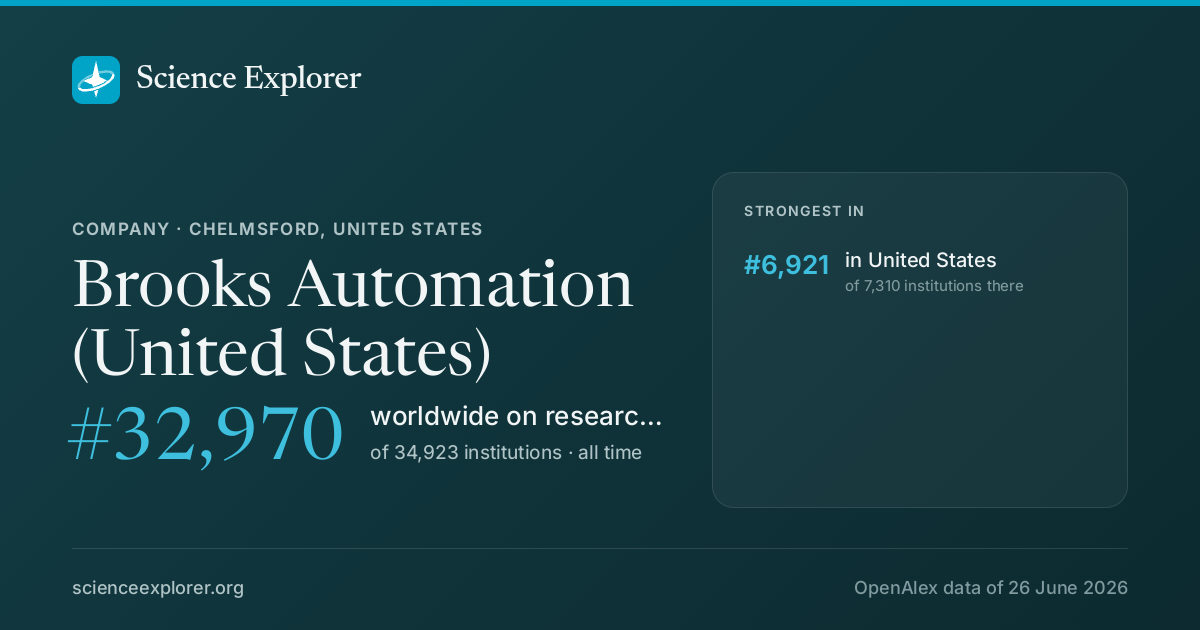
Brooks Automation (United States) on Science Explorer

A card with Brooks Automation (United States)'s standing and the fields it leads in, for a post or a slide. A link to this page previews as the same card.

Download the card

1200 × 630 PNG, sized for social posts, drawn from the latest snapshot.

Badges for a website1Each links back here and updates with every snapshot

Research measures only: rankings here say nothing about teaching, admissions or student experience. Comparable institutions and collaboration partners have tabs of their own, above.

Discussion

Ask a question or share a note about Brooks Automation (United States). Keep it to the research: no personal attacks, advertising or links. Any reader can report a post, which collapses it for everyone until it is opened.
