Science Explorer Back to mapMap
Discussion
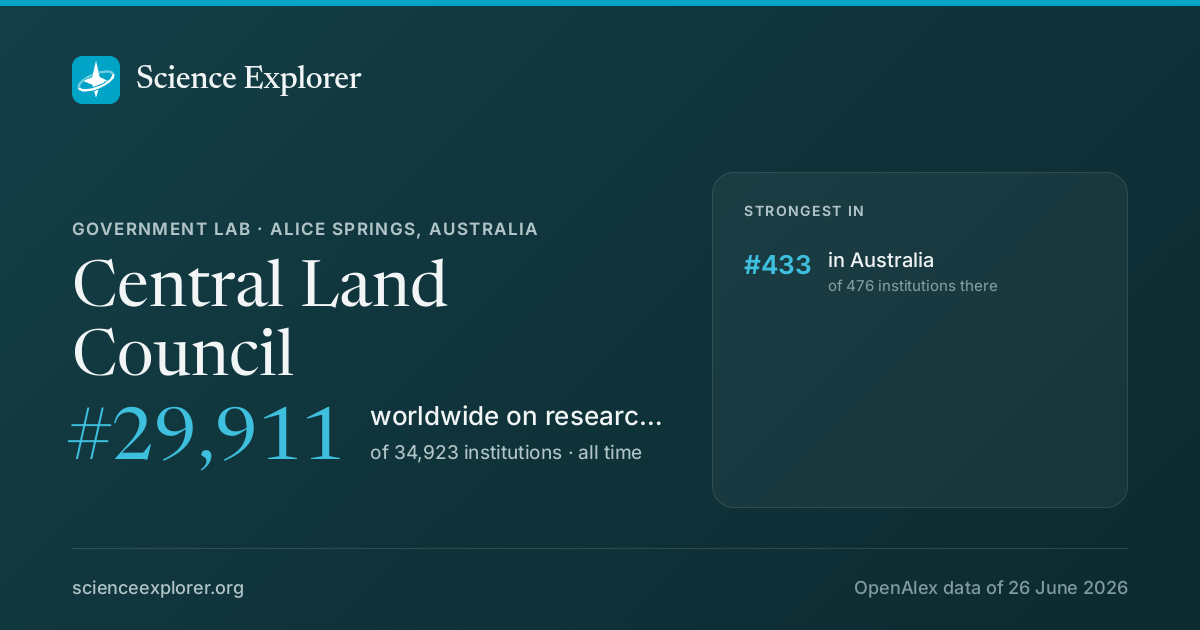
Government institution · Alice Springs · Australia

Central Land Council

World rank, all time
#29,911
of 34,923
Rank in Australia
#433
of 476
Research works
149
▲ 23% vs 2018-21
Citations
2.2k
14.7 per fractional work
Top-10% rate
13.7%
all institutions 10.0%
vs its own fields
0.94×
1.00× is exactly expected
Open access
36%
world 40%
International
15%
world 18%

Which fields of science does Central Land Council work in?

In 2022-now, 45% of research at Central Land Council is in Social Sciences, 26% in Physical Sciences. Its largest fields are Social Sciences (33%), Environmental Science (17%), Medicine (12%). It does 1.5× the world's share of Social Sciences.

Social Sciences: 11 fractional works · 44.6% of its workSocial Sciences: 8 fractional works · 33.2% of its workSociology and Political Science: 2 fractional works · 9.5% of its workHealth: 2 fractional works · 8.0% of its workAnthropology: 1 fractional works · 5.1% of its workGeography, Planning and Development: 1 fractional works · 3.0% of its workDemography: 0 fractional works · 1.7% of its workPolitical Science and International Relations: 0 fractional works · 1.3% of its workSafety Research: 0 fractional works · 1.3% of its workPublic Administration: 0 fractional works · 1.0% of its workEducation: 0 fractional works · 0.7% of its workCultural Studies: 0 fractional works · 0.5% of its workLinguistics and Language: 0 fractional works · 0.4% of its workArcheology: 0 fractional works · 0.3% of its workSmaller subfields together: 0 fractional works · 0.2% of its workPsychology: 2 fractional works · 8.0% of its workClinical Psychology: 2 fractional works · 7.1% of its workDevelopmental and Educational Psychology: 0 fractional works · 0.4% of its workExperimental and Cognitive Psychology: 0 fractional works · 0.4% of its workBusiness, Management and Accounting: 0 fractional works · 1.3% of its workManagement of Technology and Innovation: 0 fractional works · 1.3% of its workEconomics, Econometrics and Finance: 0 fractional works · 0.9% of its workFinance: 0 fractional works · 0.9% of its workSmaller subfields together: 0 fractional works · 0.0% of its workDecision Sciences: 0 fractional works · 0.6% of its workGeneral Decision Sciences: 0 fractional works · 0.3% of its workManagement Science and Operations Research: 0 fractional works · 0.3% of its workArts and Humanities: 0 fractional works · 0.5% of its workMusic: 0 fractional works · 0.3% of its workSmaller subfields together: 0 fractional works · 0.2% of its workPhysical Sciences: 6 fractional works · 26.5% of its workEnvironmental Science: 4 fractional works · 16.9% of its workEcology: 2 fractional works · 6.3% of its workNature and Landscape Conservation: 1 fractional works · 3.3% of its workGlobal and Planetary Change: 1 fractional works · 3.2% of its workEcological Modeling: 1 fractional works · 2.2% of its workManagement, Monitoring, Policy and Law: 0 fractional works · 1.2% of its workHealth, Toxicology and Mutagenesis: 0 fractional works · 0.3% of its workSmaller subfields together: 0 fractional works · 0.3% of its workEngineering: 1 fractional works · 4.8% of its workElectrical and Electronic Engineering: 1 fractional works · 3.0% of its workMedia Technology: 0 fractional works · 1.3% of its workComputational Mechanics: 0 fractional works · 0.3% of its workSmaller subfields together: 0 fractional works · 0.2% of its workEarth and Planetary Sciences: 1 fractional works · 2.8% of its workPaleontology: 0 fractional works · 1.9% of its workOceanography: 0 fractional works · 0.3% of its workSmaller subfields together: 0 fractional works · 0.6% of its workPhysics and Astronomy: 0 fractional works · 1.3% of its workAtomic and Molecular Physics, and Optics: 0 fractional works · 1.3% of its workComputer Science: 0 fractional works · 0.6% of its workHuman-Computer Interaction: 0 fractional works · 0.4% of its workSmaller subfields together: 0 fractional works · 0.2% of its workHealth Sciences: 6 fractional works · 24.3% of its workMedicine: 3 fractional works · 12.1% of its workPublic Health, Environmental and Occupational Health: 1 fractional works · 2.6% of its workEpidemiology: 0 fractional works · 1.8% of its workNephrology: 0 fractional works · 1.4% of its workEndocrinology, Diabetes and Metabolism: 0 fractional works · 0.8% of its workPhysiology: 0 fractional works · 0.8% of its workNeurology: 0 fractional works · 0.8% of its workPediatrics, Perinatology and Child Health: 0 fractional works · 0.8% of its workObstetrics and Gynecology: 0 fractional works · 0.7% of its workInfectious Diseases: 0 fractional works · 0.5% of its workSurgery: 0 fractional works · 0.5% of its workCritical Care and Intensive Care Medicine: 0 fractional works · 0.3% of its workEmergency Medicine: 0 fractional works · 0.3% of its workHepatology: 0 fractional works · 0.3% of its workRheumatology: 0 fractional works · 0.3% of its workSmaller subfields together: 0 fractional works · 0.3% of its workHealth Professions: 3 fractional works · 11.5% of its workGeneral Health Professions: 2 fractional works · 9.2% of its workPhysical Therapy, Sports Therapy and Rehabilitation: 0 fractional works · 1.0% of its workEmergency Medical Services: 0 fractional works · 0.8% of its workHealth Information Management: 0 fractional works · 0.5% of its workNursing: 0 fractional works · 0.4% of its workNutrition and Dietetics: 0 fractional works · 0.4% of its workDentistry: 0 fractional works · 0.3% of its workLife Sciences: 1 fractional works · 4.6% of its workAgricultural and Biological Sciences: 0 fractional works · 1.7% of its workPlant Science: 0 fractional works · 0.9% of its workGeneral Agricultural and Biological Sciences: 0 fractional works · 0.6% of its workSmaller subfields together: 0 fractional works · 0.2% of its workBiochemistry, Genetics and Molecular Biology: 0 fractional works · 1.3% of its workGenetics: 0 fractional works · 1.2% of its workSmaller subfields together: 0 fractional works · 0.1% of its workImmunology and Microbiology: 0 fractional works · 1.3% of its workParasitology: 0 fractional works · 0.7% of its workImmunology: 0 fractional works · 0.4% of its workSmaller subfields together: 0 fractional works · 0.2% of its workPharmacology, Toxicology and Pharmaceutics: 0 fractional works · 0.2% of its workNeuroscience: 0 fractional works · 0.1% of its workALL ITS WORKCentral LandCouncil25fractional works, 2022-now
Life Sciences5%Physical Sciences26%Health Sciences24%Social Sciences45%

Each ring splits the one inside it: the four domains of science, their fields, their subfields. Size is fractional works in 2022-now. Every slice is a page; the interactive view zooms down to single topics and colours each by how much more of it this institution does than the world.

Its 4 domains and 20 fields, with their numbers
    1. Social Sciences833.2%
    2. Psychology28.0%
    3. Business, Management and Accounting01.3%
    4. Economics, Econometrics and Finance00.9%
    5. Decision Sciences00.6%
    6. Arts and Humanities00.5%
    1. Environmental Science416.9%
    2. Engineering14.8%
    3. Earth and Planetary Sciences12.8%
    4. Physics and Astronomy01.3%
    5. Computer Science00.6%
    1. Medicine312.1%
    2. Health Professions311.5%
    3. Nursing00.4%
    4. Dentistry00.3%
    1. Agricultural and Biological Sciences01.7%
    2. Biochemistry, Genetics and Molecular Biology01.3%
    3. Immunology and Microbiology01.3%
    4. Pharmacology, Toxicology and Pharmaceutics00.2%
    5. Neuroscience00.1%
All of science, and how each field's share has moved since 1950: the Science domain explorer

Field profile

Location quotient across every field it publishes in: outside the ring is more than an institution of this size would be expected to publish, inside it is less.

Agricultural and Biological Sciences: 0.35× its world share, 0 worksAgricultural and Bio…Biochemistry, Genetics and Molecular Biology: 0.26× its world share, 0 worksBiochemistry, Geneti…Immunology and Microbiology: 1.34× its world share, 0 worksImmunology and Micro…Neuroscience: 0.05× its world share, 0 worksNeurosciencePharmacology, Toxicology and Pharmaceutics: 0.43× its world share, 0 worksPharmacology, Toxico…Computer Science: 0.08× its world share, 0 worksComputer ScienceEarth and Planetary Sciences: 1.78× its world share, 1 worksEarth and Planetary …Engineering: 0.32× its world share, 1 worksEngineeringEnvironmental Science: 3.40× its world share, 4 worksEnvironmental SciencePhysics and Astronomy: 0.61× its world share, 0 worksPhysics and AstronomyDentistry: 0.62× its world share, 0 worksDentistryHealth Professions: 4.37× its world share, 3 worksHealth ProfessionsMedicine: 0.63× its world share, 3 worksMedicineNursing: 0.86× its world share, 0 worksNursingArts and Humanities: 0.18× its world share, 0 worksArts and HumanitiesBusiness, Management and Accounting: 0.42× its world share, 0 worksBusiness, Management…Decision Sciences: 0.63× its world share, 0 worksDecision SciencesEconomics, Econometrics and Finance: 0.43× its world share, 0 worksEconomics, Econometr…Psychology: 2.62× its world share, 2 worksPsychologySocial Sciences: 2.62× its world share, 8 worksSocial Sciences1×world share
more than its size predictsabout as predictedless

Rings at 0.5×, 1× and 2×. Widest outward: Health Professions, 4.4×. Every wedge is a field page.

All 20 fields, with their numbers
  1. Health Professions4.37×3 works
  2. Environmental Science3.40×4 works
  3. Psychology2.62×2 works
  4. Social Sciences2.62×8 works
  5. Earth and Planetary Sciences1.78×1 works
  6. Immunology and Microbiology1.34×0 works
  7. Nursing0.86×0 works
  8. Medicine0.63×3 works
  9. Decision Sciences0.63×0 works
  10. Dentistry0.62×0 works
  11. Physics and Astronomy0.61×0 works
  12. Pharmacology, Toxicology and Pharmaceutics0.43×0 works
  13. Economics, Econometrics and Finance0.43×0 works
  14. Business, Management and Accounting0.42×0 works
  15. Agricultural and Biological Sciences0.35×0 works
  16. Engineering0.32×1 works
  17. Biochemistry, Genetics and Molecular Biology0.26×0 works
  18. Arts and Humanities0.18×0 works
  19. Computer Science0.08×0 works
  20. Neuroscience0.05×0 works

Who are the top researchers at Central Land Council?

Ranked on the quality score, Noel Pearson and Roger Cribb lead among researchers whose main affiliation is Central Land Council.

  1. 1 Noel Pearson Australia · #3,896,996 worldwide 420 citations · 40 works
  2. 2 Roger Cribb Australia · #3,902,309 worldwide 368 citations · 32 works
All ranked researchers at Central Land Council

What are the most cited papers from Central Land Council?

The most cited paper from Central Land Council is "Fire ecology and Aboriginal land management in central Arnhem Land, northern Australia: a tradition of ecosystem management" (Dean Yibarbuk, Peter Whitehead, Jeremy Russell‐Smith et al., 2001), with 401 citations. Next come "Chronic suppurative lung disease and bronchiectasis in children and adults in Australia and New Zealand Thoracic Society of Australia and New Zealand guidelines" (176) and "Seasonality and fire severity in savanna landscapes of monsoonal northern Australia" (151).

Most cited papers
#PaperReleasedCitations
1 Fire ecology and Aboriginal land management in central Arnhem Land, northern Australia: a tradition of ecosystem management Dean Yibarbuk, Peter Whitehead, Jeremy Russell‐Smith et al. · Journal of Biogeography Open access Mar 2001 401
2 Chronic suppurative lung disease and bronchiectasis in children and adults in Australia and New Zealand Thoracic Society of Australia and New Zealand guidelines Anne B. Chang, Scott Cameron Bell, Paul John Torzillo et al. · The Medical Journal of Australia Open access Feb 2015 176
3 Seasonality and fire severity in savanna landscapes of monsoonal northern Australia Jeremy Russell‐Smith, Andrew Edwards · International Journal of Wildland Fire 7 Dec 2006 151
4 Efficacy of a killed vaccine for the control of paratuberculosis in Australian sheep flocks LA REDDACLIFF, Jeff Eppleston, Peter Andrew Windsor et al. · Veterinary Microbiology 4 Feb 2006 143
5 Respiratory symptoms and illness in older Australians: the Burden of Obstructive Lung Disease (BOLD) study Brett G. Toelle, Xuan Wei, Taylor Bird et al. · The Medical Journal of Australia Feb 2013 134
All 59 most cited papers, with filters and sorting

Which keywords describe research at Central Land Council?

By fractional works in 2022-now, weighted toward what it does more of than the world: Climate Change, Colonialism, Decolonization, Mental Health, Health Equity, Resilience, Population Dynamics and Historical Trauma.

▲ more of its work than of the world's◆ about the world's share▼ less than the world's

Size is fractional works in 2022-now in the topics tagged with each word; colour is the word's share of this institution's work against its share of the world's. The 16 words are chosen for being large and distinctive. Each links to the topic it comes from most.

All 16 words, with their numbers
  1. Climate Change3▲ 4.5×18 topics
  2. Mental Health2▲ 6.7×6 topics
  3. Colonialism2▲ 19×6 topics
  4. Decolonization2▲ 109×3 topics
  5. Health Equity2▲ 29×4 topics
  6. Resilience2▲ 16×5 topics
  7. Historical Trauma2▲ 482×1 topic
  8. Indigenous Health2▲ 482×1 topic
  9. Population Dynamics2▲ 28×7 topics
  10. Globalization2▲ 3.5×6 topics
  11. Identity1▲ 7.7×6 topics
  12. Biodiversity1▲ 6.6×6 topics
  13. Treatment1▲ 3.9×4 topics
  14. Bereavement1▲ 122×1 topic
  15. Complicated Grief1▲ 122×1 topic
  16. Conservation1▲ 9.8×5 topics

Which research topics does Central Land Council publish most on?

By volume in 2022-now: Indigenous Health, Education, and Rights, Grief, Bereavement, and Mental Health, Anthropological Studies and Insights and Wildlife Ecology and Conservation.

  1. 1 Indigenous Health, Education, and Rights Health 2 works
  2. 2 Grief, Bereavement, and Mental Health Clinical Psychology 1 works
  3. 3 Anthropological Studies and Insights Anthropology 1 works
  4. 4 Wildlife Ecology and Conservation Ecology 1 works
  5. 5 Indigenous Studies and Ecology General Health Professions 1 works
  6. 6 Species Distribution and Climate Change Ecological Modeling 0 works
  7. 7 Child Abuse and Trauma Clinical Psychology 0 works
  8. 8 Southeast Asian Sociopolitical Studies Political Science and International Relations 0 works
  9. 9 Laser Design and Applications Electrical and Electronic Engineering 0 works
  10. 10 Innovative Approaches in Technology and Social Development Management of Technology and Innovation 0 works

How open and international is its research?

Against the world's own shares: the tick on each track. Both are shares of its output, so they sit on one scale and can be read against each other as well as against the world.

openly available36.0%not open64.0%

World: 40% of research is openly available.

with international co-authors15.4%domestic only84.6%

World: 18% is written across borders.

How has Central Land Council's research output changed?

Output in 2022-2025 was 23% higher than in 2018-2021.

still counting1990200020102020
grewheldshrank

The same series as a ribbon: one cell per year, darker for more. The line above answers how much; this answers when.

Its share of all research

Growing output can still be a shrinking share: all of science grows. This is Central Land Council as a percentage of every work published that year, 0.00012% in 2024.

still counting0.0010%0.0020%0.0030%Central Land Council0.00013% in 202519801990200020102020

Fractional works of Central Land Council over all fractional works that year. How the balance of science has shifted.

Other research institutions in Alice Springs

All research institutions in Alice Springs

Share Central Land Council's ranking

Central Land Council on Science Explorer

A card with Central Land Council's standing and the fields it leads in, for a post or a slide. A link to this page previews as the same card.

Download the card

1200 × 630 PNG, sized for social posts, drawn from the latest snapshot.

Badges for a website1Each links back here and updates with every snapshot

Research measures only: rankings here say nothing about teaching, admissions or student experience. Comparable institutions and collaboration partners have tabs of their own, above.

Discussion

Ask a question or share a note about Central Land Council. Keep it to the research: no personal attacks, advertising or links. Any reader can report a post, which collapses it for everyone until it is opened.