Circle (United States)
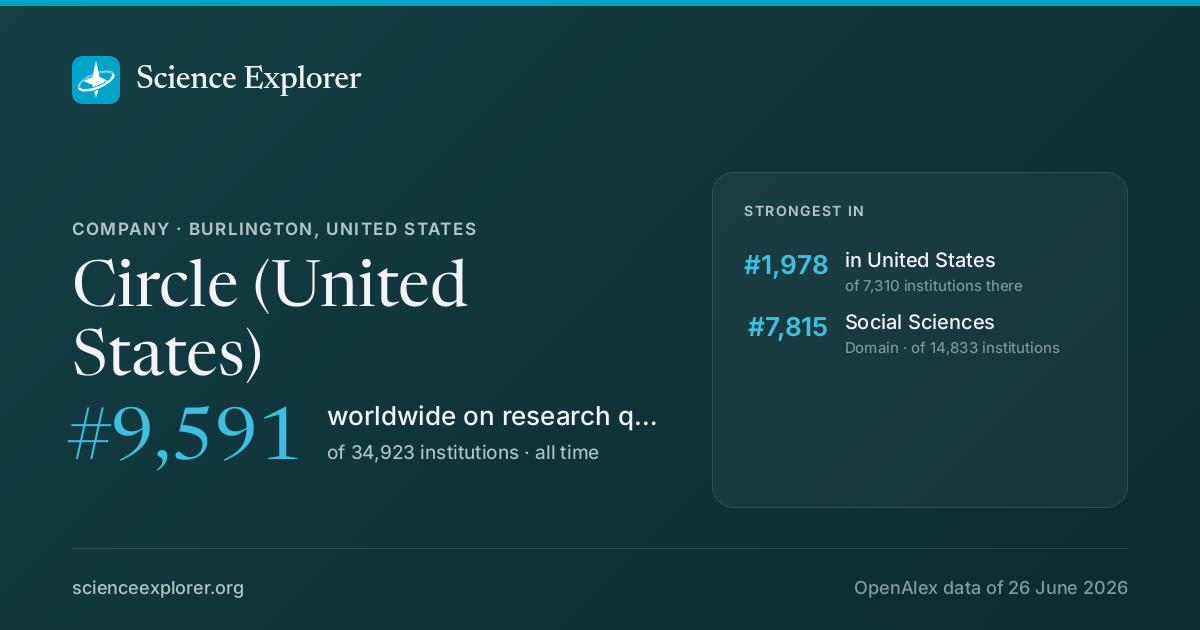
In research, Circle (United States) stands highest in Social Sciences (#7,815 of 14,833 worldwide), over all time.
- World rank, all time
- #9,591 of 34,923
- Rank in United States
- #1,978 of 7,310
- Research works
- 288 ▲ 14% vs 2018-21
- Citations
- 4.2k 14.7 per fractional work
- Top-10% rate
- 4.4% all institutions 10.0%
- vs its own fields
- 1.07× 1.00× is exactly expected
- Open access
- 31% world 40%
- International
- 10% world 18%
What is Circle (United States) known for in research?
The fields where it stands highest, over all time, ranked among every institution above the floor in each field.
| Field | World rank | Where that sits | Top-10% rate | Works |
|---|---|---|---|---|
| Social SciencesDomain | #7,815 of 14,833 | 8.6% | 120 |
Each strip is that field's whole ranked pool, with the notch where Circle (United States) sits in it, in the colour of the band that rank falls in. The track under the rate is the rate itself: it carries no average mark, because the average differs by field (from about 6% in Dentistry to 21% in Economics).
Which fields of science does Circle (United States) work in?
In all years, 42% of research at Circle (United States) is in Social Sciences, 34% in Physical Sciences. Its largest fields are Social Sciences (16%), Engineering (11%), Arts and Humanities (9%). It does 1.9× the world's share of Social Sciences.
Each ring splits the one inside it: the four domains of science, their fields, their subfields. Size is fractional works in all years. Every slice is a page; the interactive view zooms down to single topics and colours each by how much more of it this institution does than the world.
Its 4 domains and 25 fields, with their numbers
- Social Sciences12041.8%
- Social Sciences4616.0%
- Arts and Humanities268.9%
- Psychology175.9%
- Decision Sciences155.3%
- Economics, Econometrics and Finance124.2%
- Business, Management and Accounting41.5%
- Physical Sciences9834.0%
- Engineering3211.2%
- Computer Science248.3%
- Environmental Science144.9%
- Materials Science72.3%
- Chemistry62.0%
- Mathematics61.9%
- Physics and Astronomy51.8%
- Earth and Planetary Sciences31.1%
- Chemical Engineering10.4%
- Energy00.1%
- Life Sciences3612.4%
- Health Sciences3411.9%
- Medicine248.5%
- Health Professions82.7%
- Nursing20.6%
- Dentistry00.1%
- Veterinary00.0%
Field profile
Location quotient across every field it publishes in: outside the ring is more than an institution of this size would be expected to publish, inside it is less.
Rings at 0.5×, 1× and 2×. Widest outward: Agricultural and Biological Sciences, 6.5×. Every wedge is a field page.
All 16 fields, with their numbers
- Agricultural and Biological Sciences6.46×5 works
- Nursing3.87×0 works
- Environmental Science2.08×2 works
- Economics, Econometrics and Finance1.86×1 works
- Social Sciences1.80×4 works
- Biochemistry, Genetics and Molecular Biology1.16×1 works
- Psychology0.98×0 works
- Health Professions0.92×0 works
- Medicine0.48×2 works
- Earth and Planetary Sciences0.40×0 works
- Immunology and Microbiology0.38×0 works
- Computer Science0.35×0 works
- Mathematics0.32×0 works
- Engineering0.29×1 works
- Arts and Humanities0.22×0 works
- Physics and Astronomy0.17×0 works
- Agricultural and Biological Sciences 6.5×
- Nursing 3.9×
- Environmental Science 2.1×
- Economics, Econometrics and Finance 1.9×
- Social Sciences 1.8×
- Biochemistry, Genetics and Molecular Biology 1.2×
- Psychology 1.0×
- Health Professions 0.9×
- Medicine 0.5×
- Earth and Planetary Sciences 0.4×
- Immunology and Microbiology 0.4×
- Computer Science 0.3×
- Mathematics 0.3×
- Engineering 0.3×
- Arts and Humanities 0.2×
- Physics and Astronomy 0.2×
Who are the top researchers at Circle (United States)?
Ranked on the quality score, Gary Blick, A. Judson Wells and William H. Deaderick lead among researchers whose main affiliation is Circle (United States).
- 1
Gary Blick
 United States · #1,176,362 worldwide
1.8k citations · 51 works
- 2
A. Judson Wells
United States · #1,746,751 worldwide
1.2k citations · 25 works
- 3
William H. Deaderick
United States · #2,825,103 worldwide
10 citations · 15 works
- 4
Daniel E. Varland
United States · #3,527,881 worldwide
484 citations · 27 works
- 5
Wilbur T. Yaxley
United States · #4,328,904 worldwide
1 citations · 16 works
- 6
V.A. Kasten
United States · #4,373,875 worldwide
69 citations · 15 works
- 7
Lee E. Heindel
United States · #4,866,467 worldwide
95 citations · 23 works
Which keywords describe research at Circle (United States)?
By fractional works in all years, weighted toward what it does more of than the world: COVID-19, Open Access, Peer Review, Science Communication, Preprints, Scientific Publishing, Monetary Policy and Asset Pricing.
- Intelligence Agencies
- Social Science
- National Security
- Therapeutic Alliance
- Religion
- Nationalism
- Philosophy
- Psychological Interventions
- Humanoid Robotics
- Evidence-Based Practice
- Ethics
- Learning Environments
- Financial Analysis
- Meta-Analysis
- Asset Pricing
- Sustainability
- Climate Change
- Scientific Publishing
- Preprints
- Open Access
- COVID-19
- Peer Review
- Science Communication
- Education
- Globalization
- Monetary Policy
- History
- Economic Evaluation
- Panel Data Models
- STEM Education
- Engineering Design
- Literature
- Identity
- Robotics Programming
- Gender
- Social Justice
- Psychotherapy Outcome
- Counterinsurgency
- Anthropology
- Regional Growth
Size is fractional works in all years in the topics tagged with each word; colour is the word's share of this institution's work against its share of the world's. The 40 words are chosen for being large and distinctive. Each links to the topic it comes from most.
All 40 words, with their numbers
- COVID-1914▲ 7.4×6 topics
- Open Access13▲ 54×2 topics
- Peer Review13▲ 142×2 topics
- Preprints13▲ 373×1 topic
- Science Communication13▲ 72×2 topics
- Scientific Publishing13▲ 373×1 topic
- Education11▲ 2.9×18 topics
- Climate Change10▲ 1.26×30 topics
- Globalization8▲ 1.55×22 topics
- Sustainability8▲ 1.53×19 topics
- Monetary Policy8▲ 9.6×5 topics
- Asset Pricing8▲ 20×3 topics
- History7▲ 3.2×17 topics
- Meta-Analysis7▲ 4.6×8 topics
- Economic Evaluation7▲ 20×2 topics
- Financial Analysis7▲ 30×1 topic
- Panel Data Models7▲ 51×1 topic
- Learning Environments6▲ 52×2 topics
- STEM Education6▲ 7.3×4 topics
- Ethics6▲ 4.2×9 topics
- Engineering Design5▲ 23×2 topics
- Evidence-Based Practice5▲ 10×3 topics
- Literature5▲ 3.4×11 topics
- Humanoid Robotics5▲ 96×1 topic
- Identity5▲ 2.1×15 topics
- Psychological Interventions5▲ 12×3 topics
- Robotics Programming5▲ 96×1 topic
- Philosophy5▲ 3.6×8 topics
- Gender4▲ 2.7×14 topics
- Nationalism4▲ 2.7×9 topics
- Social Justice4▲ 3.0×9 topics
- Religion4▲ 2.6×8 topics
- Psychotherapy Outcome4▲ 32×1 topic
- Therapeutic Alliance4▲ 32×1 topic
- Counterinsurgency3▲ 62×2 topics
- National Security3▲ 21×2 topics
- Anthropology3▲ 9.4×2 topics
- Social Science3▲ 17×2 topics
- Regional Growth2▲ 9.0×2 topics
- Intelligence Agencies2▲ 141×1 topic
Which research topics does Circle (United States) publish most on?
By volume in 2022-now: Botanical Research and Chemistry, Animal Diversity and Health Studies, Ethnobotanical and Medicinal Plants Studies and Global Educational Policies and Reforms.
Area is fractional works; colour is the subfield each topic belongs to.
- 1 Botanical Research and Chemistry Ecology, Evolution, Behavior and Systematics 1 works
- 2 Animal Diversity and Health Studies Food Science 1 works
- 3 Ethnobotanical and Medicinal Plants Studies Plant Science 1 works
- 4 Global Educational Policies and Reforms Political Science and International Relations 1 works
- 5 Regional Development and Policy Political Science and International Relations 0 works
- 6 Cultural Industries and Urban Development Urban Studies 0 works
- 7 Adult and Continuing Education Topics Education 0 works
- 8 Avian ecology and behavior Ecology 0 works
- 9 African studies and sociopolitical issues Sociology and Political Science 0 works
- 10 Animal Nutrition and Physiology Animal Science and Zoology 0 works
How open and international is its research?
Against the world's own shares: the tick on each track. Both are shares of its output, so they sit on one scale and can be read against each other as well as against the world.
World: 40% of research is openly available.
World: 18% is written across borders.
How has Circle (United States)'s research output changed?
Output in 2022-2025 was 14% higher than in 2018-2021.
The same series as a ribbon: one cell per year, darker for more. The line above answers how much; this answers when.
Its share of all research
Growing output can still be a shrinking share: all of science grows. This is Circle (United States) as a percentage of every work published that year, 0.00019% in 2024.
Fractional works of Circle (United States) over all fractional works that year. How the balance of science has shifted.
Share Circle (United States)'s ranking
Badges for a website1Each links back here and updates with every snapshot

Research measures only: rankings here say nothing about teaching, admissions or student experience. Comparable institutions and collaboration partners have tabs of their own, above.
Discussion
Ask a question or share a note about Circle (United States). Keep it to the research: no personal attacks, advertising or links. Any reader can report a post, which collapses it for everyone until it is opened.